
Eukaryotic Chromosome
Organization
Dr C R Meera
Assistant Professor & HOD
Department of Microbiology
St. Mary’s College, Thrissur
Eukaryotic Chromosome Organisation, Dr C R Meera, St.Mary’s College, TCR,
Eukaryotic Chromosomes
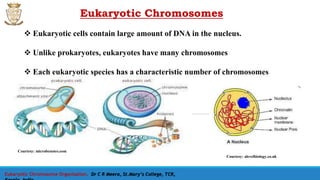
 Eukaryotic cells contain large amount of DNA in the nucleus.
 Unlike prokaryotes, eukaryotes have many chromosomes
 Each eukaryotic species has a characteristic number of chromosomes
Courtesy: microbenotes.com
Courtesy: alevelbiology.co.uk
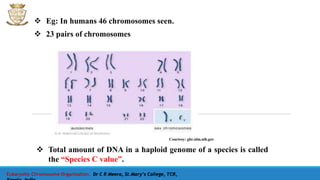
 Eg: In humans 46 chromosomes seen.
 23 pairs of chromosomes
 Total amount of DNA in a haploid genome of a species is called
the “Species C value”.
Courtesy: ghr.nlm.nih.gov
Eukaryotic Chromosome Organisation, Dr C R Meera, St.Mary’s College, TCR,
C value
 Total amount of DNA in a haploid genome of a species is called the “Species C
value”.
 Amount of DNA found in different organisms varies considerably.
 Amount of DNA can not be correlated with the relatedness of organisms.
 Also, no direct relationship between C value and structural and organizational
complexity of organisms – “C value Paradox”.
 Its due to the occurrence of repetitive sequence DNA in the genome.
Eukaryotic Chromosome Organisation, Dr C R Meera, St.Mary’s College, TCR,
Chromosome organization in Eukaryotic cells
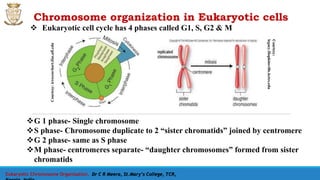
 Eukaryotic cell cycle has 4 phases called G1, S, G2 & M
Courtesy:irrecenvhort.ifas.ufl.edu
G 1 phase- Single chromosome
S phase- Chromosome duplicate to 2 “sister chromatids” joined by centromere
G 2 phase- same as S phase
M phase- centromeres separate- “daughter chromosomes” formed from sister
chromatids
Courtesy:
legacy.Hopkinsville.kctcs.edu
Eukaryotic Chromosome Organisation, Dr C R Meera, St.Mary’s College, TCR,
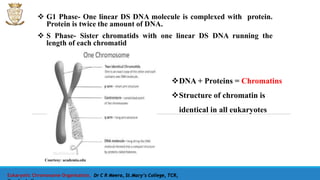
 G1 Phase- One linear DS DNA molecule is complexed with protein.
Protein is twice the amount of DNA.
 S Phase- Sister chromatids with one linear DS DNA running the
length of each chromatid
Eukaryotic Chromosome Organisation, Dr C R Meera, St.Mary’s College, TCR,
DNA + Proteins = Chromatins
Structure of chromatin is
identical in all eukaryotes
Courtesy: academia.edu
Chromatin structure
Eukaryotic Chromosome Organisation, Dr C R Meera, St.Mary’s College, TCR,
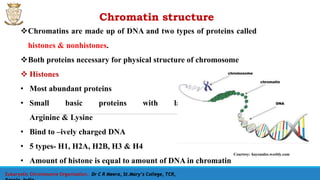
Chromatins are made up of DNA and two types of proteins called
histones & nonhistones.
Both proteins necessary for physical structure of chromosome
 Histones
• Most abundant proteins
• Small basic proteins with large amount of
Arginine & Lysine
• Bind to –ively charged DNA
• 5 types- H1, H2A, H2B, H3 & H4
• Amount of histone is equal to amount of DNA in chromatin
Courtesy: hayounlee.weebly.com
Histones
Eukaryotic Chromosome Organisation, Dr C R Meera, St.Mary’s College, TCR,
 H2A, H2B, H3 & H4 amino acid sequences are very similar & highly
conserved between even distantly related species
 Histones play some vital role in eukaryotes in organizing DNA in
chromosome
 Human DNA is 700 times greater than E coli
 DNA in chromosome of a single human cell is >2m long
 Several levels of packing is necessary to pack it into the nucleus
 Histones play very important role in this chromatin packing
Non-histone proteins
Eukaryotic Chromosome Organisation, Dr C R Meera, St.Mary’s College, TCR,
All proteins associated with DNA except histones
Eg: Proteins that bind to DNA during DNA replication, repair, transcription,
gene regulation, recombination etc.
Mainly with –ive charge, hence bind to +ive histones
Each eukaryotic cell will have different non-histones
Differ in number & type from cell to cell in same organism
Also differ at times in the same cell
Also differ from organism to organism
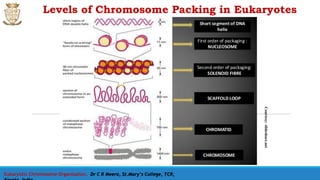
Levels of packing in Chromatin
Eukaryotic Chromosome Organisation, Dr C R Meera, St.Mary’s College, TCR,
Chromatin structure differs in different stages of the life cycle
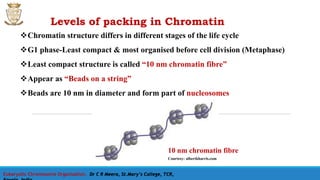
G1 phase-Least compact & most organised before cell division (Metaphase)
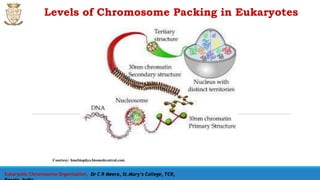
Least compact structure is called “10 nm chromatin fibre”
Appear as “Beads on a string”
Beads are 10 nm in diameter and form part of nucleosomes
10 nm chromatin fibre
Courtesy: albertkharris.com
Eukaryotic Chromosome Organisation, Dr C R Meera, St.Mary’s College, TCR,
Nucleosome- 1st level of chromatin packing
Courtesy: en.Wikipedia.org
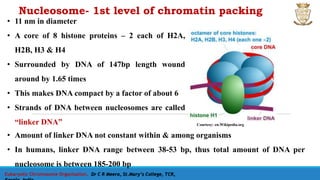
• 11 nm in diameter
• A core of 8 histone proteins – 2 each of H2A,
H2B, H3 & H4
• Surrounded by DNA of 147bp length wound
around by 1.65 times
• This makes DNA compact by a factor of about 6
• Strands of DNA between nucleosomes are called
“linker DNA”
• Amount of linker DNA not constant within & among organisms
• In humans, linker DNA range between 38-53 bp, thus total amount of DNA per
nucleosome is between 185-200 bp
Eukaryotic Chromosome Organisation, Dr C R Meera, St.Mary’s College, TCR,
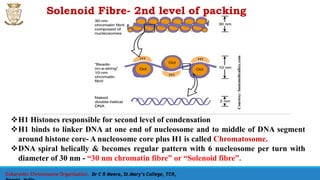
Solenoid Fibre- 2nd level of packing
Courtesy:basicmedicalkey.com
H1 Histones responsible for second level of condensation
H1 binds to linker DNA at one end of nucleosome and to middle of DNA segment
around histone core- A nucleosome core plus H1 is called Chromatosome.
DNA spiral helically & becomes regular pattern with 6 nucleosome per turn with
diameter of 30 nm - “30 nm chromatin fibre” or “Solenoid fibre”.
Eukaryotic Chromosome Organisation, Dr C R Meera, St.Mary’s College, TCR,
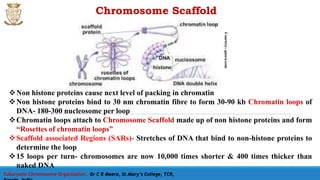
Chromosome Scaffold
Non histone proteins cause next level of packing in chromatin
Non histone proteins bind to 30 nm chromatin fibre to form 30-90 kb Chromatin loops of
DNA- 180-300 nucleosome per loop
Chromatin loops attach to Chromosome Scaffold made up of non histone proteins and form
“Rosettes of chromatin loops”
Scaffold associated Regions (SARs)- Stretches of DNA that bind to non-histone proteins to
determine the loop
15 loops per turn- chromosomes are now 10,000 times shorter & 400 times thicker than
naked DNA
Courtesy:quora.com
Eukaryotic Chromosome Organisation, Dr C R Meera, St.Mary’s College, TCR,
Levels of Chromosome Packing in Eukaryotes
Courtesy:slideshare.net
Eukaryotic Chromosome Organisation, Dr C R Meera, St.Mary’s College, TCR,
Levels of Chromosome Packing in Eukaryotes
Courtesy: bmcbiophys.biomedcentral.com
Eukaryotic Chromosome Organisation, Dr C R Meera, St.Mary’s College, TCR,

Eukaryotic Chromosome Organisation

  • 1.
    Eukaryotic Chromosome Organization Dr CR Meera Assistant Professor & HOD Department of Microbiology St. Mary’s College, Thrissur
  • 2.
    Eukaryotic Chromosome Organisation,Dr C R Meera, St.Mary’s College, TCR, Eukaryotic Chromosomes  Eukaryotic cells contain large amount of DNA in the nucleus.  Unlike prokaryotes, eukaryotes have many chromosomes  Each eukaryotic species has a characteristic number of chromosomes Courtesy: microbenotes.com Courtesy: alevelbiology.co.uk
  • 3.
     Eg: Inhumans 46 chromosomes seen.  23 pairs of chromosomes  Total amount of DNA in a haploid genome of a species is called the “Species C value”. Courtesy: ghr.nlm.nih.gov Eukaryotic Chromosome Organisation, Dr C R Meera, St.Mary’s College, TCR,
  • 4.
    C value  Totalamount of DNA in a haploid genome of a species is called the “Species C value”.  Amount of DNA found in different organisms varies considerably.  Amount of DNA can not be correlated with the relatedness of organisms.  Also, no direct relationship between C value and structural and organizational complexity of organisms – “C value Paradox”.  Its due to the occurrence of repetitive sequence DNA in the genome. Eukaryotic Chromosome Organisation, Dr C R Meera, St.Mary’s College, TCR,
  • 5.
    Chromosome organization inEukaryotic cells  Eukaryotic cell cycle has 4 phases called G1, S, G2 & M Courtesy:irrecenvhort.ifas.ufl.edu G 1 phase- Single chromosome S phase- Chromosome duplicate to 2 “sister chromatids” joined by centromere G 2 phase- same as S phase M phase- centromeres separate- “daughter chromosomes” formed from sister chromatids Courtesy: legacy.Hopkinsville.kctcs.edu Eukaryotic Chromosome Organisation, Dr C R Meera, St.Mary’s College, TCR,
  • 6.
     G1 Phase-One linear DS DNA molecule is complexed with protein. Protein is twice the amount of DNA.  S Phase- Sister chromatids with one linear DS DNA running the length of each chromatid Eukaryotic Chromosome Organisation, Dr C R Meera, St.Mary’s College, TCR, DNA + Proteins = Chromatins Structure of chromatin is identical in all eukaryotes Courtesy: academia.edu
  • 7.
    Chromatin structure Eukaryotic ChromosomeOrganisation, Dr C R Meera, St.Mary’s College, TCR, Chromatins are made up of DNA and two types of proteins called histones & nonhistones. Both proteins necessary for physical structure of chromosome  Histones • Most abundant proteins • Small basic proteins with large amount of Arginine & Lysine • Bind to –ively charged DNA • 5 types- H1, H2A, H2B, H3 & H4 • Amount of histone is equal to amount of DNA in chromatin Courtesy: hayounlee.weebly.com
  • 8.
    Histones Eukaryotic Chromosome Organisation,Dr C R Meera, St.Mary’s College, TCR,  H2A, H2B, H3 & H4 amino acid sequences are very similar & highly conserved between even distantly related species  Histones play some vital role in eukaryotes in organizing DNA in chromosome  Human DNA is 700 times greater than E coli  DNA in chromosome of a single human cell is >2m long  Several levels of packing is necessary to pack it into the nucleus  Histones play very important role in this chromatin packing
  • 9.
    Non-histone proteins Eukaryotic ChromosomeOrganisation, Dr C R Meera, St.Mary’s College, TCR, All proteins associated with DNA except histones Eg: Proteins that bind to DNA during DNA replication, repair, transcription, gene regulation, recombination etc. Mainly with –ive charge, hence bind to +ive histones Each eukaryotic cell will have different non-histones Differ in number & type from cell to cell in same organism Also differ at times in the same cell Also differ from organism to organism
  • 10.
    Levels of packingin Chromatin Eukaryotic Chromosome Organisation, Dr C R Meera, St.Mary’s College, TCR, Chromatin structure differs in different stages of the life cycle G1 phase-Least compact & most organised before cell division (Metaphase) Least compact structure is called “10 nm chromatin fibre” Appear as “Beads on a string” Beads are 10 nm in diameter and form part of nucleosomes 10 nm chromatin fibre Courtesy: albertkharris.com
  • 11.
    Eukaryotic Chromosome Organisation,Dr C R Meera, St.Mary’s College, TCR, Nucleosome- 1st level of chromatin packing Courtesy: en.Wikipedia.org • 11 nm in diameter • A core of 8 histone proteins – 2 each of H2A, H2B, H3 & H4 • Surrounded by DNA of 147bp length wound around by 1.65 times • This makes DNA compact by a factor of about 6 • Strands of DNA between nucleosomes are called “linker DNA” • Amount of linker DNA not constant within & among organisms • In humans, linker DNA range between 38-53 bp, thus total amount of DNA per nucleosome is between 185-200 bp
  • 12.
    Eukaryotic Chromosome Organisation,Dr C R Meera, St.Mary’s College, TCR, Solenoid Fibre- 2nd level of packing Courtesy:basicmedicalkey.com H1 Histones responsible for second level of condensation H1 binds to linker DNA at one end of nucleosome and to middle of DNA segment around histone core- A nucleosome core plus H1 is called Chromatosome. DNA spiral helically & becomes regular pattern with 6 nucleosome per turn with diameter of 30 nm - “30 nm chromatin fibre” or “Solenoid fibre”.
  • 13.
    Eukaryotic Chromosome Organisation,Dr C R Meera, St.Mary’s College, TCR, Chromosome Scaffold Non histone proteins cause next level of packing in chromatin Non histone proteins bind to 30 nm chromatin fibre to form 30-90 kb Chromatin loops of DNA- 180-300 nucleosome per loop Chromatin loops attach to Chromosome Scaffold made up of non histone proteins and form “Rosettes of chromatin loops” Scaffold associated Regions (SARs)- Stretches of DNA that bind to non-histone proteins to determine the loop 15 loops per turn- chromosomes are now 10,000 times shorter & 400 times thicker than naked DNA Courtesy:quora.com
  • 14.
    Eukaryotic Chromosome Organisation,Dr C R Meera, St.Mary’s College, TCR, Levels of Chromosome Packing in Eukaryotes Courtesy:slideshare.net
  • 15.
    Eukaryotic Chromosome Organisation,Dr C R Meera, St.Mary’s College, TCR, Levels of Chromosome Packing in Eukaryotes Courtesy: bmcbiophys.biomedcentral.com
  • 16.
    Eukaryotic Chromosome Organisation,Dr C R Meera, St.Mary’s College, TCR,