Most popular continuous probability
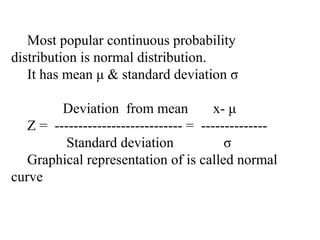
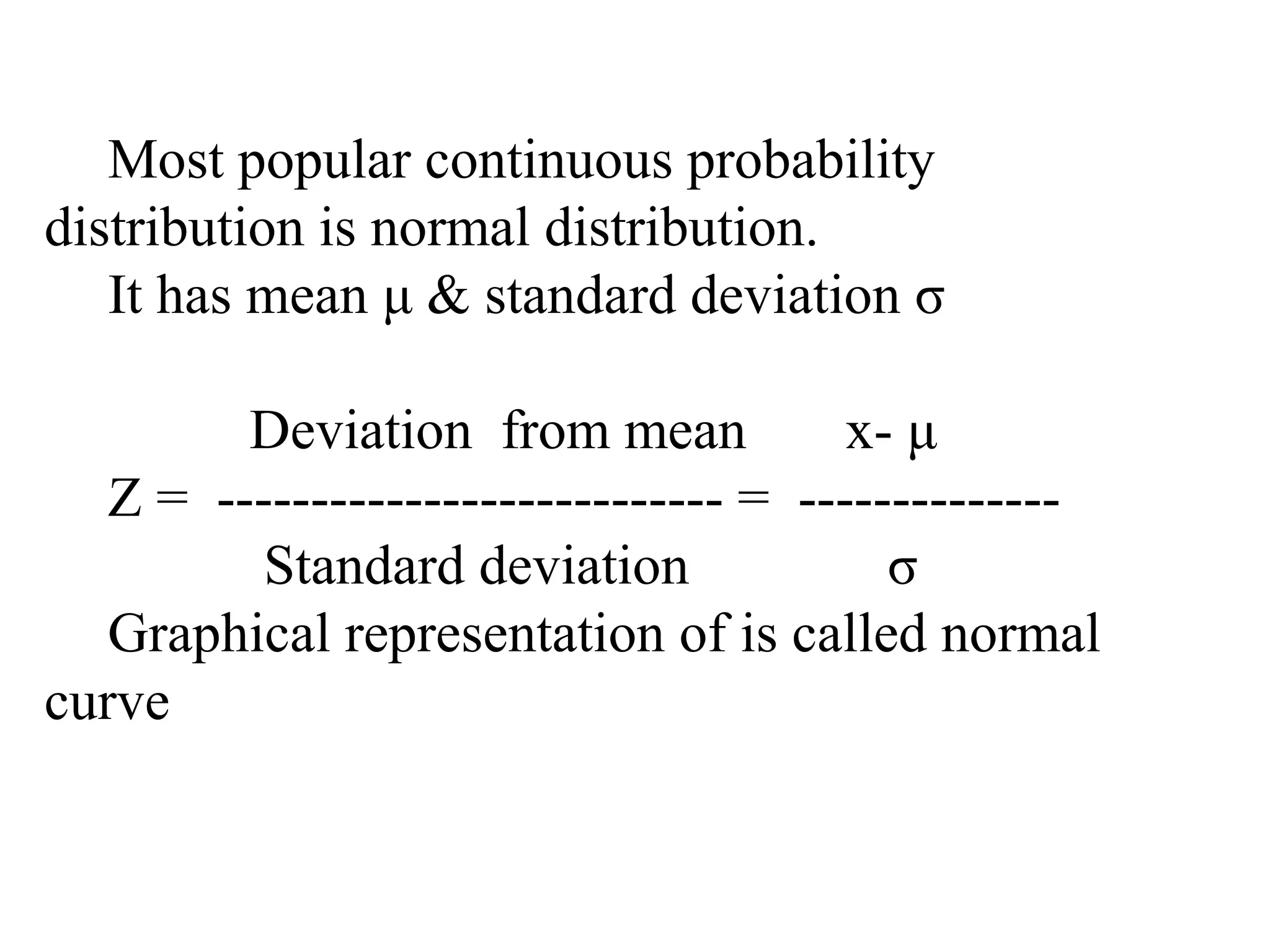
distribution is normal distribution.
It has mean μ & standard deviation σ
Deviation from mean x- μ
Z = --------------------------- = --------------
Standard deviation σ
Graphical representation of is called normal
curve
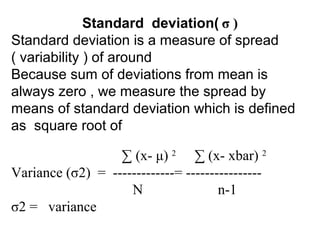
Standard deviation( σ )
Standard deviation is a measure of spread
( variability ) of around
Because sum of deviations from mean is
always zero , we measure the spread by
means of standard deviation which is defined
as square root of
∑ (x- μ) 2
∑ (x- xbar) 2
Variance (σ2) = -------------= ----------------
N n-1
σ2 = variance
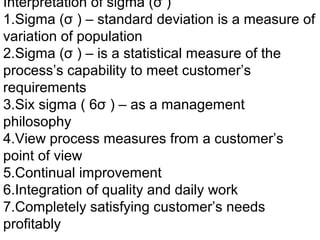
Interpretation of sigma (σ )
1.Sigma (σ ) – standard deviation is a measure of
variation of population
2.Sigma (σ ) – is a statistical measure of the
process’s capability to meet customer’s
requirements
3.Six sigma ( 6σ ) – as a management
philosophy
4.View process measures from a customer’s
point of view
5.Continual improvement
6.Integration of quality and daily work
7.Completely satisfying customer’s needs
profitably
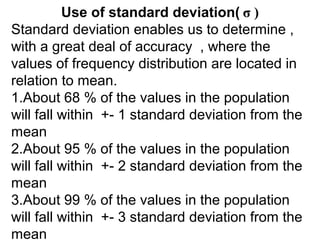
Use of standard deviation( σ )
Standard deviation enables us to determine ,
with a great deal of accuracy , where the
values of frequency distribution are located in
relation to mean.
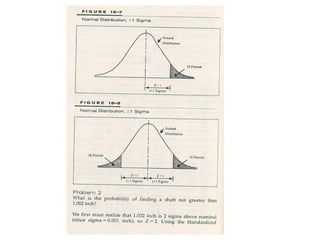
1.About 68 % of the values in the population
will fall within +- 1 standard deviation from the
mean
2.About 95 % of the values in the population
will fall within +- 2 standard deviation from the
mean
3.About 99 % of the values in the population
will fall within +- 3 standard deviation from the
mean
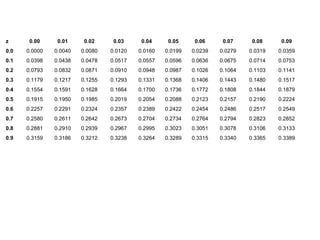
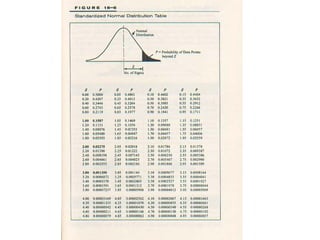
z 0.00 0.01 0.02 0.03 0.04 0.05 0.06 0.07 0.08 0.09
0.0 0.0000 0.0040 0.0080 0.0120 0.0160 0.0199 0.0239 0.0279 0.0319 0.0359
0.1 0.0398 0.0438 0.0478 0.0517 0.0557 0.0596 0.0636 0.0675 0.0714 0.0753
0.2 0.0793 0.0832 0.0871 0.0910 0.0948 0.0987 0.1026 0.1064 0.1103 0.1141
0.3 0.1179 0.1217 0.1255 0.1293 0.1331 0.1368 0.1406 0.1443 0.1480 0.1517
0.4 0.1554 0.1591 0.1628 0.1664 0.1700 0.1736 0.1772 0.1808 0.1844 0.1879
0.5 0.1915 0.1950 0.1985 0.2019 0.2054 0.2088 0.2123 0.2157 0.2190 0.2224
0.6 0.2257 0.2291 0.2324 0.2357 0.2389 0.2422 0.2454 0.2486 0.2517 0.2549
0.7 0.2580 0.2611 0.2642 0.2673 0.2704 0.2734 0.2764 0.2794 0.2823 0.2852
0.8 0.2881 0.2910 0.2939 0.2967 0.2995 0.3023 0.3051 0.3078 0.3106 0.3133
0.9 0.3159 0.3186 0.3212 0.3238 0.3264 0.3289 0.3315 0.3340 0.3365 0.3389
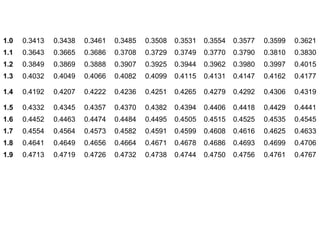
1.0 0.3413 0.3438 0.3461 0.3485 0.3508 0.3531 0.3554 0.3577 0.3599 0.3621
1.1 0.3643 0.3665 0.3686 0.3708 0.3729 0.3749 0.3770 0.3790 0.3810 0.3830
1.2 0.3849 0.3869 0.3888 0.3907 0.3925 0.3944 0.3962 0.3980 0.3997 0.4015
1.3 0.4032 0.4049 0.4066 0.4082 0.4099 0.4115 0.4131 0.4147 0.4162 0.4177
1.4 0.4192 0.4207 0.4222 0.4236 0.4251 0.4265 0.4279 0.4292 0.4306 0.4319
1.5 0.4332 0.4345 0.4357 0.4370 0.4382 0.4394 0.4406 0.4418 0.4429 0.4441
1.6 0.4452 0.4463 0.4474 0.4484 0.4495 0.4505 0.4515 0.4525 0.4535 0.4545
1.7 0.4554 0.4564 0.4573 0.4582 0.4591 0.4599 0.4608 0.4616 0.4625 0.4633
1.8 0.4641 0.4649 0.4656 0.4664 0.4671 0.4678 0.4686 0.4693 0.4699 0.4706
1.9 0.4713 0.4719 0.4726 0.4732 0.4738 0.4744 0.4750 0.4756 0.4761 0.4767
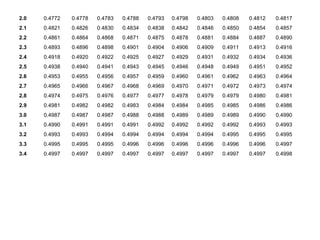
2.0 0.4772 0.4778 0.4783 0.4788 0.4793 0.4798 0.4803 0.4808 0.4812 0.4817
2.1 0.4821 0.4826 0.4830 0.4834 0.4838 0.4842 0.4846 0.4850 0.4854 0.4857
2.2 0.4861 0.4864 0.4868 0.4871 0.4875 0.4878 0.4881 0.4884 0.4887 0.4890
2.3 0.4893 0.4896 0.4898 0.4901 0.4904 0.4906 0.4909 0.4911 0.4913 0.4916
2.4 0.4918 0.4920 0.4922 0.4925 0.4927 0.4929 0.4931 0.4932 0.4934 0.4936
2.5 0.4938 0.4940 0.4941 0.4943 0.4945 0.4946 0.4948 0.4949 0.4951 0.4952
2.6 0.4953 0.4955 0.4956 0.4957 0.4959 0.4960 0.4961 0.4962 0.4963 0.4964
2.7 0.4965 0.4966 0.4967 0.4968 0.4969 0.4970 0.4971 0.4972 0.4973 0.4974
2.8 0.4974 0.4975 0.4976 0.4977 0.4977 0.4978 0.4979 0.4979 0.4980 0.4981
2.9 0.4981 0.4982 0.4982 0.4983 0.4984 0.4984 0.4985 0.4985 0.4986 0.4986
3.0 0.4987 0.4987 0.4987 0.4988 0.4988 0.4989 0.4989 0.4989 0.4990 0.4990
3.1 0.4990 0.4991 0.4991 0.4991 0.4992 0.4992 0.4992 0.4992 0.4993 0.4993
3.2 0.4993 0.4993 0.4994 0.4994 0.4994 0.4994 0.4994 0.4995 0.4995 0.4995
3.3 0.4995 0.4995 0.4995 0.4996 0.4996 0.4996 0.4996 0.4996 0.4996 0.4997
3.4 0.4997 0.4997 0.4997 0.4997 0.4997 0.4997 0.4997 0.4997 0.4997 0.4998
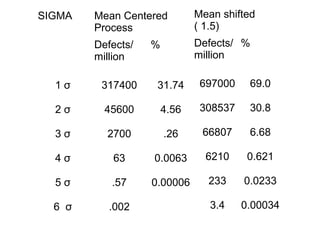
SIGMA Mean Centered
Process
Mean shifted
( 1.5)
Defects/
million
% Defects/
million
%
1 σ 317400 31.74 697000 69.0
2 σ 45600 4.56 308537 30.8
3 σ 2700 .26 66807 6.68
4 σ 63 0.0063 6210 0.621
5 σ .57 0.00006 233 0.0233
6 σ .002 3.4 0.00034
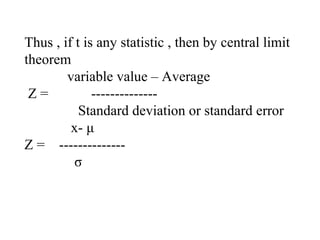
Thus , if t is any statistic , then by central limit
theorem
variable value – Average
Z = --------------
Standard deviation or standard error
x- μ
Z = --------------
σ
Properties
1. Perfectly symmetrical to y axis
2. Bell shaped curve
3. Two halves on left & right are same. Skewness
is zero
4. Total area1. area on left & right is 0.5
5. Mean = mode = median , unimodal
6. Has asymptotic base i.e. two tails of the curve
extend indefinitely & never touch x – axis
( horizontal )
Importance of Normal Distribution
1. When number of trials increase , probability
distribution tends to normal distribution .hence
, majority of problems and studies can be
analysed through normal distribution
2. Used in statistical quality control for setting
quality standards and to define control limits
Hypothesis : a statement about the population
parameter
Statistical hypothesis is some assumption or
statement which may or may not be true ,
about a population or a probability
distribution characteristics about the given
population , which we want to test on the
basis of the evidence from a random sample
Testing of Hypothesis : is a procedure that
helps us to ascertain the likelihood of
hypothecated population parameter being
correct by making use of sample statistic
A statistic is computed from a sample drawn
from the parent population and on the basis of
this statistic , it is observed whether the
sample so drawn has come from the
population with certain specified
characteristic
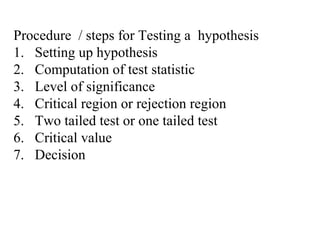
Procedure / steps for Testing a hypothesis
1. Setting up hypothesis
2. Computation of test statistic
3. Level of significance
4. Critical region or rejection region
5. Two tailed test or one tailed test
6. Critical value
7. Decision
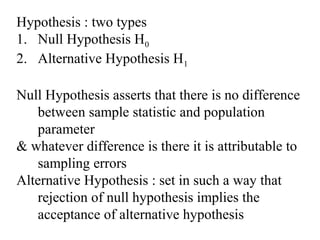
Hypothesis : two types
1. Null Hypothesis H0
2. Alternative Hypothesis H1
Null Hypothesis asserts that there is no difference
between sample statistic and population
parameter
& whatever difference is there it is attributable to
sampling errors
Alternative Hypothesis : set in such a way that
rejection of null hypothesis implies the
acceptance of alternative hypothesis
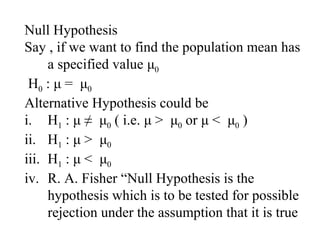
Null Hypothesis
Say , if we want to find the population mean has
a specified value μ0
H0 : μ = μ0
Alternative Hypothesis could be
i. H1 : μ ≠ μ0 ( i.e. μ > μ0 or μ < μ0 )
ii. H1 : μ > μ0
iii. H1 : μ < μ0
iv. R. A. Fisher “Null Hypothesis is the
hypothesis which is to be tested for possible
rejection under the assumption that it is true
4. level of significance :is the maximum probability
( α ) of making a Type I error i.e. : P [ Rejecting H0
when H0 is true ]
Probability of making correct decision is ( 1 - α )
Common level of significance 5 % ( .05 ) or 1 % ( .
01 )
For 5 % level of significance ( α = .05 ) , probability
of making a Type I error is 5 % or .05 i.e. : P
[ Rejecting H0 when H0 is true ] = .05
Or we are ( 1 - α or 1-0.05 = 95 % ) confidence that
a correct decision is made
When no level of significance is given we take α =
0.05
5.Critical region or rejection region :the value
of test statistic computed to test the null
hypothesis H0is known as critical value . It
separates rejection region from the
acceptance region
6.Two tailed test or one tailed test :
Rejection region may be represented by a
portion of the area on each of the two sides
or by only one side of the normal curve ,
accordingly the test is known as two tailed
test ( or two sided test )
or one tailed ( or one sided test )
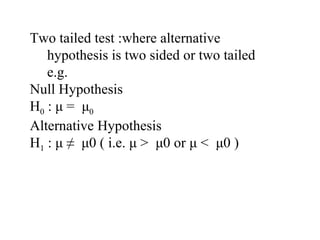
Two tailed test :where alternative
hypothesis is two sided or two tailed
e.g.
Null Hypothesis
H0 : μ = μ0
Alternative Hypothesis
H1 : μ ≠ μ0 ( i.e. μ > μ0 or μ < μ0 )
One tailed test :where alternative
hypothesis is one sided or one
tailed
two types
a. Right tailed test :- rejection
region or critical region lies
entirely on right tail of normal
curve
b. Left tailed test :- rejection region
or critical region lies entirely on
left tail of normal curve
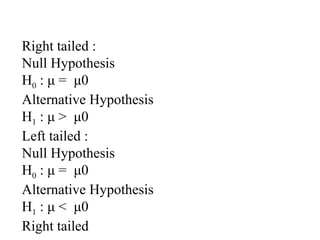
Right tailed :
Null Hypothesis
H0 : μ = μ0
Alternative Hypothesis
H1 : μ > μ0
Left tailed :
Null Hypothesis
H0 : μ = μ0
Alternative Hypothesis
H1 : μ < μ0
Right tailed
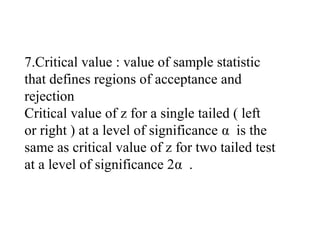
7.Critical value : value of sample statistic
that defines regions of acceptance and
rejection
Critical value of z for a single tailed ( left
or right ) at a level of significance α is the
same as critical value of z for two tailed test
at a level of significance 2α .
Critical value
(Zα )
Level of significance
1 % 5 % 10 %
Two tailed test [Zα ] =
2.58
[Zα ] = 1.96 [Zα ] = 1.645
Right tailed
test
Zα = 2.33 Zα = 1.645 Zα= 1.28
Left tailed test Zα = -
2.33
Zα = -1.645 Zα = - 1.28
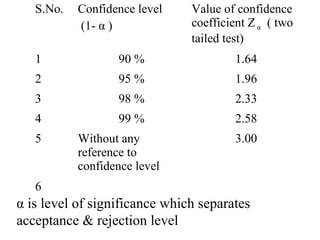
S.No. Confidence level
(1- α )
Value of confidence
coefficient Zα ( two
tailed test)
1 90 % 1.64
2 95 % 1.96
3 98 % 2.33
4 99 % 2.58
5 Without any
reference to
confidence level
3.00
6
α is level of significance which separates
acceptance & rejection level
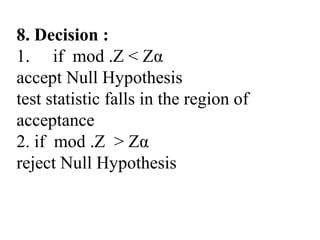
8. Decision :
1. if mod .Z < Zα
accept Null Hypothesis
test statistic falls in the region of
acceptance
2. if mod .Z > Zα
reject Null Hypothesis
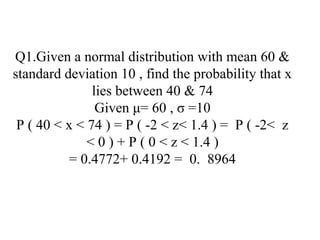
Q1.Given a normal distribution with mean 60 &
standard deviation 10 , find the probability that x
lies between 40 & 74
Given μ= 60 , σ =10
P ( 40 < x < 74 ) = P ( -2 < z< 1.4 ) = P ( -2< z
< 0 ) + P ( 0 < z < 1.4 )
= 0.4772+ 0.4192 = 0. 8964
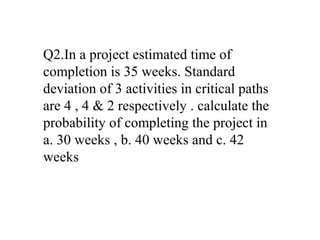
Q2.In a project estimated time of
completion is 35 weeks. Standard
deviation of 3 activities in critical paths
are 4 , 4 & 2 respectively . calculate the
probability of completing the project in
a. 30 weeks , b. 40 weeks and c. 42
weeks
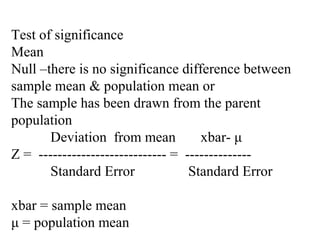
Test of significance
Mean
Null –there is no significance difference between
sample mean & population mean or
The sample has been drawn from the parent
population
Deviation from mean xbar- μ
Z = --------------------------- = --------------
Standard Error Standard Error
xbar = sample mean
μ = population mean
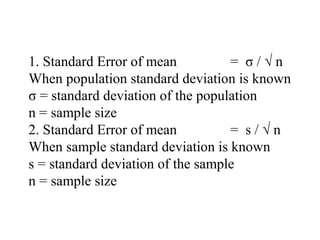
1. Standard Error of mean = σ / √ n
When population standard deviation is known
σ = standard deviation of the population
n = sample size
2. Standard Error of mean = s / √ n
When sample standard deviation is known
s = standard deviation of the sample
n = sample size
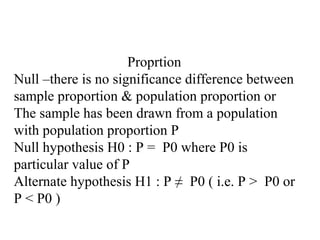
Proprtion
Null –there is no significance difference between
sample proportion & population proportion or
The sample has been drawn from a population
with population proportion P
Null hypothesis H0 : P = P0 where P0 is
particular value of P
Alternate hypothesis H1 : P ≠ P0 ( i.e. P > P0 or
P < P0 )
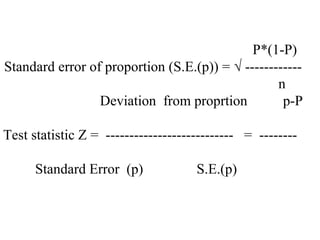
P*(1-P)
Standard error of proportion (S.E.(p)) = √ ------------
n
Deviation from proprtion p-P
Test statistic Z = --------------------------- = --------
Standard Error (p) S.E.(p)
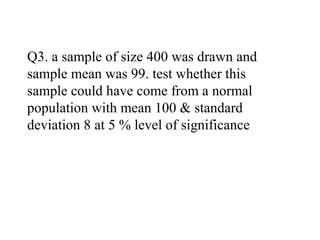
Q3. a sample of size 400 was drawn and
sample mean was 99. test whether this
sample could have come from a normal
population with mean 100 & standard
deviation 8 at 5 % level of significance
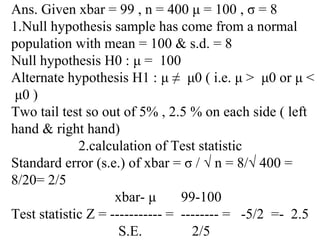
Ans. Given xbar = 99 , n = 400 μ = 100 , σ = 8
1.Null hypothesis sample has come from a normal
population with mean = 100 & s.d. = 8
Null hypothesis H0 : μ = 100
Alternate hypothesis H1 : μ ≠ μ0 ( i.e. μ > μ0 or μ <
μ0 )
Two tail test so out of 5% , 2.5 % on each side ( left
hand & right hand)
2.calculation of Test statistic
Standard error (s.e.) of xbar = σ / √ n = 8/√ 400 =
8/20= 2/5
xbar- μ 99-100
Test statistic Z = ----------- = -------- = -5/2 =- 2.5
S.E. 2/5
Mod z = 2.5
3. level of significance 5 % i.e.value of α = .05
( hence , level of confidence = 1- α = 1-0.05 = 0.95
or 95%)
4. Critical value (since it is Two tail test so out of
5% , we take two tails on each side i.e.2.5 % on
each side = 0.025 ( left hand & right hand)
= read from z –table value corresponding to area
= 0.5 -0.025 = 0.4750
( 0.4750 on both sides i.e. 2* 0.4750 = 0.95 area
which means 95% confidence)
= value of z corresponding to area is 1.96
5. Decision – since mod value of z is more than
critical value
Null Hypothesis is rejected & alternate hypothesis
is accepted
Sample has not been drawn from a normal
population with mean 100 &s.d. 8
Q4. the mean life time of a sample of 400
fluorescent light tube produced by a
company is found to be 1570 hours with a
standard deviation of 150 hrs. test the
hypothesis that the mean life time of the
bulbs produced by the company is 1600 hrs
against the alternative hypothesis that it is
greater than 1600 hrs at 1 &% level of
significance
Ans. Given xbar = 1570 , n = 400 μ = 1600
, standard deviation of sample mean s= 150
= 8
Null hypothesis : mean life time of bulbs is
1600 hrs
i.e. Null hypothesis H0 : μ = 1600
Alternate hypothesis H1 : μ > 1600
i.e. it is a case of right tailed test
2.calculation of Test statistic
Standard error (s.e.) of xbar = s / √ n
150/√ 400 = 150/20= 7.5
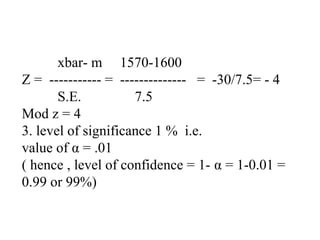
xbar- m 1570-1600
Z = ----------- = -------------- = -30/7.5= - 4
S.E. 7.5
Mod z = 4
3. level of significance 1 % i.e.
value of α = .01
( hence , level of confidence = 1- α = 1-0.01 =
0.99 or 99%)
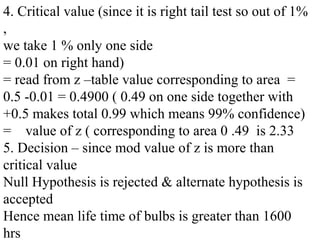
4. Critical value (since it is right tail test so out of 1%
,
we take 1 % only one side
= 0.01 on right hand)
= read from z –table value corresponding to area =
0.5 -0.01 = 0.4900 ( 0.49 on one side together with
+0.5 makes total 0.99 which means 99% confidence)
= value of z ( corresponding to area 0 .49 is 2.33
5. Decision – since mod value of z is more than
critical value
Null Hypothesis is rejected & alternate hypothesis is
accepted
Hence mean life time of bulbs is greater than 1600
hrs
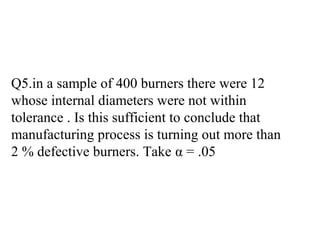
Q5.in a sample of 400 burners there were 12
whose internal diameters were not within
tolerance . Is this sufficient to conclude that
manufacturing process is turning out more than
2 % defective burners. Take α = .05
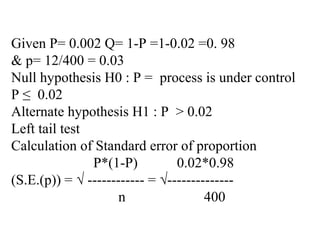
Given P= 0.002 Q= 1-P =1-0.02 =0. 98
& p= 12/400 = 0.03
Null hypothesis H0 : P = process is under control
P ≤ 0.02
Alternate hypothesis H1 : P > 0.02
Left tail test
Calculation of Standard error of proportion
P*(1-P) 0.02*0.98
(S.E.(p)) = √ ------------ = √--------------
n 400
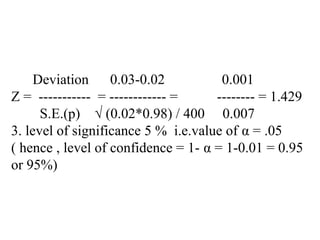
Deviation 0.03-0.02 0.001
Z = ----------- = ------------ = -------- = 1.429
S.E.(p) √ (0.02*0.98) / 400 0.007
3. level of significance 5 % i.e.value of α = .05
( hence , level of confidence = 1- α = 1-0.01 = 0.95
or 95%)
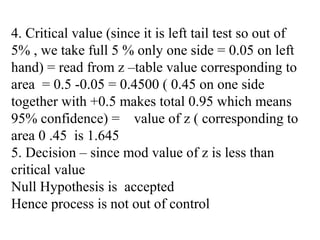
4. Critical value (since it is left tail test so out of
5% , we take full 5 % only one side = 0.05 on left
hand) = read from z –table value corresponding to
area = 0.5 -0.05 = 0.4500 ( 0.45 on one side
together with +0.5 makes total 0.95 which means
95% confidence) = value of z ( corresponding to
area 0 .45 is 1.645
5. Decision – since mod value of z is less than
critical value
Null Hypothesis is accepted
Hence process is not out of control
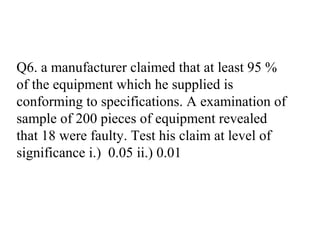
Q6. a manufacturer claimed that at least 95 %
of the equipment which he supplied is
conforming to specifications. A examination of
sample of 200 pieces of equipment revealed
that 18 were faulty. Test his claim at level of
significance i.) 0.05 ii.) 0.01
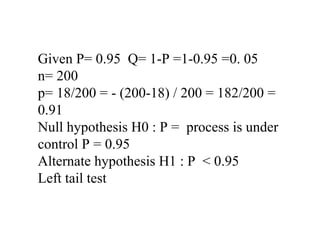
Given P= 0.95 Q= 1-P =1-0.95 =0. 05
n= 200
p= 18/200 = - (200-18) / 200 = 182/200 =
0.91
Null hypothesis H0 : P = process is under
control P = 0.95
Alternate hypothesis H1 : P < 0.95
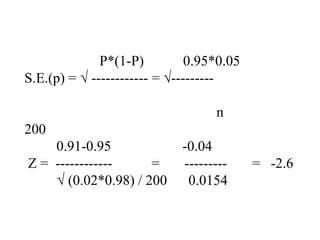
Left tail test
P*(1-P) 0.95*0.05
S.E.(p) = √ ------------ = √---------
n
200
0.91-0.95 -0.04
Z = ------------ = --------- = -2.6
√ (0.02*0.98) / 200 0.0154
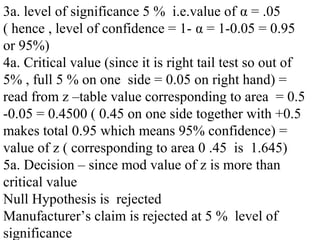
3a. level of significance 5 % i.e.value of α = .05
( hence , level of confidence = 1- α = 1-0.05 = 0.95
or 95%)
4a. Critical value (since it is right tail test so out of
5% , full 5 % on one side = 0.05 on right hand) =
read from z –table value corresponding to area = 0.5
-0.05 = 0.4500 ( 0.45 on one side together with +0.5
makes total 0.95 which means 95% confidence) =
value of z ( corresponding to area 0 .45 is 1.645)
5a. Decision – since mod value of z is more than
critical value
Null Hypothesis is rejected
Manufacturer’s claim is rejected at 5 % level of
significance
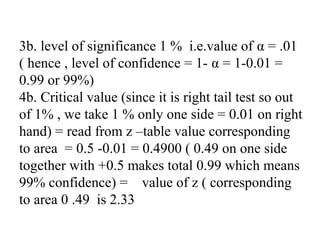
3b. level of significance 1 % i.e.value of α = .01
( hence , level of confidence = 1- α = 1-0.01 =
0.99 or 99%)
4b. Critical value (since it is right tail test so out
of 1% , we take 1 % only one side = 0.01 on right
hand) = read from z –table value corresponding
to area = 0.5 -0.01 = 0.4900 ( 0.49 on one side
together with +0.5 makes total 0.99 which means
99% confidence) = value of z ( corresponding
to area 0 .49 is 2.33
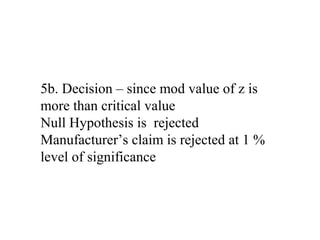
5b. Decision – since mod value of z is
more than critical value
Null Hypothesis is rejected
Manufacturer’s claim is rejected at 1 %
level of significance

Normal distribution - Unitedworld School of Business

  • 1.
    Most popular continuousprobability distribution is normal distribution. It has mean μ & standard deviation σ Deviation from mean x- μ Z = --------------------------- = -------------- Standard deviation σ Graphical representation of is called normal curve
  • 2.
    Standard deviation( σ) Standard deviation is a measure of spread ( variability ) of around Because sum of deviations from mean is always zero , we measure the spread by means of standard deviation which is defined as square root of ∑ (x- μ) 2 ∑ (x- xbar) 2 Variance (σ2) = -------------= ---------------- N n-1 σ2 = variance
  • 3.
    Interpretation of sigma(σ ) 1.Sigma (σ ) – standard deviation is a measure of variation of population 2.Sigma (σ ) – is a statistical measure of the process’s capability to meet customer’s requirements 3.Six sigma ( 6σ ) – as a management philosophy 4.View process measures from a customer’s point of view 5.Continual improvement 6.Integration of quality and daily work 7.Completely satisfying customer’s needs profitably
  • 4.
    Use of standarddeviation( σ ) Standard deviation enables us to determine , with a great deal of accuracy , where the values of frequency distribution are located in relation to mean. 1.About 68 % of the values in the population will fall within +- 1 standard deviation from the mean 2.About 95 % of the values in the population will fall within +- 2 standard deviation from the mean 3.About 99 % of the values in the population will fall within +- 3 standard deviation from the mean
  • 5.
    z 0.00 0.010.02 0.03 0.04 0.05 0.06 0.07 0.08 0.09 0.0 0.0000 0.0040 0.0080 0.0120 0.0160 0.0199 0.0239 0.0279 0.0319 0.0359 0.1 0.0398 0.0438 0.0478 0.0517 0.0557 0.0596 0.0636 0.0675 0.0714 0.0753 0.2 0.0793 0.0832 0.0871 0.0910 0.0948 0.0987 0.1026 0.1064 0.1103 0.1141 0.3 0.1179 0.1217 0.1255 0.1293 0.1331 0.1368 0.1406 0.1443 0.1480 0.1517 0.4 0.1554 0.1591 0.1628 0.1664 0.1700 0.1736 0.1772 0.1808 0.1844 0.1879 0.5 0.1915 0.1950 0.1985 0.2019 0.2054 0.2088 0.2123 0.2157 0.2190 0.2224 0.6 0.2257 0.2291 0.2324 0.2357 0.2389 0.2422 0.2454 0.2486 0.2517 0.2549 0.7 0.2580 0.2611 0.2642 0.2673 0.2704 0.2734 0.2764 0.2794 0.2823 0.2852 0.8 0.2881 0.2910 0.2939 0.2967 0.2995 0.3023 0.3051 0.3078 0.3106 0.3133 0.9 0.3159 0.3186 0.3212 0.3238 0.3264 0.3289 0.3315 0.3340 0.3365 0.3389
  • 6.
    1.0 0.3413 0.34380.3461 0.3485 0.3508 0.3531 0.3554 0.3577 0.3599 0.3621 1.1 0.3643 0.3665 0.3686 0.3708 0.3729 0.3749 0.3770 0.3790 0.3810 0.3830 1.2 0.3849 0.3869 0.3888 0.3907 0.3925 0.3944 0.3962 0.3980 0.3997 0.4015 1.3 0.4032 0.4049 0.4066 0.4082 0.4099 0.4115 0.4131 0.4147 0.4162 0.4177 1.4 0.4192 0.4207 0.4222 0.4236 0.4251 0.4265 0.4279 0.4292 0.4306 0.4319 1.5 0.4332 0.4345 0.4357 0.4370 0.4382 0.4394 0.4406 0.4418 0.4429 0.4441 1.6 0.4452 0.4463 0.4474 0.4484 0.4495 0.4505 0.4515 0.4525 0.4535 0.4545 1.7 0.4554 0.4564 0.4573 0.4582 0.4591 0.4599 0.4608 0.4616 0.4625 0.4633 1.8 0.4641 0.4649 0.4656 0.4664 0.4671 0.4678 0.4686 0.4693 0.4699 0.4706 1.9 0.4713 0.4719 0.4726 0.4732 0.4738 0.4744 0.4750 0.4756 0.4761 0.4767
  • 7.
    2.0 0.4772 0.47780.4783 0.4788 0.4793 0.4798 0.4803 0.4808 0.4812 0.4817 2.1 0.4821 0.4826 0.4830 0.4834 0.4838 0.4842 0.4846 0.4850 0.4854 0.4857 2.2 0.4861 0.4864 0.4868 0.4871 0.4875 0.4878 0.4881 0.4884 0.4887 0.4890 2.3 0.4893 0.4896 0.4898 0.4901 0.4904 0.4906 0.4909 0.4911 0.4913 0.4916 2.4 0.4918 0.4920 0.4922 0.4925 0.4927 0.4929 0.4931 0.4932 0.4934 0.4936 2.5 0.4938 0.4940 0.4941 0.4943 0.4945 0.4946 0.4948 0.4949 0.4951 0.4952 2.6 0.4953 0.4955 0.4956 0.4957 0.4959 0.4960 0.4961 0.4962 0.4963 0.4964 2.7 0.4965 0.4966 0.4967 0.4968 0.4969 0.4970 0.4971 0.4972 0.4973 0.4974 2.8 0.4974 0.4975 0.4976 0.4977 0.4977 0.4978 0.4979 0.4979 0.4980 0.4981 2.9 0.4981 0.4982 0.4982 0.4983 0.4984 0.4984 0.4985 0.4985 0.4986 0.4986 3.0 0.4987 0.4987 0.4987 0.4988 0.4988 0.4989 0.4989 0.4989 0.4990 0.4990 3.1 0.4990 0.4991 0.4991 0.4991 0.4992 0.4992 0.4992 0.4992 0.4993 0.4993 3.2 0.4993 0.4993 0.4994 0.4994 0.4994 0.4994 0.4994 0.4995 0.4995 0.4995 3.3 0.4995 0.4995 0.4995 0.4996 0.4996 0.4996 0.4996 0.4996 0.4996 0.4997 3.4 0.4997 0.4997 0.4997 0.4997 0.4997 0.4997 0.4997 0.4997 0.4997 0.4998
  • 10.
    SIGMA Mean Centered Process Meanshifted ( 1.5) Defects/ million % Defects/ million % 1 σ 317400 31.74 697000 69.0 2 σ 45600 4.56 308537 30.8 3 σ 2700 .26 66807 6.68 4 σ 63 0.0063 6210 0.621 5 σ .57 0.00006 233 0.0233 6 σ .002 3.4 0.00034
  • 11.
    Thus , ift is any statistic , then by central limit theorem variable value – Average Z = -------------- Standard deviation or standard error x- μ Z = -------------- σ
  • 12.
    Properties 1. Perfectly symmetricalto y axis 2. Bell shaped curve 3. Two halves on left & right are same. Skewness is zero 4. Total area1. area on left & right is 0.5 5. Mean = mode = median , unimodal 6. Has asymptotic base i.e. two tails of the curve extend indefinitely & never touch x – axis ( horizontal )
  • 13.
    Importance of NormalDistribution 1. When number of trials increase , probability distribution tends to normal distribution .hence , majority of problems and studies can be analysed through normal distribution 2. Used in statistical quality control for setting quality standards and to define control limits
  • 14.
    Hypothesis : astatement about the population parameter Statistical hypothesis is some assumption or statement which may or may not be true , about a population or a probability distribution characteristics about the given population , which we want to test on the basis of the evidence from a random sample
  • 15.
    Testing of Hypothesis: is a procedure that helps us to ascertain the likelihood of hypothecated population parameter being correct by making use of sample statistic A statistic is computed from a sample drawn from the parent population and on the basis of this statistic , it is observed whether the sample so drawn has come from the population with certain specified characteristic
  • 16.
    Procedure / stepsfor Testing a hypothesis 1. Setting up hypothesis 2. Computation of test statistic 3. Level of significance 4. Critical region or rejection region 5. Two tailed test or one tailed test 6. Critical value 7. Decision
  • 17.
    Hypothesis : twotypes 1. Null Hypothesis H0 2. Alternative Hypothesis H1 Null Hypothesis asserts that there is no difference between sample statistic and population parameter & whatever difference is there it is attributable to sampling errors Alternative Hypothesis : set in such a way that rejection of null hypothesis implies the acceptance of alternative hypothesis
  • 18.
    Null Hypothesis Say ,if we want to find the population mean has a specified value μ0 H0 : μ = μ0 Alternative Hypothesis could be i. H1 : μ ≠ μ0 ( i.e. μ > μ0 or μ < μ0 ) ii. H1 : μ > μ0 iii. H1 : μ < μ0 iv. R. A. Fisher “Null Hypothesis is the hypothesis which is to be tested for possible rejection under the assumption that it is true
  • 19.
    4. level ofsignificance :is the maximum probability ( α ) of making a Type I error i.e. : P [ Rejecting H0 when H0 is true ] Probability of making correct decision is ( 1 - α ) Common level of significance 5 % ( .05 ) or 1 % ( . 01 ) For 5 % level of significance ( α = .05 ) , probability of making a Type I error is 5 % or .05 i.e. : P [ Rejecting H0 when H0 is true ] = .05 Or we are ( 1 - α or 1-0.05 = 95 % ) confidence that a correct decision is made When no level of significance is given we take α = 0.05
  • 20.
    5.Critical region orrejection region :the value of test statistic computed to test the null hypothesis H0is known as critical value . It separates rejection region from the acceptance region
  • 21.
    6.Two tailed testor one tailed test : Rejection region may be represented by a portion of the area on each of the two sides or by only one side of the normal curve , accordingly the test is known as two tailed test ( or two sided test ) or one tailed ( or one sided test )
  • 22.
    Two tailed test:where alternative hypothesis is two sided or two tailed e.g. Null Hypothesis H0 : μ = μ0 Alternative Hypothesis H1 : μ ≠ μ0 ( i.e. μ > μ0 or μ < μ0 )
  • 23.
    One tailed test:where alternative hypothesis is one sided or one tailed two types a. Right tailed test :- rejection region or critical region lies entirely on right tail of normal curve b. Left tailed test :- rejection region or critical region lies entirely on left tail of normal curve
  • 24.
    Right tailed : NullHypothesis H0 : μ = μ0 Alternative Hypothesis H1 : μ > μ0 Left tailed : Null Hypothesis H0 : μ = μ0 Alternative Hypothesis H1 : μ < μ0 Right tailed
  • 25.
    7.Critical value :value of sample statistic that defines regions of acceptance and rejection Critical value of z for a single tailed ( left or right ) at a level of significance α is the same as critical value of z for two tailed test at a level of significance 2α .
  • 26.
    Critical value (Zα ) Levelof significance 1 % 5 % 10 % Two tailed test [Zα ] = 2.58 [Zα ] = 1.96 [Zα ] = 1.645 Right tailed test Zα = 2.33 Zα = 1.645 Zα= 1.28 Left tailed test Zα = - 2.33 Zα = -1.645 Zα = - 1.28
  • 27.
    S.No. Confidence level (1-α ) Value of confidence coefficient Zα ( two tailed test) 1 90 % 1.64 2 95 % 1.96 3 98 % 2.33 4 99 % 2.58 5 Without any reference to confidence level 3.00 6 α is level of significance which separates acceptance & rejection level
  • 28.
    8. Decision : 1.if mod .Z < Zα accept Null Hypothesis test statistic falls in the region of acceptance 2. if mod .Z > Zα reject Null Hypothesis
  • 29.
    Q1.Given a normaldistribution with mean 60 & standard deviation 10 , find the probability that x lies between 40 & 74 Given μ= 60 , σ =10 P ( 40 < x < 74 ) = P ( -2 < z< 1.4 ) = P ( -2< z < 0 ) + P ( 0 < z < 1.4 ) = 0.4772+ 0.4192 = 0. 8964
  • 30.
    Q2.In a projectestimated time of completion is 35 weeks. Standard deviation of 3 activities in critical paths are 4 , 4 & 2 respectively . calculate the probability of completing the project in a. 30 weeks , b. 40 weeks and c. 42 weeks
  • 31.
    Test of significance Mean Null–there is no significance difference between sample mean & population mean or The sample has been drawn from the parent population Deviation from mean xbar- μ Z = --------------------------- = -------------- Standard Error Standard Error xbar = sample mean μ = population mean
  • 32.
    1. Standard Errorof mean = σ / √ n When population standard deviation is known σ = standard deviation of the population n = sample size 2. Standard Error of mean = s / √ n When sample standard deviation is known s = standard deviation of the sample n = sample size
  • 33.
    Proprtion Null –there isno significance difference between sample proportion & population proportion or The sample has been drawn from a population with population proportion P Null hypothesis H0 : P = P0 where P0 is particular value of P Alternate hypothesis H1 : P ≠ P0 ( i.e. P > P0 or P < P0 )
  • 34.
    P*(1-P) Standard error ofproportion (S.E.(p)) = √ ------------ n Deviation from proprtion p-P Test statistic Z = --------------------------- = -------- Standard Error (p) S.E.(p)
  • 35.
    Q3. a sampleof size 400 was drawn and sample mean was 99. test whether this sample could have come from a normal population with mean 100 & standard deviation 8 at 5 % level of significance
  • 36.
    Ans. Given xbar= 99 , n = 400 μ = 100 , σ = 8 1.Null hypothesis sample has come from a normal population with mean = 100 & s.d. = 8 Null hypothesis H0 : μ = 100 Alternate hypothesis H1 : μ ≠ μ0 ( i.e. μ > μ0 or μ < μ0 ) Two tail test so out of 5% , 2.5 % on each side ( left hand & right hand) 2.calculation of Test statistic Standard error (s.e.) of xbar = σ / √ n = 8/√ 400 = 8/20= 2/5 xbar- μ 99-100 Test statistic Z = ----------- = -------- = -5/2 =- 2.5 S.E. 2/5
  • 37.
    Mod z =2.5 3. level of significance 5 % i.e.value of α = .05 ( hence , level of confidence = 1- α = 1-0.05 = 0.95 or 95%) 4. Critical value (since it is Two tail test so out of 5% , we take two tails on each side i.e.2.5 % on each side = 0.025 ( left hand & right hand) = read from z –table value corresponding to area = 0.5 -0.025 = 0.4750 ( 0.4750 on both sides i.e. 2* 0.4750 = 0.95 area which means 95% confidence) = value of z corresponding to area is 1.96
  • 38.
    5. Decision –since mod value of z is more than critical value Null Hypothesis is rejected & alternate hypothesis is accepted Sample has not been drawn from a normal population with mean 100 &s.d. 8
  • 39.
    Q4. the meanlife time of a sample of 400 fluorescent light tube produced by a company is found to be 1570 hours with a standard deviation of 150 hrs. test the hypothesis that the mean life time of the bulbs produced by the company is 1600 hrs against the alternative hypothesis that it is greater than 1600 hrs at 1 &% level of significance
  • 40.
    Ans. Given xbar= 1570 , n = 400 μ = 1600 , standard deviation of sample mean s= 150 = 8 Null hypothesis : mean life time of bulbs is 1600 hrs i.e. Null hypothesis H0 : μ = 1600 Alternate hypothesis H1 : μ > 1600 i.e. it is a case of right tailed test 2.calculation of Test statistic Standard error (s.e.) of xbar = s / √ n 150/√ 400 = 150/20= 7.5
  • 41.
    xbar- m 1570-1600 Z= ----------- = -------------- = -30/7.5= - 4 S.E. 7.5 Mod z = 4 3. level of significance 1 % i.e. value of α = .01 ( hence , level of confidence = 1- α = 1-0.01 = 0.99 or 99%)
  • 42.
    4. Critical value(since it is right tail test so out of 1% , we take 1 % only one side = 0.01 on right hand) = read from z –table value corresponding to area = 0.5 -0.01 = 0.4900 ( 0.49 on one side together with +0.5 makes total 0.99 which means 99% confidence) = value of z ( corresponding to area 0 .49 is 2.33 5. Decision – since mod value of z is more than critical value Null Hypothesis is rejected & alternate hypothesis is accepted Hence mean life time of bulbs is greater than 1600 hrs
  • 43.
    Q5.in a sampleof 400 burners there were 12 whose internal diameters were not within tolerance . Is this sufficient to conclude that manufacturing process is turning out more than 2 % defective burners. Take α = .05
  • 44.
    Given P= 0.002Q= 1-P =1-0.02 =0. 98 & p= 12/400 = 0.03 Null hypothesis H0 : P = process is under control P ≤ 0.02 Alternate hypothesis H1 : P > 0.02 Left tail test Calculation of Standard error of proportion P*(1-P) 0.02*0.98 (S.E.(p)) = √ ------------ = √-------------- n 400
  • 45.
    Deviation 0.03-0.02 0.001 Z= ----------- = ------------ = -------- = 1.429 S.E.(p) √ (0.02*0.98) / 400 0.007 3. level of significance 5 % i.e.value of α = .05 ( hence , level of confidence = 1- α = 1-0.01 = 0.95 or 95%)
  • 46.
    4. Critical value(since it is left tail test so out of 5% , we take full 5 % only one side = 0.05 on left hand) = read from z –table value corresponding to area = 0.5 -0.05 = 0.4500 ( 0.45 on one side together with +0.5 makes total 0.95 which means 95% confidence) = value of z ( corresponding to area 0 .45 is 1.645 5. Decision – since mod value of z is less than critical value Null Hypothesis is accepted Hence process is not out of control
  • 47.
    Q6. a manufacturerclaimed that at least 95 % of the equipment which he supplied is conforming to specifications. A examination of sample of 200 pieces of equipment revealed that 18 were faulty. Test his claim at level of significance i.) 0.05 ii.) 0.01
  • 48.
    Given P= 0.95Q= 1-P =1-0.95 =0. 05 n= 200 p= 18/200 = - (200-18) / 200 = 182/200 = 0.91 Null hypothesis H0 : P = process is under control P = 0.95 Alternate hypothesis H1 : P < 0.95 Left tail test
  • 49.
    P*(1-P) 0.95*0.05 S.E.(p) =√ ------------ = √--------- n 200 0.91-0.95 -0.04 Z = ------------ = --------- = -2.6 √ (0.02*0.98) / 200 0.0154
  • 50.
    3a. level ofsignificance 5 % i.e.value of α = .05 ( hence , level of confidence = 1- α = 1-0.05 = 0.95 or 95%) 4a. Critical value (since it is right tail test so out of 5% , full 5 % on one side = 0.05 on right hand) = read from z –table value corresponding to area = 0.5 -0.05 = 0.4500 ( 0.45 on one side together with +0.5 makes total 0.95 which means 95% confidence) = value of z ( corresponding to area 0 .45 is 1.645) 5a. Decision – since mod value of z is more than critical value Null Hypothesis is rejected Manufacturer’s claim is rejected at 5 % level of significance
  • 51.
    3b. level ofsignificance 1 % i.e.value of α = .01 ( hence , level of confidence = 1- α = 1-0.01 = 0.99 or 99%) 4b. Critical value (since it is right tail test so out of 1% , we take 1 % only one side = 0.01 on right hand) = read from z –table value corresponding to area = 0.5 -0.01 = 0.4900 ( 0.49 on one side together with +0.5 makes total 0.99 which means 99% confidence) = value of z ( corresponding to area 0 .49 is 2.33
  • 52.
    5b. Decision –since mod value of z is more than critical value Null Hypothesis is rejected Manufacturer’s claim is rejected at 1 % level of significance