Marketing Project
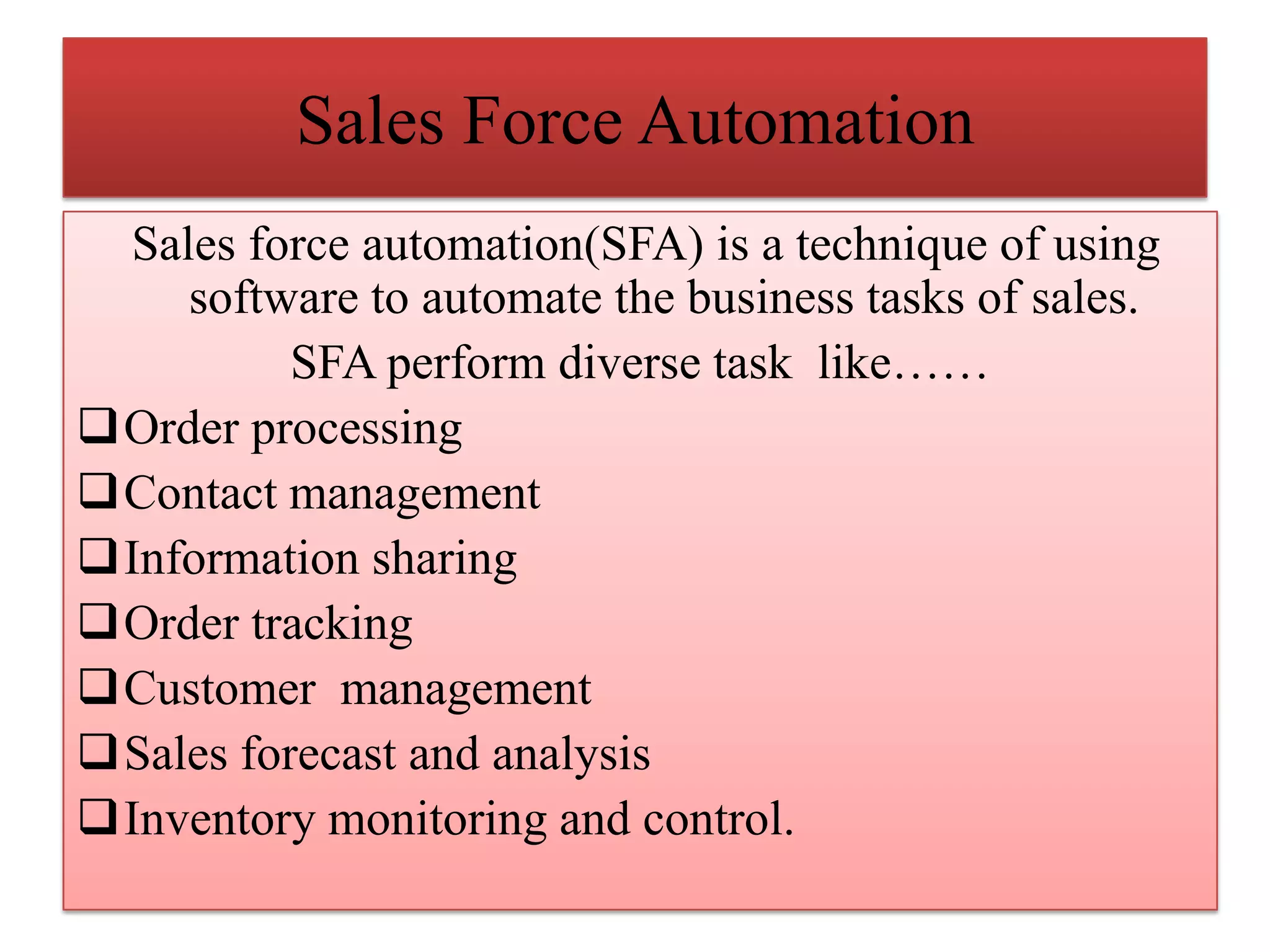
Sales Force Automation
Sales force automation(SFA) is a technique of using
software to automate the business tasks of sales.
SFA perform diverse task like……
Order processing
Contact management
Information sharing
Order tracking
Customer management
Sales forecast and analysis
Inventory monitoring and control.
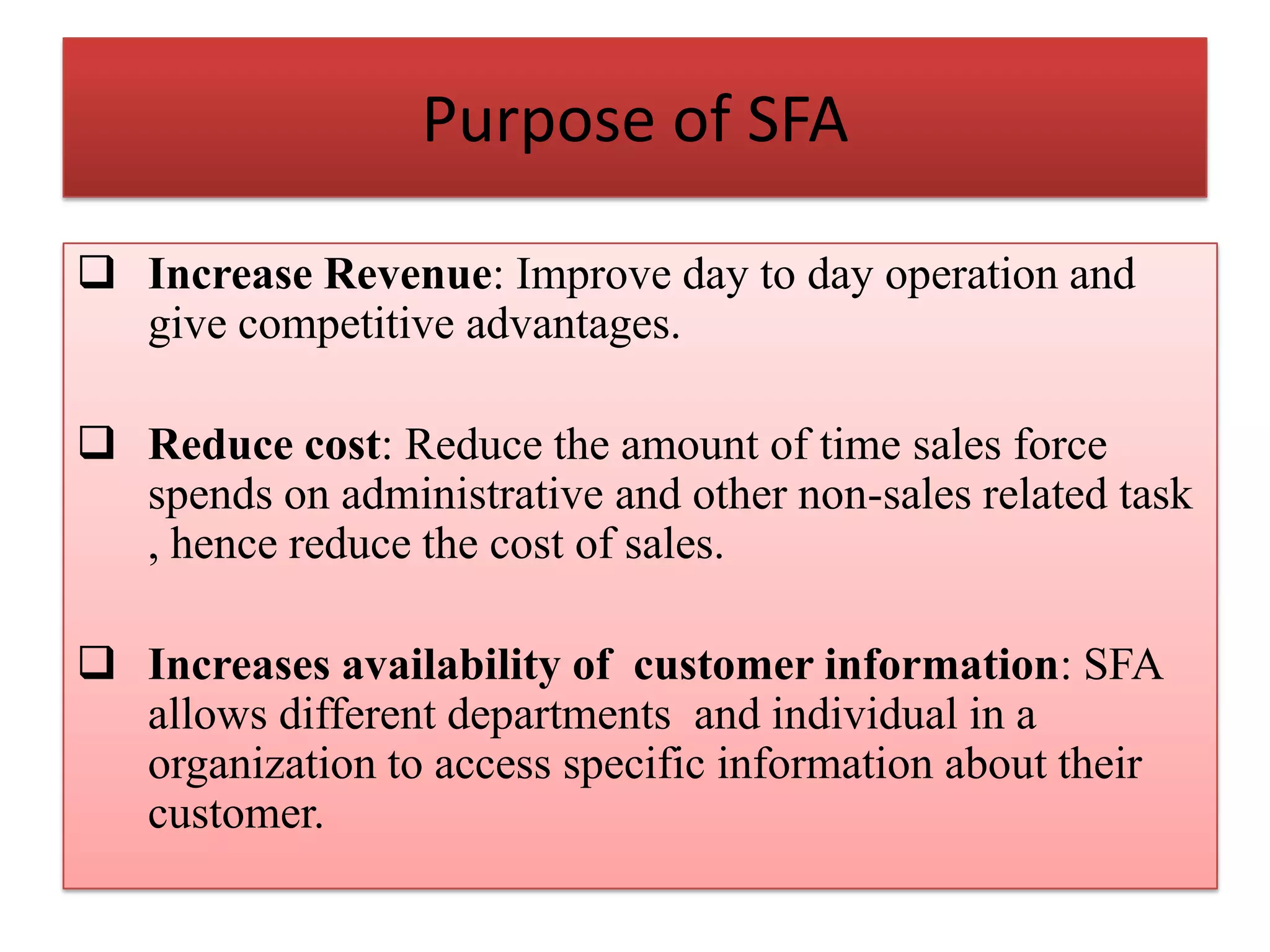
Purpose of SFA
 Increase Revenue: Improve day to day operation and
give competitive advantages.
 Reduce cost: Reduce the amount of time sales force
spends on administrative and other non-sales related task
, hence reduce the cost of sales.
 Increases availability of customer information: SFA
allows different departments and individual in a
organization to access specific information about their
customer.
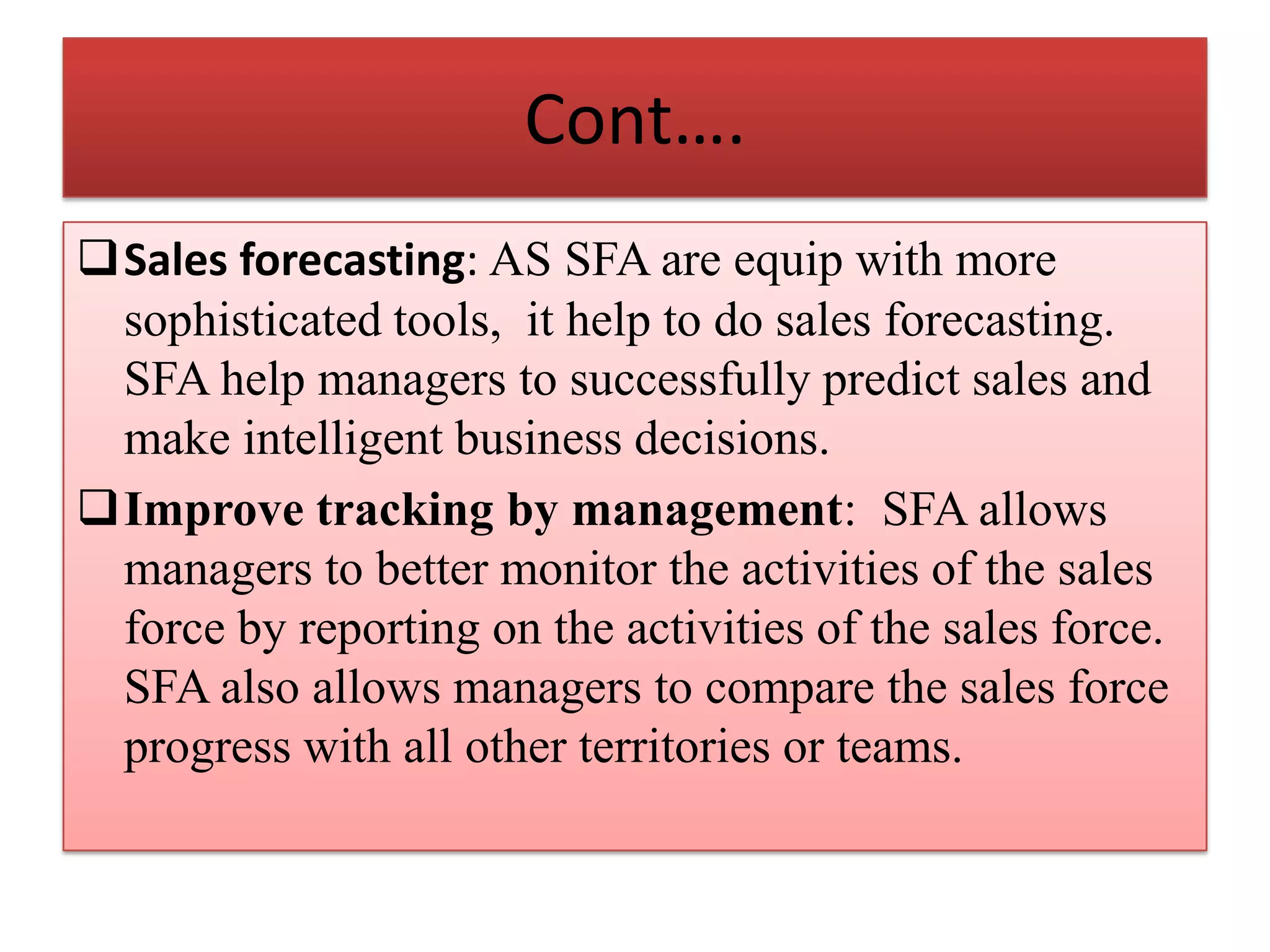
Cont….
Sales forecasting: AS SFA are equip with more
sophisticated tools, it help to do sales forecasting.
SFA help managers to successfully predict sales and
make intelligent business decisions.
Improve tracking by management: SFA allows
managers to better monitor the activities of the sales
force by reporting on the activities of the sales force.
SFA also allows managers to compare the sales force
progress with all other territories or teams.
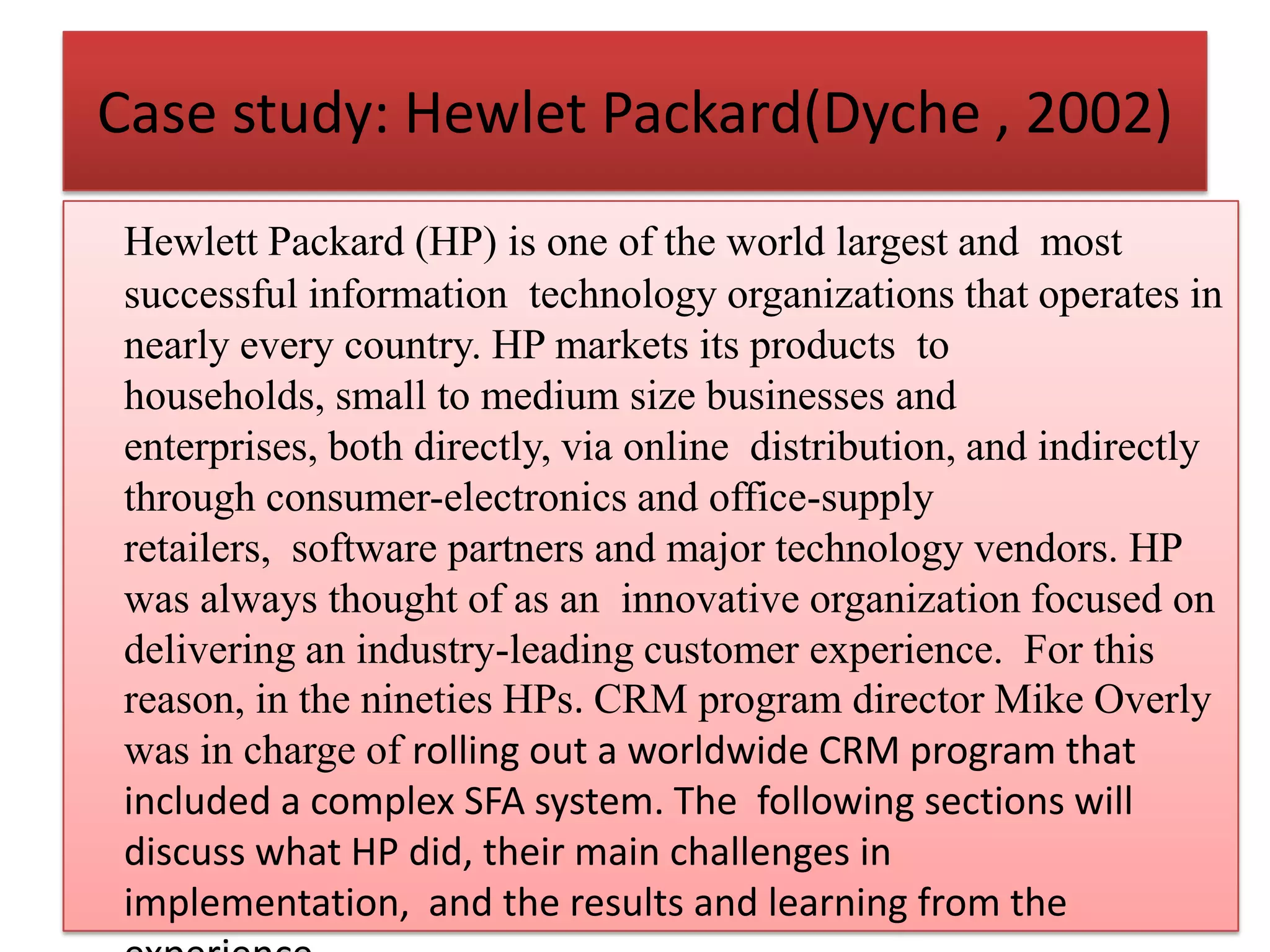
Case study: Hewlet Packard(Dyche , 2002)
Hewlett Packard (HP) is one of the world largest and most
successful information technology organizations that operates in
nearly every country. HP markets its products to
households, small to medium size businesses and
enterprises, both directly, via online distribution, and indirectly
through consumer-electronics and office-supply
retailers, software partners and major technology vendors. HP
was always thought of as an innovative organization focused on
delivering an industry-leading customer experience. For this
reason, in the nineties HPs. CRM program director Mike Overly
was in charge of rolling out a worldwide CRM program that
included a complex SFA system. The following sections will
discuss what HP did, their main challenges in
implementation, and the results and learning from the
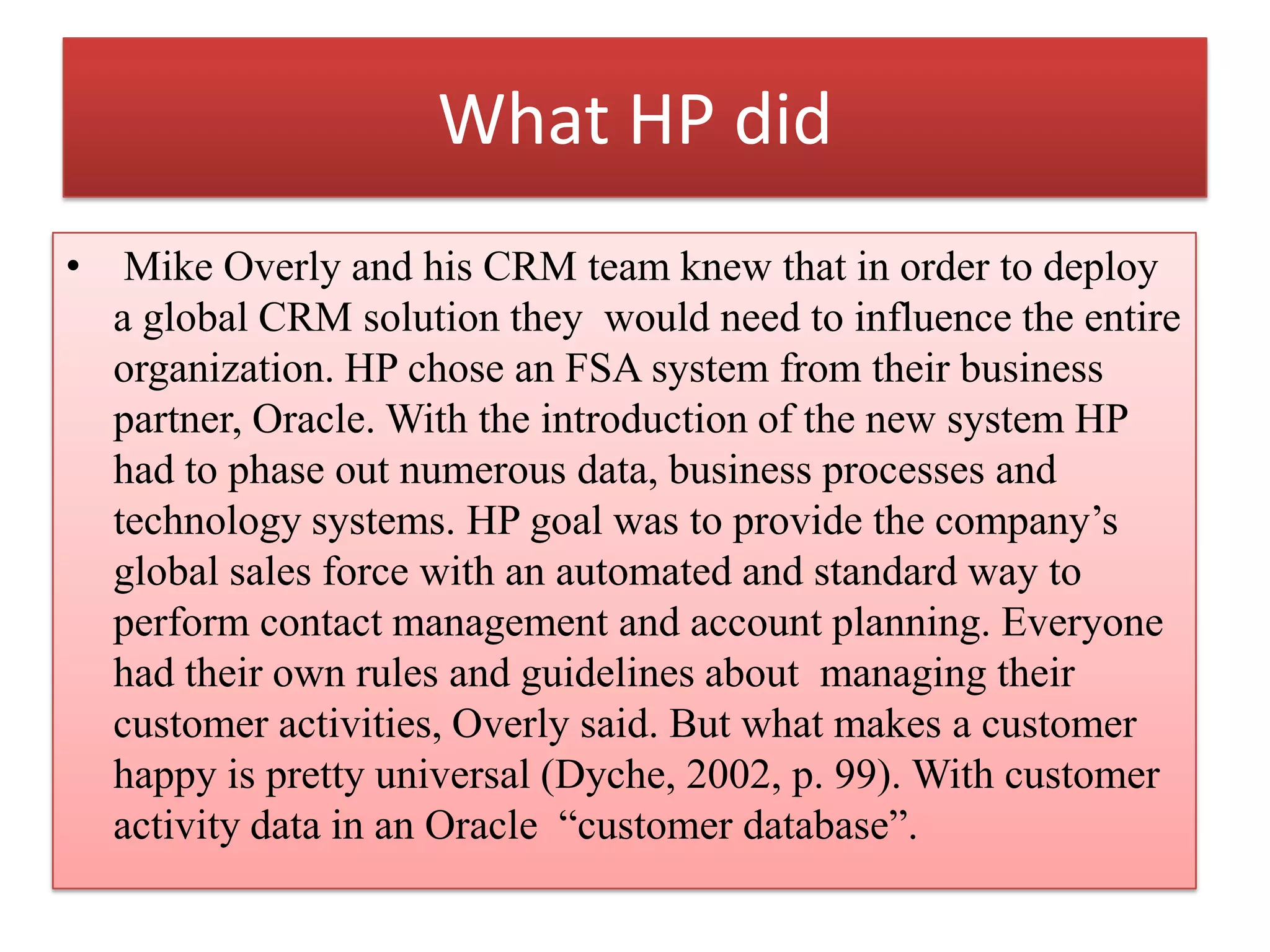
What HP did
• Mike Overly and his CRM team knew that in order to deploy
a global CRM solution they would need to influence the entire
organization. HP chose an FSA system from their business
partner, Oracle. With the introduction of the new system HP
had to phase out numerous data, business processes and
technology systems. HP goal was to provide the company’s
global sales force with an automated and standard way to
perform contact management and account planning. Everyone
had their own rules and guidelines about managing their
customer activities, Overly said. But what makes a customer
happy is pretty universal (Dyche, 2002, p. 99). With customer
activity data in an Oracle “customer database”.
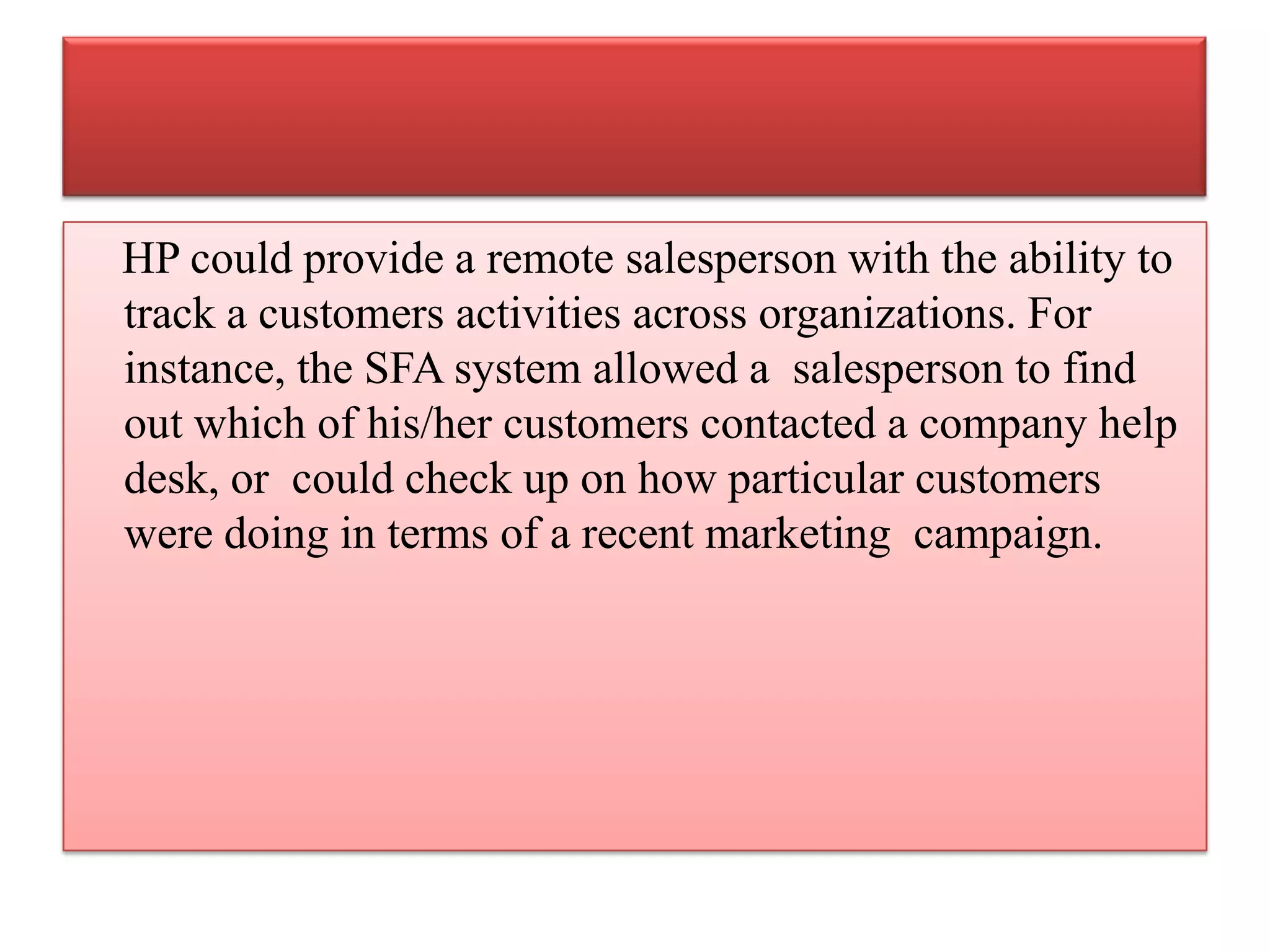
HP could provide a remote salesperson with the ability to
track a customers activities across organizations. For
instance, the SFA system allowed a salesperson to find
out which of his/her customers contacted a company help
desk, or could check up on how particular customers
were doing in terms of a recent marketing campaign.
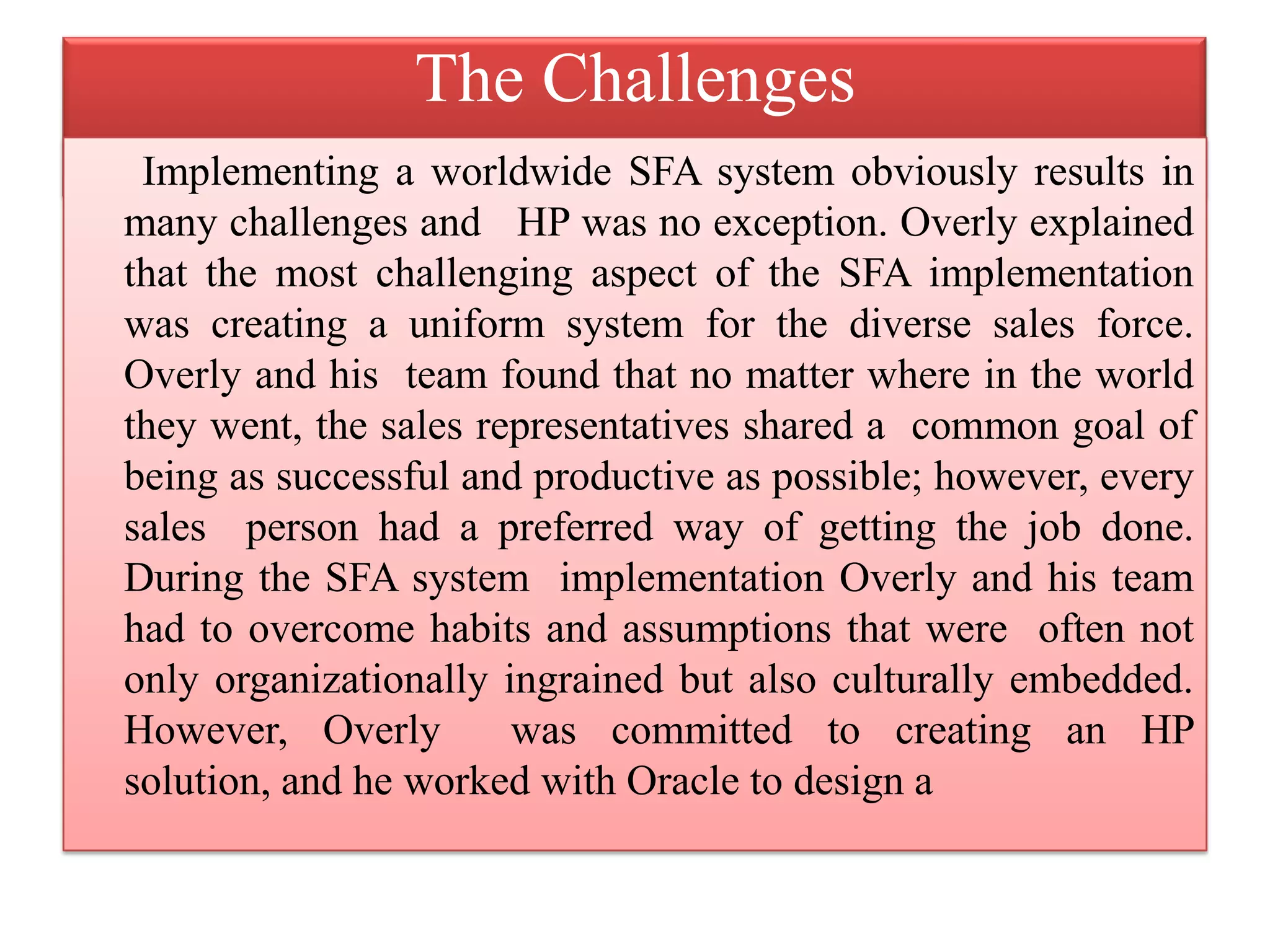
The Challenges
Implementing a worldwide SFA system obviously results in
many challenges and HP was no exception. Overly explained
that the most challenging aspect of the SFA implementation
was creating a uniform system for the diverse sales force.
Overly and his team found that no matter where in the world
they went, the sales representatives shared a common goal of
being as successful and productive as possible; however, every
sales person had a preferred way of getting the job done.
During the SFA system implementation Overly and his team
had to overcome habits and assumptions that were often not
only organizationally ingrained but also culturally embedded.
However, Overly was committed to creating an HP
solution, and he worked with Oracle to design a
Cont..
system that allowed the sales force to customize their interfaces
to include client information and contact activities as well as
data from external news sources and the global financial markets.
HP also developed a training program in order to help the sales
force apply the technology to their specific job.
Results and Learning
Overly measured the overall success of the system based on
three primary measures” increased revenue, decreased costs and
industry-leading total customer experience. The overall results
from the SFA implementation were positive and Overly was
confident that the system would continue to pay off in the future.
Overly was reluctant about estimating the revenue generated by
the SFA system, however his optimism made it clear HP expects
additional revenue to be generated by the improvements resulting
from the system.
Cont…
Based on his experience with HP, Overly advised other
organizations that might be deploying CRM to be mindful
of three success metrics. First, organizations should obtain
sustained executive presence, meaning that executive
leadership must be engaged throughout the CRM lifecycle.
Second, organizations should always keep one eye on the
problems of today, and the other on tomorrow’s problem.
Third, organizations need to ensure change leadership, with
emphasis on the world leader. Finally, Overly stressed that
Every day there a new challenge you need someone who has
a good understanding of the problem and the authority to fix
it.

Sales force automation - Unitedworld School of Business

  • 1.
  • 2.
    Sales Force Automation Salesforce automation(SFA) is a technique of using software to automate the business tasks of sales. SFA perform diverse task like…… Order processing Contact management Information sharing Order tracking Customer management Sales forecast and analysis Inventory monitoring and control.
  • 3.
    Purpose of SFA Increase Revenue: Improve day to day operation and give competitive advantages.  Reduce cost: Reduce the amount of time sales force spends on administrative and other non-sales related task , hence reduce the cost of sales.  Increases availability of customer information: SFA allows different departments and individual in a organization to access specific information about their customer.
  • 4.
    Cont…. Sales forecasting: ASSFA are equip with more sophisticated tools, it help to do sales forecasting. SFA help managers to successfully predict sales and make intelligent business decisions. Improve tracking by management: SFA allows managers to better monitor the activities of the sales force by reporting on the activities of the sales force. SFA also allows managers to compare the sales force progress with all other territories or teams.
  • 5.
    Case study: HewletPackard(Dyche , 2002) Hewlett Packard (HP) is one of the world largest and most successful information technology organizations that operates in nearly every country. HP markets its products to households, small to medium size businesses and enterprises, both directly, via online distribution, and indirectly through consumer-electronics and office-supply retailers, software partners and major technology vendors. HP was always thought of as an innovative organization focused on delivering an industry-leading customer experience. For this reason, in the nineties HPs. CRM program director Mike Overly was in charge of rolling out a worldwide CRM program that included a complex SFA system. The following sections will discuss what HP did, their main challenges in implementation, and the results and learning from the
  • 6.
    What HP did •Mike Overly and his CRM team knew that in order to deploy a global CRM solution they would need to influence the entire organization. HP chose an FSA system from their business partner, Oracle. With the introduction of the new system HP had to phase out numerous data, business processes and technology systems. HP goal was to provide the company’s global sales force with an automated and standard way to perform contact management and account planning. Everyone had their own rules and guidelines about managing their customer activities, Overly said. But what makes a customer happy is pretty universal (Dyche, 2002, p. 99). With customer activity data in an Oracle “customer database”.
  • 7.
    HP could providea remote salesperson with the ability to track a customers activities across organizations. For instance, the SFA system allowed a salesperson to find out which of his/her customers contacted a company help desk, or could check up on how particular customers were doing in terms of a recent marketing campaign.
  • 8.
    The Challenges Implementing aworldwide SFA system obviously results in many challenges and HP was no exception. Overly explained that the most challenging aspect of the SFA implementation was creating a uniform system for the diverse sales force. Overly and his team found that no matter where in the world they went, the sales representatives shared a common goal of being as successful and productive as possible; however, every sales person had a preferred way of getting the job done. During the SFA system implementation Overly and his team had to overcome habits and assumptions that were often not only organizationally ingrained but also culturally embedded. However, Overly was committed to creating an HP solution, and he worked with Oracle to design a
  • 9.
    Cont.. system that allowedthe sales force to customize their interfaces to include client information and contact activities as well as data from external news sources and the global financial markets. HP also developed a training program in order to help the sales force apply the technology to their specific job. Results and Learning Overly measured the overall success of the system based on three primary measures” increased revenue, decreased costs and industry-leading total customer experience. The overall results from the SFA implementation were positive and Overly was confident that the system would continue to pay off in the future. Overly was reluctant about estimating the revenue generated by the SFA system, however his optimism made it clear HP expects additional revenue to be generated by the improvements resulting from the system.
  • 10.
    Cont… Based on hisexperience with HP, Overly advised other organizations that might be deploying CRM to be mindful of three success metrics. First, organizations should obtain sustained executive presence, meaning that executive leadership must be engaged throughout the CRM lifecycle. Second, organizations should always keep one eye on the problems of today, and the other on tomorrow’s problem. Third, organizations need to ensure change leadership, with emphasis on the world leader. Finally, Overly stressed that Every day there a new challenge you need someone who has a good understanding of the problem and the authority to fix it.