

SELECTION
ANNOTATED OUTLINE
INTRODUCTION
Selection is the process of picking individuals who have relevant
qualifications to fill jobs in an organization. Selection is much more
than just choosing the best candidate. It is an attempt to strike a
happy balance between what the applicant can and wants to do and
what the organization requires.
Selection
ESSENTIALS OF SELECTION
Selection
 Picking individuals possessing relevant qualifications
 Matching job requirements with the profile of candidates
 Using multiple tools and techniques to find the most suitable
candidates capable
 Of achieving success on the job
Selection
The Process
The Process of Selection
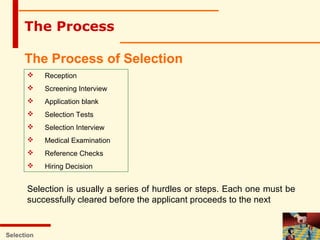
 Reception
 Screening Interview
 Application blank
 Selection Tests
 Selection Interview
 Medical Examination
 Reference Checks
 Hiring Decision
Selection is usually a series of hurdles or steps. Each one must be
successfully cleared before the applicant proceeds to the next
Selection
 Reception
A warm, friendly and courteous reception is extended to candidates
with a view to create a favourable impression. Employment
possibilities are also communicated honestly and clearly
 Screening interview
The HR department tries to screen out the obvious misfits through this
courtesy interview. A prescribed application form is given to
candidates who are found to be suitable.
 Application blank
It is a printed form completed by job aspirants detailing their
educational background, previous work history and certain personal
data.
The Process of Selection
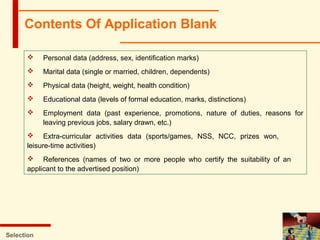
Contents Of Application Blank
Selection
 Personal data (address, sex, identification marks)
 Marital data (single or married, children, dependents)
 Physical data (height, weight, health condition)
 Educational data (levels of formal education, marks, distinctions)
 Employment data (past experience, promotions, nature of duties, reasons for
leaving previous jobs, salary drawn, etc.)
 Extra-curricular activities data (sports/games, NSS, NCC, prizes won,
leisure-time activities)
 References (names of two or more people who certify the suitability of an
applicant to the advertised position)
Selection
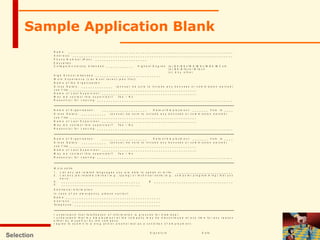
Sample Application Blank
N a m e : _ _ _ _ _ _ _ _ _ _ _ _ _ _ _ _ _ _ _ _ _ _ _ _ _ _ _ _ _ _ _ _ _ _ _ _ _ _ _ _ _ _ _ _ _ _ _ _ _ _ _ _ _ _ _ _ _ _ _ _ _ _ _ _ _ _ _ _ _ _ _ _ _
A d d r e s s : _ _ _ _ _ _ _ _ _ _ _ _ _ _ _ _ _ _ _ _ _ _ _ _ _ _ _ _ _ _ _ _ _ _ _ _ _ _ _ _ _ _ _ _ _ _ _ _ _ _ _ _ _ _ _ _ _ _ _ _ _ _ _ _ _ _ _ _ _ _ _
P h o n e N u m b e r ( R e s ) : _ _ _ _ _ _ _ _ _ _ _ _ _ _ _ _ _ _ _ _ _ _ _
E d u c a t i o n
C o l l e g e / U n i v e r s i t y A t t e n d e d : _ _ _ _ _ _ _ _ _ _ _ _ H i g h e s t D e g r e e ( a ) B A / B S c / M A / M S c / M B A / M C o m
( b ) B E / B Te c h / M T e c h
( c ) A n y o t h e r
H i g h S c h o o l A t t e n d e d : _ _ _ _ _ _ _ _ _ _ _ _ _ _ _ _ _ _ _ _ _ _ _ _ _ _ _ _ _
W o r k E x p e r i e n c e ( L i s t m o s t r e c e n t j o b s f i r s t )
N a m e o f t h e O r g a n i s a t i o n :
G r o s s S a l a r y : _ _ _ _ _ _ _ _ _ _ _ _ _ _ ( a n n u a l ; b e s u r e t o i n c l u d e a n y b o n u s e s o r c o m m i s s i o n e a r n e d )
J o b T i t l e : _ _ _ _ _ _ _ _ _ _ _ _ _ _ _ _ _ _ _ _ _ _ _ _ _ _ _ _ _ _ _ _ _ _ _ _ _ _ _ _ _ _ _ _ _ _ _ _ _ _ _ _ _ _ _ _
N a m e o f L a s t S u p e r v i s o r : _ _ _ _ _ _ _ _ _ _ _ _ _ _ _ _ _ _ _ _ _ _ _ _ _ _ _ _ _ _ _ _ _ _ _ _ _ _ _ _ _ _
M a y w e c o n t a c t t h i s s u p e r v i s o r ? Y e s / N o
R e a s o n ( s ) f o r L e a v i n g : _ _ _ _ _ _ _ _ _ _ _ _ _ _ _ _ _ _ _ _ _ _ _ _ _ _ _ _ _ _ _ _ _ _ _ _ _ _ _ _ _ _ _ _ _ _ _ _ _ _ _ _ _ _ _ _ _ _ _ _
N a m e o f O r g a n i s a t i o n : _ _ _ _ _ _ _ _ _ _ _ _ _ _ _ _ _ _ _ _ D a t e o f E m p l o y m e n t : _ _ _ _ _ _ _ f r o m t o _ _ _ _
G r o s s S a l a r y : _ _ _ _ _ _ _ _ _ _ _ ( a n n u a l ; b e s u r e t o i n c l u d e a n y b o n u s e s o r c o m m i s s i o n e a r n e d )
J o b T i t l e : _ _ _ _ _ _ _ _ _ _ _ _ _ _ _ _ _ _ _ _ _ _ _ _ _ _ _ _ _ _ _ _ _ _ _ _ _ _ _ _ _ _ _ _ _ _ _ _ _ _ _ _ _ _ _ _
N a m e o f L a s t S u p e r v i s o r : _ _ _ _ _ _ _ _ _ _ _ _ _ _ _ _ _ _ _ _ _ _ _ _ _ _ _ _ _ _ _ _ _ _ _ _ _ _ _ _ _ _
M a y w e c o n t a c t t h i s s u p e r v i s o r ? Y e s / N o
R e a s o n ( s ) f o r L e a v i n g : _ _ _ _ _ _ _ _ _ _ _ _ _ _ _ _ _ _ _ _ _ _ _ _ _ _ _ _ _ _ _ _ _ _ _ _ _ _ _ _ _ _ _ _ _ _ _ _ _ _ _ _ _ _ _ _ _ _ _ _
N a m e o f O r g a n i s a t i o n : _ _ _ _ _ _ _ _ _ _ _ _ _ _ _ _ _ _ _ _ D a t e o f E m p l o y m e n t : _ _ _ _ _ _ _ f r o m t o _ _ _ _
G r o s s S a l a r y : _ _ _ _ _ _ _ _ _ _ _ ( a n n u a l ; b e s u r e t o i n c l u d e a n y b o n u s e s o r c o m m i s s i o n e a r n e d )
J o b T i t l e : _ _ _ _ _ _ _ _ _ _ _ _ _ _ _ _ _ _ _ _ _ _ _ _ _ _ _ _ _ _ _ _ _ _ _ _ _ _ _ _ _ _ _ _ _ _ _ _ _ _ _ _ _ _ _ _
N a m e o f L a s t S u p e r v i s o r : _ _ _ _ _ _ _ _ _ _ _ _ _ _ _ _ _ _ _ _ _ _ _ _ _ _ _ _ _ _ _ _ _ _ _ _ _ _ _ _ _ _
M a y w e c o n t a c t t h i s s u p e r v i s o r ? Y e s / N o
R e a s o n ( s ) f o r L e a v i n g : _ _ _ _ _ _ _ _ _ _ _ _ _ _ _ _ _ _ _ _ _ _ _ _ _ _ _ _ _ _ _ _ _ _ _ _ _ _ _ _ _ _ _ _ _ _ _ _ _ _ _ _ _ _ _ _ _ _ _ _
W o r k s k i l l s
1 . L i s t a n y j o b - r e l a t e d l a n g u a g e s y o u a r e a b l e t o s p e a k o r w r i t e : _ _ _ _ _ _ _ _ _ _ _ _ _ _ _ _ _ _ _ _ _ _ _ _ _
2 . L i s t a n y j o b - r e l a t e d c l e r i c a l ( e . g . , t y p i n g ) o r t e c h n i c a l s k i l l s ( e . g . , c o m p u t e r p r o g r a m m i n g ) t h a t y o u
h a v e :
A . _ _ _ _ _ _ _ _ _ _ _ _ _ _ _ _ _ _ _ _ _ _ _ _ _ _ _ _ _ _ _ _ _ _ _ B . _ _ _ _ _ _ _ _ _ _ _ _ _ _ _ _ _ _ _ _ _ _ _ _ _ _ _ _ _ _ _ _ _ _ _
C . _ _ _ _ _ _ _ _ _ _ _ _ _ _ _ _ _ _ _ _ _ _ _ _ _ _ _ _ _ _ _ _ _ _ _
A d d i t i o n a l I n f o r m a t i o n
I n c a s e o f a n e m e r g e n c y , p l e a s e c o n t a c t .
N a m e : _ _ _ _ _ _ _ _ _ _ _ _ _ _ _ _ _ _ _ _ _ _ _ _ _ _ _ _ _ _ _ _ _ _ _ _ _ _ _ _ _ _
A d d r e s s : _ _ _ _ _ _ _ _ _ _ _ _ _ _ _ _ _ _ _ _ _ _ _ _ _ _ _ _ _ _ _ _ _ _ _ _ _ _ _
T e l e p h o n e : _ _ _ _ _ _ _ _ _ _ _ _ _ _ _ _ _ _ _ _ _ _ _ _ _ _ _ _ _ _ _ _ _ _ _ _ _ _
I u n d e r s t a n d t h a t f a l s i f i c a t i o n o f i n f o r m a t i o n i s g r o u n d s f o r d i s m i s s a l .
I u n d e r s t a n d t h a t m y e m p l o y m e n t a t t h e c o m p a n y m a y b e d i s c o n t i n u e d a t a n y t i m e f o r a n y r e a s o n
e i t h e r b y m y s e l f o r b y t h e c o m p a n y .
I a g r e e t o s u b m i t t o a d r u g a n d / o r a l c o h o l t e s t a s a c o n d i t i o n o f e m p l o y m e n t .
S i g n a t u r e D a t e
Selection
 Weighted application blank
The items that have a strong relationship to job performance are
given numeric values or weights so that a company can cross-
compare candidates with more or less similar qualifications on
paper
The Process of Selection
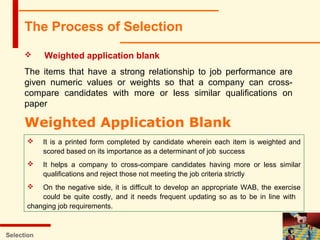
Weighted Application Blank
 It is a printed form completed by candidate wherein each item is weighted and
scored based on its importance as a determinant of job success
 It helps a company to cross-compare candidates having more or less similar
qualifications and reject those not meeting the job criteria strictly
 On the negative side, it is difficult to develop an appropriate WAB, the exercise
could be quite costly, and it needs frequent updating so as to be in line with
changing job requirements.
SELECTION TESTING
A test is a standardized, objective measure of a sample of behaviour.
Selection tests are increasingly used by companies these days because
they measure individual differences in a scientific way, leaving very little
room for Individual bias.
Selection
Selection
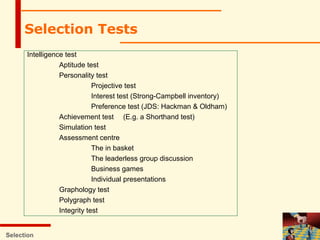
Selection Tests
Intelligence test
Aptitude test
Personality test
Projective test
Interest test (Strong-Campbell inventory)
Preference test (JDS: Hackman & Oldham)
Achievement test (E.g. a Shorthand test)
Simulation test
Assessment centre
The in basket
The leaderless group discussion
Business games
Individual presentations
Graphology test
Polygraph test
Integrity test
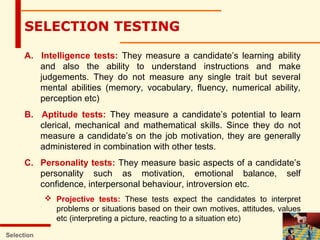
A. Intelligence tests: They measure a candidate’s learning ability
and also the ability to understand instructions and make
judgements. They do not measure any single trait but several
mental abilities (memory, vocabulary, fluency, numerical ability,
perception etc)
B. Aptitude tests: They measure a candidate’s potential to learn
clerical, mechanical and mathematical skills. Since they do not
measure a candidate’s on the job motivation, they are generally
administered in combination with other tests.
C. Personality tests: They measure basic aspects of a candidate’s
personality such as motivation, emotional balance, self
confidence, interpersonal behaviour, introversion etc.
 Projective tests: These tests expect the candidates to interpret
problems or situations based on their own motives, attitudes, values
etc (interpreting a picture, reacting to a situation etc)
Selection
SELECTION TESTING
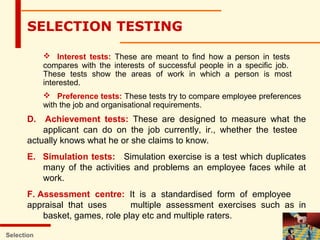
 Interest tests: These are meant to find how a person in tests
compares with the interests of successful people in a specific job.
These tests show the areas of work in which a person is most
interested.
 Preference tests: These tests try to compare employee preferences
with the job and organisational requirements.
Selection
SELECTION TESTING
D. Achievement tests: These are designed to measure what the
applicant can do on the job currently, ir., whether the testee
actually knows what he or she claims to know.
E. Simulation tests: Simulation exercise is a test which duplicates
many of the activities and problems an employee faces while at
work.
F. Assessment centre: It is a standardised form of employee
appraisal that uses multiple assessment exercises such as in
basket, games, role play etc and multiple raters.
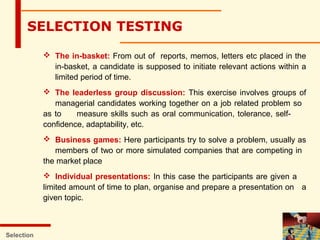
 The in-basket: From out of reports, memos, letters etc placed in the
in-basket, a candidate is supposed to initiate relevant actions within a
limited period of time.
 The leaderless group discussion: This exercise involves groups of
managerial candidates working together on a job related problem so
as to measure skills such as oral communication, tolerance, self-
confidence, adaptability, etc.
 Business games: Here participants try to solve a problem, usually as
members of two or more simulated companies that are competing in
the market place
 Individual presentations: In this case the participants are given a
limited amount of time to plan, organise and prepare a presentation on a
given topic.
Selection
SELECTION TESTING
Selection
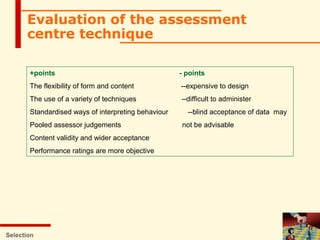
Evaluation of the assessment
centre technique
+points - points
The flexibility of form and content --expensive to design
The use of a variety of techniques --difficult to administer
Standardised ways of interpreting behaviour --blind acceptance of data may
Pooled assessor judgements not be advisable
Content validity and wider acceptance
Performance ratings are more objective
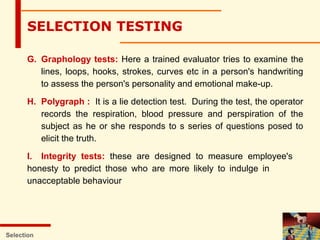
G. Graphology tests: Here a trained evaluator tries to examine the
lines, loops, hooks, strokes, curves etc in a person's handwriting
to assess the person's personality and emotional make-up.
H. Polygraph : It is a lie detection test. During the test, the operator
records the respiration, blood pressure and perspiration of the
subject as he or she responds to s series of questions posed to
elicit the truth.
I. Integrity tests: these are designed to measure employee's
honesty to predict those who are more likely to indulge in
unacceptable behaviour
Selection
SELECTION TESTING
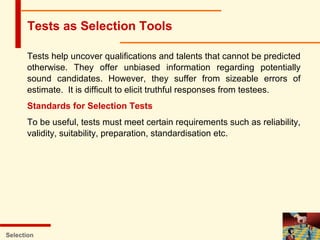
Tests help uncover qualifications and talents that cannot be predicted
otherwise. They offer unbiased information regarding potentially
sound candidates. However, they suffer from sizeable errors of
estimate. It is difficult to elicit truthful responses from testees.
Standards for Selection Tests
To be useful, tests must meet certain requirements such as reliability,
validity, suitability, preparation, standardisation etc.
Selection
Tests as Selection Tools
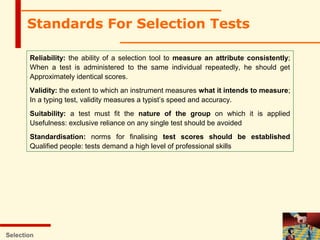
Standards For Selection Tests
Reliability: the ability of a selection tool to measure an attribute consistently;
When a test is administered to the same individual repeatedly, he should get
Approximately identical scores.
Validity: the extent to which an instrument measures what it intends to measure;
In a typing test, validity measures a typist’s speed and accuracy.
Suitability: a test must fit the nature of the group on which it is applied
Usefulness: exclusive reliance on any single test should be avoided
Standardisation: norms for finalising test scores should be established
Qualified people: tests demand a high level of professional skills
Selection
Selection testing is quite popular in India and several global giants
have been using the same to good advantage, such as Siemens
India, LG Electronics, and PepsiCo India etc.
Selection
Selection Testing in India
Selection Practices Of Global Giants
Selection
1. Siemens India: It uses extensive psychometric instruments to evaluate short-
listed candidates. The company uses occupational personality questionnaire to
understand the candidate’s personal attributes and occupational testing to
measure competencies.
2. LG Electronics India: LG Electronics uses 3 psychometric tests to measure a
person’s ability as a team player, to check personality types and to ascertain a
person’s responsiveness and assertiveness.
3. Arthur Anderson: While evaluating candidates, the company conducts critical
behavioural interviewing which evaluates the suitability of the candidate for the
position, largely based on his past experience and credentials.
4. Pepsico India: The company uses India as a global recruitment resource. To
select professionals for global careers with it, the company uses a competency-
based interviewing technique that looks at the candidate’s abilities in terms of
strategising, lateral thinking, problem solving, managing the environment.
These apart, Pepsi insists that to succeed in a global posting, these individuals
possess strong functional knowledge and come from a cosmopolitan background.
Interview is an important source of information about job applicants. Several
types of interviews are used , depending on the nature and importance of the
position to be filled within an organisation.
Selection
Selection Interview
Types Of Selection Interviews
The nondirective interview: the recruiter asks questions as they come to mind
The directive or structured interview: the recruiter uses a predetermined set of
Questions that are clearly job-related
The situational interview: the recruiter presents a hypothetical incident and asks
The candidate to respond
The behavioural interview: the focus here is on actual work related incidents and
The applicant is supposed to reveal what he or she did in a given situation
Stress interview: the recruiter attempts to find how applicants would respond to
Aggressive, embarrassing, rule and insulting (at times) questions
The panel interview: three or four interviewers pose questions to the applicant and
Examine the suitability of the candidate
Selection
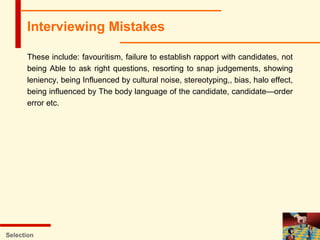
These include: favouritism, failure to establish rapport with candidates, not
being Able to ask right questions, resorting to snap judgements, showing
leniency, being Influenced by cultural noise, stereotyping,, bias, halo effect,
being influenced by The body language of the candidate, candidate—order
error etc.
Selection
Interviewing Mistakes
Selection
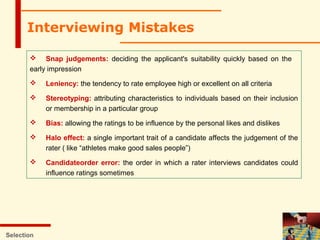
 Snap judgements: deciding the applicant's suitability quickly based on the
early impression
 Leniency: the tendency to rate employee high or excellent on all criteria
 Stereotyping: attributing characteristics to individuals based on their inclusion
or membership in a particular group
 Bias: allowing the ratings to be influence by the personal likes and dislikes
 Halo effect: a single important trait of a candidate affects the judgement of the
rater ( like “athletes make good sales people”)
 Candidateorder error: the order in which a rater interviews candidates could
influence ratings sometimes
Interviewing Mistakes
Interview Process
Selection
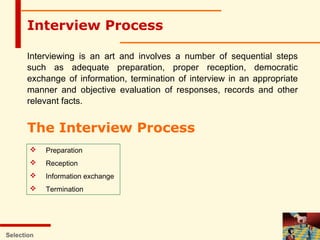
Interviewing is an art and involves a number of sequential steps
such as adequate preparation, proper reception, democratic
exchange of information, termination of interview in an appropriate
manner and objective evaluation of responses, records and other
relevant facts.
 Preparation
 Reception
 Information exchange
 Termination
The Interview Process
Selection
Medical Examination And
Reference Checking
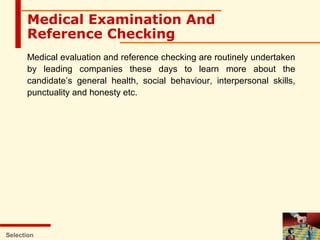
Medical evaluation and reference checking are routinely undertaken
by leading companies these days to learn more about the
candidate’s general health, social behaviour, interpersonal skills,
punctuality and honesty etc.

Selection Process in HR - Unitedworld School of Business

  • 1.
  • 2.
    ANNOTATED OUTLINE INTRODUCTION Selection isthe process of picking individuals who have relevant qualifications to fill jobs in an organization. Selection is much more than just choosing the best candidate. It is an attempt to strike a happy balance between what the applicant can and wants to do and what the organization requires. Selection
  • 3.
    ESSENTIALS OF SELECTION Selection Picking individuals possessing relevant qualifications  Matching job requirements with the profile of candidates  Using multiple tools and techniques to find the most suitable candidates capable  Of achieving success on the job
  • 4.
    Selection The Process The Processof Selection  Reception  Screening Interview  Application blank  Selection Tests  Selection Interview  Medical Examination  Reference Checks  Hiring Decision Selection is usually a series of hurdles or steps. Each one must be successfully cleared before the applicant proceeds to the next
  • 5.
    Selection  Reception A warm,friendly and courteous reception is extended to candidates with a view to create a favourable impression. Employment possibilities are also communicated honestly and clearly  Screening interview The HR department tries to screen out the obvious misfits through this courtesy interview. A prescribed application form is given to candidates who are found to be suitable.  Application blank It is a printed form completed by job aspirants detailing their educational background, previous work history and certain personal data. The Process of Selection
  • 6.
    Contents Of ApplicationBlank Selection  Personal data (address, sex, identification marks)  Marital data (single or married, children, dependents)  Physical data (height, weight, health condition)  Educational data (levels of formal education, marks, distinctions)  Employment data (past experience, promotions, nature of duties, reasons for leaving previous jobs, salary drawn, etc.)  Extra-curricular activities data (sports/games, NSS, NCC, prizes won, leisure-time activities)  References (names of two or more people who certify the suitability of an applicant to the advertised position)
  • 7.
    Selection Sample Application Blank Na m e : _ _ _ _ _ _ _ _ _ _ _ _ _ _ _ _ _ _ _ _ _ _ _ _ _ _ _ _ _ _ _ _ _ _ _ _ _ _ _ _ _ _ _ _ _ _ _ _ _ _ _ _ _ _ _ _ _ _ _ _ _ _ _ _ _ _ _ _ _ _ _ _ _ A d d r e s s : _ _ _ _ _ _ _ _ _ _ _ _ _ _ _ _ _ _ _ _ _ _ _ _ _ _ _ _ _ _ _ _ _ _ _ _ _ _ _ _ _ _ _ _ _ _ _ _ _ _ _ _ _ _ _ _ _ _ _ _ _ _ _ _ _ _ _ _ _ _ _ P h o n e N u m b e r ( R e s ) : _ _ _ _ _ _ _ _ _ _ _ _ _ _ _ _ _ _ _ _ _ _ _ E d u c a t i o n C o l l e g e / U n i v e r s i t y A t t e n d e d : _ _ _ _ _ _ _ _ _ _ _ _ H i g h e s t D e g r e e ( a ) B A / B S c / M A / M S c / M B A / M C o m ( b ) B E / B Te c h / M T e c h ( c ) A n y o t h e r H i g h S c h o o l A t t e n d e d : _ _ _ _ _ _ _ _ _ _ _ _ _ _ _ _ _ _ _ _ _ _ _ _ _ _ _ _ _ W o r k E x p e r i e n c e ( L i s t m o s t r e c e n t j o b s f i r s t ) N a m e o f t h e O r g a n i s a t i o n : G r o s s S a l a r y : _ _ _ _ _ _ _ _ _ _ _ _ _ _ ( a n n u a l ; b e s u r e t o i n c l u d e a n y b o n u s e s o r c o m m i s s i o n e a r n e d ) J o b T i t l e : _ _ _ _ _ _ _ _ _ _ _ _ _ _ _ _ _ _ _ _ _ _ _ _ _ _ _ _ _ _ _ _ _ _ _ _ _ _ _ _ _ _ _ _ _ _ _ _ _ _ _ _ _ _ _ _ N a m e o f L a s t S u p e r v i s o r : _ _ _ _ _ _ _ _ _ _ _ _ _ _ _ _ _ _ _ _ _ _ _ _ _ _ _ _ _ _ _ _ _ _ _ _ _ _ _ _ _ _ M a y w e c o n t a c t t h i s s u p e r v i s o r ? Y e s / N o R e a s o n ( s ) f o r L e a v i n g : _ _ _ _ _ _ _ _ _ _ _ _ _ _ _ _ _ _ _ _ _ _ _ _ _ _ _ _ _ _ _ _ _ _ _ _ _ _ _ _ _ _ _ _ _ _ _ _ _ _ _ _ _ _ _ _ _ _ _ _ N a m e o f O r g a n i s a t i o n : _ _ _ _ _ _ _ _ _ _ _ _ _ _ _ _ _ _ _ _ D a t e o f E m p l o y m e n t : _ _ _ _ _ _ _ f r o m t o _ _ _ _ G r o s s S a l a r y : _ _ _ _ _ _ _ _ _ _ _ ( a n n u a l ; b e s u r e t o i n c l u d e a n y b o n u s e s o r c o m m i s s i o n e a r n e d ) J o b T i t l e : _ _ _ _ _ _ _ _ _ _ _ _ _ _ _ _ _ _ _ _ _ _ _ _ _ _ _ _ _ _ _ _ _ _ _ _ _ _ _ _ _ _ _ _ _ _ _ _ _ _ _ _ _ _ _ _ N a m e o f L a s t S u p e r v i s o r : _ _ _ _ _ _ _ _ _ _ _ _ _ _ _ _ _ _ _ _ _ _ _ _ _ _ _ _ _ _ _ _ _ _ _ _ _ _ _ _ _ _ M a y w e c o n t a c t t h i s s u p e r v i s o r ? Y e s / N o R e a s o n ( s ) f o r L e a v i n g : _ _ _ _ _ _ _ _ _ _ _ _ _ _ _ _ _ _ _ _ _ _ _ _ _ _ _ _ _ _ _ _ _ _ _ _ _ _ _ _ _ _ _ _ _ _ _ _ _ _ _ _ _ _ _ _ _ _ _ _ N a m e o f O r g a n i s a t i o n : _ _ _ _ _ _ _ _ _ _ _ _ _ _ _ _ _ _ _ _ D a t e o f E m p l o y m e n t : _ _ _ _ _ _ _ f r o m t o _ _ _ _ G r o s s S a l a r y : _ _ _ _ _ _ _ _ _ _ _ ( a n n u a l ; b e s u r e t o i n c l u d e a n y b o n u s e s o r c o m m i s s i o n e a r n e d ) J o b T i t l e : _ _ _ _ _ _ _ _ _ _ _ _ _ _ _ _ _ _ _ _ _ _ _ _ _ _ _ _ _ _ _ _ _ _ _ _ _ _ _ _ _ _ _ _ _ _ _ _ _ _ _ _ _ _ _ _ N a m e o f L a s t S u p e r v i s o r : _ _ _ _ _ _ _ _ _ _ _ _ _ _ _ _ _ _ _ _ _ _ _ _ _ _ _ _ _ _ _ _ _ _ _ _ _ _ _ _ _ _ M a y w e c o n t a c t t h i s s u p e r v i s o r ? Y e s / N o R e a s o n ( s ) f o r L e a v i n g : _ _ _ _ _ _ _ _ _ _ _ _ _ _ _ _ _ _ _ _ _ _ _ _ _ _ _ _ _ _ _ _ _ _ _ _ _ _ _ _ _ _ _ _ _ _ _ _ _ _ _ _ _ _ _ _ _ _ _ _ W o r k s k i l l s 1 . L i s t a n y j o b - r e l a t e d l a n g u a g e s y o u a r e a b l e t o s p e a k o r w r i t e : _ _ _ _ _ _ _ _ _ _ _ _ _ _ _ _ _ _ _ _ _ _ _ _ _ 2 . L i s t a n y j o b - r e l a t e d c l e r i c a l ( e . g . , t y p i n g ) o r t e c h n i c a l s k i l l s ( e . g . , c o m p u t e r p r o g r a m m i n g ) t h a t y o u h a v e : A . _ _ _ _ _ _ _ _ _ _ _ _ _ _ _ _ _ _ _ _ _ _ _ _ _ _ _ _ _ _ _ _ _ _ _ B . _ _ _ _ _ _ _ _ _ _ _ _ _ _ _ _ _ _ _ _ _ _ _ _ _ _ _ _ _ _ _ _ _ _ _ C . _ _ _ _ _ _ _ _ _ _ _ _ _ _ _ _ _ _ _ _ _ _ _ _ _ _ _ _ _ _ _ _ _ _ _ A d d i t i o n a l I n f o r m a t i o n I n c a s e o f a n e m e r g e n c y , p l e a s e c o n t a c t . N a m e : _ _ _ _ _ _ _ _ _ _ _ _ _ _ _ _ _ _ _ _ _ _ _ _ _ _ _ _ _ _ _ _ _ _ _ _ _ _ _ _ _ _ A d d r e s s : _ _ _ _ _ _ _ _ _ _ _ _ _ _ _ _ _ _ _ _ _ _ _ _ _ _ _ _ _ _ _ _ _ _ _ _ _ _ _ T e l e p h o n e : _ _ _ _ _ _ _ _ _ _ _ _ _ _ _ _ _ _ _ _ _ _ _ _ _ _ _ _ _ _ _ _ _ _ _ _ _ _ I u n d e r s t a n d t h a t f a l s i f i c a t i o n o f i n f o r m a t i o n i s g r o u n d s f o r d i s m i s s a l . I u n d e r s t a n d t h a t m y e m p l o y m e n t a t t h e c o m p a n y m a y b e d i s c o n t i n u e d a t a n y t i m e f o r a n y r e a s o n e i t h e r b y m y s e l f o r b y t h e c o m p a n y . I a g r e e t o s u b m i t t o a d r u g a n d / o r a l c o h o l t e s t a s a c o n d i t i o n o f e m p l o y m e n t . S i g n a t u r e D a t e
  • 8.
    Selection  Weighted applicationblank The items that have a strong relationship to job performance are given numeric values or weights so that a company can cross- compare candidates with more or less similar qualifications on paper The Process of Selection Weighted Application Blank  It is a printed form completed by candidate wherein each item is weighted and scored based on its importance as a determinant of job success  It helps a company to cross-compare candidates having more or less similar qualifications and reject those not meeting the job criteria strictly  On the negative side, it is difficult to develop an appropriate WAB, the exercise could be quite costly, and it needs frequent updating so as to be in line with changing job requirements.
  • 9.
    SELECTION TESTING A testis a standardized, objective measure of a sample of behaviour. Selection tests are increasingly used by companies these days because they measure individual differences in a scientific way, leaving very little room for Individual bias. Selection
  • 10.
    Selection Selection Tests Intelligence test Aptitudetest Personality test Projective test Interest test (Strong-Campbell inventory) Preference test (JDS: Hackman & Oldham) Achievement test (E.g. a Shorthand test) Simulation test Assessment centre The in basket The leaderless group discussion Business games Individual presentations Graphology test Polygraph test Integrity test
  • 11.
    A. Intelligence tests:They measure a candidate’s learning ability and also the ability to understand instructions and make judgements. They do not measure any single trait but several mental abilities (memory, vocabulary, fluency, numerical ability, perception etc) B. Aptitude tests: They measure a candidate’s potential to learn clerical, mechanical and mathematical skills. Since they do not measure a candidate’s on the job motivation, they are generally administered in combination with other tests. C. Personality tests: They measure basic aspects of a candidate’s personality such as motivation, emotional balance, self confidence, interpersonal behaviour, introversion etc.  Projective tests: These tests expect the candidates to interpret problems or situations based on their own motives, attitudes, values etc (interpreting a picture, reacting to a situation etc) Selection SELECTION TESTING
  • 12.
     Interest tests:These are meant to find how a person in tests compares with the interests of successful people in a specific job. These tests show the areas of work in which a person is most interested.  Preference tests: These tests try to compare employee preferences with the job and organisational requirements. Selection SELECTION TESTING D. Achievement tests: These are designed to measure what the applicant can do on the job currently, ir., whether the testee actually knows what he or she claims to know. E. Simulation tests: Simulation exercise is a test which duplicates many of the activities and problems an employee faces while at work. F. Assessment centre: It is a standardised form of employee appraisal that uses multiple assessment exercises such as in basket, games, role play etc and multiple raters.
  • 13.
     The in-basket:From out of reports, memos, letters etc placed in the in-basket, a candidate is supposed to initiate relevant actions within a limited period of time.  The leaderless group discussion: This exercise involves groups of managerial candidates working together on a job related problem so as to measure skills such as oral communication, tolerance, self- confidence, adaptability, etc.  Business games: Here participants try to solve a problem, usually as members of two or more simulated companies that are competing in the market place  Individual presentations: In this case the participants are given a limited amount of time to plan, organise and prepare a presentation on a given topic. Selection SELECTION TESTING
  • 14.
    Selection Evaluation of theassessment centre technique +points - points The flexibility of form and content --expensive to design The use of a variety of techniques --difficult to administer Standardised ways of interpreting behaviour --blind acceptance of data may Pooled assessor judgements not be advisable Content validity and wider acceptance Performance ratings are more objective
  • 15.
    G. Graphology tests:Here a trained evaluator tries to examine the lines, loops, hooks, strokes, curves etc in a person's handwriting to assess the person's personality and emotional make-up. H. Polygraph : It is a lie detection test. During the test, the operator records the respiration, blood pressure and perspiration of the subject as he or she responds to s series of questions posed to elicit the truth. I. Integrity tests: these are designed to measure employee's honesty to predict those who are more likely to indulge in unacceptable behaviour Selection SELECTION TESTING
  • 16.
    Tests help uncoverqualifications and talents that cannot be predicted otherwise. They offer unbiased information regarding potentially sound candidates. However, they suffer from sizeable errors of estimate. It is difficult to elicit truthful responses from testees. Standards for Selection Tests To be useful, tests must meet certain requirements such as reliability, validity, suitability, preparation, standardisation etc. Selection Tests as Selection Tools
  • 17.
    Standards For SelectionTests Reliability: the ability of a selection tool to measure an attribute consistently; When a test is administered to the same individual repeatedly, he should get Approximately identical scores. Validity: the extent to which an instrument measures what it intends to measure; In a typing test, validity measures a typist’s speed and accuracy. Suitability: a test must fit the nature of the group on which it is applied Usefulness: exclusive reliance on any single test should be avoided Standardisation: norms for finalising test scores should be established Qualified people: tests demand a high level of professional skills Selection
  • 18.
    Selection testing isquite popular in India and several global giants have been using the same to good advantage, such as Siemens India, LG Electronics, and PepsiCo India etc. Selection Selection Testing in India
  • 19.
    Selection Practices OfGlobal Giants Selection 1. Siemens India: It uses extensive psychometric instruments to evaluate short- listed candidates. The company uses occupational personality questionnaire to understand the candidate’s personal attributes and occupational testing to measure competencies. 2. LG Electronics India: LG Electronics uses 3 psychometric tests to measure a person’s ability as a team player, to check personality types and to ascertain a person’s responsiveness and assertiveness. 3. Arthur Anderson: While evaluating candidates, the company conducts critical behavioural interviewing which evaluates the suitability of the candidate for the position, largely based on his past experience and credentials. 4. Pepsico India: The company uses India as a global recruitment resource. To select professionals for global careers with it, the company uses a competency- based interviewing technique that looks at the candidate’s abilities in terms of strategising, lateral thinking, problem solving, managing the environment. These apart, Pepsi insists that to succeed in a global posting, these individuals possess strong functional knowledge and come from a cosmopolitan background.
  • 20.
    Interview is animportant source of information about job applicants. Several types of interviews are used , depending on the nature and importance of the position to be filled within an organisation. Selection Selection Interview
  • 21.
    Types Of SelectionInterviews The nondirective interview: the recruiter asks questions as they come to mind The directive or structured interview: the recruiter uses a predetermined set of Questions that are clearly job-related The situational interview: the recruiter presents a hypothetical incident and asks The candidate to respond The behavioural interview: the focus here is on actual work related incidents and The applicant is supposed to reveal what he or she did in a given situation Stress interview: the recruiter attempts to find how applicants would respond to Aggressive, embarrassing, rule and insulting (at times) questions The panel interview: three or four interviewers pose questions to the applicant and Examine the suitability of the candidate Selection
  • 22.
    These include: favouritism,failure to establish rapport with candidates, not being Able to ask right questions, resorting to snap judgements, showing leniency, being Influenced by cultural noise, stereotyping,, bias, halo effect, being influenced by The body language of the candidate, candidate—order error etc. Selection Interviewing Mistakes
  • 23.
    Selection  Snap judgements:deciding the applicant's suitability quickly based on the early impression  Leniency: the tendency to rate employee high or excellent on all criteria  Stereotyping: attributing characteristics to individuals based on their inclusion or membership in a particular group  Bias: allowing the ratings to be influence by the personal likes and dislikes  Halo effect: a single important trait of a candidate affects the judgement of the rater ( like “athletes make good sales people”)  Candidateorder error: the order in which a rater interviews candidates could influence ratings sometimes Interviewing Mistakes
  • 24.
    Interview Process Selection Interviewing isan art and involves a number of sequential steps such as adequate preparation, proper reception, democratic exchange of information, termination of interview in an appropriate manner and objective evaluation of responses, records and other relevant facts.  Preparation  Reception  Information exchange  Termination The Interview Process
  • 25.
    Selection Medical Examination And ReferenceChecking Medical evaluation and reference checking are routinely undertaken by leading companies these days to learn more about the candidate’s general health, social behaviour, interpersonal skills, punctuality and honesty etc.