STRUCTURE OF CELL – ITS COMPONENTS AND THEIR
FUNCTIONS
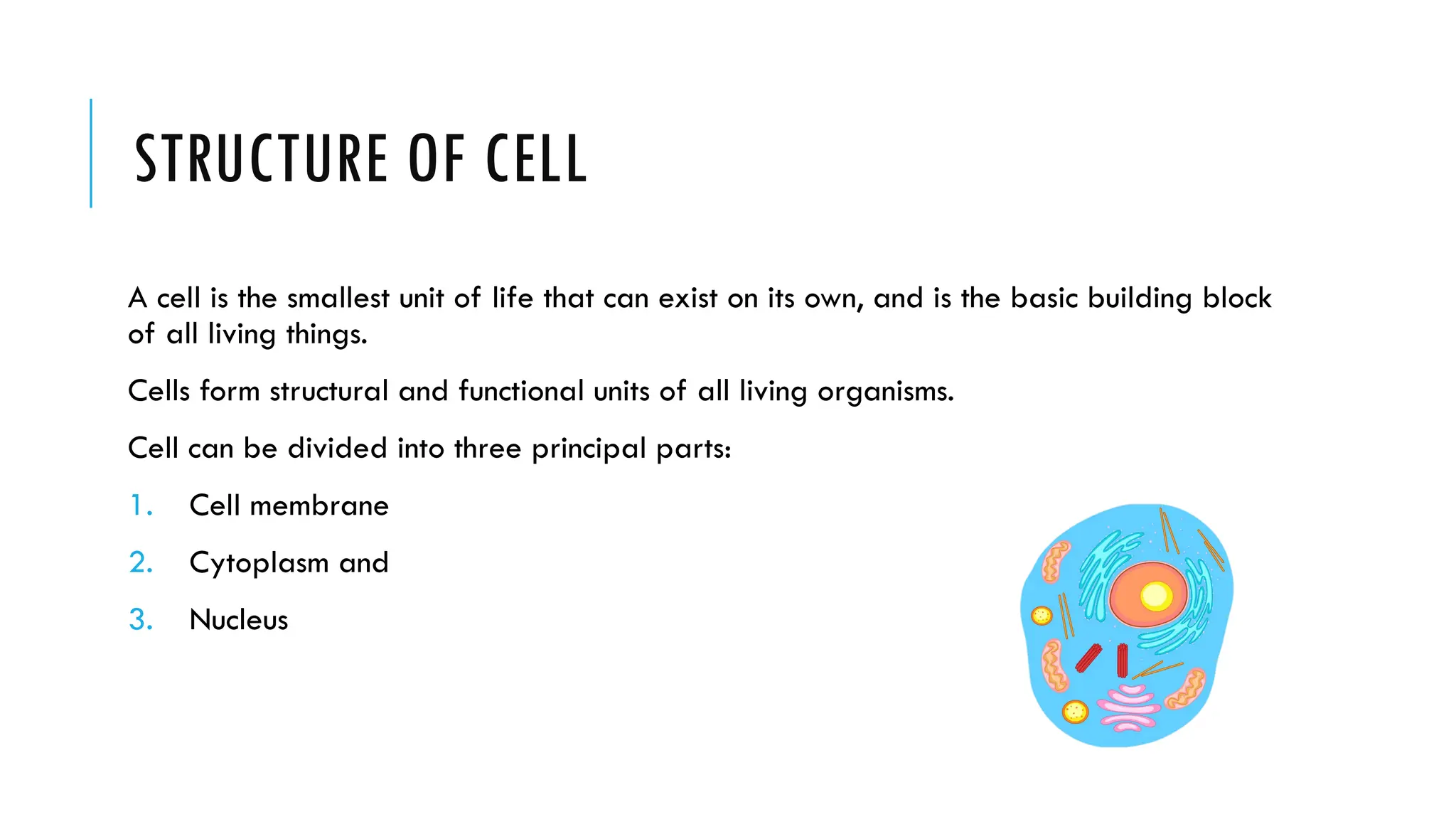
STRUCTURE OF CELL
A cell is the smallest unit of life that can exist on its own, and is the basic building block
of all living things.
Cells form structural and functional units of all living organisms.
Cell can be divided into three principal parts:
1. Cell membrane
2. Cytoplasm and
3. Nucleus
CELL COMPONENTS AND THEIR FUNCTIONS
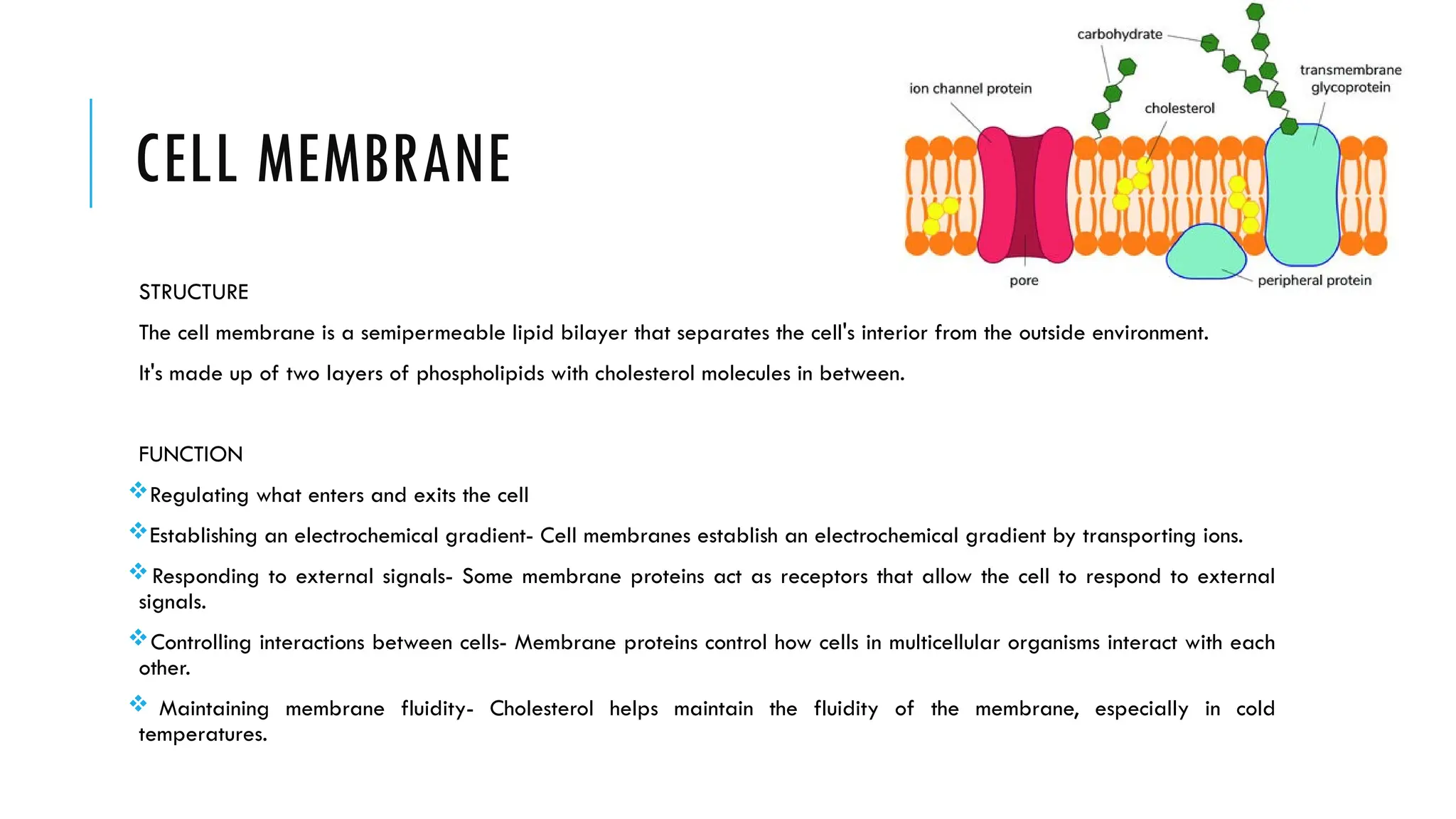
CELL MEMBRANE
STRUCTURE
The cell membrane is a semipermeable lipid bilayer that separates the cell's interior from the outside environment.
It's made up of two layers of phospholipids with cholesterol molecules in between.
FUNCTION
Regulating what enters and exits the cell
Establishing an electrochemical gradient- Cell membranes establish an electrochemical gradient by transporting ions.
Responding to external signals- Some membrane proteins act as receptors that allow the cell to respond to external
signals.
Controlling interactions between cells- Membrane proteins control how cells in multicellular organisms interact with each
other.
 Maintaining membrane fluidity- Cholesterol helps maintain the fluidity of the membrane, especially in cold
temperatures.
NUCLEAR MEMBRANE
STRUCTURE
The nuclear membrane is made up of two lipid bilayer membranes, an inner nuclear membrane (INM) and an outer nuclear
membrane (ONM). The space between the membranes is called the perinuclear space.
FUNCTION
Separating the nucleus from the cytoplasm
Acts as a barrier
Protecting DNA
Controls the flow of materials into and out of the nucleus through nuclear pores
Regulating gene transcription through the movement of transcription factors
Providing structural support
The nuclear membrane has a structure called the nuclear lamina, which is made of intermediate filament proteins called lamins.
The nuclear lamina provides structural support to the nucleus.
NUCLEAR PORE
STRUCTURE
Nuclear pore complex (NPC) is a cylindrical structure comprised of eight spokes
surrounding a central tube that connects the nucleoplasm and cytoplasm.
FUNCTION
Nucleocytoplasmic transport: The NPC allows proteins and RNA to pass through the
nuclear envelope.
Gene expression: Nucleoporins are involved in regulating gene expression and
signalling events.
Nuclear Pore Gene expression
NUCLEUS
STRUCTURE
Spherical with double membrane contain nucleolus, chromosome and nuclear
membrane
FUNCTION
Control and regulate all activities on cell
Contain hereditary factor (gene)
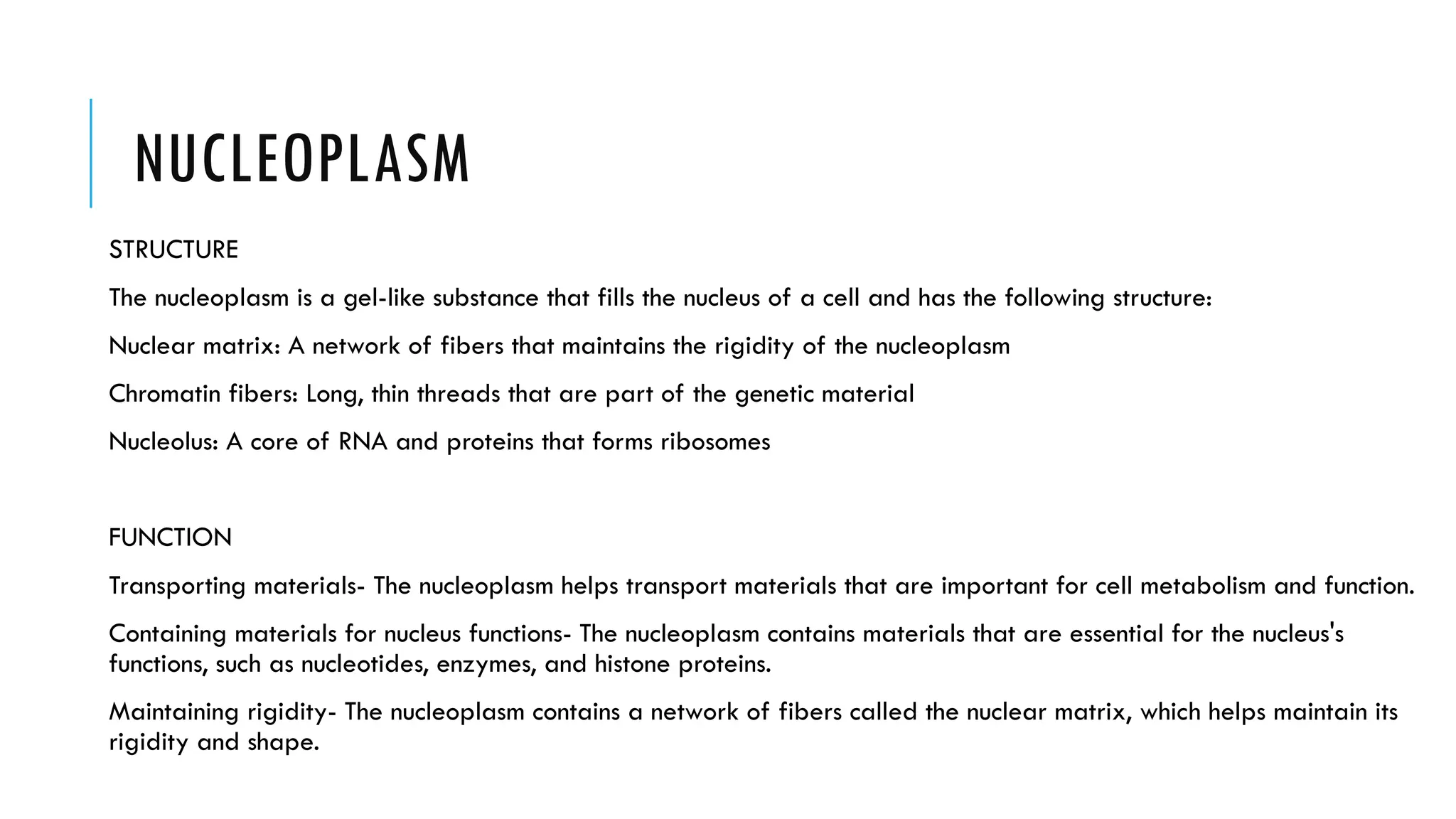
NUCLEOPLASM
STRUCTURE
The nucleoplasm is a gel-like substance that fills the nucleus of a cell and has the following structure:
Nuclear matrix: A network of fibers that maintains the rigidity of the nucleoplasm
Chromatin fibers: Long, thin threads that are part of the genetic material
Nucleolus: A core of RNA and proteins that forms ribosomes
FUNCTION
Transporting materials- The nucleoplasm helps transport materials that are important for cell metabolism and function.
Containing materials for nucleus functions- The nucleoplasm contains materials that are essential for the nucleus's
functions, such as nucleotides, enzymes, and histone proteins.
Maintaining rigidity- The nucleoplasm contains a network of fibers called the nuclear matrix, which helps maintain its
rigidity and shape.
NUCLEOLUS
STRUCTURE
The nucleolus is a spherical structure in the nucleus of eukaryotic cells that is made up of proteins, DNA, and
RNA.
It has three main parts, each of which is thought to represent a different stage of ribosome assembly and
RNA processing:
Fibrillar center: Contains the rRNA genes
Dense fibrillar component: Where transcription occurs
Granular component: Where ribosomal subunits are assembled
FUNCTION
Ribosome production: The nucleolus is the primary site of ribosome production and assembly, which is
necessary for protein synthesis.
Transcription: The nucleolus is where ribosomal RNA genes are transcribed.
ENDOPLASMIC RETICULUM
The endoplasmic reticulum (ER) is a cell organelle that is a network of tubules and sacs that extends
throughout the cytoplasm of a cell. It's the largest organelle in most eukaryotic cells
STRUCTURE
System of membrane enclosed tubules closely packed together and continuous with nuclear membrane
Rough ER has ribosome while smooth ER did not have
FUNCTION
Transport system for protein and lipid within the cell
Rough ER transport protein synthesis by ribosome to other part of the cell
Smooth ER stimulate the synthesis of lipid and cholesterol and transport within cell
RIBOSOME
STRUCTURE
Small particle consist of RNA
Exist freely in cytoplasm or on the surface of rough ER
FUNCTION
Synthesis of protein
STRUCTURE
Consist of two cylindrical body structure arranged at right angles to one another.
FUNCTION
Cell structure: Centrosomes provide structure for the cell.
Cell motility: Centrosomes regulate cell motility and adhesion.
Immune response: Centrosomes play a role in the immune response by affecting the
production of cytokines secreted by CD4+ T cells.
CENTROSOMES
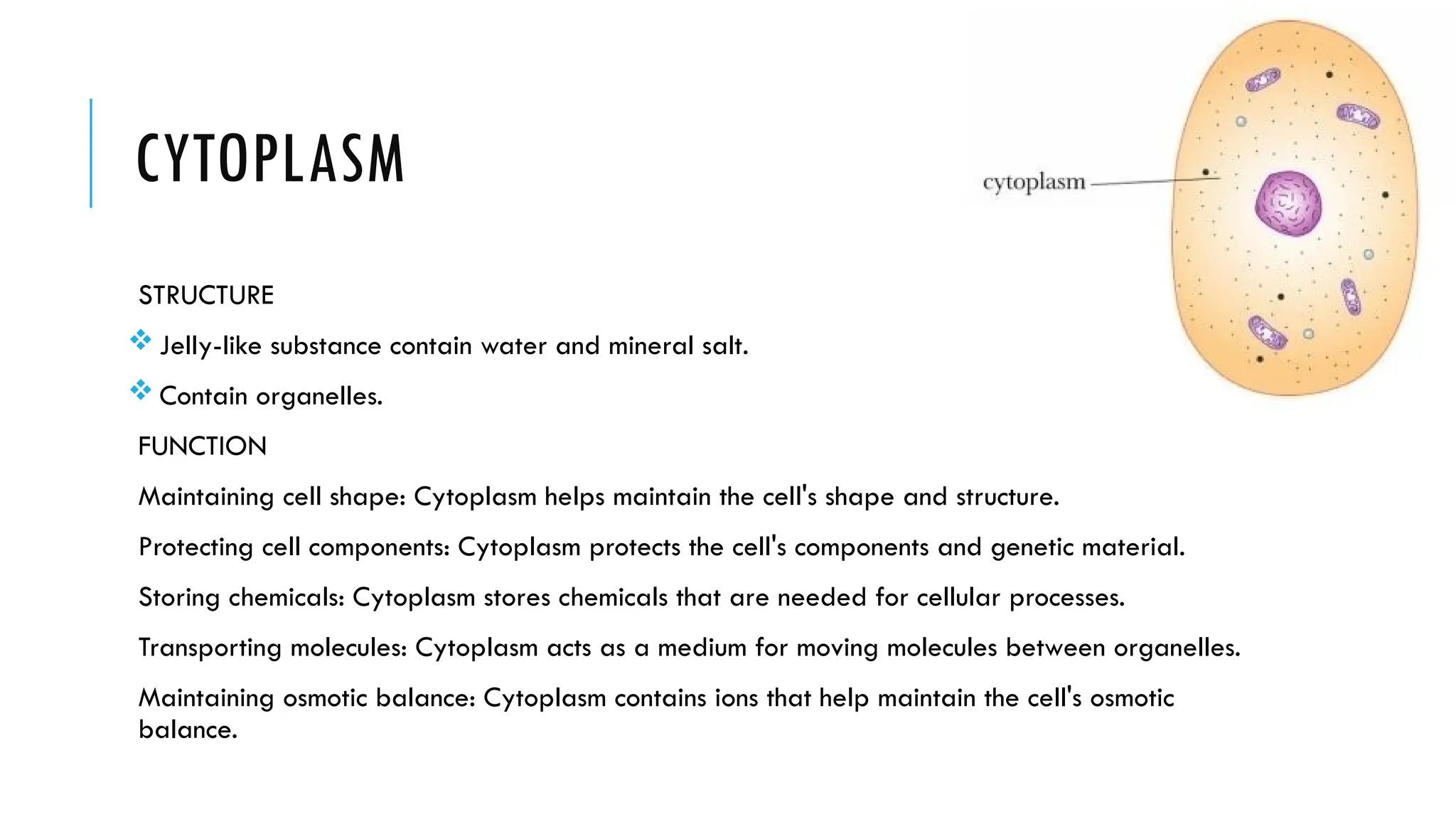
CYTOPLASM
STRUCTURE
 Jelly-like substance contain water and mineral salt.
 Contain organelles.
FUNCTION
Maintaining cell shape: Cytoplasm helps maintain the cell's shape and structure.
Protecting cell components: Cytoplasm protects the cell's components and genetic material.
Storing chemicals: Cytoplasm stores chemicals that are needed for cellular processes.
Transporting molecules: Cytoplasm acts as a medium for moving molecules between organelles.
Maintaining osmotic balance: Cytoplasm contains ions that help maintain the cell's osmotic
balance.
GOLGI APPARATUS
STRUCTURE
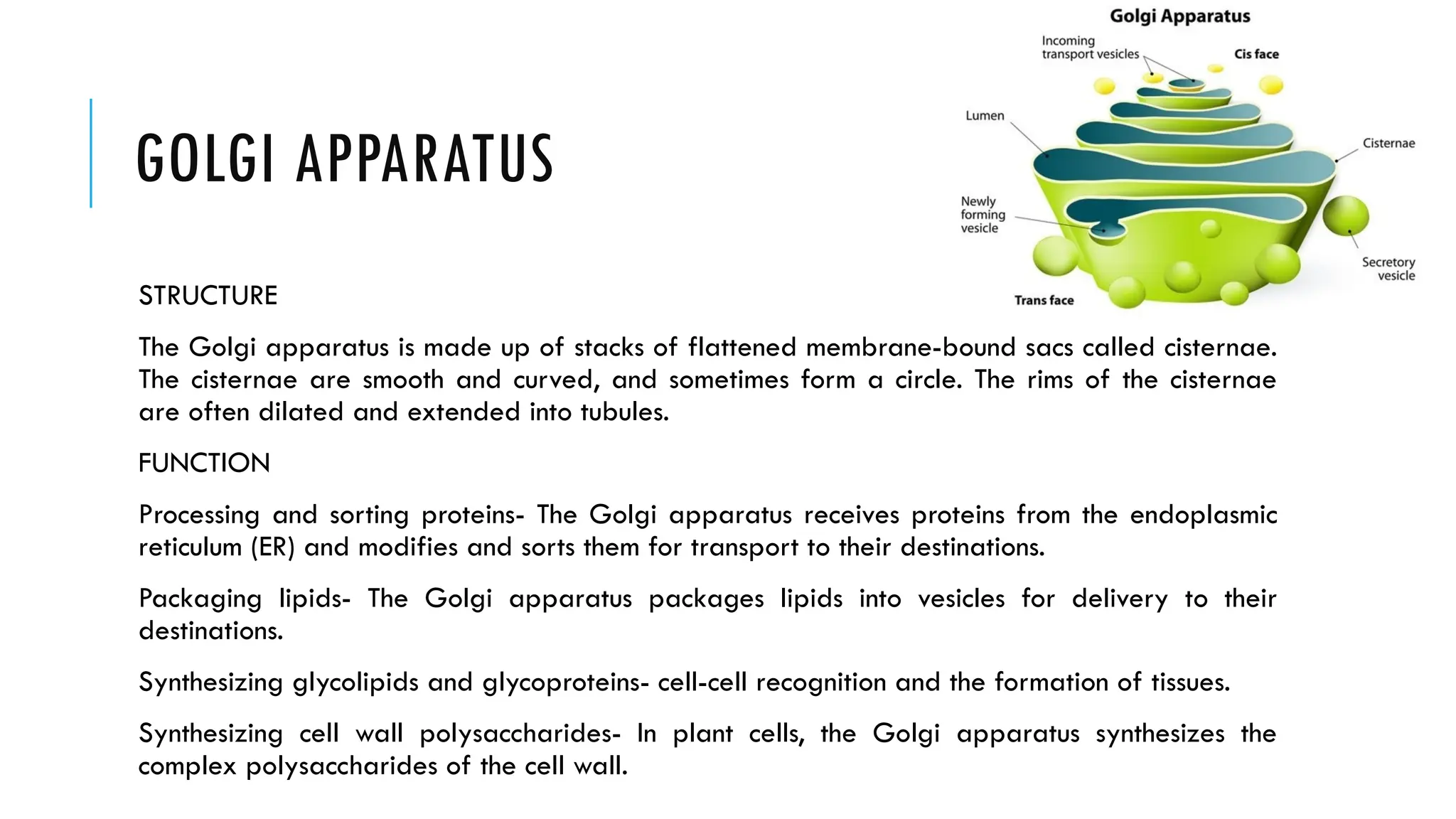
The Golgi apparatus is made up of stacks of flattened membrane-bound sacs called cisternae.
The cisternae are smooth and curved, and sometimes form a circle. The rims of the cisternae
are often dilated and extended into tubules.
FUNCTION
Processing and sorting proteins- The Golgi apparatus receives proteins from the endoplasmic
reticulum (ER) and modifies and sorts them for transport to their destinations.
Packaging lipids- The Golgi apparatus packages lipids into vesicles for delivery to their
destinations.
Synthesizing glycolipids and glycoproteins- cell-cell recognition and the formation of tissues.
Synthesizing cell wall polysaccharides- In plant cells, the Golgi apparatus synthesizes the
complex polysaccharides of the cell wall.
LYSOSOMES
STRUCTURE
Membrane bound vesicle found in animal
FUNCTION
Digestion
Lysosomes are the cell's digestive system, breaking down materials taken in from outside the cell and digesting obsolete cell
components.
Waste disposal
Lysosomes act as the cell's waste disposal system, digesting used materials in the cytoplasm.
Cell death
When a cell is damaged beyond repair, lysosomes can help it self-destruct through a process called programmed cell death, or
apoptosis.
Immune system
Lysosomes play a role in the immune system, including phagocytosis, antigen processing, and inflammation.
MICROVILLI
STRUCTURE
Microvilli are made up of a core of actin filaments (Protein fibres) that extend into the cell
cytoplasm.
FUNCTION
Increasing surface area: Microvilli increase the surface area of cells, which helps them absorb
more nutrients.
Absorption: Microvilli help absorb nutrients from food in the small intestine.
Secretion: Microvilli are involved in secretion.
Cellular adhesion: Microvilli are involved in cellular adhesion.
MITOCHONDRIA
STRUCTURE
Rod-shape with a double membrane
Outer membrane is smooth and regular while inner membrane is folded to form
cristae
FUNCTION
Known as the ‘power-house’ of the cell
Releases energy as it the site for aerobic respiration
19
THANKYOU

Ch-2_Cell and its components- Pharm D_Pharmacy

  • 1.
    STRUCTURE OF CELL– ITS COMPONENTS AND THEIR FUNCTIONS
  • 2.
    STRUCTURE OF CELL Acell is the smallest unit of life that can exist on its own, and is the basic building block of all living things. Cells form structural and functional units of all living organisms. Cell can be divided into three principal parts: 1. Cell membrane 2. Cytoplasm and 3. Nucleus
  • 3.
    CELL COMPONENTS ANDTHEIR FUNCTIONS
  • 4.
    CELL MEMBRANE STRUCTURE The cellmembrane is a semipermeable lipid bilayer that separates the cell's interior from the outside environment. It's made up of two layers of phospholipids with cholesterol molecules in between. FUNCTION Regulating what enters and exits the cell Establishing an electrochemical gradient- Cell membranes establish an electrochemical gradient by transporting ions. Responding to external signals- Some membrane proteins act as receptors that allow the cell to respond to external signals. Controlling interactions between cells- Membrane proteins control how cells in multicellular organisms interact with each other.  Maintaining membrane fluidity- Cholesterol helps maintain the fluidity of the membrane, especially in cold temperatures.
  • 5.
    NUCLEAR MEMBRANE STRUCTURE The nuclearmembrane is made up of two lipid bilayer membranes, an inner nuclear membrane (INM) and an outer nuclear membrane (ONM). The space between the membranes is called the perinuclear space. FUNCTION Separating the nucleus from the cytoplasm Acts as a barrier Protecting DNA Controls the flow of materials into and out of the nucleus through nuclear pores Regulating gene transcription through the movement of transcription factors Providing structural support The nuclear membrane has a structure called the nuclear lamina, which is made of intermediate filament proteins called lamins. The nuclear lamina provides structural support to the nucleus.
  • 6.
    NUCLEAR PORE STRUCTURE Nuclear porecomplex (NPC) is a cylindrical structure comprised of eight spokes surrounding a central tube that connects the nucleoplasm and cytoplasm. FUNCTION Nucleocytoplasmic transport: The NPC allows proteins and RNA to pass through the nuclear envelope. Gene expression: Nucleoporins are involved in regulating gene expression and signalling events.
  • 7.
  • 8.
    NUCLEUS STRUCTURE Spherical with doublemembrane contain nucleolus, chromosome and nuclear membrane FUNCTION Control and regulate all activities on cell Contain hereditary factor (gene)
  • 9.
    NUCLEOPLASM STRUCTURE The nucleoplasm isa gel-like substance that fills the nucleus of a cell and has the following structure: Nuclear matrix: A network of fibers that maintains the rigidity of the nucleoplasm Chromatin fibers: Long, thin threads that are part of the genetic material Nucleolus: A core of RNA and proteins that forms ribosomes FUNCTION Transporting materials- The nucleoplasm helps transport materials that are important for cell metabolism and function. Containing materials for nucleus functions- The nucleoplasm contains materials that are essential for the nucleus's functions, such as nucleotides, enzymes, and histone proteins. Maintaining rigidity- The nucleoplasm contains a network of fibers called the nuclear matrix, which helps maintain its rigidity and shape.
  • 10.
    NUCLEOLUS STRUCTURE The nucleolus isa spherical structure in the nucleus of eukaryotic cells that is made up of proteins, DNA, and RNA. It has three main parts, each of which is thought to represent a different stage of ribosome assembly and RNA processing: Fibrillar center: Contains the rRNA genes Dense fibrillar component: Where transcription occurs Granular component: Where ribosomal subunits are assembled FUNCTION Ribosome production: The nucleolus is the primary site of ribosome production and assembly, which is necessary for protein synthesis. Transcription: The nucleolus is where ribosomal RNA genes are transcribed.
  • 11.
    ENDOPLASMIC RETICULUM The endoplasmicreticulum (ER) is a cell organelle that is a network of tubules and sacs that extends throughout the cytoplasm of a cell. It's the largest organelle in most eukaryotic cells STRUCTURE System of membrane enclosed tubules closely packed together and continuous with nuclear membrane Rough ER has ribosome while smooth ER did not have FUNCTION Transport system for protein and lipid within the cell Rough ER transport protein synthesis by ribosome to other part of the cell Smooth ER stimulate the synthesis of lipid and cholesterol and transport within cell
  • 12.
    RIBOSOME STRUCTURE Small particle consistof RNA Exist freely in cytoplasm or on the surface of rough ER FUNCTION Synthesis of protein
  • 13.
    STRUCTURE Consist of twocylindrical body structure arranged at right angles to one another. FUNCTION Cell structure: Centrosomes provide structure for the cell. Cell motility: Centrosomes regulate cell motility and adhesion. Immune response: Centrosomes play a role in the immune response by affecting the production of cytokines secreted by CD4+ T cells. CENTROSOMES
  • 14.
    CYTOPLASM STRUCTURE  Jelly-like substancecontain water and mineral salt.  Contain organelles. FUNCTION Maintaining cell shape: Cytoplasm helps maintain the cell's shape and structure. Protecting cell components: Cytoplasm protects the cell's components and genetic material. Storing chemicals: Cytoplasm stores chemicals that are needed for cellular processes. Transporting molecules: Cytoplasm acts as a medium for moving molecules between organelles. Maintaining osmotic balance: Cytoplasm contains ions that help maintain the cell's osmotic balance.
  • 15.
    GOLGI APPARATUS STRUCTURE The Golgiapparatus is made up of stacks of flattened membrane-bound sacs called cisternae. The cisternae are smooth and curved, and sometimes form a circle. The rims of the cisternae are often dilated and extended into tubules. FUNCTION Processing and sorting proteins- The Golgi apparatus receives proteins from the endoplasmic reticulum (ER) and modifies and sorts them for transport to their destinations. Packaging lipids- The Golgi apparatus packages lipids into vesicles for delivery to their destinations. Synthesizing glycolipids and glycoproteins- cell-cell recognition and the formation of tissues. Synthesizing cell wall polysaccharides- In plant cells, the Golgi apparatus synthesizes the complex polysaccharides of the cell wall.
  • 16.
    LYSOSOMES STRUCTURE Membrane bound vesiclefound in animal FUNCTION Digestion Lysosomes are the cell's digestive system, breaking down materials taken in from outside the cell and digesting obsolete cell components. Waste disposal Lysosomes act as the cell's waste disposal system, digesting used materials in the cytoplasm. Cell death When a cell is damaged beyond repair, lysosomes can help it self-destruct through a process called programmed cell death, or apoptosis. Immune system Lysosomes play a role in the immune system, including phagocytosis, antigen processing, and inflammation.
  • 17.
    MICROVILLI STRUCTURE Microvilli are madeup of a core of actin filaments (Protein fibres) that extend into the cell cytoplasm. FUNCTION Increasing surface area: Microvilli increase the surface area of cells, which helps them absorb more nutrients. Absorption: Microvilli help absorb nutrients from food in the small intestine. Secretion: Microvilli are involved in secretion. Cellular adhesion: Microvilli are involved in cellular adhesion.
  • 18.
    MITOCHONDRIA STRUCTURE Rod-shape with adouble membrane Outer membrane is smooth and regular while inner membrane is folded to form cristae FUNCTION Known as the ‘power-house’ of the cell Releases energy as it the site for aerobic respiration
  • 19.