Charge Transfer
Spectra
Upma Shrivastava
Asstt. Prof.
Govt. V.Y.T.PG.Auto.College
Durg
Chhattisgarh
1
Charge Transfer Spectra
An electronic transition between orbitals that are centred on different
atoms is called charge transfer transition and absorption band is usually
very strong. These transitions involve electron transfer from one part of
a complex to another. More specifically an electron moves from an
orbital that is mainly ligand in character to one that is mainly metal in
character (ligand-to-metal charge transfer, LMCT) or vice versa (metal-
to-Ligand charge transfer, MLCT). Unlike d-d transitions, these are fully
allowed and hence give rise to much more intense absorptions. When
these absorptions fall within the visible region, they often produce rich
colours. In these transitions, the electronic transitions are Laporte and
spin allowed, i. e. Δl = ±1 and ΔS=0
2
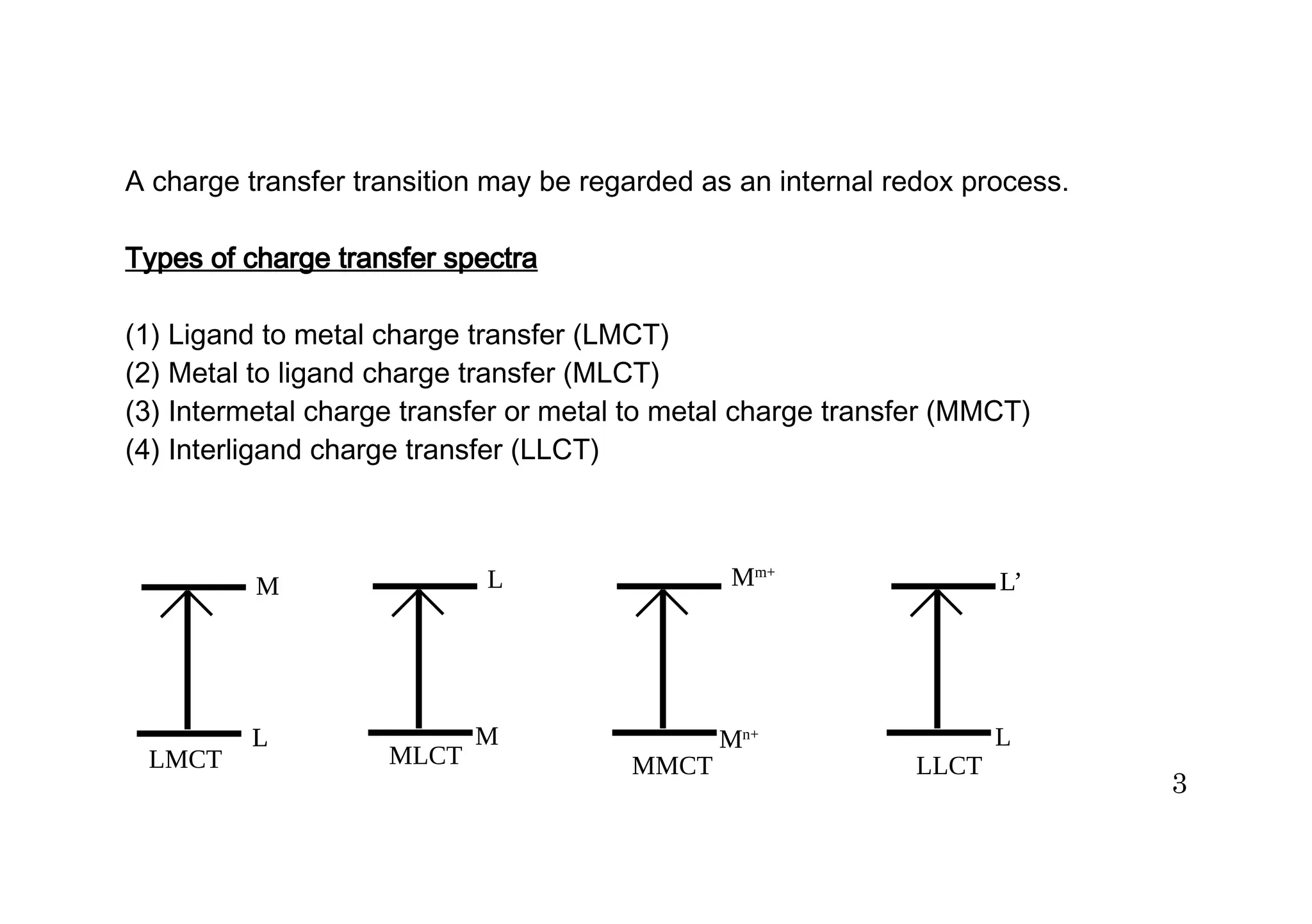
A charge transfer transition may be regarded as an internal redox process.
Types of charge transfer spectra
(1) Ligand to metal charge transfer (LMCT)
(2) Metal to ligand charge transfer (MLCT)
(3) Intermetal charge transfer or metal to metal charge transfer (MMCT)
(4) Interligand charge transfer (LLCT)
3
L
L
M L
M Mn+
Mm+
L
L’
LMCT MLCT MMCT LLCT
Ligand to metal charge transfer (LMCT)
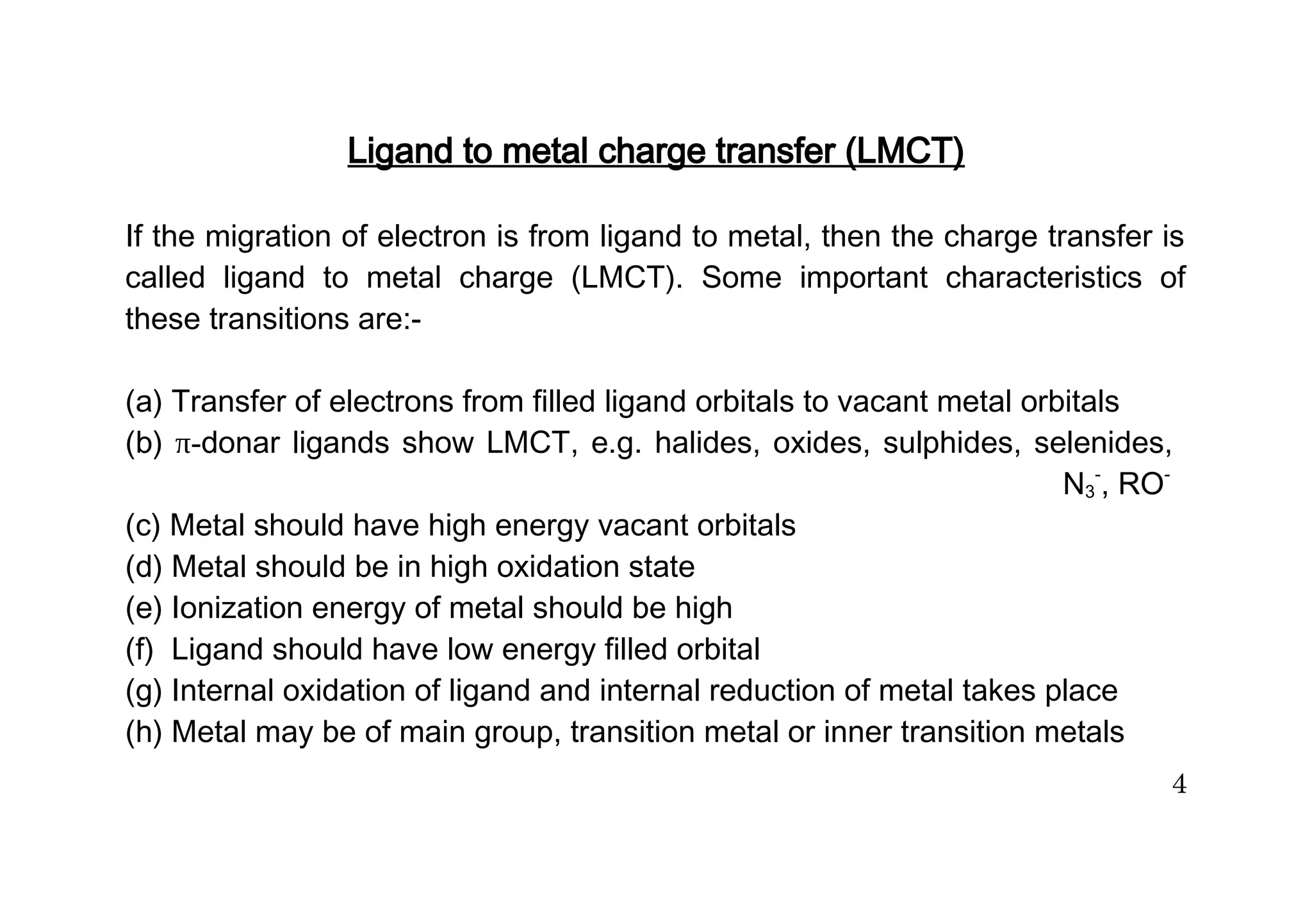
If the migration of electron is from ligand to metal, then the charge transfer is
called ligand to metal charge (LMCT). Some important characteristics of
these transitions are:-
(a) Transfer of electrons from filled ligand orbitals to vacant metal orbitals
(b) π-donar ligands show LMCT, e.g. halides, oxides, sulphides, selenides,
N3
-
, RO-
(c) Metal should have high energy vacant orbitals
(d) Metal should be in high oxidation state
(e) Ionization energy of metal should be high
(f) Ligand should have low energy filled orbital
(g) Internal oxidation of ligand and internal reduction of metal takes place
(h) Metal may be of main group, transition metal or inner transition metals
4
Molecular Orbital Diagram of MnO4
-
5
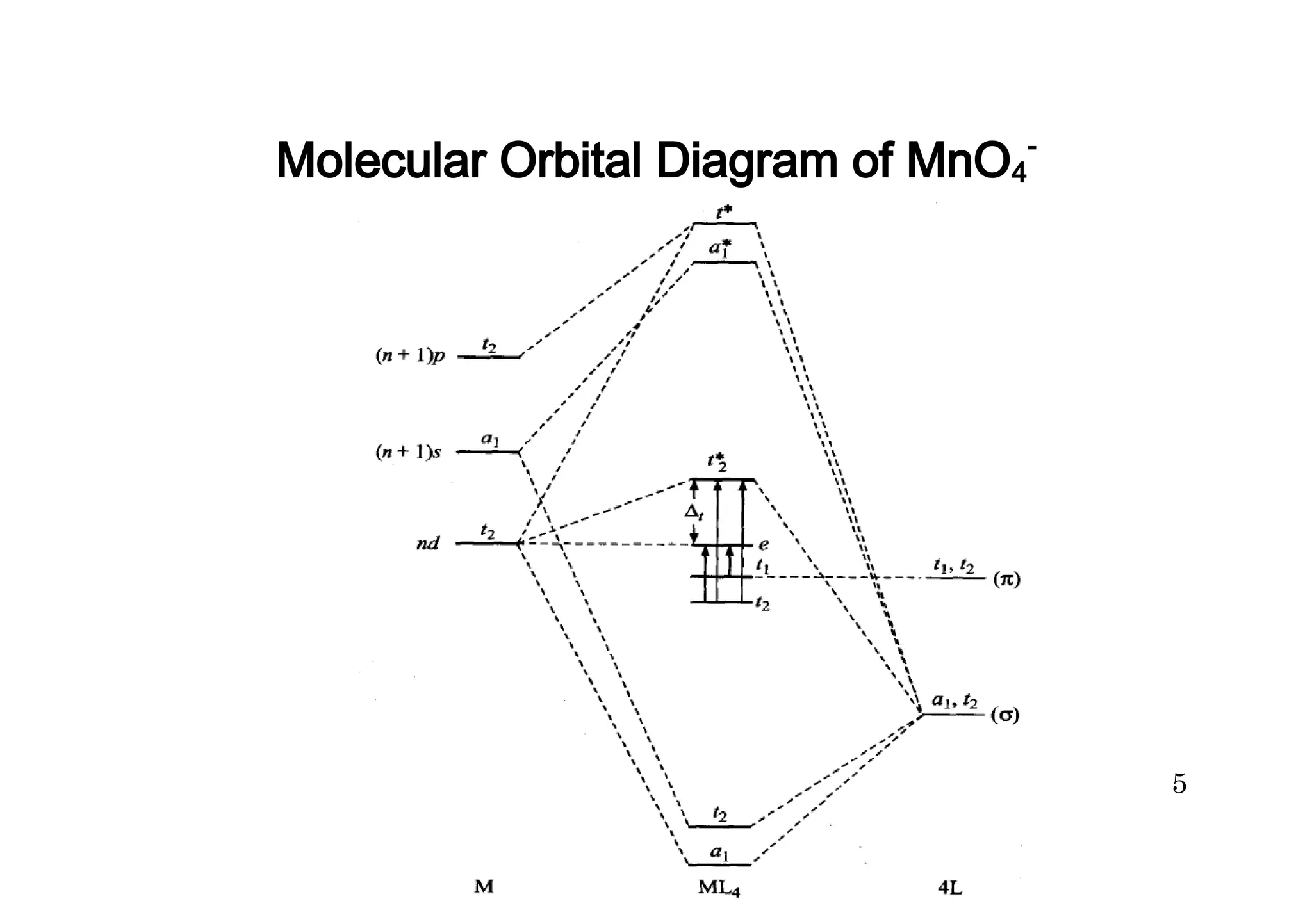
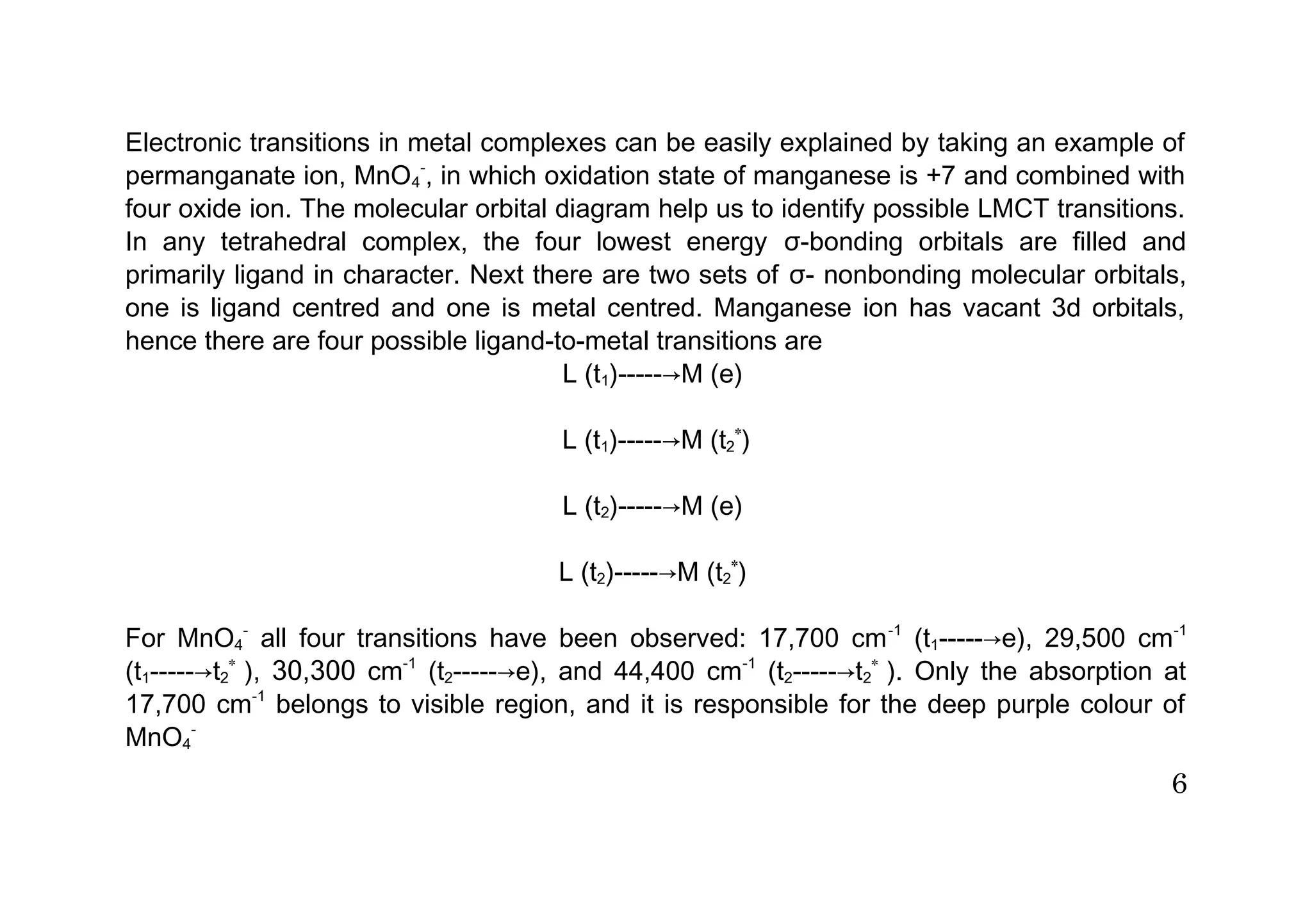
Electronic transitions in metal complexes can be easily explained by taking an example of
permanganate ion, MnO4
-
, in which oxidation state of manganese is +7 and combined with
four oxide ion. The molecular orbital diagram help us to identify possible LMCT transitions.
In any tetrahedral complex, the four lowest energy σ-bonding orbitals are filled and
primarily ligand in character. Next there are two sets of σ- nonbonding molecular orbitals,
one is ligand centred and one is metal centred. Manganese ion has vacant 3d orbitals,
hence there are four possible ligand-to-metal transitions are
L (t1)-----→M (e)
L (t1)-----→M (t2
‫٭‬
)
L (t2)-----→M (e)
L (t2)-----→M (t2
‫٭‬
)
For MnO4
-
all four transitions have been observed: 17,700 cm-1
(t1-----→e), 29,500 cm-1
(t1-----→t2
‫٭‬
), 30,300 cm-1
(t2-----→e), and 44,400 cm-1
(t2-----→t2
‫٭‬
). Only the absorption at
17,700 cm-1
belongs to visible region, and it is responsible for the deep purple colour of
MnO4
-
6
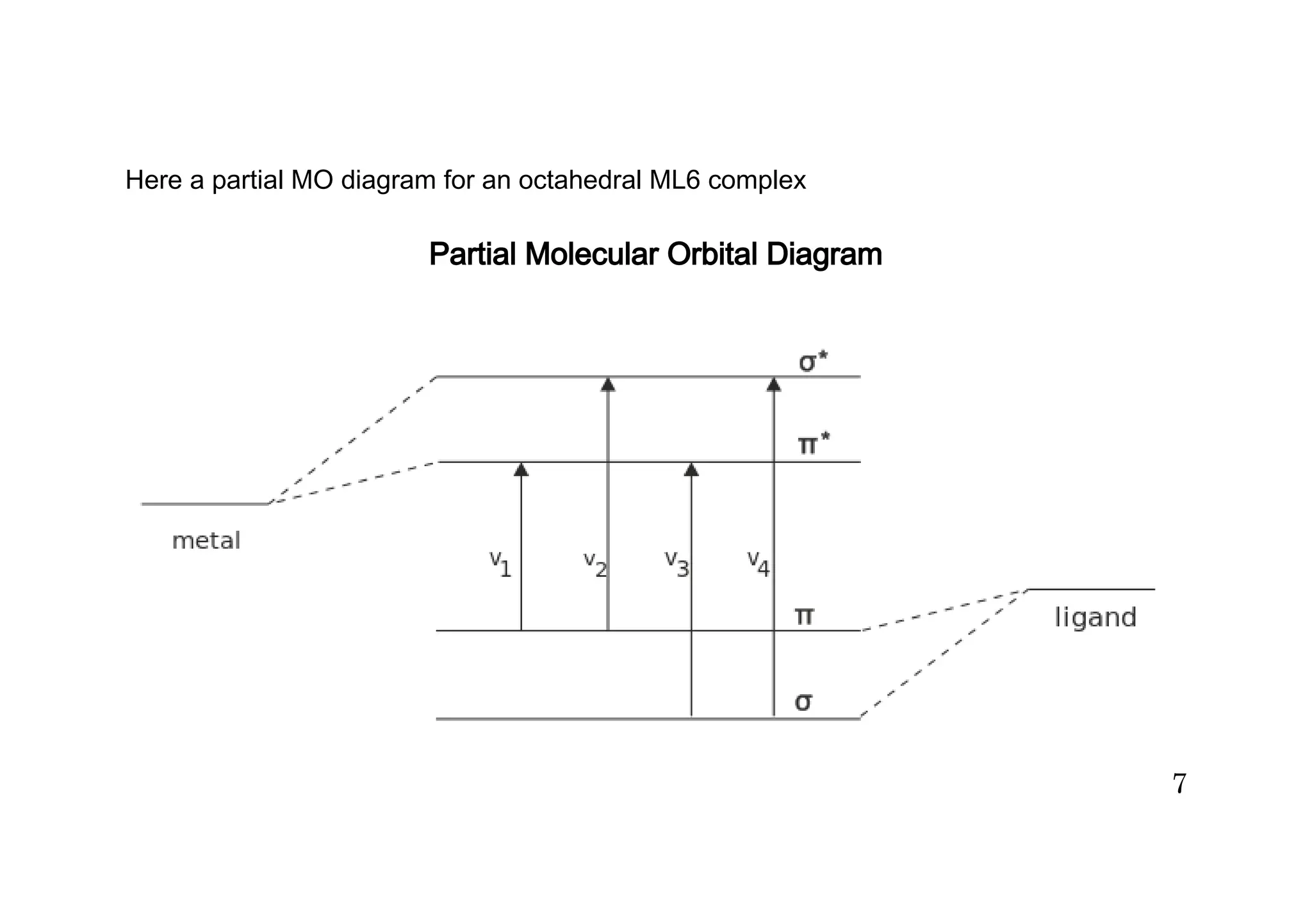
Here a partial MO diagram for an octahedral ML6 complex
Partial Molecular Orbital Diagram
7
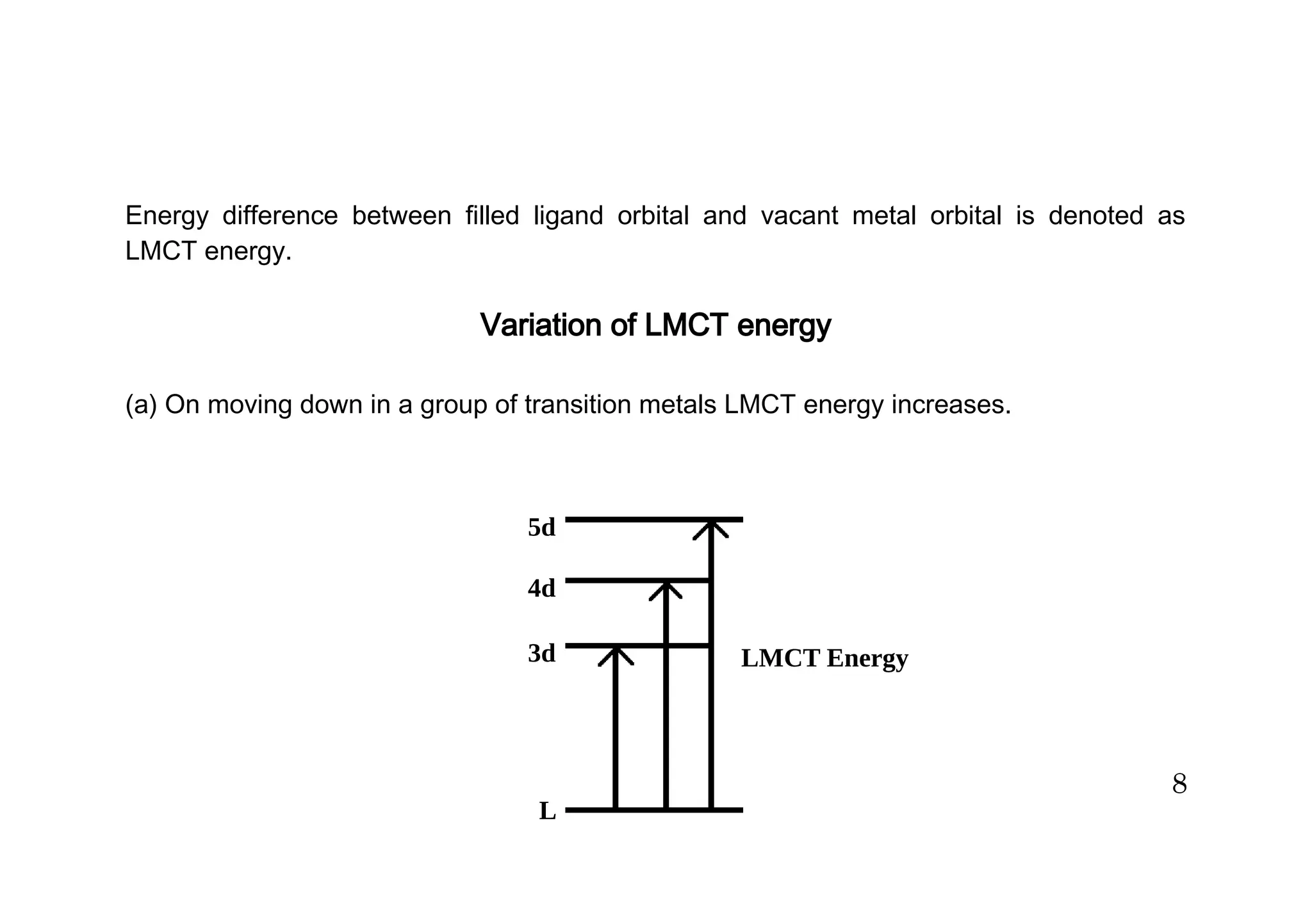
Energy difference between filled ligand orbital and vacant metal orbital is denoted as
LMCT energy.
Variation of LMCT energy
(a) On moving down in a group of transition metals LMCT energy increases.
8
L
3d
4d
5d
LMCT Energy
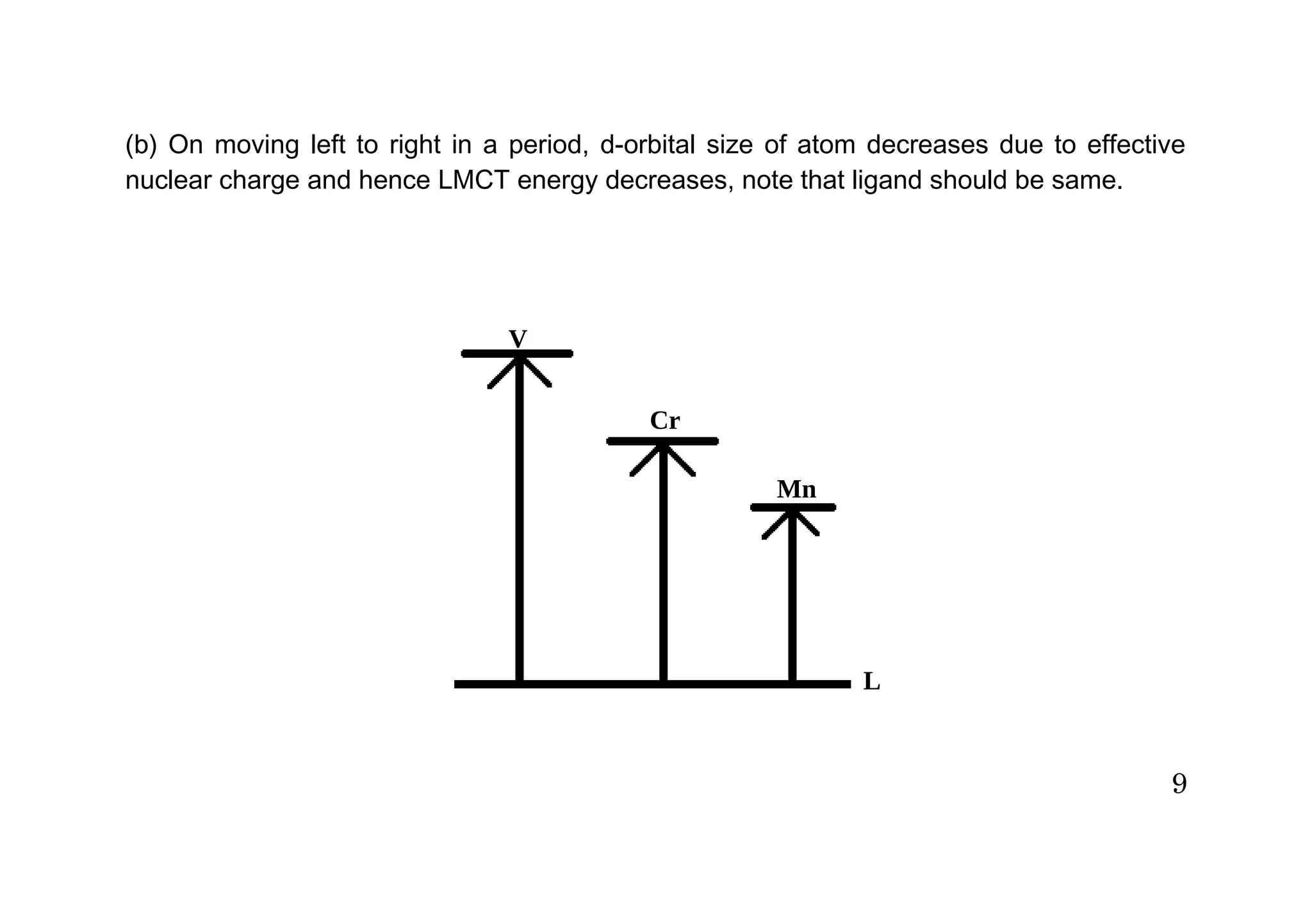
(b) On moving left to right in a period, d-orbital size of atom decreases due to effective
nuclear charge and hence LMCT energy decreases, note that ligand should be same.
9
V
Cr
Mn
L
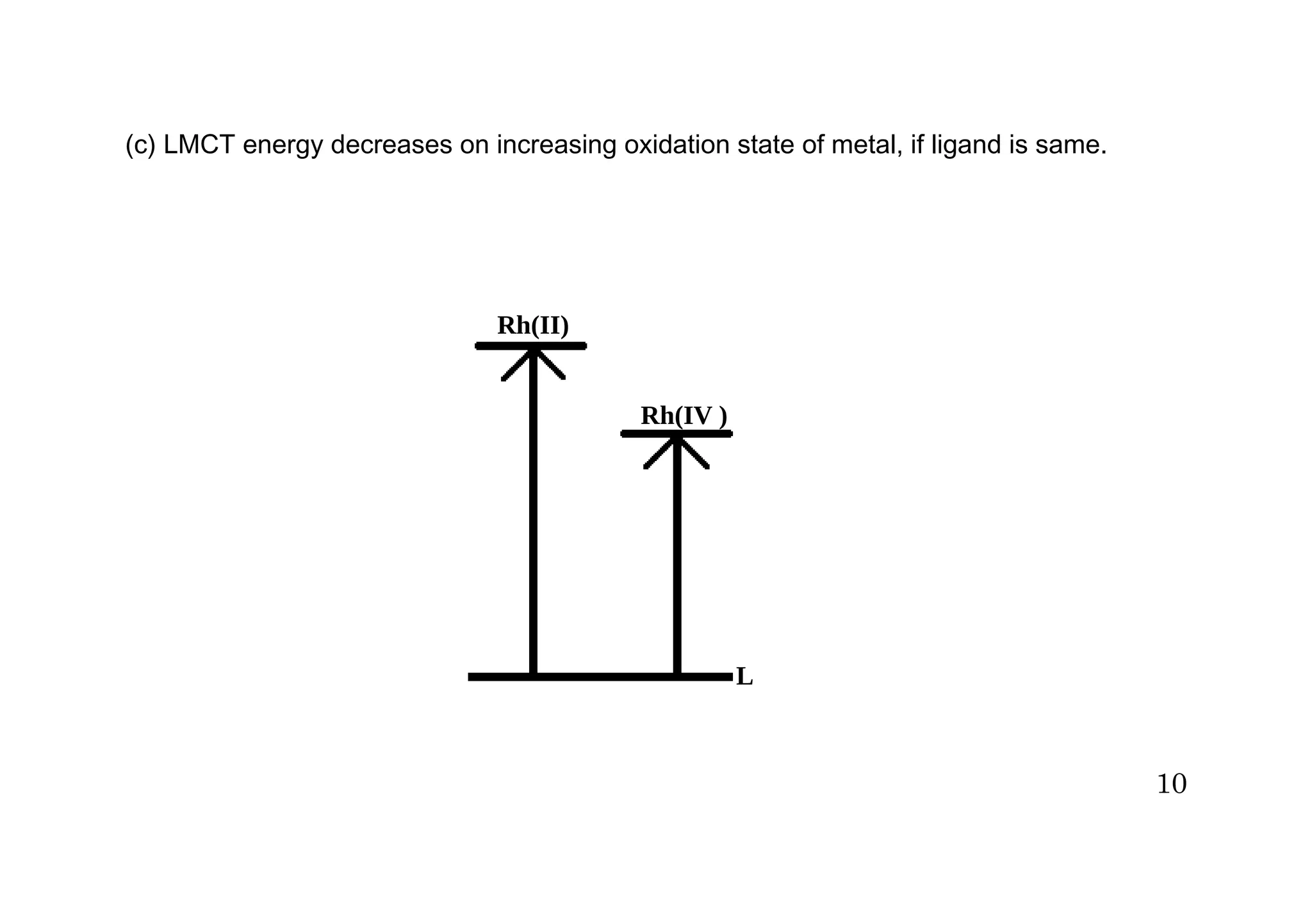
(c) LMCT energy decreases on increasing oxidation state of metal, if ligand is same.
10
Rh(II)
Rh(IV )
L
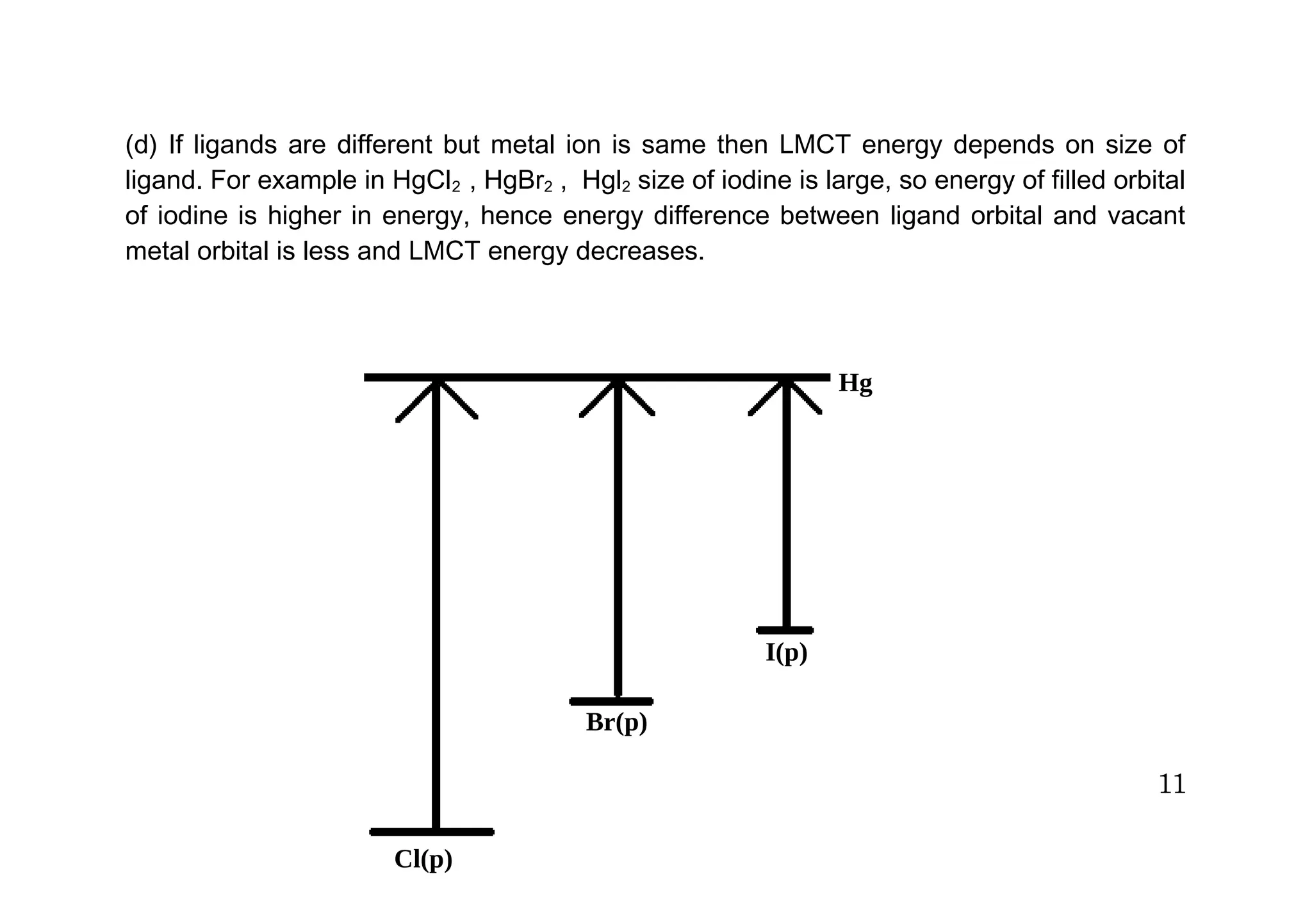
(d) If ligands are different but metal ion is same then LMCT energy depends on size of
ligand. For example in HgCl2 , HgBr2 , Hgl2 size of iodine is large, so energy of filled orbital
of iodine is higher in energy, hence energy difference between ligand orbital and vacant
metal orbital is less and LMCT energy decreases.
11
Hg
Cl(p)
Br(p)
I(p)
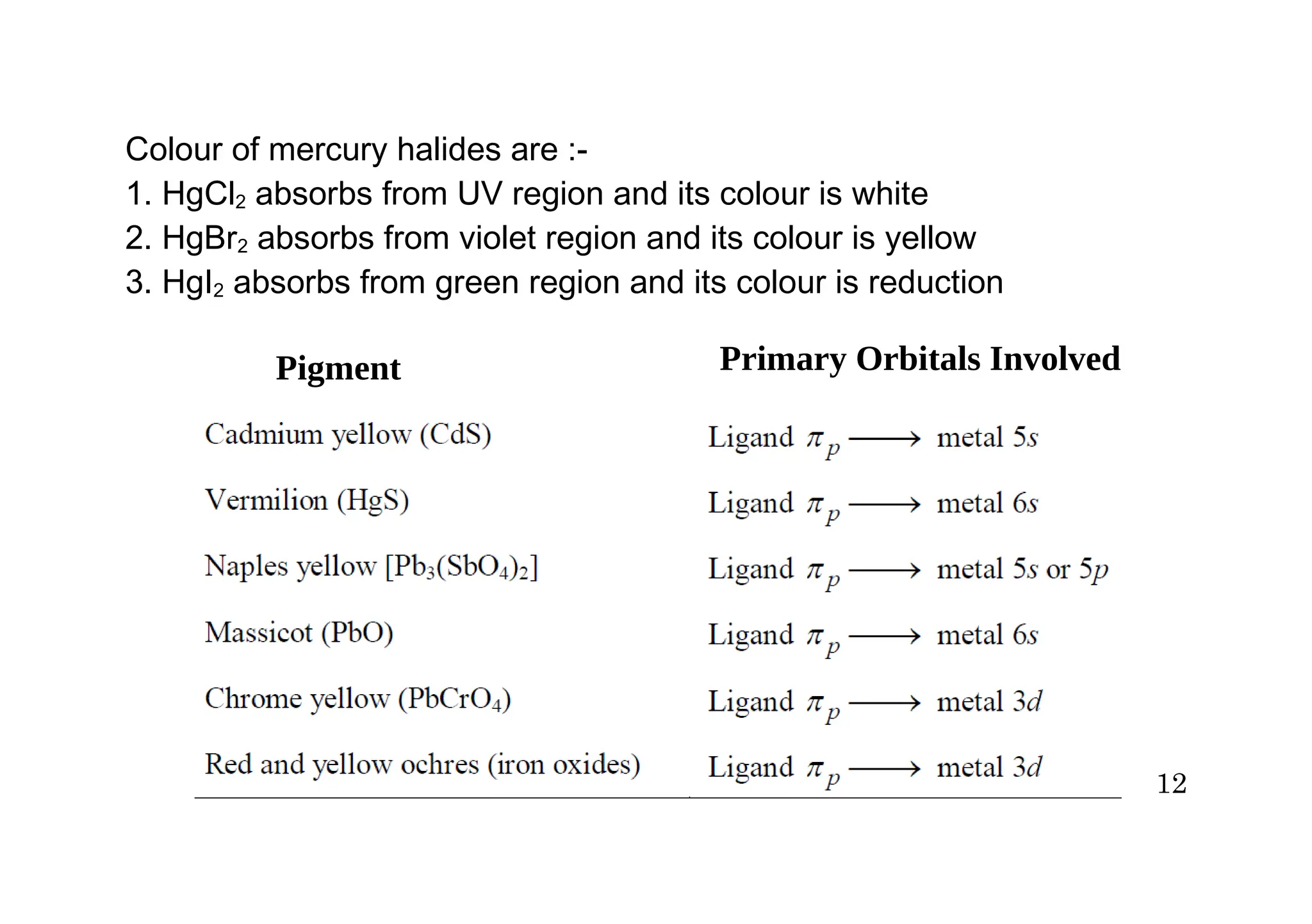
Colour of mercury halides are :-
1. HgCl2 absorbs from UV region and its colour is white
2. HgBr2 absorbs from violet region and its colour is yellow
3. HgI2 absorbs from green region and its colour is reduction
12
Pigment Primary Orbitals Involved
Metal to ligand charge transfer (MLCT)
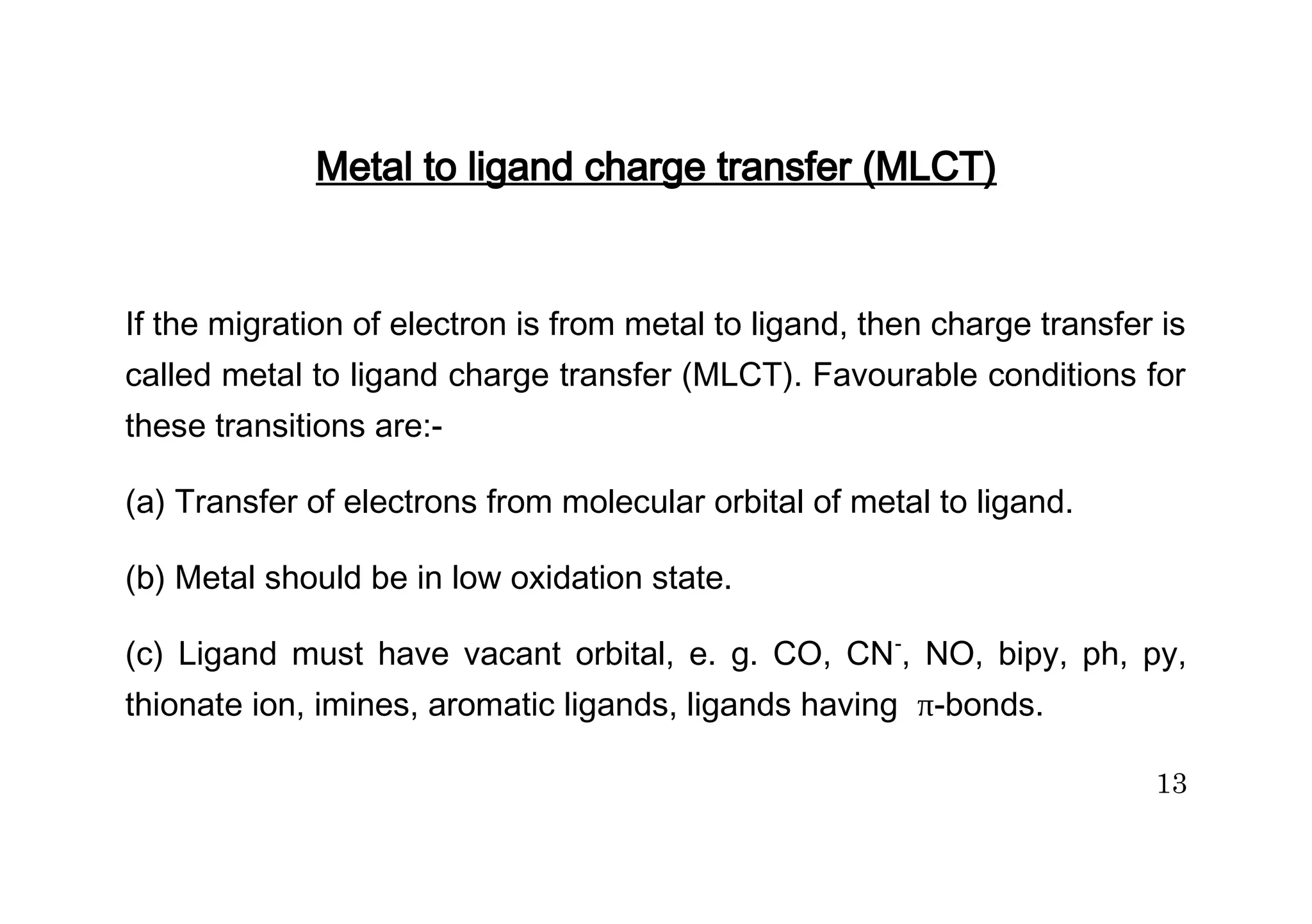
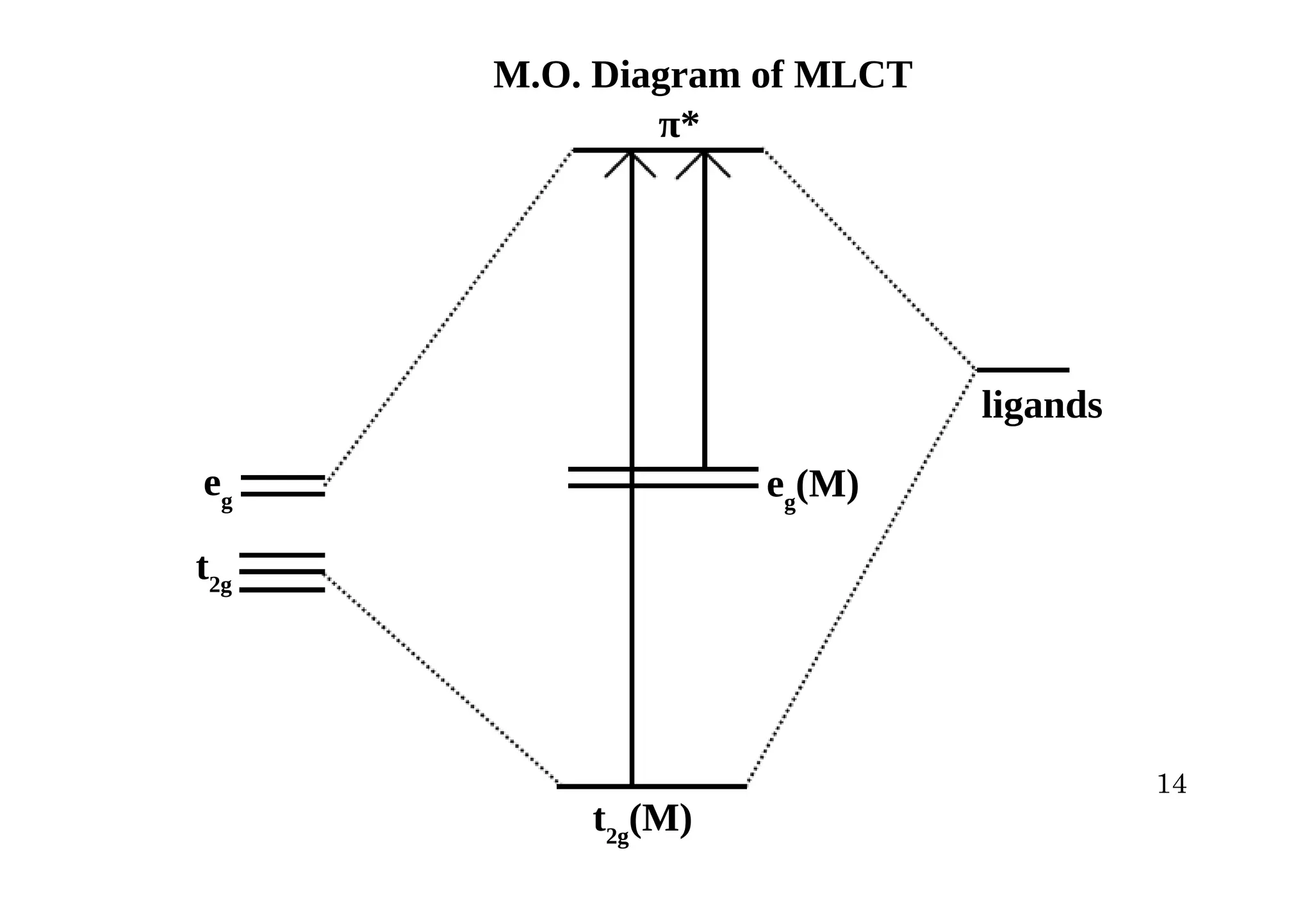
If the migration of electron is from metal to ligand, then charge transfer is
called metal to ligand charge transfer (MLCT). Favourable conditions for
these transitions are:-
(a) Transfer of electrons from molecular orbital of metal to ligand.
(b) Metal should be in low oxidation state.
(c) Ligand must have vacant orbital, e. g. CO, CN-
, NO, bipy, ph, py,
thionate ion, imines, aromatic ligands, ligands having π-bonds.
13
14
t2g
eg
t2g
(M)
ligands
eg
(M)
π*
M.O. Diagram of MLCT
Value of MLCT energy (energy difference between filled metal orbital and vacant ligand
orbital) depends on nature of metal orbital
(a) Electron rich metals, which have filled eg orbitals show coloured complex i. e. it absorbs
from visible region.
(b) If metals have filled t2g orbitals then MLCT energy is more, and complex absorbs from
uv region and complex will be colourless.
Metal to metal charge transfer (MMCT)
If in a complex same metal ions are present in different oxidation state, then electron
transfers between both metal ions is called MMCT.
Some examples are here---
(a) KFeIII
[FeII
(CN)6] Prussian Blue
KFeII
[FeIII
(CN)6] Turnbull’s Blue
(b) Rust ( Fe3O4 ) is reddish brown here elctrons transfers from Fe2+
-----→ Fe3+
(c) If spinels (mixed oxides) are coloured, it is due to MMCT eg. Pb3O4
15
Ligand to Ligand Charge Transfer (LLCT)
In Complex if ligands are present of different nature, one is
electron donor and other is electron accepter then we get
LLCT.
Intense absorption bands which are assigned to inter
system LLCT transitions appear in the electronic spectra of
square planar NiII
,PdII
& PtII
complexes, which contain a
1,2-ethyldithionate as electron donating and 1,3-diimine as
accepting ligand.
16
Thank You
Upma Shrivastava
17

Charge-Transfer-Spectra. metal to metal, metal to ligand

  • 1.
    Charge Transfer Spectra Upma Shrivastava Asstt.Prof. Govt. V.Y.T.PG.Auto.College Durg Chhattisgarh 1
  • 2.
    Charge Transfer Spectra Anelectronic transition between orbitals that are centred on different atoms is called charge transfer transition and absorption band is usually very strong. These transitions involve electron transfer from one part of a complex to another. More specifically an electron moves from an orbital that is mainly ligand in character to one that is mainly metal in character (ligand-to-metal charge transfer, LMCT) or vice versa (metal- to-Ligand charge transfer, MLCT). Unlike d-d transitions, these are fully allowed and hence give rise to much more intense absorptions. When these absorptions fall within the visible region, they often produce rich colours. In these transitions, the electronic transitions are Laporte and spin allowed, i. e. Δl = ±1 and ΔS=0 2
  • 3.
    A charge transfertransition may be regarded as an internal redox process. Types of charge transfer spectra (1) Ligand to metal charge transfer (LMCT) (2) Metal to ligand charge transfer (MLCT) (3) Intermetal charge transfer or metal to metal charge transfer (MMCT) (4) Interligand charge transfer (LLCT) 3 L L M L M Mn+ Mm+ L L’ LMCT MLCT MMCT LLCT
  • 4.
    Ligand to metalcharge transfer (LMCT) If the migration of electron is from ligand to metal, then the charge transfer is called ligand to metal charge (LMCT). Some important characteristics of these transitions are:- (a) Transfer of electrons from filled ligand orbitals to vacant metal orbitals (b) π-donar ligands show LMCT, e.g. halides, oxides, sulphides, selenides, N3 - , RO- (c) Metal should have high energy vacant orbitals (d) Metal should be in high oxidation state (e) Ionization energy of metal should be high (f) Ligand should have low energy filled orbital (g) Internal oxidation of ligand and internal reduction of metal takes place (h) Metal may be of main group, transition metal or inner transition metals 4
  • 5.
  • 6.
    Electronic transitions inmetal complexes can be easily explained by taking an example of permanganate ion, MnO4 - , in which oxidation state of manganese is +7 and combined with four oxide ion. The molecular orbital diagram help us to identify possible LMCT transitions. In any tetrahedral complex, the four lowest energy σ-bonding orbitals are filled and primarily ligand in character. Next there are two sets of σ- nonbonding molecular orbitals, one is ligand centred and one is metal centred. Manganese ion has vacant 3d orbitals, hence there are four possible ligand-to-metal transitions are L (t1)-----→M (e) L (t1)-----→M (t2 ‫٭‬ ) L (t2)-----→M (e) L (t2)-----→M (t2 ‫٭‬ ) For MnO4 - all four transitions have been observed: 17,700 cm-1 (t1-----→e), 29,500 cm-1 (t1-----→t2 ‫٭‬ ), 30,300 cm-1 (t2-----→e), and 44,400 cm-1 (t2-----→t2 ‫٭‬ ). Only the absorption at 17,700 cm-1 belongs to visible region, and it is responsible for the deep purple colour of MnO4 - 6
  • 7.
    Here a partialMO diagram for an octahedral ML6 complex Partial Molecular Orbital Diagram 7
  • 8.
    Energy difference betweenfilled ligand orbital and vacant metal orbital is denoted as LMCT energy. Variation of LMCT energy (a) On moving down in a group of transition metals LMCT energy increases. 8 L 3d 4d 5d LMCT Energy
  • 9.
    (b) On movingleft to right in a period, d-orbital size of atom decreases due to effective nuclear charge and hence LMCT energy decreases, note that ligand should be same. 9 V Cr Mn L
  • 10.
    (c) LMCT energydecreases on increasing oxidation state of metal, if ligand is same. 10 Rh(II) Rh(IV ) L
  • 11.
    (d) If ligandsare different but metal ion is same then LMCT energy depends on size of ligand. For example in HgCl2 , HgBr2 , Hgl2 size of iodine is large, so energy of filled orbital of iodine is higher in energy, hence energy difference between ligand orbital and vacant metal orbital is less and LMCT energy decreases. 11 Hg Cl(p) Br(p) I(p)
  • 12.
    Colour of mercuryhalides are :- 1. HgCl2 absorbs from UV region and its colour is white 2. HgBr2 absorbs from violet region and its colour is yellow 3. HgI2 absorbs from green region and its colour is reduction 12 Pigment Primary Orbitals Involved
  • 13.
    Metal to ligandcharge transfer (MLCT) If the migration of electron is from metal to ligand, then charge transfer is called metal to ligand charge transfer (MLCT). Favourable conditions for these transitions are:- (a) Transfer of electrons from molecular orbital of metal to ligand. (b) Metal should be in low oxidation state. (c) Ligand must have vacant orbital, e. g. CO, CN- , NO, bipy, ph, py, thionate ion, imines, aromatic ligands, ligands having π-bonds. 13
  • 14.
  • 15.
    Value of MLCTenergy (energy difference between filled metal orbital and vacant ligand orbital) depends on nature of metal orbital (a) Electron rich metals, which have filled eg orbitals show coloured complex i. e. it absorbs from visible region. (b) If metals have filled t2g orbitals then MLCT energy is more, and complex absorbs from uv region and complex will be colourless. Metal to metal charge transfer (MMCT) If in a complex same metal ions are present in different oxidation state, then electron transfers between both metal ions is called MMCT. Some examples are here--- (a) KFeIII [FeII (CN)6] Prussian Blue KFeII [FeIII (CN)6] Turnbull’s Blue (b) Rust ( Fe3O4 ) is reddish brown here elctrons transfers from Fe2+ -----→ Fe3+ (c) If spinels (mixed oxides) are coloured, it is due to MMCT eg. Pb3O4 15
  • 16.
    Ligand to LigandCharge Transfer (LLCT) In Complex if ligands are present of different nature, one is electron donor and other is electron accepter then we get LLCT. Intense absorption bands which are assigned to inter system LLCT transitions appear in the electronic spectra of square planar NiII ,PdII & PtII complexes, which contain a 1,2-ethyldithionate as electron donating and 1,3-diimine as accepting ligand. 16
  • 17.