CONSUME WITH
CARE
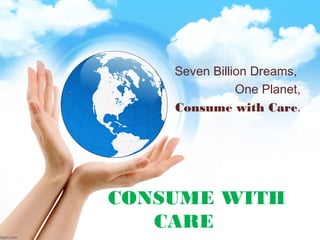
Seven Billion Dreams,
One Planet,
Consume with Care.
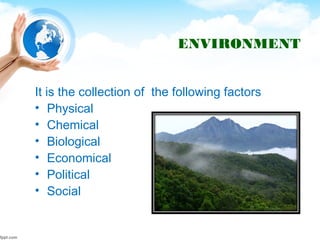
ENVIRONMENT
It is the collection of the following factors
• Physical
• Chemical
• Biological
• Economical
• Political
• Social
How we see? – May be wrong?
• Normally environment is
defined as the things
surrounding us.
• This makes the human as
center
Anthropocentric view
• The actual problem lies here
• We never realize what is our
part.
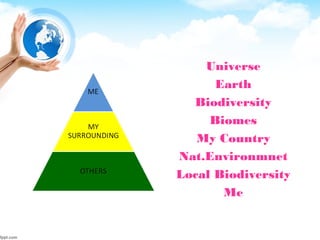
Universe
Earth
Biodiversity
Biomes
My Country
Nat.Environmnet
Local Biodiversity
Me
• All other animals live in a place
where they can
• But we human, have changed the
environment as we move on
• The main reason for the problem
CURRENT ISSUES
Why we have to take care ?
“Nature provides enough to satisfy every
man's needs, but not every man's greed.” 
- Mahatma Gandhi
– Since we get everything from the natural
environment, at least for that sake we have
to protect it
WORLD ENVIORNMENT DAY
• World Environment Day (WED) is the
United Nations’ principal vehicle for
encouraging worldwide awareness and
action for the environment.
• It also serves as the ‘people’s day’ for
doing something positive for the
environment, galvanizing individual actions
into a collective power that generates an
exponential positive impact on the planet.
"Seven Billion Dreams. One Planet. Consume with Care."
• The well-being of humanity, the environment, and
the functioning of the economy, ultimately depend
upon the responsible management of the planet’s
natural resources.
• People are consuming far more natural resources
than what the planet can sustainably provide.
• By 2050, if current consumption and
production patterns remain the same and
with a rising population expected to reach
9.6 billion, we will need three planets to
sustain our ways of living and consumption
Consuming with care means…
• Human prosperity need not cost the earth.
• living within planetary boundaries to ensure a
healthy future where our dreams can be
realized.
• Living sustainably is about doing more and
better with less.
• It is about knowing that rising rates of natural
resource use and the environmental impacts
that occur are not a necessary by-product of
economic growth.
Every Action Counts
• WED is the opportunity for everyone to realize the
responsibility to care for the Earth and to become
agents of change.
"Although individual decisions may seem small in
the face of global threats and trends, when
billions of people join forces in common purpose, we
can make a tremendous difference.”
- UN Secretary-General Ban Ki-Moon
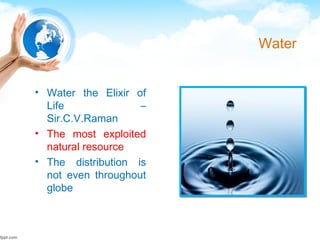
Water
• Water the Elixir of
Life –
Sir.C.V.Raman
• The most exploited
natural resource
• The distribution is
not even throughout
globe
WATER
• Even though households are relatively low
consumers of water, population growth and
expanded water use have outweighed the
effect of water saving technology and
behavior.
• Less than 3% of the world’s water is fresh
(drinkable), of which 2.5% is frozen in the
Antarctica, Arctic and glaciers. Humanity must
therefore rely on 0.5% for all of man’s
ecosystem’s and fresh water needs.
• Man is polluting water faster than
nature can recycle and purify water in
rivers and lakes.
• More than 1 billion people still do not
have access to fresh water.
• Excessive use of water contributes to the
global water stress.
• Water is free from nature but the
infrastructure needed to deliver it is
expensive.
ENERGY
• Despite technological advances that have
promoted energy efficiency gains, energy use in
OECD countries will continue to grow another
35% by 2020.
• Commercial and residential energy use is the
second most rapidly growing area of global
energy use after transport.
• A 32% increase in vehicle ownership is expected
by 2020. At the same time, motor vehicle
kilometres are projected to increase by 40% and
global air travel is projected to triple in the same
period.
• Households consume 29% of global energy and
consequently contribute to 21% of resultant CO2
emissions.
• The cost of renewable energy is increasingly
competitive with that derived from fossil fuels.
One-fifth of the world’s final energy consumption
in 2013 was from renewables.
• Globally, energy consumption grew most quickly
in the transport and service sectors, driven by
rising passenger travel and freight transport, and
a rapid expansion in the service economy
FOOD
• 1.3 billion tonnes of food is wasted every
year while almost 1 billion people go
undernourished and another 1 billion
hungry.
• Overconsumption of food is detrimental to
our health and the environment.
– 1.5 billion people globally are
overweight or obese.
– Land degradation, declining soil fertility,
unsustainable water use, overfishing and
marine environment degradation are all
lessening the ability of the natural resource
base to supply food.
– The food sector accounts for around 30%
of the world’s total energy consumption and
accounts for around 22% of total
Greenhouse Gas emissions.
• Increased consumption adversely affects food
security.
– Increase in food prices.
– Upsurge in production methods that use
more resource-intensive food products.
– Resource-intensive foods deplete the agro-
ecological resource base, affecting its
ability to produce plentiful food.
What I can do?
• Before consuming anything, think twice
whether it is necessary ?
• Use only judicious amounts of natural
resources
• Wherever possible reduce the use
• Avoid the wastage
• Completely avoid one time usage items
• Before leaving a room switch-off the fans
and lights
• Attend the pipe leaks immediately
• Do not waste food
• Avoid using plastic bags
• Use public transport systems
• Plant more number of trees and take care
of them
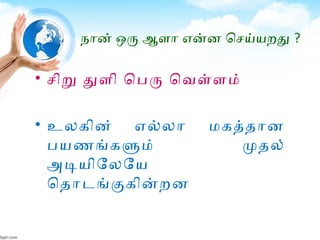
நான் ஒரு ஆளா என்ன ெசெய்யறது ?
• செிற துளி ெபரு ெவளளம்
• உலகின் எலலா மகததான
பயணஙகளம் மதல்
அடயிேலேய
ெதாடஙககின்றன
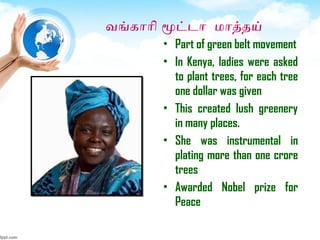
வஙகாாி மூட்டா மாததய்
• Part of green belt movement
• In Kenya, ladies were asked
to plant trees, for each tree
one dollar was given
• This created lush greenery
in many places.
• She was instrumental in
plating more than one crore
trees
• Awarded Nobel prize for
Peace
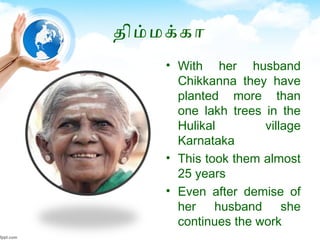
திமமககா
• With her husband
Chikkanna they have
planted more than
one lakh trees in the
Hulikal village
Karnataka
• This took them almost
25 years
• Even after demise of
her husband she
continues the work
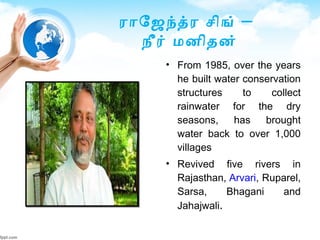
–ராேஜநதர செிங்
நீர் மனிதன்
• From 1985, over the years
he built water conservation
structures to collect
rainwater for the dry
seasons, has brought
water back to over 1,000
villages
• Revived five rivers in
Rajasthan, Arvari, Ruparel,
Sarsa, Bhagani and
Jahajwali.
…இறதியாக .
காகைக கருவி எஙகள் ஜாதி
நீளகடலம் மைலயம் எஙகள் கட்டம்
ேநாககம் திைசெெயலலாம் நாமன்றி
ேவறிலைல ேநாகக ேநாககக் களியாட்டம்
- பாரதியார்
World environment day

World environment day

  • 1.
    CONSUME WITH CARE Seven BillionDreams, One Planet, Consume with Care.
  • 2.
    ENVIRONMENT It is thecollection of the following factors • Physical • Chemical • Biological • Economical • Political • Social
  • 3.
    How we see?– May be wrong? • Normally environment is defined as the things surrounding us. • This makes the human as center Anthropocentric view • The actual problem lies here • We never realize what is our part.
  • 4.
  • 5.
    • All otheranimals live in a place where they can • But we human, have changed the environment as we move on • The main reason for the problem
  • 6.
  • 7.
    Why we haveto take care ? “Nature provides enough to satisfy every man's needs, but not every man's greed.”  - Mahatma Gandhi – Since we get everything from the natural environment, at least for that sake we have to protect it
  • 8.
    WORLD ENVIORNMENT DAY •World Environment Day (WED) is the United Nations’ principal vehicle for encouraging worldwide awareness and action for the environment. • It also serves as the ‘people’s day’ for doing something positive for the environment, galvanizing individual actions into a collective power that generates an exponential positive impact on the planet.
  • 9.
    "Seven Billion Dreams.One Planet. Consume with Care." • The well-being of humanity, the environment, and the functioning of the economy, ultimately depend upon the responsible management of the planet’s natural resources. • People are consuming far more natural resources than what the planet can sustainably provide.
  • 10.
    • By 2050,if current consumption and production patterns remain the same and with a rising population expected to reach 9.6 billion, we will need three planets to sustain our ways of living and consumption
  • 11.
    Consuming with caremeans… • Human prosperity need not cost the earth. • living within planetary boundaries to ensure a healthy future where our dreams can be realized. • Living sustainably is about doing more and better with less. • It is about knowing that rising rates of natural resource use and the environmental impacts that occur are not a necessary by-product of economic growth.
  • 12.
    Every Action Counts •WED is the opportunity for everyone to realize the responsibility to care for the Earth and to become agents of change. "Although individual decisions may seem small in the face of global threats and trends, when billions of people join forces in common purpose, we can make a tremendous difference.” - UN Secretary-General Ban Ki-Moon
  • 13.
    Water • Water theElixir of Life – Sir.C.V.Raman • The most exploited natural resource • The distribution is not even throughout globe
  • 14.
    WATER • Even thoughhouseholds are relatively low consumers of water, population growth and expanded water use have outweighed the effect of water saving technology and behavior. • Less than 3% of the world’s water is fresh (drinkable), of which 2.5% is frozen in the Antarctica, Arctic and glaciers. Humanity must therefore rely on 0.5% for all of man’s ecosystem’s and fresh water needs.
  • 15.
    • Man ispolluting water faster than nature can recycle and purify water in rivers and lakes. • More than 1 billion people still do not have access to fresh water. • Excessive use of water contributes to the global water stress. • Water is free from nature but the infrastructure needed to deliver it is expensive.
  • 16.
    ENERGY • Despite technologicaladvances that have promoted energy efficiency gains, energy use in OECD countries will continue to grow another 35% by 2020. • Commercial and residential energy use is the second most rapidly growing area of global energy use after transport. • A 32% increase in vehicle ownership is expected by 2020. At the same time, motor vehicle kilometres are projected to increase by 40% and global air travel is projected to triple in the same period.
  • 17.
    • Households consume29% of global energy and consequently contribute to 21% of resultant CO2 emissions. • The cost of renewable energy is increasingly competitive with that derived from fossil fuels. One-fifth of the world’s final energy consumption in 2013 was from renewables. • Globally, energy consumption grew most quickly in the transport and service sectors, driven by rising passenger travel and freight transport, and a rapid expansion in the service economy
  • 18.
    FOOD • 1.3 billiontonnes of food is wasted every year while almost 1 billion people go undernourished and another 1 billion hungry. • Overconsumption of food is detrimental to our health and the environment. – 1.5 billion people globally are overweight or obese.
  • 19.
    – Land degradation,declining soil fertility, unsustainable water use, overfishing and marine environment degradation are all lessening the ability of the natural resource base to supply food. – The food sector accounts for around 30% of the world’s total energy consumption and accounts for around 22% of total Greenhouse Gas emissions.
  • 20.
    • Increased consumptionadversely affects food security. – Increase in food prices. – Upsurge in production methods that use more resource-intensive food products. – Resource-intensive foods deplete the agro- ecological resource base, affecting its ability to produce plentiful food.
  • 21.
    What I cando? • Before consuming anything, think twice whether it is necessary ? • Use only judicious amounts of natural resources • Wherever possible reduce the use • Avoid the wastage • Completely avoid one time usage items
  • 22.
    • Before leavinga room switch-off the fans and lights • Attend the pipe leaks immediately • Do not waste food • Avoid using plastic bags • Use public transport systems • Plant more number of trees and take care of them
  • 23.
    நான் ஒரு ஆளாஎன்ன ெசெய்யறது ? • செிற துளி ெபரு ெவளளம் • உலகின் எலலா மகததான பயணஙகளம் மதல் அடயிேலேய ெதாடஙககின்றன
  • 24.
    வஙகாாி மூட்டா மாததய் •Part of green belt movement • In Kenya, ladies were asked to plant trees, for each tree one dollar was given • This created lush greenery in many places. • She was instrumental in plating more than one crore trees • Awarded Nobel prize for Peace
  • 25.
    திமமககா • With herhusband Chikkanna they have planted more than one lakh trees in the Hulikal village Karnataka • This took them almost 25 years • Even after demise of her husband she continues the work
  • 26.
    –ராேஜநதர செிங் நீர் மனிதன் •From 1985, over the years he built water conservation structures to collect rainwater for the dry seasons, has brought water back to over 1,000 villages • Revived five rivers in Rajasthan, Arvari, Ruparel, Sarsa, Bhagani and Jahajwali.
  • 27.
    …இறதியாக . காகைக கருவிஎஙகள் ஜாதி நீளகடலம் மைலயம் எஙகள் கட்டம் ேநாககம் திைசெெயலலாம் நாமன்றி ேவறிலைல ேநாகக ேநாககக் களியாட்டம் - பாரதியார்