V.SANTHANAM
DEPARTMENT OF CHEMISTRY
SCSVMV
DEFINING STABILITY
 The statement that a complex is stable is rather loose
and misleading very often.
 It means that a complex exists and under suitable and
required conditions it can be stored for a long time.
 But this cannot be generalized to all complexes.
 One particular complex may be stable towards a
reagent and highly reactive towards another
2santhanam SCSVMV
Thermodynamic stability
• As for as complexes in solutions are
concerned there are two kinds of stabilities
• Thermodynamic stability – Measure of the
extent to which the complex will be formed
or will be transformed into another species,
when the system has reached equilibrium
3santhanam SCSVMV
Kinetic stability
• Kinetic stability – refers to the speed with
which the transformations leading to
equilibrium will occur.
• Under this , the rates of substitutions,
racemisations and their mechanisms.
• The factors which are affecting the rates of
the reactions are also studied
4santhanam SCSVMV
Labile and Inert complexes
• The complexes which rapidly exchange their
ligands with other species are called labile.
• If the ligand exchange reaction rate is slow
then they are called inert complexes.
• But the reactive nature should not be
confused with the stability.
5santhanam SCSVMV
Stability constant / Formation constant
• According to Bjerrum formation of a complex in
aqueous solution proceeds through a stepwise
fashion with corresponding equilibrium constants
M + L ML K1 = [ML] / [M] [L]
ML + L ML2 K2 = [ML2] / [ML] [L]
ML2 + L ML3 K3 = [ML2] / [ML2] [L]
…………..……………………………….
………….………………………………..
MLn-1 + L MLn Kn = [MLn] / [MLn-1] [L]
These K1,K2 K3 … Kn are called stepwise formation constants
K1
Kn
K3
K2
6santhanam SCSVMV
Overall stability constant
• If the complex formation is considered as a
single step process
M + nL MLn
= [MLn] / [M] [L]ᵝn
7santhanam SCSVMV
Trends in stability constants
[Cu(OH2)4]2+
+ NH3  [Cu(OH2)3(NH3)]2+
+ H2O log K1 = 4.22
[Cu(OH2)3(NH3)]2+
+ NH3  [Cu(OH2)2(NH3)2]2+
+ H2O log K2 = 3.50
[Cu(OH2)2(NH3)2]2+
+ NH3  [Cu(OH2)(NH3)3]2+
+ H2O log K3 = 2.92
[Cu(OH2)(NH3)3]2+
+ NH3  [Cu(NH3)4]2+
+ H2O log K4 = 2.18
• Generally the stepwise stability constant values decrease with
successive replacement by the ligands
8santhanam SCSVMV
Statistical effect
9santhanam SCSVMV
Statistical effect explanation
• When more ligands are entering into the
coordination sphere the number of aqua
ligand decreases.
• This reduces the probability of substitution of
aqua ligand with the new ligand.
• Reflected as decreasing stepwise formation
constants
10santhanam SCSVMV
Relationship between Kn and ᵝn
• Let us consider
ᵝ3 = [ML3] / [M] [L]3
= [ML3] . [ML2] . [ML]
[M] [L]3
. [ML2] . [ML]
= [ML] . [ML2] . [ML3]
[M] [L] [ML] [L] [ML2] [L]
= K1 . K2 . K3
In general
ᵝn = K .K .K . ….. K
11santhanam SCSVMV
Kinetic Vs Thermodynamic stability
• The terms labile and inert refer to the
reactivity of a complex only.
• Not to be confused with its stability.
• An inert complex may be stable or unstable.
• Similarly a labile complex may be stable or
unstable
12santhanam SCSVMV
Exemplification
• The above said fact is clearly shown by the
complex [Hg(CN)4]2-
.
Hg2+
+ 4CN-
[Hg(CN)4]2-
ᵝ ≈ 10 42
• The over all formation constant is having very
high value which means that equilibrium is
lying far too right.
13santhanam SCSVMV
• But when this complex exchanges its CN-
ligands with 14
C labeled CN-
solution very high
rate showing that the complex is labile.
• So the thermodynamic stability is not
connected to the lability or inertness of a
complex.
14santhanam SCSVMV
Explanation of lability and inertness according to VBT
• VBT classifies octahedral complexes into two
types.
• Inner orbital complexes – d2
sp3
• Outer orbital complex – sp3
d2
• The two d-orbitals involved in the hybridization
are the egset of orbitals.
15santhanam SCSVMV
Outer orbital complexes
• The complexes having sp3
d2
hybridization are
called outer orbital complexes.
• In terms of VBT these bonds are weaker.
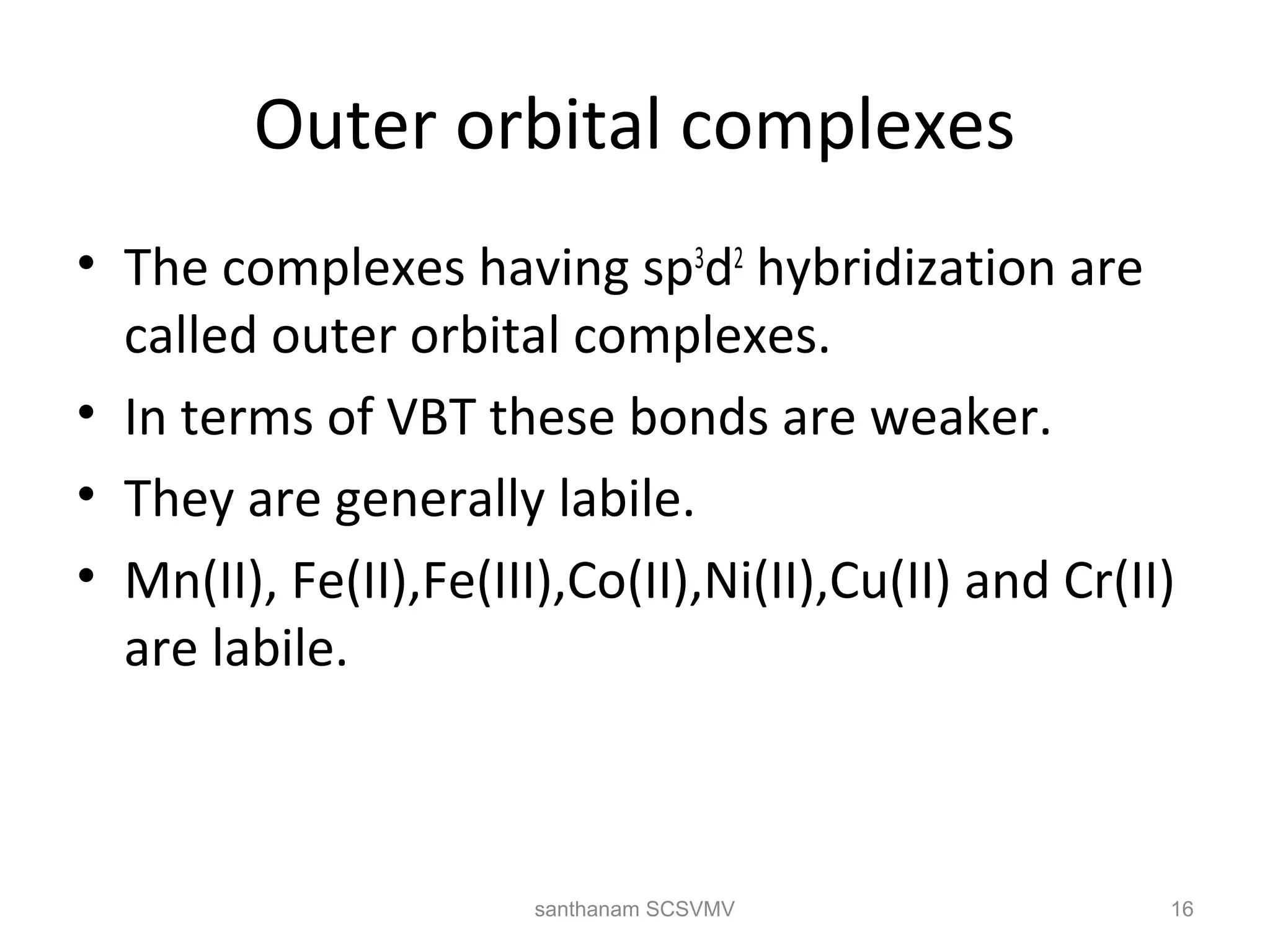
• They are generally labile.
• Mn(II), Fe(II),Fe(III),Co(II),Ni(II),Cu(II) and Cr(II)
are labile.
16santhanam SCSVMV
Inner orbital complexes
• These complexes generally have d2
sp3
hybridization.
• The hybrid orbitals are filled with the ligand
electrons.
• The t2g orbitals of metal accommodate the d
electrons of the metal.
17santhanam SCSVMV
• If the t2g levels are left vacant then the
complex can associate with an incoming
ligand and the complex is labile
• If all the t2g levels are occupied then the
complex becomes inert.
18santhanam SCSVMV
Labile and inert complexes on the basis of CFT
• According to CFT the ligand field splits the d-
orbitals.
• This splitting leads to a decrease in energy of
the system whose magnitude depends on the
number of d electrons present.
• if the CFSE value increases by association or
dissociation of a ligand then the complex is
labile.
• On the other hand it is inert when there is a
loss in CFSE value. 19santhanam SCSVMV
Factors affecting lability of complexes
• Charge of the central ion: Highly charged ions form
complexes which react slowly i.e. inert
• Radii of the ion: the reactivity decreases with
decreasing ionic radii.
• Charge to radius ratio: if all the factors are similar, the
ion with largest z/r value reacts with the least rate.
• Geometry of the complex: Generally four coordinated
complexes are more labile
20santhanam SCSVMV
FACTORS AFFECTING
STABILITY OF THE COMPLEXES
Properties of the metal ion
• Charge and size
• Natural order (or) Irving –William order of
stability
• Class a and Class b metals
• Electronegativity of the metal ion
22santhanam SCSVMV
Charge and size of the ion
• In general metal ions with higher charge and
small size form stable complexes.
• A small cation with high charge attracts the
ligands more closely leading to stable
complexes.
• The following tables explain the facts that if
z/r ratio (polarizing power) of the metal ion is
high then stability of the complex is also high
23santhanam SCSVMV
Effect of ionic radius
Complex ion Charge on the
ion
Ionic radii (Aₒ
)
Value of ᵝ stability
[BeII
(OH)] +
+2 0.31 107
[MgII
(OH)] +
+2 0.65 120
[CaII
(OH)] +
+2 0.99 30
[BaII
(OH)] +
+2 1.35 4
24santhanam SCSVMV
Effect of charge
Complex ion Charge on the
ion
Ionic radii (Aₒ
)
Value of log ᵝ stability
[FeIII
(CN)6] 3-
+3 31.0
[FeIII
(CN)6] 4-
+2 8.3
CoIII
complex +3 high
CoII
complex +2 low
Almost
same
Almost
same
25santhanam SCSVMV
Irving – William order of stability
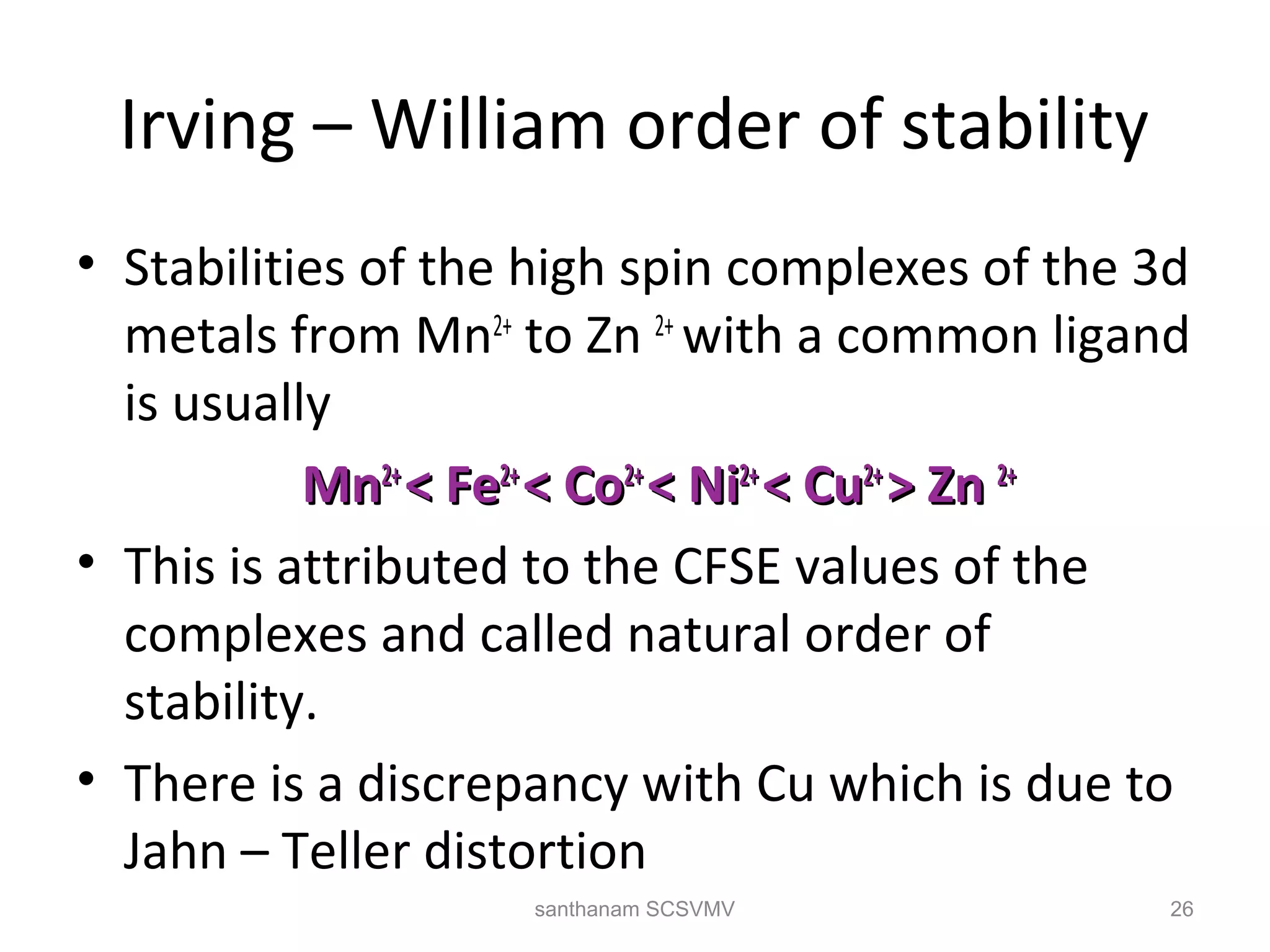
• Stabilities of the high spin complexes of the 3d
metals from Mn2+
to Zn 2+
with a common ligand
is usually
MnMn2+2+
< Fe< Fe2+2+
< Co< Co2+2+
< Ni< Ni2+2+
< Cu< Cu2+2+
> Zn> Zn 2+2+
• This is attributed to the CFSE values of the
complexes and called natural order of
stability.
• There is a discrepancy with Cu which is due to
Jahn – Teller distortion
26santhanam SCSVMV
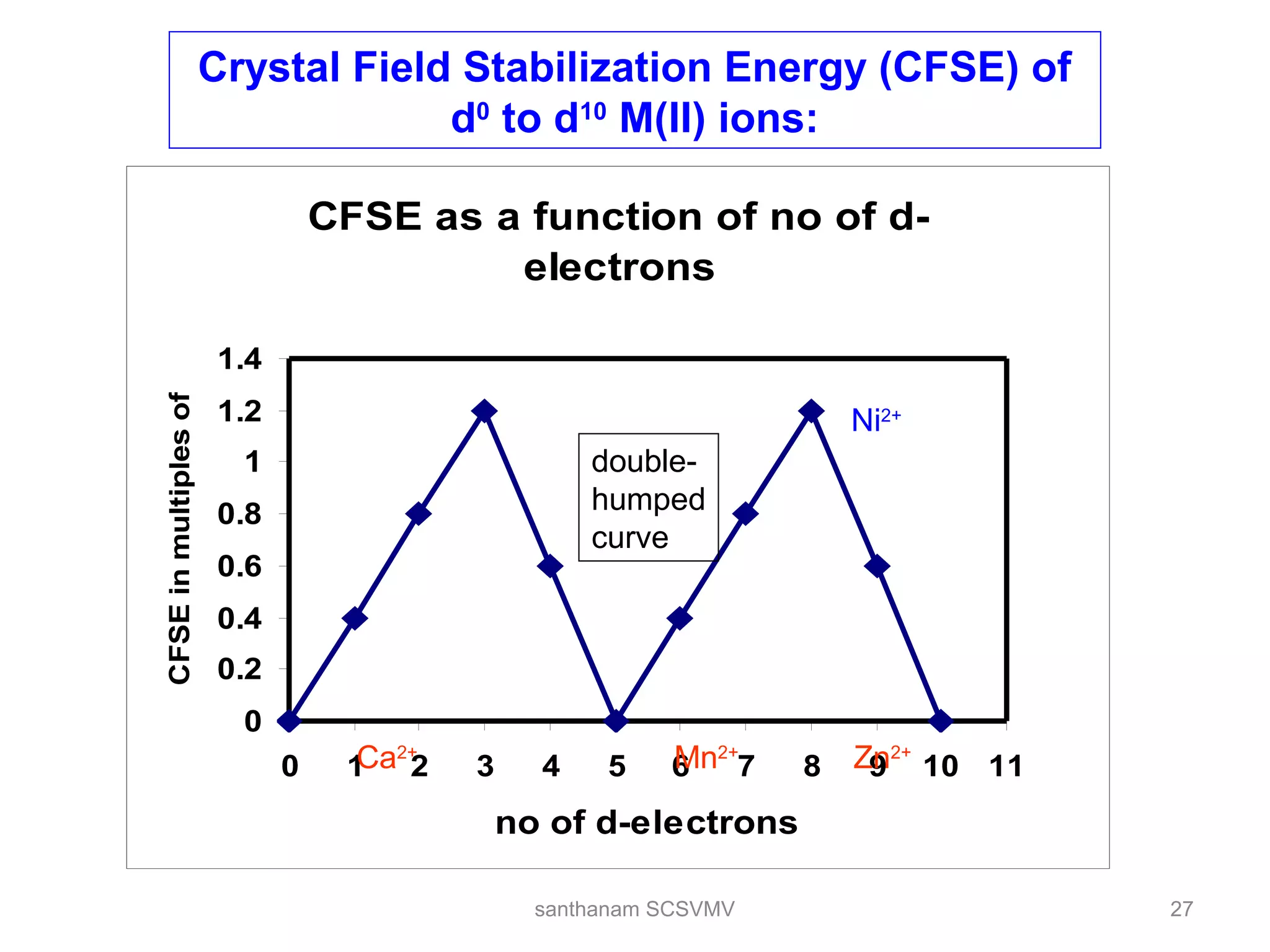
CFSE as a function of no of d-
electrons
0
0.2
0.4
0.6
0.8
1
1.2
1.4
0 1 2 3 4 5 6 7 8 9 10 11
no of d-electrons
CFSEinmultiplesofΔ.
Crystal Field Stabilization Energy (CFSE) of
d0
to d10
M(II) ions:
Ca2+
Mn2+
Zn2+
double-
humped
curve
Ni2+
27santhanam SCSVMV
log K1(EDTA) as a function of no of d-
electrons
10
12
14
16
18
20
0 1 2 3 4 5 6 7 8 9 10 11
no of d-electrons
logK1(EDTA).
Log K1(EDTA) of d0
to d10
M(II) ions:
Ca2+
Mn2+
Zn2+
double-
humped
curve
= CFSE
rising baseline
due to ionic
contraction
28santhanam SCSVMV
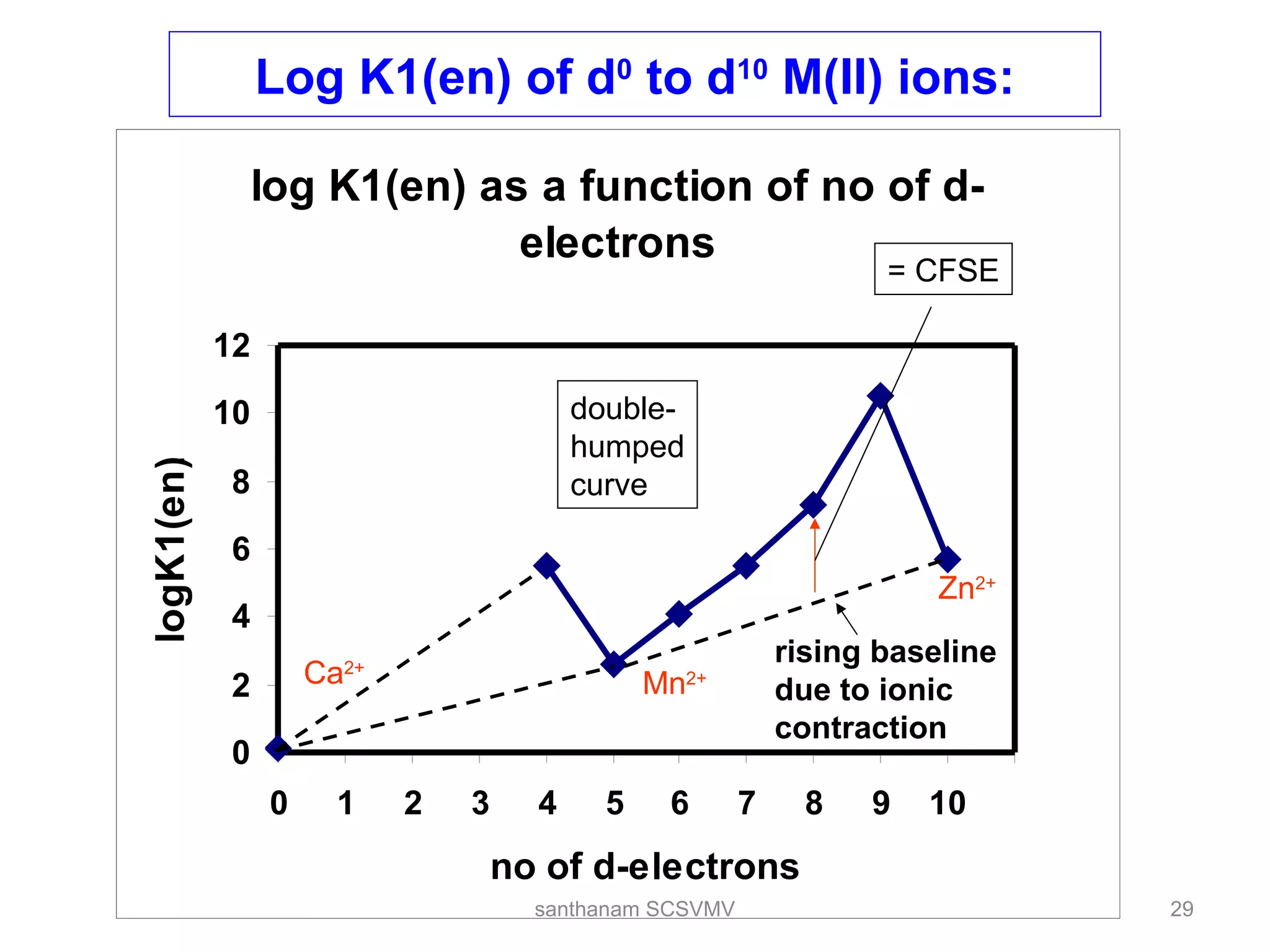
log K1(en) as a function of no of d-
electrons
0
2
4
6
8
10
12
0 1 2 3 4 5 6 7 8 9 10 11
no of d-electrons
logK1(en).
Log K1(en) of d0
to d10
M(II) ions:
double-
humped
curve
Ca2+
Mn2+
Zn2+
rising baseline
due to ionic
contraction
= CFSE
29santhanam SCSVMV
log K1(tpen) as a function of no of d-
electrons
0
5
10
15
20
0 1 2 3 4 5 6 7 8 9 10 11
no of d-electrons
logK1(tpen).
Log K1(tpen) of d0
to d10
M(II) ions:
Ca2+
Mn2+
Zn2+
double-
humped
curve
N N NN
N Ntpen
30santhanam SCSVMV
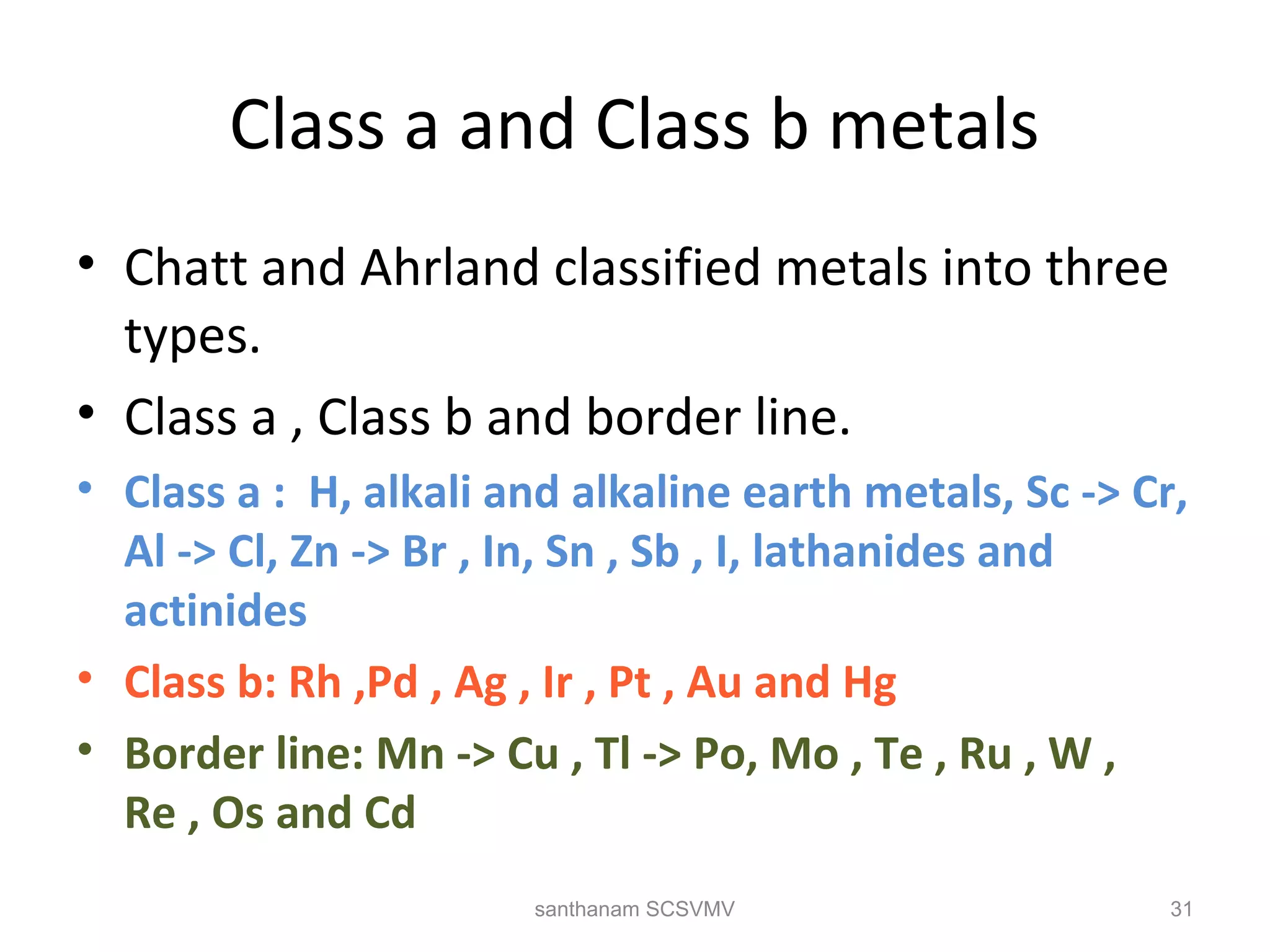
Class a and Class b metals
• Chatt and Ahrland classified metals into three
types.
• Class a , Class b and border line.
• Class a : H, alkali and alkaline earth metals, Sc -> Cr,
Al -> Cl, Zn -> Br , In, Sn , Sb , I, lathanides and
actinides
• Class b: Rh ,Pd , Ag , Ir , Pt , Au and Hg
• Border line: Mn -> Cu , Tl -> Po, Mo , Te , Ru , W ,
Re , Os and Cd
31santhanam SCSVMV
• Class a metals form more stable complexes with
ligands in which coordination atoms are from
second period. ( N , O , F)
• Class b metals form more stable complexes with
ligands having third period elements as ligating
atoms. (P , S , Cl)
• Class b metals are having capacity to form pi bonds
with the ligand atoms. The expansion is possible only
from the third period donor atoms.
• Border line metals do not show any noticeable trend.
32santhanam SCSVMV
Electronegativity of the metal
atom
• The bond between metal and ligand atom is,
to some extent due to the donation of
electron pair to the metal.
• If the metal is having a tendency attract the
electron pair (Higher electronegativity) then
more stable complexes are formed .
33santhanam SCSVMV
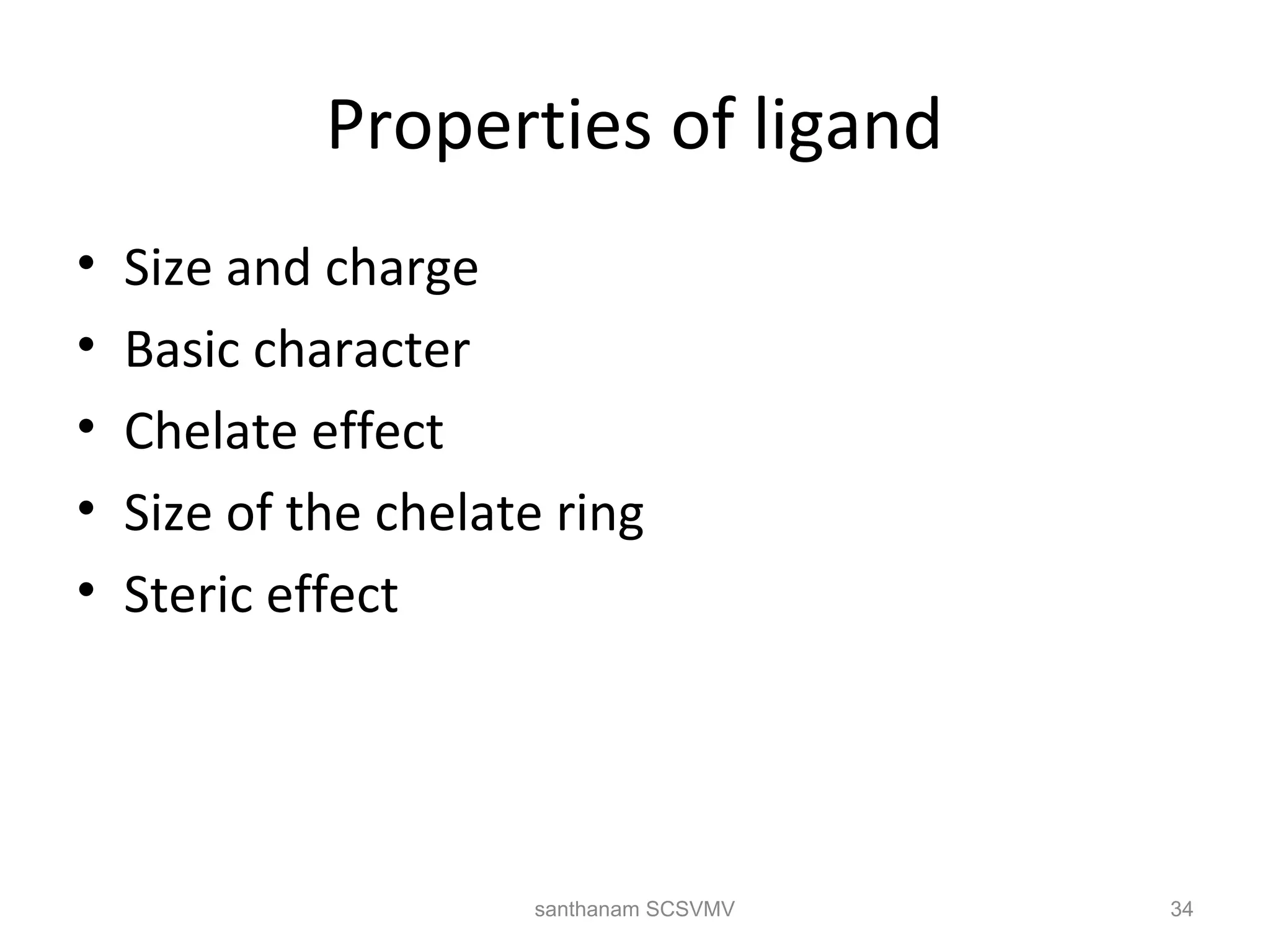
Properties of ligand
• Size and charge
• Basic character
• Chelate effect
• Size of the chelate ring
• Steric effect
34santhanam SCSVMV
Size and charge of the ligand
• To some extent we can say that if the ligand is
smaller in size and bearing higher charge it
will form more stable complexes.
• For example usually F-
forms more stable
complexes that Cl-
• In the case of neutral mono dentate ligands,
high dipole moment and small size favour
more stable complexes.
35santhanam SCSVMV
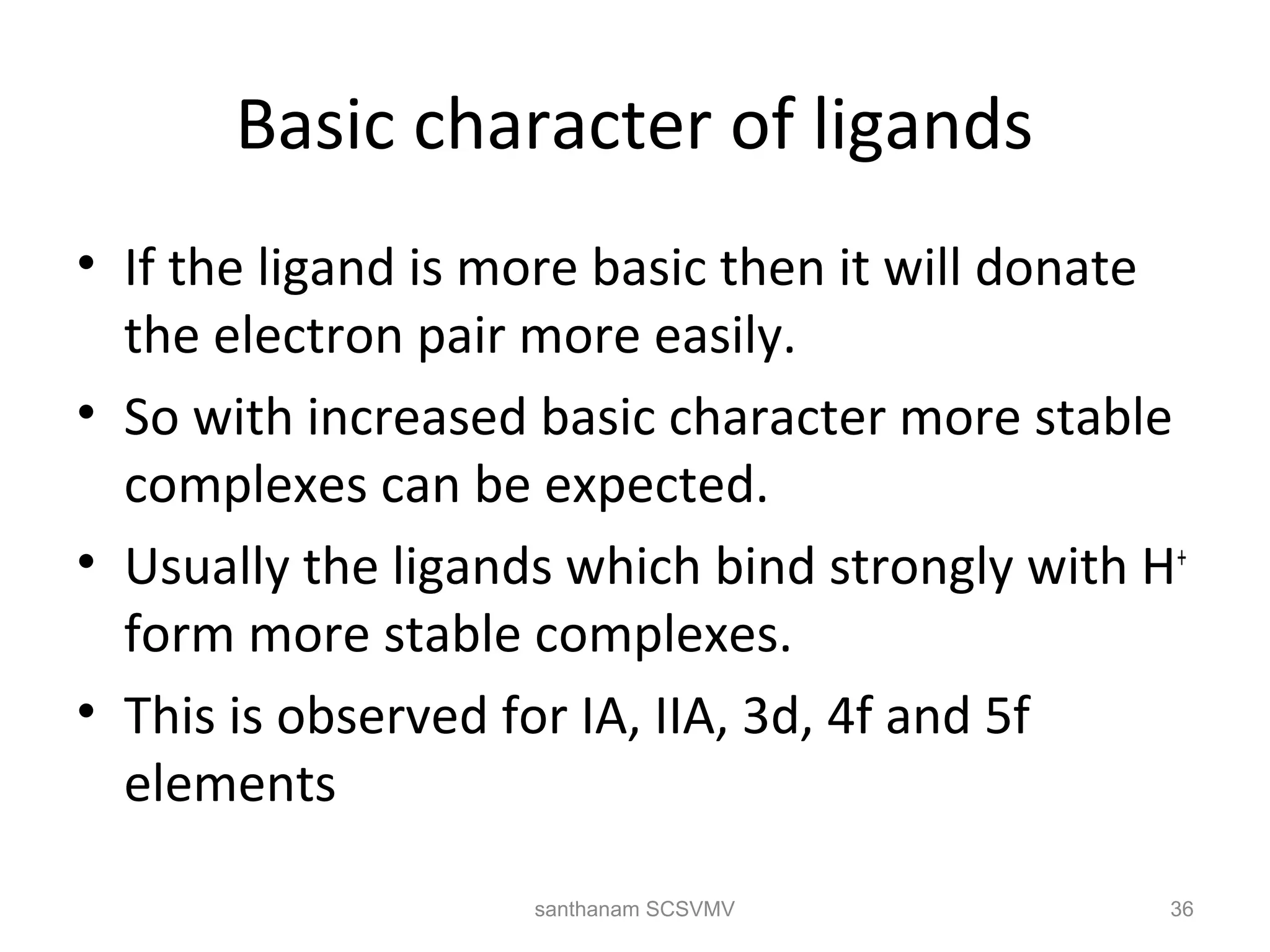
Basic character of ligands
• If the ligand is more basic then it will donate
the electron pair more easily.
• So with increased basic character more stable
complexes can be expected.
• Usually the ligands which bind strongly with H+
form more stable complexes.
• This is observed for IA, IIA, 3d, 4f and 5f
elements
36santhanam SCSVMV
The chelate effect or chelation is one of the most important ligand effects inThe chelate effect or chelation is one of the most important ligand effects in
transition metal coordination chemistry.transition metal coordination chemistry.
"The adjective chelate, derived from the great claw or chela (chely - Greek)
of the lobster, is suggested for the groups which function as two units
and fasten to the central atom so as to produce heterocyclic rings."
J. Chem. Soc., 1920, 117, 1456
Ni2+
Chelate
37santhanam SCSVMV
What are the implications of the following results?
NiCl2 + 6H2O → [Ni(H2O)6]+2
[Ni(H2O)6]+2
+ 6NH3 → [Ni(NH3)6]2+
+ 6H2O log β = 8.6
[Ni(NH3)6]2+
+ 3 NH2CH2CH2NH2 (en)
[Ni(en)3]2+
+ 6NH3
log β = 9.7
[Ni(H2O)6]+2
+ 3 NH2CH2CH2NH2 (en)
[Ni(en)3]2+
+ 6H2O
log β = 18.3
38santhanam SCSVMV
 NH3 is a stronger (better) ligand than
H2O
 ∆O NH3 > ∆O H2O
 [Ni(NH3)6]2+
is more stable
 ∆G = ∆H - T∆S (∆H -ve, ∆S≈ 0)
 ∆G for the reaction is negative
Complex Formation: Major Factors
[Ni(H2O)6] + 6NH3
→[Ni(NH3)6]2+
+ 6H2O
39santhanam SCSVMV
Chelate Formation: Major Factors
 en and NH3 have similar N-donor environment
 but en is bidentate and chelating ligand
 rxn proceeds towards right, ∆G negative
 ∆G = ∆H - T∆S (∆H -ve, ∆S ++ve)
 rxn proceeds due to entropy gain
 ∆S ++ve is the major factor behind chelate
effect
[Ni(NH3)6]2+
+ 3 NH2CH2CH2NH2 (en)
[Ni(en)3]2+
+ 6NH3
40santhanam SCSVMV
Cd2+
+ 4 NH3
↔ [Cd(NH3
)4
]2+
Cd2+
+ 2 en ↔ [Cd(en)2
]2+
Chelate Formation: Entropy Gain
Ligands
4 NH3
4 MeNH2
2 en
∆G
kJmol-1
-42.5
-37.2
-60.7
∆H
kJmol-1
- 53.2
-57.3
-56.5
∆S
JK-1
mol-1
- 35.5
- 67.3
+13.8
log β
7.44
6.52
10.62
Cd2+
+ 4 MeNH2
↔ [Cd(MeNH2
)4
]2+
41santhanam SCSVMV
Reaction of ammonia and en with Cu2+
[Cu(H2O)6]2+
+ en → [Cu(en)(H2O)4]2+
+ 2 H2O
Log K1 = 10.6 ∆H = -54 kJ/mol ∆S = 23 J/K/mol
[Cu(H2O)6]2+
+ 2NH3 → [Cu(NH3)2(H2O)2]2+
+ 2 H2O
Log β2 = 7.7 ∆H = -46 kJ/mol ∆S = -8.4 J/K/mol
Chelate Formation: Entropy Gain
42santhanam SCSVMV
Chelate effect
• The stability of the complex of a metal ion with a
bidentate ligand such as en is invariably significantly
greater than the complex of the same ion with two
monodentate ligands of comparable donor ability,
i.e., for example two ammonia molecule.
• The attainment of extra stability by formation of
ring structures , by bi or poly dentate ligands which
include the metal is termed as chelate effect.
43santhanam SCSVMV
Why chelates are more stable?
Suppose we have a metal ion in solution,
and we attach to it a monodentate ligand,
followed by a second monodentate ligand.
These two processes are completely
independent of each other.
44santhanam SCSVMV
Why chelates are more stable?
• But suppose we have a metal ion and we attach to it
one end of a chelating ligand
• Attachment of the second end of the chelate is now
no longer an independent process once one end is
attached, the other end, rather than floating around
freely in solution, is anchored by the linking group in
reasonably close proximity to the metal ion.
• Therefore more likely to join onto it than a
comparable monodentate ligand would be.
45santhanam SCSVMV
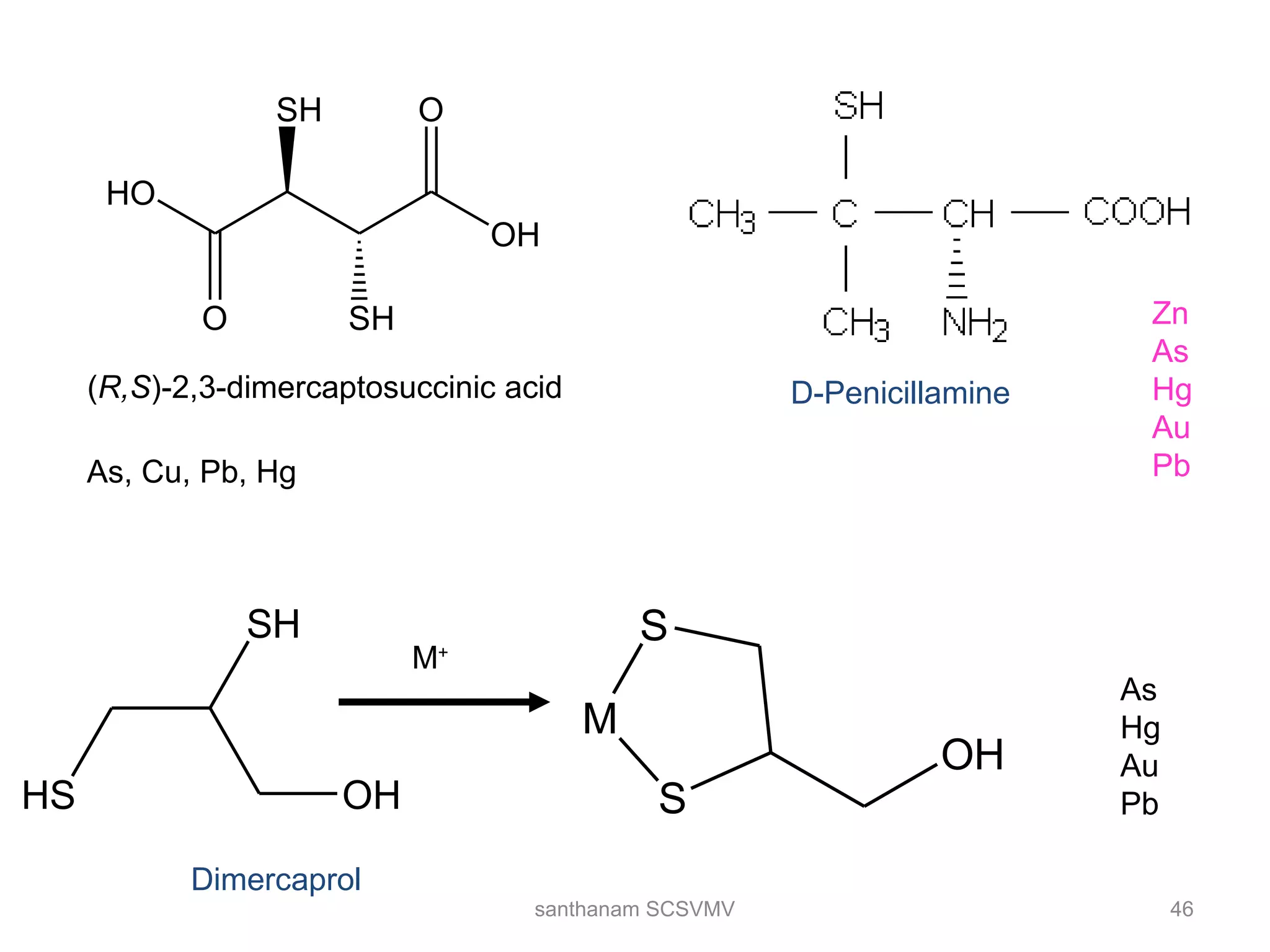
HO
OH
O
OSH
SH
(R,S)-2,3-dimercaptosuccinic acid
As, Cu, Pb, Hg
HS OH
SH
M+
S
S
OH
M
Dimercaprol
As
Hg
Au
Pb
D-Penicillamine
Zn
As
Hg
Au
Pb
46santhanam SCSVMV
CH2N
CH2
CH2
C
C
CH2 N
CH2
CH2 C
C
O
O
O
O
O O
OO
EDTA
*
* *
*
**
Important Chelating Ligands
47santhanam SCSVMV
Anticoagulant
Ca2+
EDTA: another view
48santhanam SCSVMV
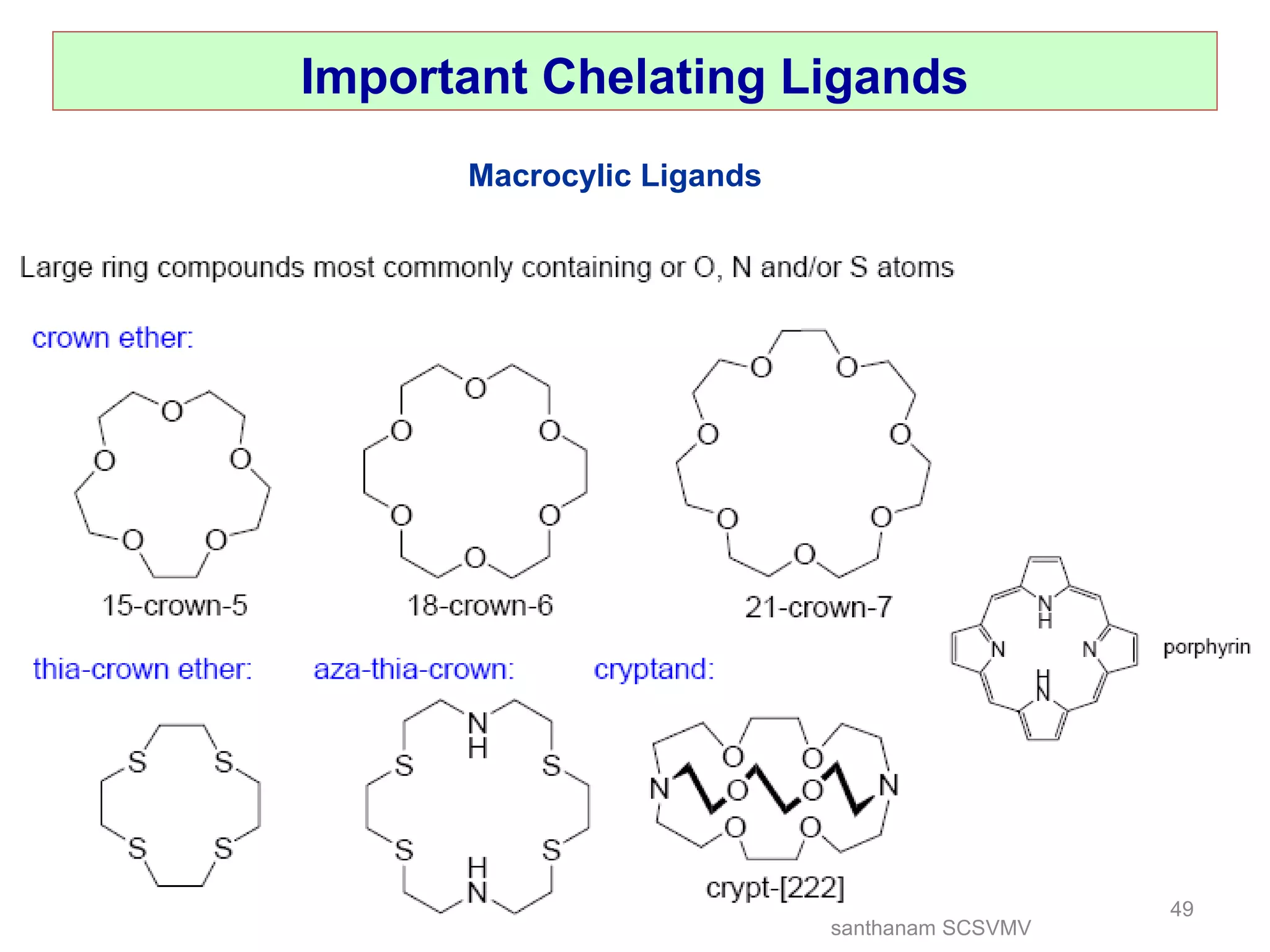
Macrocylic Ligands
Important Chelating Ligands
49
santhanam SCSVMV
[Cu(OH2)4]2+
+ en [Cu(OH2)2(en)]2+
+ 2 H2O
log K1 = 10.6 ΔH = -54 kJ mol-1
ΔS = 23 J K-1
mol-1
[Cu(OH2)4]2+
+ 2 NH3 [Cu(OH2)2(NH3)2]2+
+ 2H2O
log β2 = 7.7 ΔH = -46 kJ mol-1
ΔS = -8.4 J K-1
mol-1
50santhanam SCSVMV
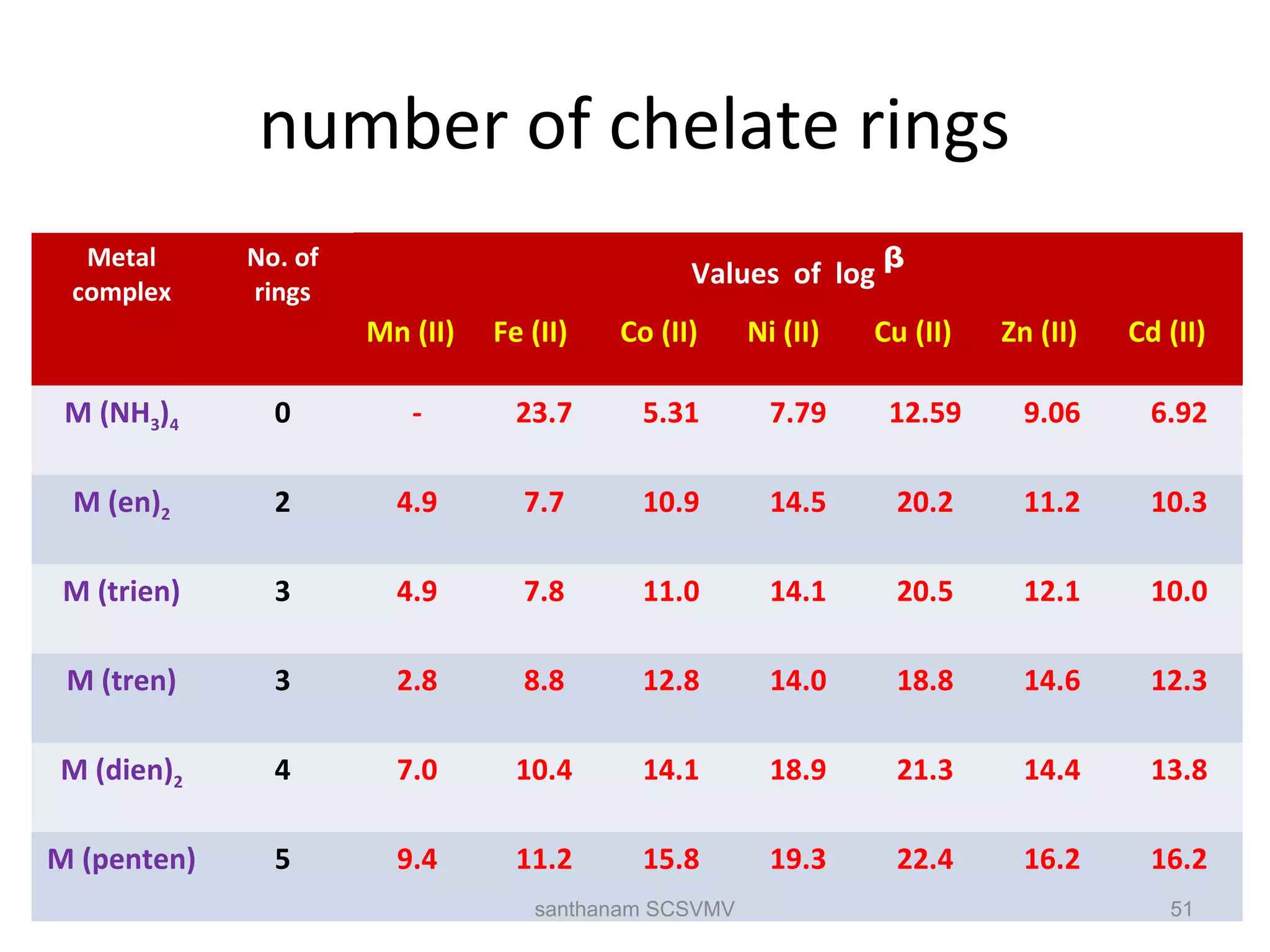
number of chelate rings
Metal
complex
No. of
rings
Values of log ᵝ
Mn (II) Fe (II) Co (II) Ni (II) Cu (II) Zn (II) Cd (II)
M (NH3)4 0 - 23.7 5.31 7.79 12.59 9.06 6.92
M (en)2 2 4.9 7.7 10.9 14.5 20.2 11.2 10.3
M (trien) 3 4.9 7.8 11.0 14.1 20.5 12.1 10.0
M (tren) 3 2.8 8.8 12.8 14.0 18.8 14.6 12.3
M (dien)2 4 7.0 10.4 14.1 18.9 21.3 14.4 13.8
M (penten) 5 9.4 11.2 15.8 19.3 22.4 16.2 16.2
51santhanam SCSVMV
Chelate ring size - i
In chelates ertain ring sizes are more
preferable than others.
Here are some data for cadmium complexes
of bidentate amines of the type
H2N(CH2)nNH2, where n = 1-4, i.e ring sizes
4-7.
52santhanam SCSVMV
Chelate ring size - ii
• When n = 1, the resulting four-membered ring is too
strained at the sp3
-hybridized carbon which wants to
try to have bond angles of 109°.
• It is worth pointing out, however, that there are lots
of perfectly stable four-membered chelate rings that
contain an sp2
-hybridized carbon in that position,
such as carboxylates (O2CR), dithiocarbamate
(S2CNR2), xanthate (S2COR) and so on
53santhanam SCSVMV
Chelate ring size - iii
• When n = 2, the resulting five-membered ring is
obviously the most stable one available, though n = 3
(six-membered ring) isn't bad either.
• When n = 4, the stability of the seven-membered
ring is starting to drop again. This is because in order
to accommodate the longer hydrocarbon chain, the
two nitrogens are being forced too far apart
54santhanam SCSVMV
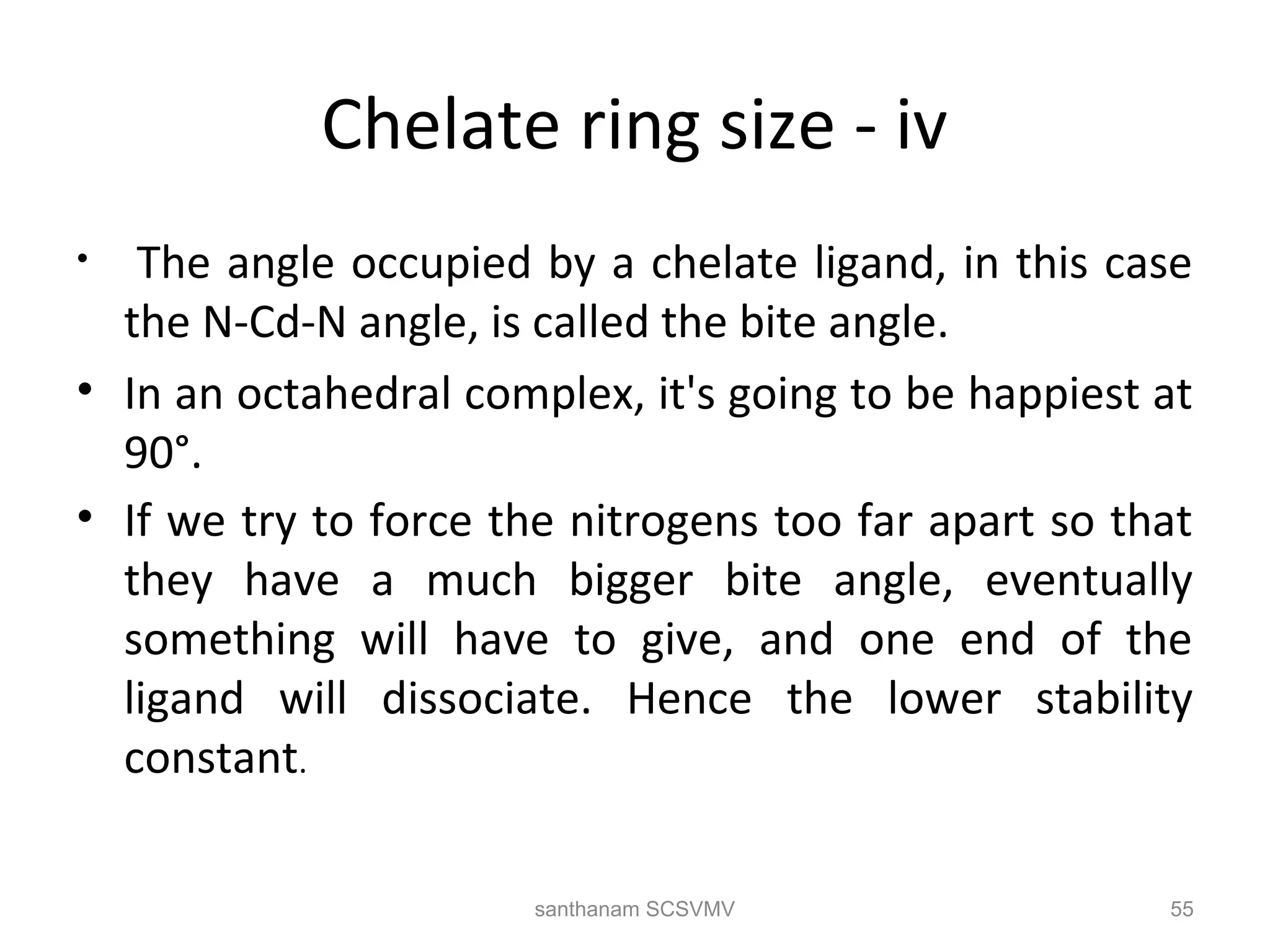
Chelate ring size - iv
• The angle occupied by a chelate ligand, in this case
the N-Cd-N angle, is called the bite angle.
• In an octahedral complex, it's going to be happiest at
90°.
• If we try to force the nitrogens too far apart so that
they have a much bigger bite angle, eventually
something will have to give, and one end of the
ligand will dissociate. Hence the lower stability
constant.
55santhanam SCSVMV
Steric factors
• when bulky groups are present near or on the
ligating atom, the steric forces come into play.
• Presence of bulkier groups near coordination
sites reduce the chances of ligand getting
closer to the metal.
• Even when complex is formed, to get relieved
from the steric hindrance the bond may
dissociate. This reduces the stability of
complex
56santhanam SCSVMV
EXPERIMENTAL DETERMINATIONEXPERIMENTAL DETERMINATION
OFOF
STABILITY CONSTANTSSTABILITY CONSTANTS
57santhanam SCSVMV
Spectrophotometric method
• While formation of a complex a striking colour change
also occurs.
• The absorption obeys Beer – Lambert’s law
– A = ε . C. l
• A can be measured by using a spectrophotometer
• If ε and l are known then C can be calculated.
• Considering the following reaction,
M2+
+ L ML2+
K = [ML2+
] / [M2+
] [L]
58santhanam SCSVMV
It is known that ,
CM = [M2+
] + [ML2+
]
CL = [L] + [ML2+
]
A = ε [ML2+]. C[ML2+] . l
C[ML2+] = A / ε [ML2+].l
So
[M2+
] = CM - (A / ε [ML2+].l)
[L] = CL - (A / ε [ML2+].l) 59santhanam SCSVMV
• A series of solutions containing varying ratios
of metal and ligand are taken.
• The absorption of the solution at wavelength
maximum is measured.
• From the absorbance and C,l values K is
calculated.
60santhanam SCSVMV
Potentiometric method
• Also known as Bjerrum method
• When ligand is a weak base or acid, there is
competition between hydrogen ions and
metal ions for the ligand .
L + H+
 HL+
Ka = [HL+
] / [L] [H+
]
L + M+
 ML+
KF = [ML+
] / [L] [M+
]
• If CH,CM and CL are the molar concentrations
santhanam SCSVMV 61
CH = [H+
] + [HL+
]
CL = [L] + [ML+
] + [HL+
]
CM = [M+
] + [ML+
]
• Solving the equations by using the association
constant of the ligand
[ML+
] = CL-CH+[H+] – CH-[H+
] / Ka [H+
]
[M+
] = CM – [ML+
]
[L] = CH – [H+
] / Ka [H+
]
santhanam SCSVMV 62
• Except [H+
] all the other parameters are
known , hence the stability constant can be
calculated after measuring the pH of the
solution by using a pH meter
• In order to get precise results the ligand must
be a moderately weak base or acid.
• KF value should be within 105
times of the
association constant
santhanam SCSVMV 63
santhanam SCSVMV 64

Stability of metal complexes

  • 1.
  • 2.
    DEFINING STABILITY  Thestatement that a complex is stable is rather loose and misleading very often.  It means that a complex exists and under suitable and required conditions it can be stored for a long time.  But this cannot be generalized to all complexes.  One particular complex may be stable towards a reagent and highly reactive towards another 2santhanam SCSVMV
  • 3.
    Thermodynamic stability • Asfor as complexes in solutions are concerned there are two kinds of stabilities • Thermodynamic stability – Measure of the extent to which the complex will be formed or will be transformed into another species, when the system has reached equilibrium 3santhanam SCSVMV
  • 4.
    Kinetic stability • Kineticstability – refers to the speed with which the transformations leading to equilibrium will occur. • Under this , the rates of substitutions, racemisations and their mechanisms. • The factors which are affecting the rates of the reactions are also studied 4santhanam SCSVMV
  • 5.
    Labile and Inertcomplexes • The complexes which rapidly exchange their ligands with other species are called labile. • If the ligand exchange reaction rate is slow then they are called inert complexes. • But the reactive nature should not be confused with the stability. 5santhanam SCSVMV
  • 6.
    Stability constant /Formation constant • According to Bjerrum formation of a complex in aqueous solution proceeds through a stepwise fashion with corresponding equilibrium constants M + L ML K1 = [ML] / [M] [L] ML + L ML2 K2 = [ML2] / [ML] [L] ML2 + L ML3 K3 = [ML2] / [ML2] [L] …………..………………………………. ………….……………………………….. MLn-1 + L MLn Kn = [MLn] / [MLn-1] [L] These K1,K2 K3 … Kn are called stepwise formation constants K1 Kn K3 K2 6santhanam SCSVMV
  • 7.
    Overall stability constant •If the complex formation is considered as a single step process M + nL MLn = [MLn] / [M] [L]ᵝn 7santhanam SCSVMV
  • 8.
    Trends in stabilityconstants [Cu(OH2)4]2+ + NH3  [Cu(OH2)3(NH3)]2+ + H2O log K1 = 4.22 [Cu(OH2)3(NH3)]2+ + NH3  [Cu(OH2)2(NH3)2]2+ + H2O log K2 = 3.50 [Cu(OH2)2(NH3)2]2+ + NH3  [Cu(OH2)(NH3)3]2+ + H2O log K3 = 2.92 [Cu(OH2)(NH3)3]2+ + NH3  [Cu(NH3)4]2+ + H2O log K4 = 2.18 • Generally the stepwise stability constant values decrease with successive replacement by the ligands 8santhanam SCSVMV
  • 9.
  • 10.
    Statistical effect explanation •When more ligands are entering into the coordination sphere the number of aqua ligand decreases. • This reduces the probability of substitution of aqua ligand with the new ligand. • Reflected as decreasing stepwise formation constants 10santhanam SCSVMV
  • 11.
    Relationship between Knand ᵝn • Let us consider ᵝ3 = [ML3] / [M] [L]3 = [ML3] . [ML2] . [ML] [M] [L]3 . [ML2] . [ML] = [ML] . [ML2] . [ML3] [M] [L] [ML] [L] [ML2] [L] = K1 . K2 . K3 In general ᵝn = K .K .K . ….. K 11santhanam SCSVMV
  • 12.
    Kinetic Vs Thermodynamicstability • The terms labile and inert refer to the reactivity of a complex only. • Not to be confused with its stability. • An inert complex may be stable or unstable. • Similarly a labile complex may be stable or unstable 12santhanam SCSVMV
  • 13.
    Exemplification • The abovesaid fact is clearly shown by the complex [Hg(CN)4]2- . Hg2+ + 4CN- [Hg(CN)4]2- ᵝ ≈ 10 42 • The over all formation constant is having very high value which means that equilibrium is lying far too right. 13santhanam SCSVMV
  • 14.
    • But whenthis complex exchanges its CN- ligands with 14 C labeled CN- solution very high rate showing that the complex is labile. • So the thermodynamic stability is not connected to the lability or inertness of a complex. 14santhanam SCSVMV
  • 15.
    Explanation of labilityand inertness according to VBT • VBT classifies octahedral complexes into two types. • Inner orbital complexes – d2 sp3 • Outer orbital complex – sp3 d2 • The two d-orbitals involved in the hybridization are the egset of orbitals. 15santhanam SCSVMV
  • 16.
    Outer orbital complexes •The complexes having sp3 d2 hybridization are called outer orbital complexes. • In terms of VBT these bonds are weaker. • They are generally labile. • Mn(II), Fe(II),Fe(III),Co(II),Ni(II),Cu(II) and Cr(II) are labile. 16santhanam SCSVMV
  • 17.
    Inner orbital complexes •These complexes generally have d2 sp3 hybridization. • The hybrid orbitals are filled with the ligand electrons. • The t2g orbitals of metal accommodate the d electrons of the metal. 17santhanam SCSVMV
  • 18.
    • If thet2g levels are left vacant then the complex can associate with an incoming ligand and the complex is labile • If all the t2g levels are occupied then the complex becomes inert. 18santhanam SCSVMV
  • 19.
    Labile and inertcomplexes on the basis of CFT • According to CFT the ligand field splits the d- orbitals. • This splitting leads to a decrease in energy of the system whose magnitude depends on the number of d electrons present. • if the CFSE value increases by association or dissociation of a ligand then the complex is labile. • On the other hand it is inert when there is a loss in CFSE value. 19santhanam SCSVMV
  • 20.
    Factors affecting labilityof complexes • Charge of the central ion: Highly charged ions form complexes which react slowly i.e. inert • Radii of the ion: the reactivity decreases with decreasing ionic radii. • Charge to radius ratio: if all the factors are similar, the ion with largest z/r value reacts with the least rate. • Geometry of the complex: Generally four coordinated complexes are more labile 20santhanam SCSVMV
  • 21.
  • 22.
    Properties of themetal ion • Charge and size • Natural order (or) Irving –William order of stability • Class a and Class b metals • Electronegativity of the metal ion 22santhanam SCSVMV
  • 23.
    Charge and sizeof the ion • In general metal ions with higher charge and small size form stable complexes. • A small cation with high charge attracts the ligands more closely leading to stable complexes. • The following tables explain the facts that if z/r ratio (polarizing power) of the metal ion is high then stability of the complex is also high 23santhanam SCSVMV
  • 24.
    Effect of ionicradius Complex ion Charge on the ion Ionic radii (Aₒ ) Value of ᵝ stability [BeII (OH)] + +2 0.31 107 [MgII (OH)] + +2 0.65 120 [CaII (OH)] + +2 0.99 30 [BaII (OH)] + +2 1.35 4 24santhanam SCSVMV
  • 25.
    Effect of charge Complexion Charge on the ion Ionic radii (Aₒ ) Value of log ᵝ stability [FeIII (CN)6] 3- +3 31.0 [FeIII (CN)6] 4- +2 8.3 CoIII complex +3 high CoII complex +2 low Almost same Almost same 25santhanam SCSVMV
  • 26.
    Irving – Williamorder of stability • Stabilities of the high spin complexes of the 3d metals from Mn2+ to Zn 2+ with a common ligand is usually MnMn2+2+ < Fe< Fe2+2+ < Co< Co2+2+ < Ni< Ni2+2+ < Cu< Cu2+2+ > Zn> Zn 2+2+ • This is attributed to the CFSE values of the complexes and called natural order of stability. • There is a discrepancy with Cu which is due to Jahn – Teller distortion 26santhanam SCSVMV
  • 27.
    CFSE as afunction of no of d- electrons 0 0.2 0.4 0.6 0.8 1 1.2 1.4 0 1 2 3 4 5 6 7 8 9 10 11 no of d-electrons CFSEinmultiplesofΔ. Crystal Field Stabilization Energy (CFSE) of d0 to d10 M(II) ions: Ca2+ Mn2+ Zn2+ double- humped curve Ni2+ 27santhanam SCSVMV
  • 28.
    log K1(EDTA) asa function of no of d- electrons 10 12 14 16 18 20 0 1 2 3 4 5 6 7 8 9 10 11 no of d-electrons logK1(EDTA). Log K1(EDTA) of d0 to d10 M(II) ions: Ca2+ Mn2+ Zn2+ double- humped curve = CFSE rising baseline due to ionic contraction 28santhanam SCSVMV
  • 29.
    log K1(en) asa function of no of d- electrons 0 2 4 6 8 10 12 0 1 2 3 4 5 6 7 8 9 10 11 no of d-electrons logK1(en). Log K1(en) of d0 to d10 M(II) ions: double- humped curve Ca2+ Mn2+ Zn2+ rising baseline due to ionic contraction = CFSE 29santhanam SCSVMV
  • 30.
    log K1(tpen) asa function of no of d- electrons 0 5 10 15 20 0 1 2 3 4 5 6 7 8 9 10 11 no of d-electrons logK1(tpen). Log K1(tpen) of d0 to d10 M(II) ions: Ca2+ Mn2+ Zn2+ double- humped curve N N NN N Ntpen 30santhanam SCSVMV
  • 31.
    Class a andClass b metals • Chatt and Ahrland classified metals into three types. • Class a , Class b and border line. • Class a : H, alkali and alkaline earth metals, Sc -> Cr, Al -> Cl, Zn -> Br , In, Sn , Sb , I, lathanides and actinides • Class b: Rh ,Pd , Ag , Ir , Pt , Au and Hg • Border line: Mn -> Cu , Tl -> Po, Mo , Te , Ru , W , Re , Os and Cd 31santhanam SCSVMV
  • 32.
    • Class ametals form more stable complexes with ligands in which coordination atoms are from second period. ( N , O , F) • Class b metals form more stable complexes with ligands having third period elements as ligating atoms. (P , S , Cl) • Class b metals are having capacity to form pi bonds with the ligand atoms. The expansion is possible only from the third period donor atoms. • Border line metals do not show any noticeable trend. 32santhanam SCSVMV
  • 33.
    Electronegativity of themetal atom • The bond between metal and ligand atom is, to some extent due to the donation of electron pair to the metal. • If the metal is having a tendency attract the electron pair (Higher electronegativity) then more stable complexes are formed . 33santhanam SCSVMV
  • 34.
    Properties of ligand •Size and charge • Basic character • Chelate effect • Size of the chelate ring • Steric effect 34santhanam SCSVMV
  • 35.
    Size and chargeof the ligand • To some extent we can say that if the ligand is smaller in size and bearing higher charge it will form more stable complexes. • For example usually F- forms more stable complexes that Cl- • In the case of neutral mono dentate ligands, high dipole moment and small size favour more stable complexes. 35santhanam SCSVMV
  • 36.
    Basic character ofligands • If the ligand is more basic then it will donate the electron pair more easily. • So with increased basic character more stable complexes can be expected. • Usually the ligands which bind strongly with H+ form more stable complexes. • This is observed for IA, IIA, 3d, 4f and 5f elements 36santhanam SCSVMV
  • 37.
    The chelate effector chelation is one of the most important ligand effects inThe chelate effect or chelation is one of the most important ligand effects in transition metal coordination chemistry.transition metal coordination chemistry. "The adjective chelate, derived from the great claw or chela (chely - Greek) of the lobster, is suggested for the groups which function as two units and fasten to the central atom so as to produce heterocyclic rings." J. Chem. Soc., 1920, 117, 1456 Ni2+ Chelate 37santhanam SCSVMV
  • 38.
    What are theimplications of the following results? NiCl2 + 6H2O → [Ni(H2O)6]+2 [Ni(H2O)6]+2 + 6NH3 → [Ni(NH3)6]2+ + 6H2O log β = 8.6 [Ni(NH3)6]2+ + 3 NH2CH2CH2NH2 (en) [Ni(en)3]2+ + 6NH3 log β = 9.7 [Ni(H2O)6]+2 + 3 NH2CH2CH2NH2 (en) [Ni(en)3]2+ + 6H2O log β = 18.3 38santhanam SCSVMV
  • 39.
     NH3 isa stronger (better) ligand than H2O  ∆O NH3 > ∆O H2O  [Ni(NH3)6]2+ is more stable  ∆G = ∆H - T∆S (∆H -ve, ∆S≈ 0)  ∆G for the reaction is negative Complex Formation: Major Factors [Ni(H2O)6] + 6NH3 →[Ni(NH3)6]2+ + 6H2O 39santhanam SCSVMV
  • 40.
    Chelate Formation: MajorFactors  en and NH3 have similar N-donor environment  but en is bidentate and chelating ligand  rxn proceeds towards right, ∆G negative  ∆G = ∆H - T∆S (∆H -ve, ∆S ++ve)  rxn proceeds due to entropy gain  ∆S ++ve is the major factor behind chelate effect [Ni(NH3)6]2+ + 3 NH2CH2CH2NH2 (en) [Ni(en)3]2+ + 6NH3 40santhanam SCSVMV
  • 41.
    Cd2+ + 4 NH3 ↔[Cd(NH3 )4 ]2+ Cd2+ + 2 en ↔ [Cd(en)2 ]2+ Chelate Formation: Entropy Gain Ligands 4 NH3 4 MeNH2 2 en ∆G kJmol-1 -42.5 -37.2 -60.7 ∆H kJmol-1 - 53.2 -57.3 -56.5 ∆S JK-1 mol-1 - 35.5 - 67.3 +13.8 log β 7.44 6.52 10.62 Cd2+ + 4 MeNH2 ↔ [Cd(MeNH2 )4 ]2+ 41santhanam SCSVMV
  • 42.
    Reaction of ammoniaand en with Cu2+ [Cu(H2O)6]2+ + en → [Cu(en)(H2O)4]2+ + 2 H2O Log K1 = 10.6 ∆H = -54 kJ/mol ∆S = 23 J/K/mol [Cu(H2O)6]2+ + 2NH3 → [Cu(NH3)2(H2O)2]2+ + 2 H2O Log β2 = 7.7 ∆H = -46 kJ/mol ∆S = -8.4 J/K/mol Chelate Formation: Entropy Gain 42santhanam SCSVMV
  • 43.
    Chelate effect • Thestability of the complex of a metal ion with a bidentate ligand such as en is invariably significantly greater than the complex of the same ion with two monodentate ligands of comparable donor ability, i.e., for example two ammonia molecule. • The attainment of extra stability by formation of ring structures , by bi or poly dentate ligands which include the metal is termed as chelate effect. 43santhanam SCSVMV
  • 44.
    Why chelates aremore stable? Suppose we have a metal ion in solution, and we attach to it a monodentate ligand, followed by a second monodentate ligand. These two processes are completely independent of each other. 44santhanam SCSVMV
  • 45.
    Why chelates aremore stable? • But suppose we have a metal ion and we attach to it one end of a chelating ligand • Attachment of the second end of the chelate is now no longer an independent process once one end is attached, the other end, rather than floating around freely in solution, is anchored by the linking group in reasonably close proximity to the metal ion. • Therefore more likely to join onto it than a comparable monodentate ligand would be. 45santhanam SCSVMV
  • 46.
    HO OH O OSH SH (R,S)-2,3-dimercaptosuccinic acid As, Cu,Pb, Hg HS OH SH M+ S S OH M Dimercaprol As Hg Au Pb D-Penicillamine Zn As Hg Au Pb 46santhanam SCSVMV
  • 47.
    CH2N CH2 CH2 C C CH2 N CH2 CH2 C C O O O O OO OO EDTA * * * * ** Important Chelating Ligands 47santhanam SCSVMV
  • 48.
  • 49.
    Macrocylic Ligands Important ChelatingLigands 49 santhanam SCSVMV
  • 50.
    [Cu(OH2)4]2+ + en [Cu(OH2)2(en)]2+ +2 H2O log K1 = 10.6 ΔH = -54 kJ mol-1 ΔS = 23 J K-1 mol-1 [Cu(OH2)4]2+ + 2 NH3 [Cu(OH2)2(NH3)2]2+ + 2H2O log β2 = 7.7 ΔH = -46 kJ mol-1 ΔS = -8.4 J K-1 mol-1 50santhanam SCSVMV
  • 51.
    number of chelaterings Metal complex No. of rings Values of log ᵝ Mn (II) Fe (II) Co (II) Ni (II) Cu (II) Zn (II) Cd (II) M (NH3)4 0 - 23.7 5.31 7.79 12.59 9.06 6.92 M (en)2 2 4.9 7.7 10.9 14.5 20.2 11.2 10.3 M (trien) 3 4.9 7.8 11.0 14.1 20.5 12.1 10.0 M (tren) 3 2.8 8.8 12.8 14.0 18.8 14.6 12.3 M (dien)2 4 7.0 10.4 14.1 18.9 21.3 14.4 13.8 M (penten) 5 9.4 11.2 15.8 19.3 22.4 16.2 16.2 51santhanam SCSVMV
  • 52.
    Chelate ring size- i In chelates ertain ring sizes are more preferable than others. Here are some data for cadmium complexes of bidentate amines of the type H2N(CH2)nNH2, where n = 1-4, i.e ring sizes 4-7. 52santhanam SCSVMV
  • 53.
    Chelate ring size- ii • When n = 1, the resulting four-membered ring is too strained at the sp3 -hybridized carbon which wants to try to have bond angles of 109°. • It is worth pointing out, however, that there are lots of perfectly stable four-membered chelate rings that contain an sp2 -hybridized carbon in that position, such as carboxylates (O2CR), dithiocarbamate (S2CNR2), xanthate (S2COR) and so on 53santhanam SCSVMV
  • 54.
    Chelate ring size- iii • When n = 2, the resulting five-membered ring is obviously the most stable one available, though n = 3 (six-membered ring) isn't bad either. • When n = 4, the stability of the seven-membered ring is starting to drop again. This is because in order to accommodate the longer hydrocarbon chain, the two nitrogens are being forced too far apart 54santhanam SCSVMV
  • 55.
    Chelate ring size- iv • The angle occupied by a chelate ligand, in this case the N-Cd-N angle, is called the bite angle. • In an octahedral complex, it's going to be happiest at 90°. • If we try to force the nitrogens too far apart so that they have a much bigger bite angle, eventually something will have to give, and one end of the ligand will dissociate. Hence the lower stability constant. 55santhanam SCSVMV
  • 56.
    Steric factors • whenbulky groups are present near or on the ligating atom, the steric forces come into play. • Presence of bulkier groups near coordination sites reduce the chances of ligand getting closer to the metal. • Even when complex is formed, to get relieved from the steric hindrance the bond may dissociate. This reduces the stability of complex 56santhanam SCSVMV
  • 57.
    EXPERIMENTAL DETERMINATIONEXPERIMENTAL DETERMINATION OFOF STABILITYCONSTANTSSTABILITY CONSTANTS 57santhanam SCSVMV
  • 58.
    Spectrophotometric method • Whileformation of a complex a striking colour change also occurs. • The absorption obeys Beer – Lambert’s law – A = ε . C. l • A can be measured by using a spectrophotometer • If ε and l are known then C can be calculated. • Considering the following reaction, M2+ + L ML2+ K = [ML2+ ] / [M2+ ] [L] 58santhanam SCSVMV
  • 59.
    It is knownthat , CM = [M2+ ] + [ML2+ ] CL = [L] + [ML2+ ] A = ε [ML2+]. C[ML2+] . l C[ML2+] = A / ε [ML2+].l So [M2+ ] = CM - (A / ε [ML2+].l) [L] = CL - (A / ε [ML2+].l) 59santhanam SCSVMV
  • 60.
    • A seriesof solutions containing varying ratios of metal and ligand are taken. • The absorption of the solution at wavelength maximum is measured. • From the absorbance and C,l values K is calculated. 60santhanam SCSVMV
  • 61.
    Potentiometric method • Alsoknown as Bjerrum method • When ligand is a weak base or acid, there is competition between hydrogen ions and metal ions for the ligand . L + H+  HL+ Ka = [HL+ ] / [L] [H+ ] L + M+  ML+ KF = [ML+ ] / [L] [M+ ] • If CH,CM and CL are the molar concentrations santhanam SCSVMV 61
  • 62.
    CH = [H+ ]+ [HL+ ] CL = [L] + [ML+ ] + [HL+ ] CM = [M+ ] + [ML+ ] • Solving the equations by using the association constant of the ligand [ML+ ] = CL-CH+[H+] – CH-[H+ ] / Ka [H+ ] [M+ ] = CM – [ML+ ] [L] = CH – [H+ ] / Ka [H+ ] santhanam SCSVMV 62
  • 63.
    • Except [H+ ]all the other parameters are known , hence the stability constant can be calculated after measuring the pH of the solution by using a pH meter • In order to get precise results the ligand must be a moderately weak base or acid. • KF value should be within 105 times of the association constant santhanam SCSVMV 63
  • 64.