Determinants
Introduction
Every square matrix has associated with it a scalar called its
determinant.
Given a matrix A, we use det(A) or |A| to designate its determinant.
We can also designate the determinant of matrix A by replacing the
brackets by vertical straight lines. For example,
A=[2 1
0 3 ] det(A)=∣
2 1
0 3
∣
Definition 1: The determinant of a 1×1 matrix [a] is the scalar a.
Definition 2: The determinant of a 2×2 matrix is the scalar ad-bc.
For higher order matrices, we will use a recursive procedure to compute
determinants.
[a b
c d]
Expansion by Cofactors
Definition 1: Given a matrix A, a minor is the determinant of
square submatrix of A.
Definition 2: Given a matrix A=[aij] , the cofactor of the element
aij is a scalar obtained by multiplying together the term (-1)i+j
and the minor obtained from A by removing the ith row and the
jth column.
In other words, the cofactor Cij is given by Cij = (−1)i+j
Mij.
For example,
A=
[
a11 a12 a13
a21 a22 a23
a31 a32 a33
]
M21=∣
a12 a13
a32 a33
∣
M22=∣
a11 a13
a31 a33
∣
⇒C21=(−1)2+1
M 21=−M21
⇒C22=(−1)
2+2
M22=M22
Expansion by Cofactors
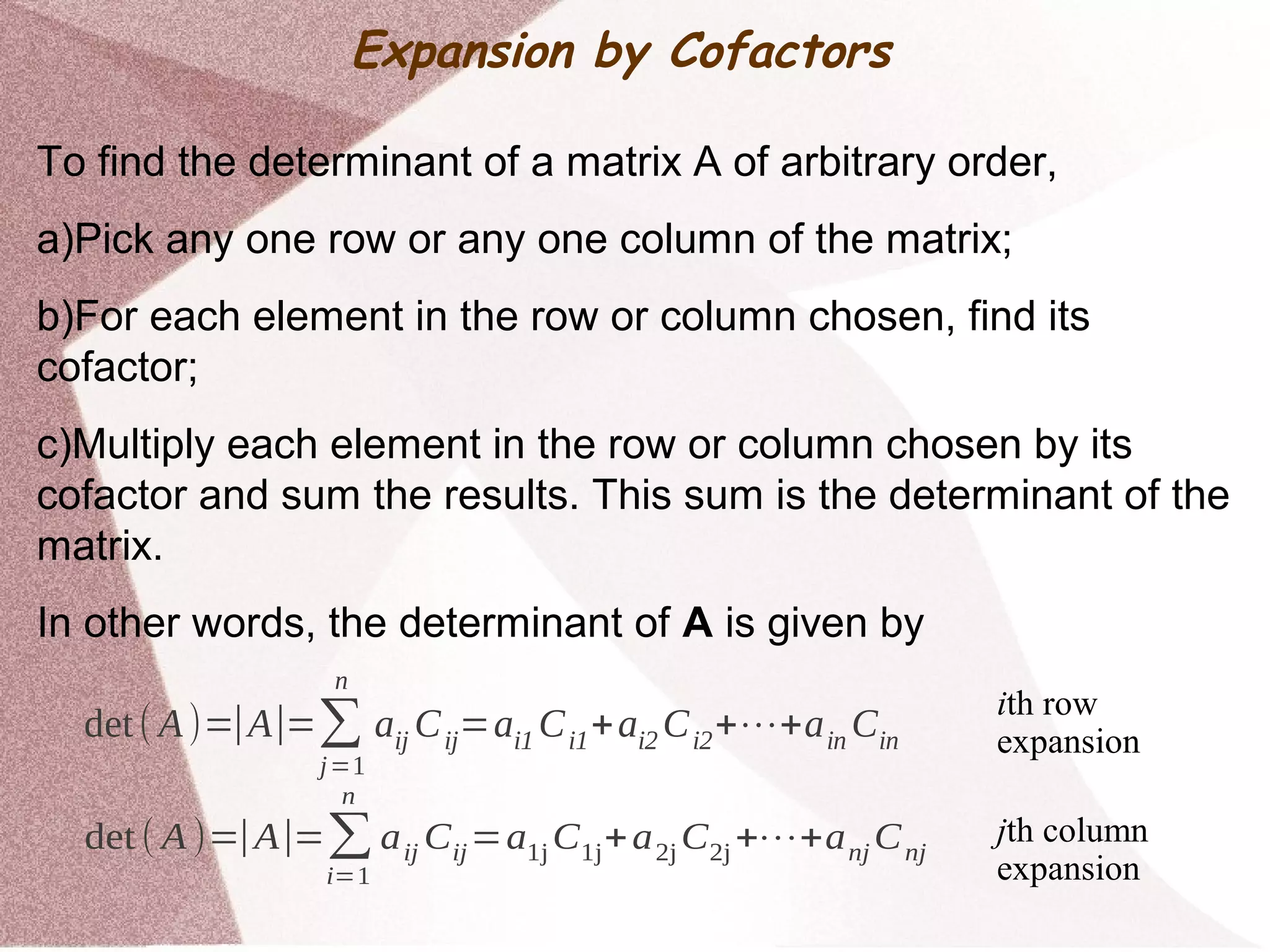
To find the determinant of a matrix A of arbitrary order,
a)Pick any one row or any one column of the matrix;
b)For each element in the row or column chosen, find its
cofactor;
c)Multiply each element in the row or column chosen by its
cofactor and sum the results. This sum is the determinant of the
matrix.
In other words, the determinant of A is given by
det( A)=∣A∣=∑
j=1
n
aij Cij=ai1 Ci1+ai2 Ci2+⋯+ain Cin
det ( A )=∣A∣=∑
i=1
n
aij Cij=a1j C1j+a2j C2j +⋯+anj Cnj
ith row
expansion
jth column
expansion
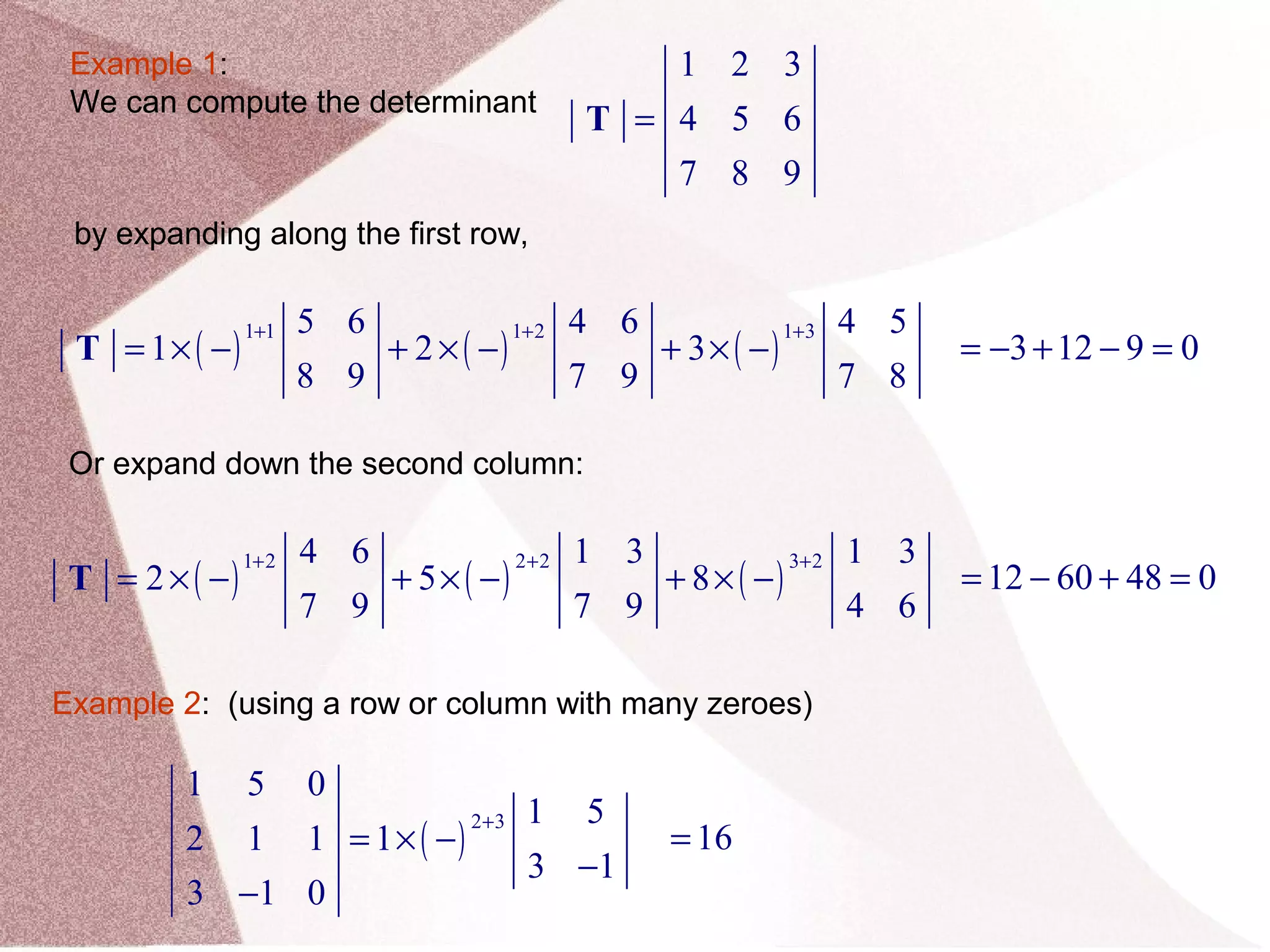
Example 1:
We can compute the determinant
1 2 3
4 5 6
7 8 9
=T
by expanding along the first row,
( ) ( ) ( )
1 1 1 2 1 35 6 4 6 4 5
1 2 3
8 9 7 9 7 8
+ + +
= × − + × − + × −T 3 12 9 0= − + − =
Or expand down the second column:
( ) ( ) ( )
1 2 2 2 3 24 6 1 3 1 3
2 5 8
7 9 7 9 4 6
+ + +
= × − + × − + × −T 12 60 48 0= − + =
Example 2: (using a row or column with many zeroes)
( )
2 3
1 5 0
1 5
2 1 1 1
3 1
3 1 0
+
= × −
−
−
16=
Properties of determinants
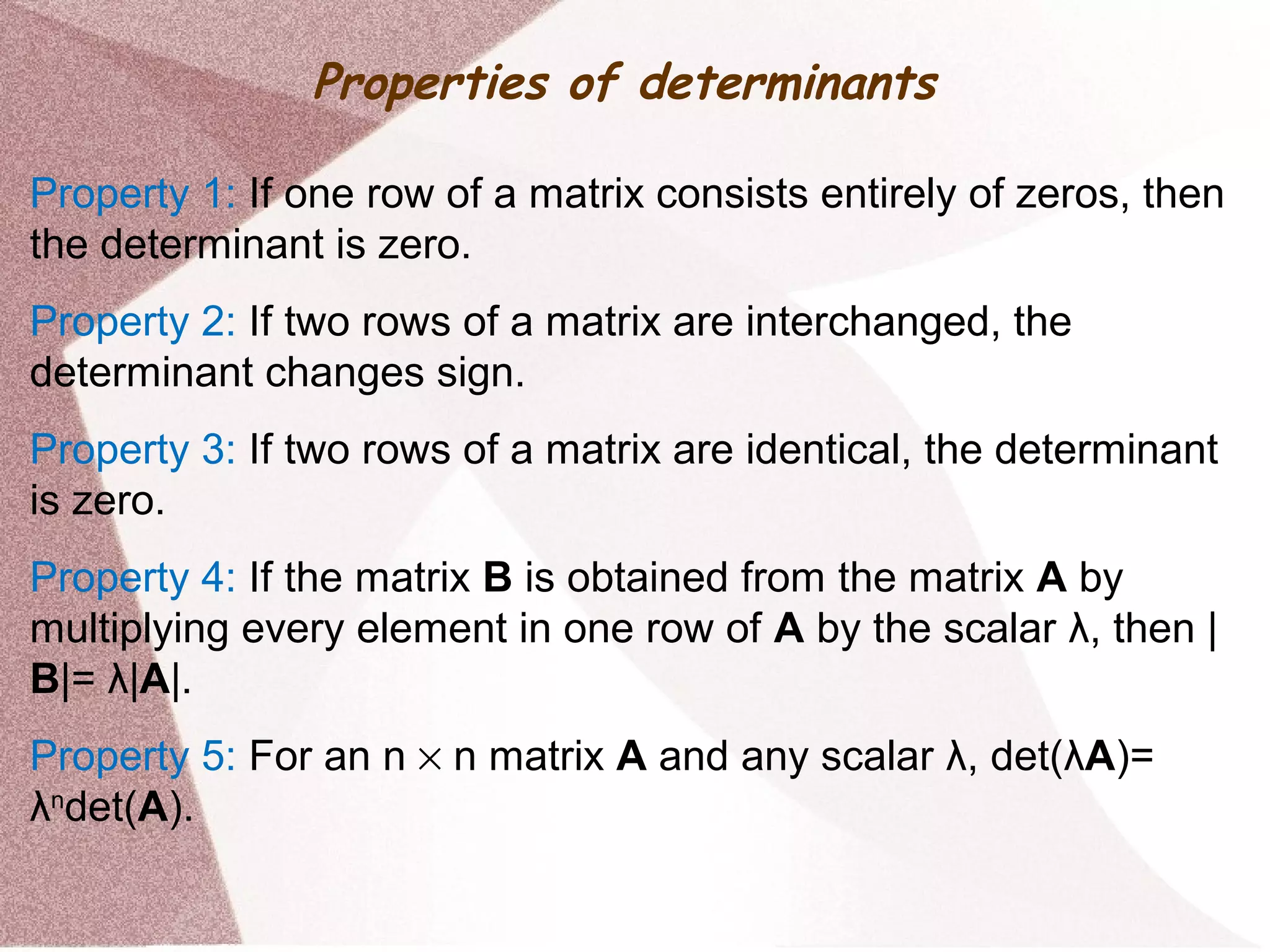
Property 1: If one row of a matrix consists entirely of zeros, then
the determinant is zero.
Property 2: If two rows of a matrix are interchanged, the
determinant changes sign.
Property 3: If two rows of a matrix are identical, the determinant
is zero.
Property 4: If the matrix B is obtained from the matrix A by
multiplying every element in one row of A by the scalar λ, then |
B|= λ|A|.
Property 5: For an n × n matrix A and any scalar λ, det(λA)=
λn
det(A).
Properties of determinants
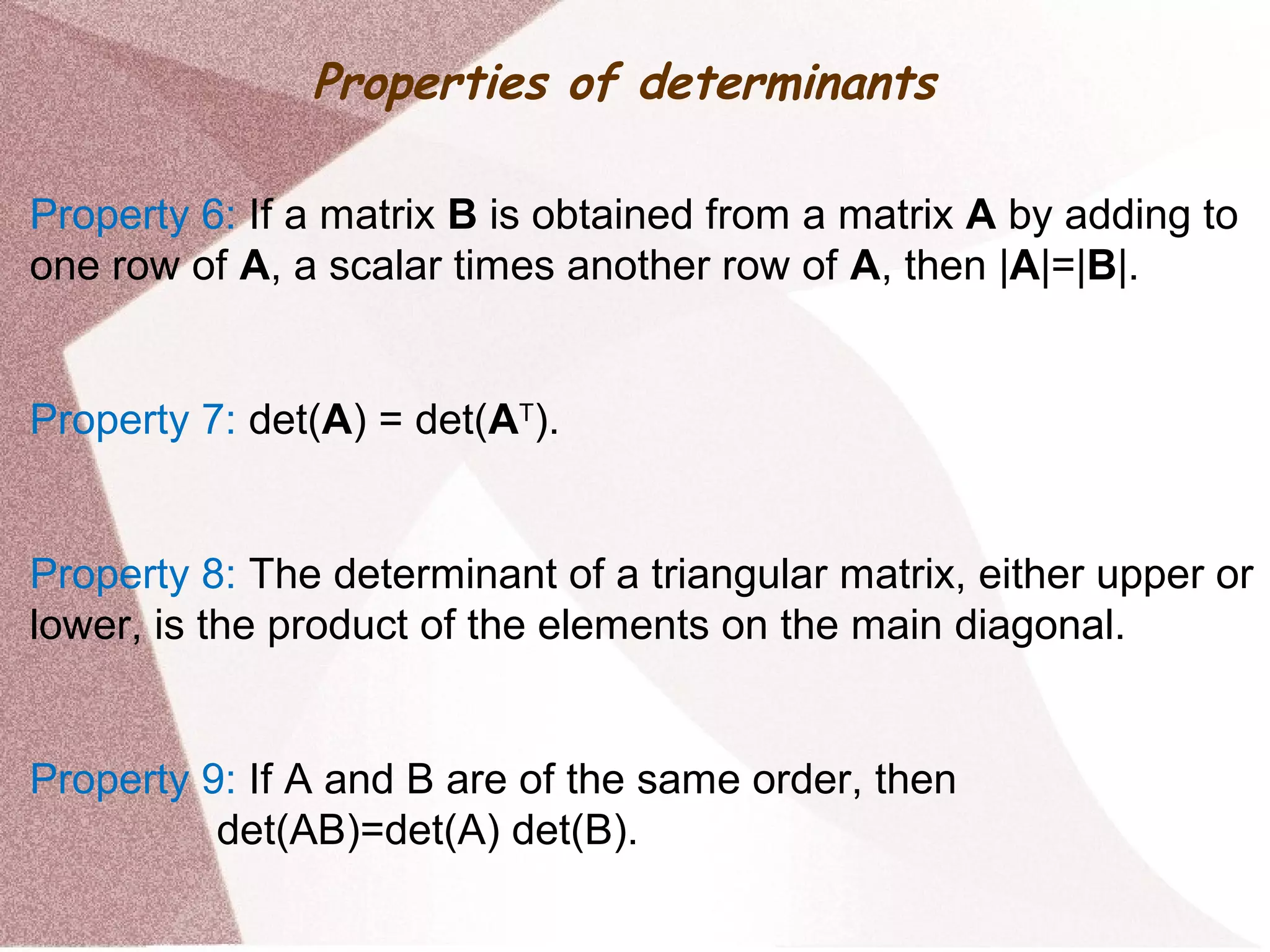
Property 6: If a matrix B is obtained from a matrix A by adding to
one row of A, a scalar times another row of A, then |A|=|B|.
Property 7: det(A) = det(AT
).
Property 8: The determinant of a triangular matrix, either upper or
lower, is the product of the elements on the main diagonal.
Property 9: If A and B are of the same order, then
det(AB)=det(A) det(B).
Inversion
Theorem 1: A square matrix has an inverse if and only if its
determinant is not zero.
Below we develop a method to calculate the inverse of
nonsingular matrices using determinants.
Definition 1: The cofactor matrix associated with an n × n matrix
A is an n × n matrix Ac
obtained from A by replacing each
element of A by its cofactor.
Definition 2: The adjugate of an n × n matrix A is the transpose
of the cofactor matrix of A: Aa
= (Ac
)T

Find the adjugate of
Solution:
The cofactor matrix of A:
A=
[−1 3 2
0 −2 1
1 0 −2 ]
[
∣−2 1
0 −2
∣ −∣0 1
1 −2
∣ ∣0 −2
1 0
∣
−∣
3 2
0 −2
∣ ∣
−1 2
1 −2
∣ −∣
−1 3
1 0
∣
∣
3 2
−2 1
∣ −∣
−1 2
0 1
∣ ∣
−1 3
0 −2
∣] =
[4 1 2
6 0 3
7 1 2 ]
Aa
=
[4 6 7
1 0 1
2 3 2 ]
Example of finding adjugate
Inversion using determinants
Theorem 2: A Aa
= Aa
A = |A| I .
If |A| ≠ 0 then from Theorem 2, A(Aa
∣A∣)=(Aa
∣A∣)A=I
A
−1
=
1
∣A∣
A
a
if ∣A∣≠0
That is, if |A| ≠ 0, then A-1
may be obtained by dividing the
adjugate of A by the determinant of A.
For example, if
then
A=[a b
c d ],
A−1
=
1
∣A∣
Aa
=
1
ad−bc [d −b
−c a ]
Use the adjugate of to find A-1A=
[−1 3 2
0 −2 1
1 0 −2 ]
Aa
=
[4 6 7
1 0 1
2 3 2 ]
∣A∣=(−1)(−2)(−2)+(3)(1)(1)−(1)(−2)(2)=3
A
−1
=
1
∣A∣
A
a
=
1
3 [
4 6 7
1 0 1
2 3 2 ]=
[
4
3
2 7
3
1
3
0
1
3
2
3
1 2
3
]
Inversion using determinants: example

Determinants - Mathematics

  • 1.
  • 2.
    Introduction Every square matrixhas associated with it a scalar called its determinant. Given a matrix A, we use det(A) or |A| to designate its determinant. We can also designate the determinant of matrix A by replacing the brackets by vertical straight lines. For example, A=[2 1 0 3 ] det(A)=∣ 2 1 0 3 ∣ Definition 1: The determinant of a 1×1 matrix [a] is the scalar a. Definition 2: The determinant of a 2×2 matrix is the scalar ad-bc. For higher order matrices, we will use a recursive procedure to compute determinants. [a b c d]
  • 3.
    Expansion by Cofactors Definition1: Given a matrix A, a minor is the determinant of square submatrix of A. Definition 2: Given a matrix A=[aij] , the cofactor of the element aij is a scalar obtained by multiplying together the term (-1)i+j and the minor obtained from A by removing the ith row and the jth column. In other words, the cofactor Cij is given by Cij = (−1)i+j Mij. For example, A= [ a11 a12 a13 a21 a22 a23 a31 a32 a33 ] M21=∣ a12 a13 a32 a33 ∣ M22=∣ a11 a13 a31 a33 ∣ ⇒C21=(−1)2+1 M 21=−M21 ⇒C22=(−1) 2+2 M22=M22
  • 4.
    Expansion by Cofactors Tofind the determinant of a matrix A of arbitrary order, a)Pick any one row or any one column of the matrix; b)For each element in the row or column chosen, find its cofactor; c)Multiply each element in the row or column chosen by its cofactor and sum the results. This sum is the determinant of the matrix. In other words, the determinant of A is given by det( A)=∣A∣=∑ j=1 n aij Cij=ai1 Ci1+ai2 Ci2+⋯+ain Cin det ( A )=∣A∣=∑ i=1 n aij Cij=a1j C1j+a2j C2j +⋯+anj Cnj ith row expansion jth column expansion
  • 5.
    Example 1: We cancompute the determinant 1 2 3 4 5 6 7 8 9 =T by expanding along the first row, ( ) ( ) ( ) 1 1 1 2 1 35 6 4 6 4 5 1 2 3 8 9 7 9 7 8 + + + = × − + × − + × −T 3 12 9 0= − + − = Or expand down the second column: ( ) ( ) ( ) 1 2 2 2 3 24 6 1 3 1 3 2 5 8 7 9 7 9 4 6 + + + = × − + × − + × −T 12 60 48 0= − + = Example 2: (using a row or column with many zeroes) ( ) 2 3 1 5 0 1 5 2 1 1 1 3 1 3 1 0 + = × − − − 16=
  • 6.
    Properties of determinants Property1: If one row of a matrix consists entirely of zeros, then the determinant is zero. Property 2: If two rows of a matrix are interchanged, the determinant changes sign. Property 3: If two rows of a matrix are identical, the determinant is zero. Property 4: If the matrix B is obtained from the matrix A by multiplying every element in one row of A by the scalar λ, then | B|= λ|A|. Property 5: For an n × n matrix A and any scalar λ, det(λA)= λn det(A).
  • 7.
    Properties of determinants Property6: If a matrix B is obtained from a matrix A by adding to one row of A, a scalar times another row of A, then |A|=|B|. Property 7: det(A) = det(AT ). Property 8: The determinant of a triangular matrix, either upper or lower, is the product of the elements on the main diagonal. Property 9: If A and B are of the same order, then det(AB)=det(A) det(B).
  • 8.
    Inversion Theorem 1: Asquare matrix has an inverse if and only if its determinant is not zero. Below we develop a method to calculate the inverse of nonsingular matrices using determinants. Definition 1: The cofactor matrix associated with an n × n matrix A is an n × n matrix Ac obtained from A by replacing each element of A by its cofactor. Definition 2: The adjugate of an n × n matrix A is the transpose of the cofactor matrix of A: Aa = (Ac )T
  • 9.
     Find the adjugateof Solution: The cofactor matrix of A: A= [−1 3 2 0 −2 1 1 0 −2 ] [ ∣−2 1 0 −2 ∣ −∣0 1 1 −2 ∣ ∣0 −2 1 0 ∣ −∣ 3 2 0 −2 ∣ ∣ −1 2 1 −2 ∣ −∣ −1 3 1 0 ∣ ∣ 3 2 −2 1 ∣ −∣ −1 2 0 1 ∣ ∣ −1 3 0 −2 ∣] = [4 1 2 6 0 3 7 1 2 ] Aa = [4 6 7 1 0 1 2 3 2 ] Example of finding adjugate
  • 10.
    Inversion using determinants Theorem2: A Aa = Aa A = |A| I . If |A| ≠ 0 then from Theorem 2, A(Aa ∣A∣)=(Aa ∣A∣)A=I A −1 = 1 ∣A∣ A a if ∣A∣≠0 That is, if |A| ≠ 0, then A-1 may be obtained by dividing the adjugate of A by the determinant of A. For example, if then A=[a b c d ], A−1 = 1 ∣A∣ Aa = 1 ad−bc [d −b −c a ]
  • 11.
    Use the adjugateof to find A-1A= [−1 3 2 0 −2 1 1 0 −2 ] Aa = [4 6 7 1 0 1 2 3 2 ] ∣A∣=(−1)(−2)(−2)+(3)(1)(1)−(1)(−2)(2)=3 A −1 = 1 ∣A∣ A a = 1 3 [ 4 6 7 1 0 1 2 3 2 ]= [ 4 3 2 7 3 1 3 0 1 3 2 3 1 2 3 ] Inversion using determinants: example