A matrix is an ordered rectangular
array of numbers or functions.
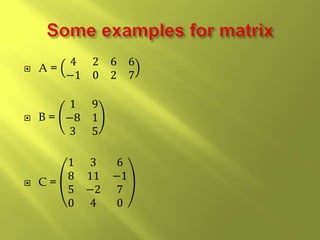
 A =
4 2 6 6
−1 0 2 7
 B =
1 9
−8 1
3 5
 C =
1 3 6
8 11 −1
5 −2 7
0 4 0
The numbers or functions are called
the elements or the entries of the
matrix.
 The number of rows and columns of a matrix is
defined as the order of the matrix.
 Matrix having m rows and n columns is called
(m × n) matrix.
 Order of the matrix = m x n
 Read as m by n
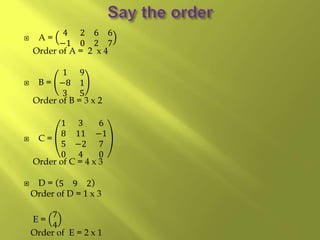
 A =
4 2 6 6
−1 0 2 7
Order of A = 2 x 4
 B =
1 9
−8 1
3 5
Order of B = 3 x 2
 C =
1 3 6
8 11 −1
5 −2 7
0 4 0
Order of C = 4 x 3
 D = 5 9 2
Order of D = 1 x 3
E =
7
4
Order of E = 2 x 1
 By the Order of the Matrix , number of
elements can be calculated by the product of
the row and column.
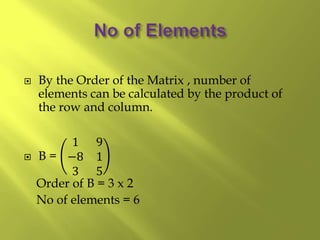
 B =
1 9
−8 1
3 5
Order of B = 3 x 2
No of elements = 6
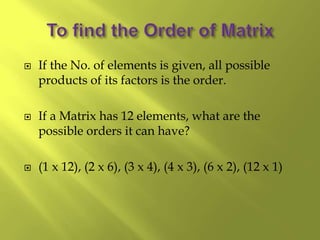
 If the No. of elements is given, all possible
products of its factors is the order.
 If a Matrix has 12 elements, what are the
possible orders it can have?
 (1 x 12), (2 x 6), (3 x 4), (4 x 3), (6 x 2), (12 x 1)
A =
𝑎11 𝑎12 𝑎13 … … … … . 𝑎1𝑗 … … . … . 𝑎1𝑛
𝑎21 𝑎22 𝑎23 … … … . … 𝑎2𝑗 … … . … . 𝑎2𝑛
⋮ ⋮ ⋮ ⋮ ⋮
⋮ ⋮ ⋮ ⋮ ⋮
𝑎𝑖1 𝑎𝑖2 𝑎𝑖3 … . … . … . 𝑎𝑖𝑗 … … . … . 𝑎𝑖𝑛
⋮ ⋮ ⋮ ⋮ ⋮
⋮ ⋮ ⋮ ⋮ ⋮
𝑎 𝑚1 𝑎 𝑚2 𝑎 𝑚3 … … . … . 𝑎 𝑚𝑗 … … . … 𝑎 𝑚𝑛
ie., A = [aij]mxn where 1 ≤ i ≤ m , 1 ≤ j ≤ n
 Matrices are named by Capital alphabets
 Elements with small alphabets
 R represents the Rows
 C represents the Columns
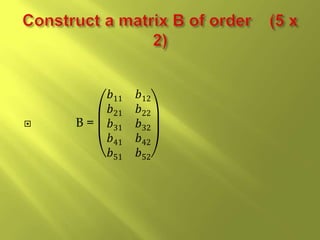
 B =
𝑏11 𝑏12
𝑏21 𝑏22
𝑏31 𝑏32
𝑏41 𝑏42
𝑏51 𝑏52
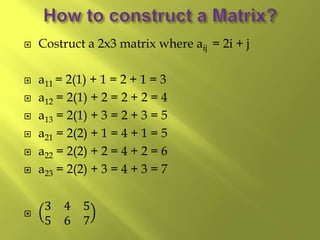
 Costruct a 2x3 matrix where aij = 2i + j
 a11 = 2(1) + 1 = 2 + 1 = 3
 a12 = 2(1) + 2 = 2 + 2 = 4
 a13 = 2(1) + 3 = 2 + 3 = 5
 a21 = 2(2) + 1 = 4 + 1 = 5
 a22 = 2(2) + 2 = 4 + 2 = 6
 a23 = 2(2) + 3 = 4 + 3 = 7

3 4 5
5 6 7
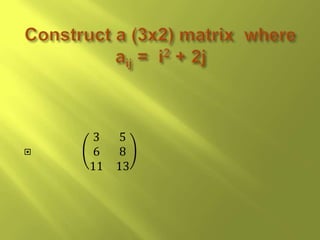

3 5
6 8
11 13
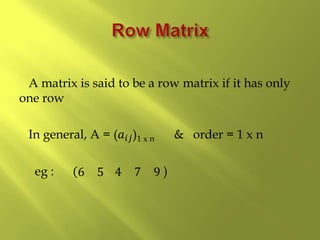
A matrix is said to be a row matrix if it has only
one row
In general, A = (𝑎𝑖𝑗)1 x n & order = 1 x n
eg : (6 5 4 7 9 )
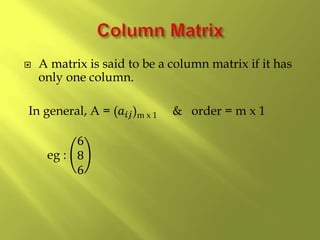
 A matrix is said to be a column matrix if it has
only one column.
In general, A = (𝑎𝑖𝑗)m x 1 & order = m x 1
eg :
6
8
6
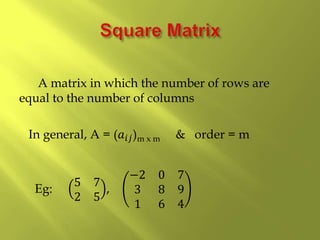
A matrix in which the number of rows are
equal to the number of columns
In general, A = (𝑎𝑖𝑗)m x m & order = m
Eg:
5 7
2 5
,
−2 0 7
3 8 9
1 6 4
 A square matrix is said to be a diagonal matrix
if all the elements except those in the leading
diagonal are zero.
 ie., B = [bij ]mxn is a diagonal matrix if
bij = 0 when i ≠ j
 Eg: 3 0 0
0 7 0
0 0 −1
 A diagonal matrix is said to be a scalar matrix if
its diagonal elements are equal
 ie., B = [bij ]mxn is a scalar matrix if
bij = 0 when i ≠ j
bij = k when i = j Where k is some constant
 Eg: 2 0 0
0 2 0
0 0 2
 A square matrix in which the diagonal
elements are all 1 and rest are all zero is called
an identity matrix or unit matrix.
 B = [bij ]mxn is a unit matrix if
bij = 0 when i ≠ j
bij = 1 when i = j
 Eg:
1 0 0
0 1 0
0 0 1
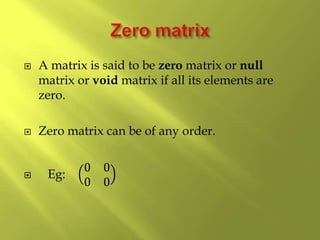
 A matrix is said to be zero matrix or null
matrix or void matrix if all its elements are
zero.
 Zero matrix can be of any order.
 Eg:
0 0
0 0
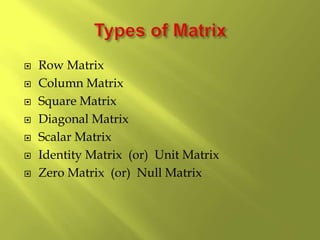
 Row Matrix
 Column Matrix
 Square Matrix
 Diagonal Matrix
 Scalar Matrix
 Identity Matrix (or) Unit Matrix
 Zero Matrix (or) Null Matrix
 Two matrices A = [aij] and B = [bij] are equal if
 (i) They are of the same order .
(ii) Corresponding elements are equal
ie., aij = bij for all i and j.
 Eg: A =
4 2 6
−1 0 7
, B =
4 2 6
−1 0 7
A = B
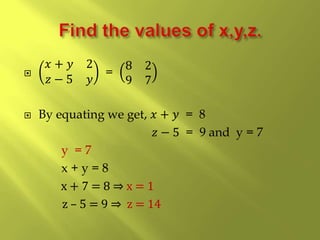

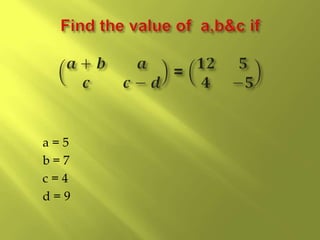
𝑥 + 𝑦 2
𝑧 − 5 𝑦
=
8 2
9 7
 By equating we get, 𝑥 + 𝑦 = 8
𝑧 − 5 = 9 and y = 7
y = 7
x + y = 8
x + 7 = 8 ⇒ x = 1
z – 5 = 9 ⇒ z = 14
a = 5
b = 7
c = 4
d = 9
 Addition of two matrices is possible only if both the matrices of
same order.
 sum of A + B = D where D = [dij] &
dij = aij +bij for all values of i and j.
Eg :
8 2
9 7
+
3 6
9 5
=
8 + 3 2 + 6
9 + 9 7 + 5
=
11 8
18 12
 A = [aᵢj] and k is any scalar.
 kA = k [aij]m × n = [k (aij)]m × n.
 Eg: A=
5 7
2 4
and k = 3
3A =
3𝑿5 3𝑿7
3𝑿2 3𝑿4
=
15 21
6 12
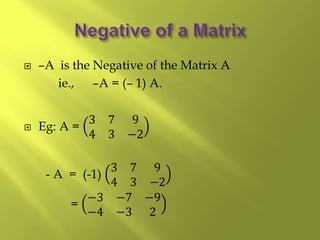
 –A is the Negative of the Matrix A
ie., –A = (– 1) A.
 Eg: A =
3 7 9
4 3 −2
- A = (-1)
3 7 9
4 3 −2
=
−3 −7 −9
−4 −3 2
 Difference of two matrices is possible only if both the
matrices of same order.
 A - B = D where D = [dij] &
dij = aij - bij for all values of i and j.
Eg :
8 2
9 7
-
3 6
9 5
=
8 − 3 2 − 6
9 − 9 7 − 5
=
5 −4
0 2
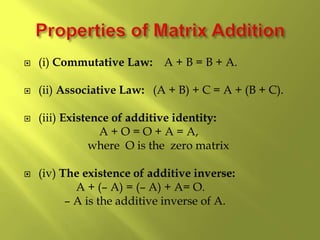
 (i) Commutative Law: A + B = B + A.
 (ii) Associative Law: (A + B) + C = A + (B + C).
 (iii) Existence of additive identity:
A + O = O + A = A,
where O is the zero matrix
 (iv) The existence of additive inverse:
A + (– A) = (– A) + A= O.
– A is the additive inverse of A.
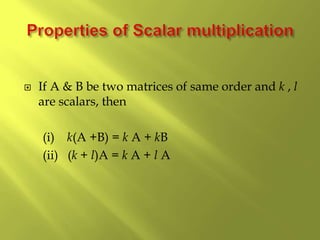
 If A & B be two matrices of same order and k , l
are scalars, then
(i) k(A +B) = k A + kB
(ii) (k + l)A = k A + l A
http://www.youtube.com/watch?v=bo_5FTjc2Is
http://www.youtube.com/watch?v=0L90Kkn90J8
 The product of two matrices A and B is defined
only if the number of columns of A(pre
multiplier) is equal to the number of rows of B
(post multiplier).
 Let A = [aij]mxn and B = [bjk]n×p matrix.
Then AB = C = [cik](m×n)( nxp)= [cik]m×p
where cik = ai1 b1k + ai2 b2k + ai3 b3k + ... + ainbnk
= 𝑗=1
𝑛
𝑎𝑖𝑗 𝑏𝑗𝑘
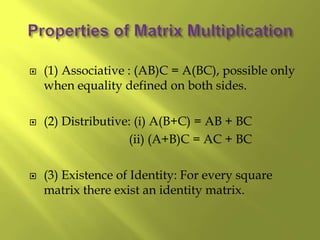
 (1) Associative : (AB)C = A(BC), possible only
when equality defined on both sides.
 (2) Distributive: (i) A(B+C) = AB + BC
(ii) (A+B)C = AC + BC
 (3) Existence of Identity: For every square
matrix there exist an identity matrix.
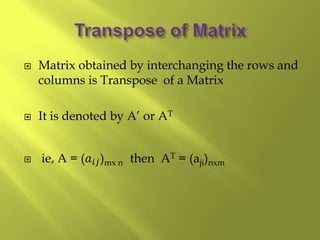
 Matrix obtained by interchanging the rows and
columns is Transpose of a Matrix
 It is denoted by A’ or AT
 ie, A = (𝑎𝑖𝑗)mx n then AT = (aji)nxm
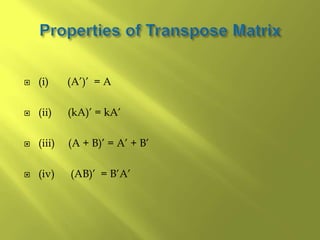
 (i) (A’)’ = A
 (ii) (kA)’ = kA’
 (iii) (A + B)’ = A’ + B’
 (iv) (AB)’ = B’A’
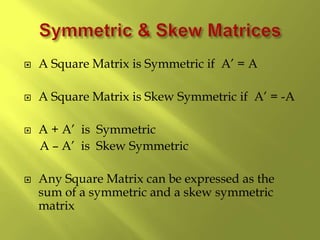
 A Square Matrix is Symmetric if A’ = A
 A Square Matrix is Skew Symmetric if A’ = -A
 A + A’ is Symmetric
A – A’ is Skew Symmetric
 Any Square Matrix can be expressed as the
sum of a symmetric and a skew symmetric
matrix
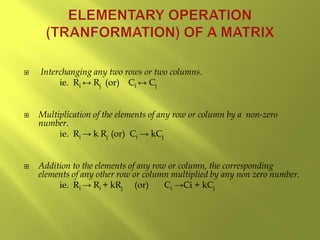
 Interchanging any two rows or two columns.
ie. Ri ↔ Rj (or) Ci ↔ Cj
 Multiplication of the elements of any row or column by a non-zero
number.
ie. Ri → k Rj (or) Ci → kCj
 Addition to the elements of any row or column, the corresponding
elements of any other row or column multiplied by any non zero number.
ie. Ri → Ri + kRj (or) Ci →Ci + kCj
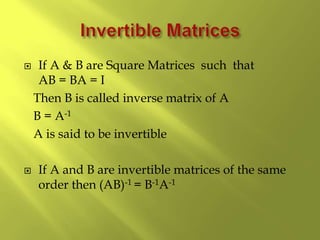
 If A & B are Square Matrices such that
AB = BA = I
Then B is called inverse matrix of A
B = A-1
A is said to be invertible
 If A and B are invertible matrices of the same
order then (AB)-1 = B-1A-1

Matrix

  • 2.
    A matrix isan ordered rectangular array of numbers or functions.
  • 3.
     A = 42 6 6 −1 0 2 7  B = 1 9 −8 1 3 5  C = 1 3 6 8 11 −1 5 −2 7 0 4 0
  • 4.
    The numbers orfunctions are called the elements or the entries of the matrix.
  • 5.
     The numberof rows and columns of a matrix is defined as the order of the matrix.  Matrix having m rows and n columns is called (m × n) matrix.  Order of the matrix = m x n  Read as m by n
  • 6.
     A = 42 6 6 −1 0 2 7 Order of A = 2 x 4  B = 1 9 −8 1 3 5 Order of B = 3 x 2  C = 1 3 6 8 11 −1 5 −2 7 0 4 0 Order of C = 4 x 3  D = 5 9 2 Order of D = 1 x 3 E = 7 4 Order of E = 2 x 1
  • 7.
     By theOrder of the Matrix , number of elements can be calculated by the product of the row and column.  B = 1 9 −8 1 3 5 Order of B = 3 x 2 No of elements = 6
  • 8.
     If theNo. of elements is given, all possible products of its factors is the order.  If a Matrix has 12 elements, what are the possible orders it can have?  (1 x 12), (2 x 6), (3 x 4), (4 x 3), (6 x 2), (12 x 1)
  • 9.
    A = 𝑎11 𝑎12𝑎13 … … … … . 𝑎1𝑗 … … . … . 𝑎1𝑛 𝑎21 𝑎22 𝑎23 … … … . … 𝑎2𝑗 … … . … . 𝑎2𝑛 ⋮ ⋮ ⋮ ⋮ ⋮ ⋮ ⋮ ⋮ ⋮ ⋮ 𝑎𝑖1 𝑎𝑖2 𝑎𝑖3 … . … . … . 𝑎𝑖𝑗 … … . … . 𝑎𝑖𝑛 ⋮ ⋮ ⋮ ⋮ ⋮ ⋮ ⋮ ⋮ ⋮ ⋮ 𝑎 𝑚1 𝑎 𝑚2 𝑎 𝑚3 … … . … . 𝑎 𝑚𝑗 … … . … 𝑎 𝑚𝑛 ie., A = [aij]mxn where 1 ≤ i ≤ m , 1 ≤ j ≤ n  Matrices are named by Capital alphabets  Elements with small alphabets  R represents the Rows  C represents the Columns
  • 10.
     B = 𝑏11𝑏12 𝑏21 𝑏22 𝑏31 𝑏32 𝑏41 𝑏42 𝑏51 𝑏52
  • 11.
     Costruct a2x3 matrix where aij = 2i + j  a11 = 2(1) + 1 = 2 + 1 = 3  a12 = 2(1) + 2 = 2 + 2 = 4  a13 = 2(1) + 3 = 2 + 3 = 5  a21 = 2(2) + 1 = 4 + 1 = 5  a22 = 2(2) + 2 = 4 + 2 = 6  a23 = 2(2) + 3 = 4 + 3 = 7  3 4 5 5 6 7
  • 12.
  • 13.
    A matrix issaid to be a row matrix if it has only one row In general, A = (𝑎𝑖𝑗)1 x n & order = 1 x n eg : (6 5 4 7 9 )
  • 14.
     A matrixis said to be a column matrix if it has only one column. In general, A = (𝑎𝑖𝑗)m x 1 & order = m x 1 eg : 6 8 6
  • 15.
    A matrix inwhich the number of rows are equal to the number of columns In general, A = (𝑎𝑖𝑗)m x m & order = m Eg: 5 7 2 5 , −2 0 7 3 8 9 1 6 4
  • 16.
     A squarematrix is said to be a diagonal matrix if all the elements except those in the leading diagonal are zero.  ie., B = [bij ]mxn is a diagonal matrix if bij = 0 when i ≠ j  Eg: 3 0 0 0 7 0 0 0 −1
  • 17.
     A diagonalmatrix is said to be a scalar matrix if its diagonal elements are equal  ie., B = [bij ]mxn is a scalar matrix if bij = 0 when i ≠ j bij = k when i = j Where k is some constant  Eg: 2 0 0 0 2 0 0 0 2
  • 18.
     A squarematrix in which the diagonal elements are all 1 and rest are all zero is called an identity matrix or unit matrix.  B = [bij ]mxn is a unit matrix if bij = 0 when i ≠ j bij = 1 when i = j  Eg: 1 0 0 0 1 0 0 0 1
  • 19.
     A matrixis said to be zero matrix or null matrix or void matrix if all its elements are zero.  Zero matrix can be of any order.  Eg: 0 0 0 0
  • 20.
     Row Matrix Column Matrix  Square Matrix  Diagonal Matrix  Scalar Matrix  Identity Matrix (or) Unit Matrix  Zero Matrix (or) Null Matrix
  • 21.
     Two matricesA = [aij] and B = [bij] are equal if  (i) They are of the same order . (ii) Corresponding elements are equal ie., aij = bij for all i and j.  Eg: A = 4 2 6 −1 0 7 , B = 4 2 6 −1 0 7 A = B
  • 22.
     𝑥 + 𝑦2 𝑧 − 5 𝑦 = 8 2 9 7  By equating we get, 𝑥 + 𝑦 = 8 𝑧 − 5 = 9 and y = 7 y = 7 x + y = 8 x + 7 = 8 ⇒ x = 1 z – 5 = 9 ⇒ z = 14
  • 23.
    a = 5 b= 7 c = 4 d = 9
  • 24.
     Addition oftwo matrices is possible only if both the matrices of same order.  sum of A + B = D where D = [dij] & dij = aij +bij for all values of i and j. Eg : 8 2 9 7 + 3 6 9 5 = 8 + 3 2 + 6 9 + 9 7 + 5 = 11 8 18 12
  • 25.
     A =[aᵢj] and k is any scalar.  kA = k [aij]m × n = [k (aij)]m × n.  Eg: A= 5 7 2 4 and k = 3 3A = 3𝑿5 3𝑿7 3𝑿2 3𝑿4 = 15 21 6 12
  • 26.
     –A isthe Negative of the Matrix A ie., –A = (– 1) A.  Eg: A = 3 7 9 4 3 −2 - A = (-1) 3 7 9 4 3 −2 = −3 −7 −9 −4 −3 2
  • 27.
     Difference oftwo matrices is possible only if both the matrices of same order.  A - B = D where D = [dij] & dij = aij - bij for all values of i and j. Eg : 8 2 9 7 - 3 6 9 5 = 8 − 3 2 − 6 9 − 9 7 − 5 = 5 −4 0 2
  • 28.
     (i) CommutativeLaw: A + B = B + A.  (ii) Associative Law: (A + B) + C = A + (B + C).  (iii) Existence of additive identity: A + O = O + A = A, where O is the zero matrix  (iv) The existence of additive inverse: A + (– A) = (– A) + A= O. – A is the additive inverse of A.
  • 29.
     If A& B be two matrices of same order and k , l are scalars, then (i) k(A +B) = k A + kB (ii) (k + l)A = k A + l A
  • 30.
  • 31.
     The productof two matrices A and B is defined only if the number of columns of A(pre multiplier) is equal to the number of rows of B (post multiplier).  Let A = [aij]mxn and B = [bjk]n×p matrix. Then AB = C = [cik](m×n)( nxp)= [cik]m×p where cik = ai1 b1k + ai2 b2k + ai3 b3k + ... + ainbnk = 𝑗=1 𝑛 𝑎𝑖𝑗 𝑏𝑗𝑘
  • 32.
     (1) Associative: (AB)C = A(BC), possible only when equality defined on both sides.  (2) Distributive: (i) A(B+C) = AB + BC (ii) (A+B)C = AC + BC  (3) Existence of Identity: For every square matrix there exist an identity matrix.
  • 33.
     Matrix obtainedby interchanging the rows and columns is Transpose of a Matrix  It is denoted by A’ or AT  ie, A = (𝑎𝑖𝑗)mx n then AT = (aji)nxm
  • 34.
     (i) (A’)’= A  (ii) (kA)’ = kA’  (iii) (A + B)’ = A’ + B’  (iv) (AB)’ = B’A’
  • 35.
     A SquareMatrix is Symmetric if A’ = A  A Square Matrix is Skew Symmetric if A’ = -A  A + A’ is Symmetric A – A’ is Skew Symmetric  Any Square Matrix can be expressed as the sum of a symmetric and a skew symmetric matrix
  • 36.
     Interchanging anytwo rows or two columns. ie. Ri ↔ Rj (or) Ci ↔ Cj  Multiplication of the elements of any row or column by a non-zero number. ie. Ri → k Rj (or) Ci → kCj  Addition to the elements of any row or column, the corresponding elements of any other row or column multiplied by any non zero number. ie. Ri → Ri + kRj (or) Ci →Ci + kCj
  • 37.
     If A& B are Square Matrices such that AB = BA = I Then B is called inverse matrix of A B = A-1 A is said to be invertible  If A and B are invertible matrices of the same order then (AB)-1 = B-1A-1