Multi-Business Strategy Multi-regional strategy
Lecture Outline What is Portfolio Management What is Portfolio Analysis Boston Box McKinsey/GE Matrix AD Little Life-Cycle Matrix
Portfolio Management “ enable strategic planners to select the optimal strategies for the individual products whilst achieving overall corporate objectives”  (Mcnamee, 1985) Multi-business And/or multi-location
Portfolio Analysis “  the strategic units that make up the company and the attempts to evaluate current effectiveness and vulnerabilities” (McDonald et al, 1992) How much of our time and money should we spend on our best products to ensure that they continue to be successful? How much of our time and money should we spend developing new costly products, most of which will never be successful?
Examples of Portfolios Unilever : ice cream, tea, spreads,  Proctor  & Gamble: Detergents, nappies,  Gillette : batteries, Shaving products Virgin ; trains, planes, cola, music stores


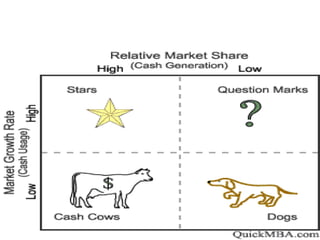
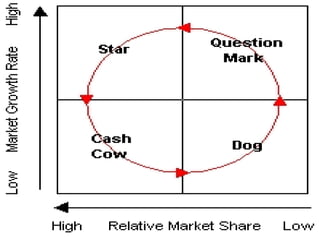
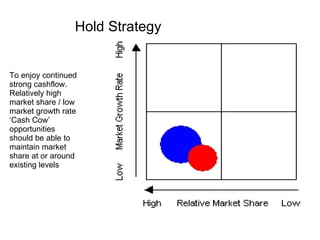
Hold Strategy To enjoy continued strong cashflow. Relatively high market share / low market growth rate ‘Cash Cow’ opportunities should be able to maintain market share at or around existing levels
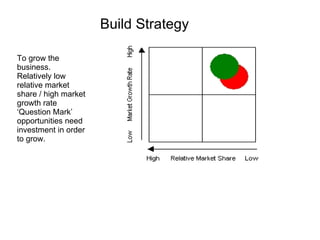
Build Strategy To grow the business. Relatively low relative market share / high market growth rate ‘Question Mark’ opportunities need investment in order to grow.
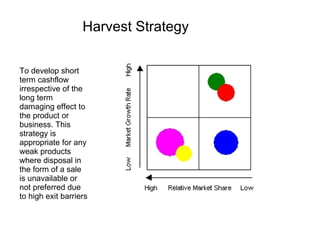
Harvest Strategy To develop short term cashflow irrespective of the long term damaging effect to the product or business. This strategy is appropriate for any weak products where disposal in the form of a sale is unavailable or not preferred due to high exit barriers
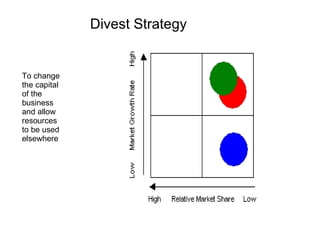
Divest Strategy To change the capital of the business and allow resources to be used elsewhere
Boston Box - Uses Simplifies complex situations Target setting tool Encourages strategists to view their business as a collection of diversified cash flows and investments Success sequences Disaster Sequences
Disadvantages  Uses 2 factors only Many businesses are “Average” Dogs -10% mkt share –most fall into this category Can use dogs as a tactical tool- barrier to entry Cash flow? – Why not ROI?
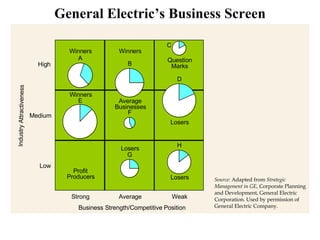
GE Business Screen Long-term industry attractiveness  Business strength/competitive position
General Electric’s Business Screen Source:  Adapted from  Strategic Management in GE , Corporate Planning and Development, General Electric Corporation. Used by permission of General Electric Company. A Winners Winners B C Question Marks D F Average Businesses E Winners Losers G Losers H Losers Profit Producers Strong Average Weak Low Medium High Business Strength/Competitive Position Industry Attractiveness
GE Matrix- uses More sophisticated than BCG – uses more variables Condenses much information into 2 variables?
Limitations Complex and Weighty The numerical estimates can be “objective” What about new products or business units in growth industries.
 
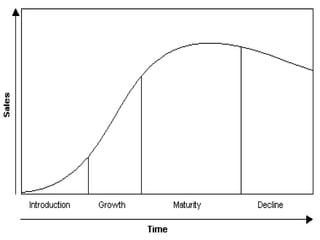
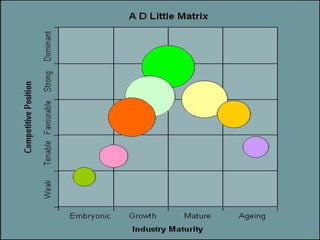
Uses The power of the Life-cycle matrix is the story it tells about the distribution of the firm’s businesses across the stages of the industry evolution
Limitations Limited strategic prescription Once defined prescription is limited Some businesses “skip” cycles Go from Growth to Decline in a short time. Duration of “cycles” Eg. Mars (1930)
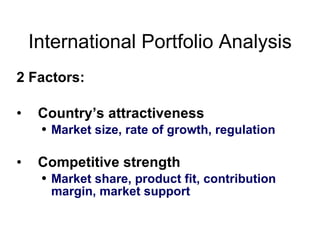
International Portfolio Analysis 2 Factors: Country’s attractiveness Market size, rate of growth, regulation Competitive strength Market share, product fit, contribution margin, market support
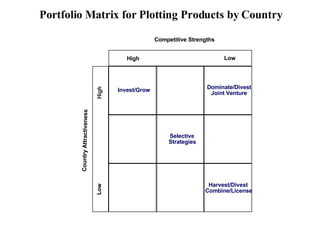
Portfolio Matrix for Plotting Products by Country Harvest/Divest Combine/License Invest/Grow Dominate/Divest Joint Venture Low High High Low Competitive Strengths Country Attractiveness Selective Strategies
Portfolio Analysis Advantages: Top management evaluates each of firm’s businesses individually Use of externally-oriented data to supplement management judgment Raises issue of cash flow availability Facilitates communication
Portfolio Analysis Disadvantages: Difficult to define product/market segments Standard strategies can miss opportunities Illusion of scientific rigor Value-laden terms

Portfolio Analysis

  • 1.
  • 2.
    Lecture Outline Whatis Portfolio Management What is Portfolio Analysis Boston Box McKinsey/GE Matrix AD Little Life-Cycle Matrix
  • 3.
    Portfolio Management “enable strategic planners to select the optimal strategies for the individual products whilst achieving overall corporate objectives” (Mcnamee, 1985) Multi-business And/or multi-location
  • 4.
    Portfolio Analysis “ the strategic units that make up the company and the attempts to evaluate current effectiveness and vulnerabilities” (McDonald et al, 1992) How much of our time and money should we spend on our best products to ensure that they continue to be successful? How much of our time and money should we spend developing new costly products, most of which will never be successful?
  • 5.
    Examples of PortfoliosUnilever : ice cream, tea, spreads, Proctor & Gamble: Detergents, nappies, Gillette : batteries, Shaving products Virgin ; trains, planes, cola, music stores
  • 6.
  • 7.
  • 8.
  • 9.
    Hold Strategy Toenjoy continued strong cashflow. Relatively high market share / low market growth rate ‘Cash Cow’ opportunities should be able to maintain market share at or around existing levels
  • 10.
    Build Strategy Togrow the business. Relatively low relative market share / high market growth rate ‘Question Mark’ opportunities need investment in order to grow.
  • 11.
    Harvest Strategy Todevelop short term cashflow irrespective of the long term damaging effect to the product or business. This strategy is appropriate for any weak products where disposal in the form of a sale is unavailable or not preferred due to high exit barriers
  • 12.
    Divest Strategy Tochange the capital of the business and allow resources to be used elsewhere
  • 13.
    Boston Box -Uses Simplifies complex situations Target setting tool Encourages strategists to view their business as a collection of diversified cash flows and investments Success sequences Disaster Sequences
  • 14.
    Disadvantages Uses2 factors only Many businesses are “Average” Dogs -10% mkt share –most fall into this category Can use dogs as a tactical tool- barrier to entry Cash flow? – Why not ROI?
  • 15.
    GE Business ScreenLong-term industry attractiveness Business strength/competitive position
  • 16.
    General Electric’s BusinessScreen Source: Adapted from Strategic Management in GE , Corporate Planning and Development, General Electric Corporation. Used by permission of General Electric Company. A Winners Winners B C Question Marks D F Average Businesses E Winners Losers G Losers H Losers Profit Producers Strong Average Weak Low Medium High Business Strength/Competitive Position Industry Attractiveness
  • 17.
    GE Matrix- usesMore sophisticated than BCG – uses more variables Condenses much information into 2 variables?
  • 18.
    Limitations Complex andWeighty The numerical estimates can be “objective” What about new products or business units in growth industries.
  • 19.
  • 20.
    Uses The powerof the Life-cycle matrix is the story it tells about the distribution of the firm’s businesses across the stages of the industry evolution
  • 21.
    Limitations Limited strategicprescription Once defined prescription is limited Some businesses “skip” cycles Go from Growth to Decline in a short time. Duration of “cycles” Eg. Mars (1930)
  • 22.
    International Portfolio Analysis2 Factors: Country’s attractiveness Market size, rate of growth, regulation Competitive strength Market share, product fit, contribution margin, market support
  • 23.
    Portfolio Matrix forPlotting Products by Country Harvest/Divest Combine/License Invest/Grow Dominate/Divest Joint Venture Low High High Low Competitive Strengths Country Attractiveness Selective Strategies
  • 24.
    Portfolio Analysis Advantages:Top management evaluates each of firm’s businesses individually Use of externally-oriented data to supplement management judgment Raises issue of cash flow availability Facilitates communication
  • 25.
    Portfolio Analysis Disadvantages:Difficult to define product/market segments Standard strategies can miss opportunities Illusion of scientific rigor Value-laden terms

Editor's Notes

  • #2 Many large corporations have more than one product, have many business units and operate in more than one location- this is what is termed a portfolio of businesses. If we look at the investment industry, many investors have a collection of investments called a portfolio. There are good reasons for this. Some of which we mention before. In terms of risk- spreading risk across a number of businesses or locations . Products may be at different stages of the product life cycle- inception, growth, maturity, decline and so on. This poses questions for the strategic manager – How to manage these firms in terms of cash, resources, marketing, In other words how does the manager manage this portfolio. To assist managers portfolio management using portfolio matrices was devised in the late 1960s and early 1970s, to encourage managers to view their individual business units as a series of investments. To address these units in terms of resource allocation. The idea behind portfolio management is to, as McNamee suggests “ to enable strategic planners to seek the optimal strategy for the individual products whilst achieving overall corporate objectives”