MATHS PROJECT
 Quadrilaterals
- Shaunak Bhima ni

     IX-B
Definition

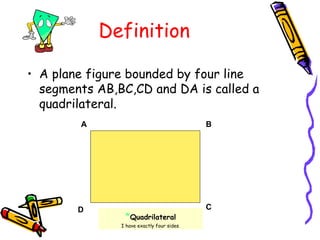
• A plane figure bounded by four line
  segments AB,BC,CD and DA is called a
  quadrilateral.
        A                                   B


        D                                   C
                *Quadrilateral
               I have exactly four sides.
In geometry, a quadrilateral is a polygon with four
      sides and four vertices. Sometimes, the term
  quadrangle is used, for etymological symmetry with
 triangle, and sometimes tetragon for consistence with
                        pentagon.


There are over 9,000,000 quadrilaterals. Quadrilaterals
  are either simple (not self-intersecting) or complex
 (self-intersecting). Simple quadrilaterals are either
                  convex or concave.
Taxonomic Classification
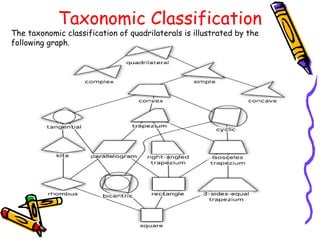
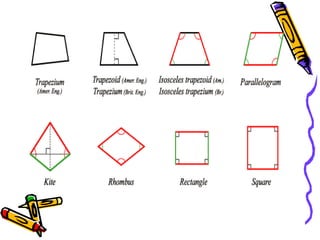
The taxonomic classification of quadrilaterals is illustrated by the
following graph.
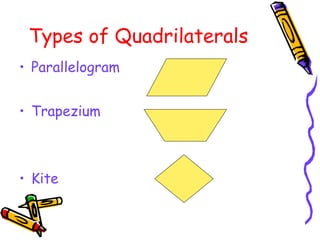
Types of Quadrilaterals
• Parallelogram


• Trapezium


• Kite
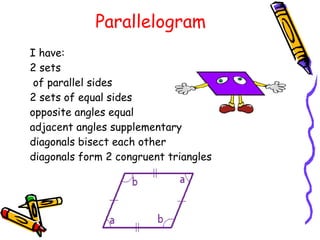
Parallelogram
I have:
2 sets
 of parallel sides
2 sets of equal sides
opposite angles equal
adjacent angles supplementary
diagonals bisect each other
diagonals form 2 congruent triangles
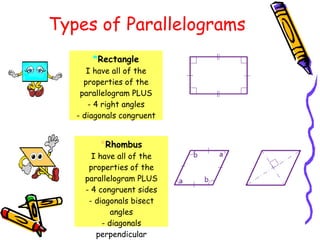
Types of Parallelograms
       *Rectangle
      I have all of the
     properties of the
    parallelogram PLUS
      - 4 right angles
   - diagonals congruent


         *Rhombus
       I have all of the
      properties of the
     parallelogram PLUS
     - 4 congruent sides
      - diagonals bisect
             angles
          - diagonals
        perpendicular
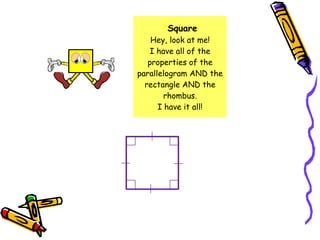
*Square
    Hey, look at me!
    I have all of the
   properties of the
parallelogram AND the
  rectangle AND the
        rhombus.
      I have it all!
Is a square a rectangle?
  Some people define categories exclusively, so that a rectangle is a
   quadrilateral with four right angles that is not a square. This is
  appropriate for everyday use of the words, as people typically use
 the less specific word only when the more specific word will not do.
        Generally a rectangle which isn't a square is an oblong.
 But in mathematics, it is important to define categories inclusively,
       so that a square is a rectangle. Inclusive categories make
statements of theorems shorter, by eliminating the need for tedious
listing of cases. For example, the visual proof that vector addition is
commutative is known as the "parallelogram diagram". If categories
  were exclusive it would have to be known as the "parallelogram (or
               rectangle or rhombus or square) diagram"!
Trapezium
    I have only one set of parallel sides. 
[The median of a trapezium is parallel to the
 bases and equal to one-half the sum of the
                    bases.]


             Trapezoid        Regular Trapezoid
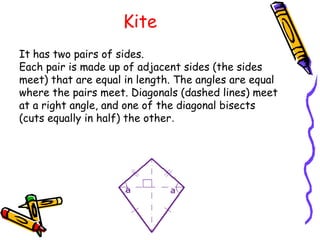
Kite
It has two pairs of sides.
Each pair is made up of adjacent sides (the sides
meet) that are equal in length. The angles are equal
where the pairs meet. Diagonals (dashed lines) meet
at a right angle, and one of the diagonal bisects
(cuts equally in half) the other.
Some other types of
    quadrilaterals
Cyclic quadrilateral: the four
vertices lie on a circumscribed circle.
Tangential quadrilateral: the four
edges are tangential to an inscribed
circle. Another term for a tangential
polygon is inscriptible.
Bicentric quadrilateral: both cyclic
and tangential.

                                                          
Angle Sum Property Of
      Quadrilateral
                                                    .
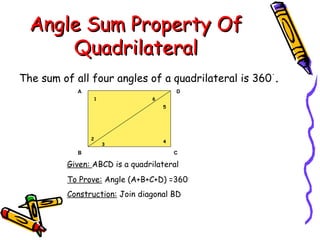
The sum of all four angles of a quadrilateral is 360 .
            A                          D
                1              6
                                   5


                2
                                   4
                    3
            B                          C

         Given: ABCD is a quadrilateral
         To Prove: Angle (A+B+C+D) =360.
         Construction: Join diagonal BD
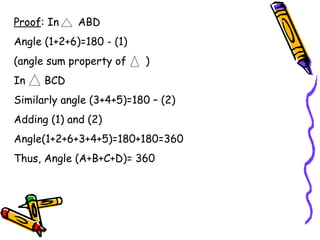
Proof: In    ABD
Angle (1+2+6)=180 - (1)
(angle sum property of    )
In    BCD
Similarly angle (3+4+5)=180 – (2)
Adding (1) and (2)
Angle(1+2+6+3+4+5)=180+180=360
Thus, Angle (A+B+C+D)= 360
The Mid-Point Theorem
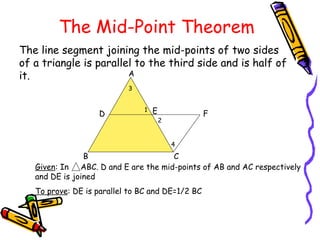
The line segment joining the mid-points of two sides
of a triangle is parallel to the third side and is half of
it.                     A
                           3


                   D
                               1   E              F
                                       2


                                           4
                B                    C
   Given: In ABC. D and E are the mid-points of AB and AC respectively
   and DE is joined
   To prove: DE is parallel to BC and DE=1/2 BC
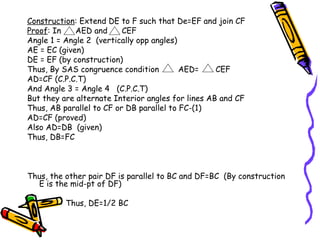
Construction: Extend DE to F such that De=EF and join CF
Proof: In    AED and      CEF
Angle 1 = Angle 2 (vertically opp angles)
AE = EC (given)
DE = EF (by construction)
Thus, By SAS congruence condition         AED=     CEF
AD=CF (C.P.C.T)
And Angle 3 = Angle 4 (C.P.C.T)
But they are alternate Interior angles for lines AB and CF
Thus, AB parallel to CF or DB parallel to FC-(1)
AD=CF (proved)
Also AD=DB (given)
Thus, DB=FC


Thus, the other pair DF is parallel to BC and DF=BC (By construction
  E is the mid-pt of DF)

          Thus, DE=1/2 BC
THE END
- Shaunak Bhimani
      IX-B
   ROLL NO. 04

Mathsproject quadrilaterals

  • 1.
    MATHS PROJECT Quadrilaterals -Shaunak Bhima ni IX-B
  • 2.
    Definition • A planefigure bounded by four line segments AB,BC,CD and DA is called a quadrilateral. A B D C *Quadrilateral I have exactly four sides.
  • 3.
    In geometry, aquadrilateral is a polygon with four sides and four vertices. Sometimes, the term quadrangle is used, for etymological symmetry with triangle, and sometimes tetragon for consistence with pentagon. There are over 9,000,000 quadrilaterals. Quadrilaterals are either simple (not self-intersecting) or complex (self-intersecting). Simple quadrilaterals are either convex or concave.
  • 4.
    Taxonomic Classification The taxonomicclassification of quadrilaterals is illustrated by the following graph.
  • 5.
    Types of Quadrilaterals •Parallelogram • Trapezium • Kite
  • 7.
    Parallelogram I have: 2 sets of parallel sides 2 sets of equal sides opposite angles equal adjacent angles supplementary diagonals bisect each other diagonals form 2 congruent triangles
  • 8.
    Types of Parallelograms *Rectangle I have all of the properties of the parallelogram PLUS - 4 right angles - diagonals congruent *Rhombus I have all of the properties of the parallelogram PLUS - 4 congruent sides - diagonals bisect angles - diagonals perpendicular
  • 9.
    *Square Hey, look at me! I have all of the properties of the parallelogram AND the rectangle AND the rhombus. I have it all!
  • 10.
    Is a squarea rectangle? Some people define categories exclusively, so that a rectangle is a quadrilateral with four right angles that is not a square. This is appropriate for everyday use of the words, as people typically use the less specific word only when the more specific word will not do. Generally a rectangle which isn't a square is an oblong. But in mathematics, it is important to define categories inclusively, so that a square is a rectangle. Inclusive categories make statements of theorems shorter, by eliminating the need for tedious listing of cases. For example, the visual proof that vector addition is commutative is known as the "parallelogram diagram". If categories were exclusive it would have to be known as the "parallelogram (or rectangle or rhombus or square) diagram"!
  • 11.
    Trapezium I have only one set of parallel sides.  [The median of a trapezium is parallel to the bases and equal to one-half the sum of the bases.] Trapezoid Regular Trapezoid
  • 12.
    Kite It has twopairs of sides. Each pair is made up of adjacent sides (the sides meet) that are equal in length. The angles are equal where the pairs meet. Diagonals (dashed lines) meet at a right angle, and one of the diagonal bisects (cuts equally in half) the other.
  • 13.
    Some other typesof quadrilaterals Cyclic quadrilateral: the four vertices lie on a circumscribed circle. Tangential quadrilateral: the four edges are tangential to an inscribed circle. Another term for a tangential polygon is inscriptible. Bicentric quadrilateral: both cyclic and tangential.                                                           
  • 14.
    Angle Sum PropertyOf Quadrilateral . The sum of all four angles of a quadrilateral is 360 . A D 1 6 5 2 4 3 B C Given: ABCD is a quadrilateral To Prove: Angle (A+B+C+D) =360. Construction: Join diagonal BD
  • 15.
    Proof: In ABD Angle (1+2+6)=180 - (1) (angle sum property of ) In BCD Similarly angle (3+4+5)=180 – (2) Adding (1) and (2) Angle(1+2+6+3+4+5)=180+180=360 Thus, Angle (A+B+C+D)= 360
  • 16.
    The Mid-Point Theorem Theline segment joining the mid-points of two sides of a triangle is parallel to the third side and is half of it. A 3 D 1 E F 2 4 B C Given: In ABC. D and E are the mid-points of AB and AC respectively and DE is joined To prove: DE is parallel to BC and DE=1/2 BC
  • 17.
    Construction: Extend DEto F such that De=EF and join CF Proof: In AED and CEF Angle 1 = Angle 2 (vertically opp angles) AE = EC (given) DE = EF (by construction) Thus, By SAS congruence condition AED= CEF AD=CF (C.P.C.T) And Angle 3 = Angle 4 (C.P.C.T) But they are alternate Interior angles for lines AB and CF Thus, AB parallel to CF or DB parallel to FC-(1) AD=CF (proved) Also AD=DB (given) Thus, DB=FC Thus, the other pair DF is parallel to BC and DF=BC (By construction E is the mid-pt of DF) Thus, DE=1/2 BC
  • 18.
    THE END - ShaunakBhimani IX-B ROLL NO. 04