Presented by :- (P.D.I.M.T.R)  GUIDED BY MR.ASHISH GHORPADE tqma2z.blogspot.com
The knowledge of matrices is necessary in various branches of mathematics. Matrices are one of the most powerful tools in mathematics. This mathematical tool simplifies our work to a great extent when compared with other straight forward method. The evolution of concept of matrices is the result of an attempt to obtain compact and simple methods of solving systems  of linear equations. Matrices  are not only used as a representation of the coefficients in system of linear equation, but utility of matrices  far exceeds that use.
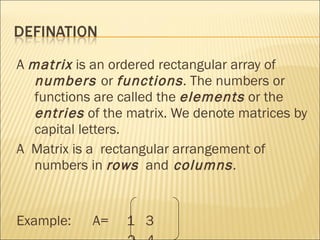
A  matrix  is an ordered rectangular array of  numbers  or  functions . The numbers or functions are called the  elements  or the  entries   of the matrix. We denote matrices by capital letters. A  Matrix is a  rectangular arrangement of numbers in  rows   and   columns .   Example:  A=  1  3  2  4
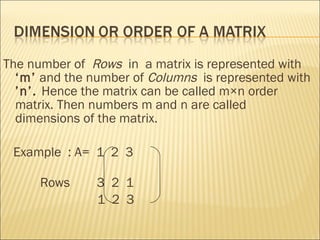
The number of  Rows   in  a matrix is represented with  ‘m’  and the number of  Columns  is represented with  ’n’.  Hence the matrix can be called m×n order matrix. Then numbers m and n are called dimensions of the matrix. Example  : A=  1  2  3  Rows  3  2  1 1  2  3
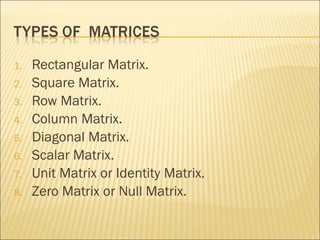
Rectangular Matrix. Square Matrix. Row Matrix. Column Matrix. Diagonal Matrix. Scalar Matrix. Unit Matrix or Identity Matrix. Zero Matrix or Null Matrix.
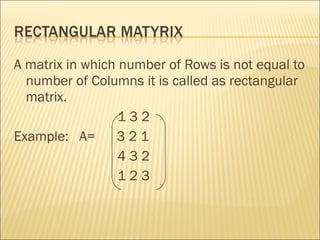
A matrix in which number of Rows is not equal to number of Columns it is called as rectangular matrix.  1 3 2 Example:  A=  3 2 1  4 3 2 1 2 3
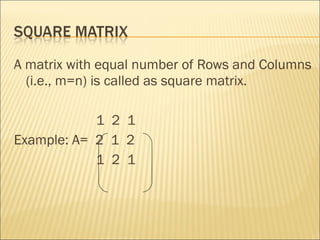
A matrix with equal number of Rows and Columns (i.e., m=n) is called as square matrix. 1  2  1  Example: A=  2  1  2  1  2  1
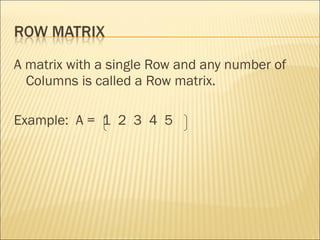
A matrix with a single Row and any number of Columns is called a Row matrix. Example:  A =  1  2  3  4  5
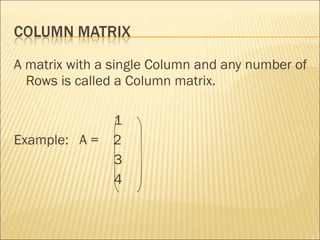
A matrix with a single Column and any number of Rows is called a Column matrix. 1  Example:  A =  2  3 4
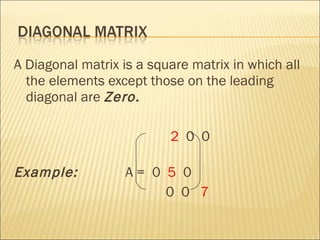
A Diagonal matrix is a square matrix in which all the elements except those on the leading diagonal are  Zero. 2   0  0   Example:  A =  0  5   0   0  0  7
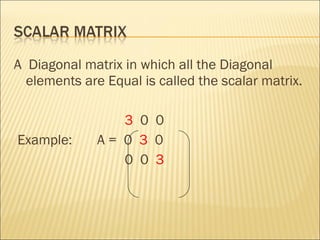
A  Diagonal matrix in which all the Diagonal elements are Equal is called the scalar matrix. 3   0  0  Example:  A =  0  3   0 0  0  3
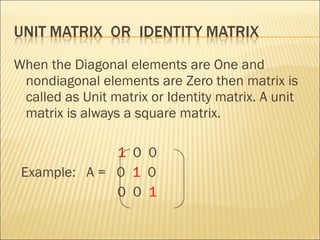
When the Diagonal elements are One and nondiagonal elements are Zero then matrix is called as Unit matrix or Identity matrix. A unit matrix is always a square matrix.  1   0  0  Example:  A =  0  1   0 0  0  1
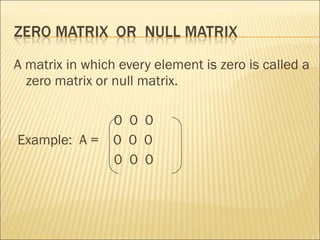
A matrix in which every element is zero is called a zero matrix or null matrix.  0  0  0 Example:  A =  0  0  0 0  0  0
Equality of Matrices :-  Two matrices are said to be equal if they have the  same order and all the corresponding elements are equal. Addition of Matrices :-  The sum of two matrices of the same order is the matrix whose elements are the sum of the corresponding elements of the given matrices.
Subtraction of Matrices :-  Subtraction of the matrices is also done in the same manner of addition of matrices. When the matrix B is to be subtracted from matrix A, the elements in matrix B are subtracted from corresponding  elements in matrix A. Multiplication of Matrices :-  A matrix may be multiplied by any one number or any other matrix. Multiplication of a matrix by any one number is called  a scalar multiplication. One matrix may also be multiplied by other matrix.
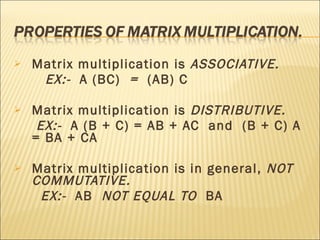
Matrix multiplication is  ASSOCIATIVE.  EX:-  A (BC)   =  (AB) C  Matrix multiplication is  DISTRIBUTIVE. EX:-   A (B + C) = AB + AC  and  (B + C) A = BA + CA Matrix multiplication is in general,  NOT COMMUTATIVE. EX:-   AB  NOT EQUAL TO  BA
 

Matrices

  • 1.
    Presented by :-(P.D.I.M.T.R) GUIDED BY MR.ASHISH GHORPADE tqma2z.blogspot.com
  • 2.
    The knowledge ofmatrices is necessary in various branches of mathematics. Matrices are one of the most powerful tools in mathematics. This mathematical tool simplifies our work to a great extent when compared with other straight forward method. The evolution of concept of matrices is the result of an attempt to obtain compact and simple methods of solving systems of linear equations. Matrices are not only used as a representation of the coefficients in system of linear equation, but utility of matrices far exceeds that use.
  • 3.
    A matrix is an ordered rectangular array of numbers or functions . The numbers or functions are called the elements or the entries of the matrix. We denote matrices by capital letters. A Matrix is a rectangular arrangement of numbers in rows and columns . Example: A= 1 3 2 4
  • 4.
    The number of Rows in a matrix is represented with ‘m’ and the number of Columns is represented with ’n’. Hence the matrix can be called m×n order matrix. Then numbers m and n are called dimensions of the matrix. Example : A= 1 2 3 Rows 3 2 1 1 2 3
  • 5.
    Rectangular Matrix. SquareMatrix. Row Matrix. Column Matrix. Diagonal Matrix. Scalar Matrix. Unit Matrix or Identity Matrix. Zero Matrix or Null Matrix.
  • 6.
    A matrix inwhich number of Rows is not equal to number of Columns it is called as rectangular matrix. 1 3 2 Example: A= 3 2 1 4 3 2 1 2 3
  • 7.
    A matrix withequal number of Rows and Columns (i.e., m=n) is called as square matrix. 1 2 1 Example: A= 2 1 2 1 2 1
  • 8.
    A matrix witha single Row and any number of Columns is called a Row matrix. Example: A = 1 2 3 4 5
  • 9.
    A matrix witha single Column and any number of Rows is called a Column matrix. 1 Example: A = 2 3 4
  • 10.
    A Diagonal matrixis a square matrix in which all the elements except those on the leading diagonal are Zero. 2 0 0 Example: A = 0 5 0 0 0 7
  • 11.
    A Diagonalmatrix in which all the Diagonal elements are Equal is called the scalar matrix. 3 0 0 Example: A = 0 3 0 0 0 3
  • 12.
    When the Diagonalelements are One and nondiagonal elements are Zero then matrix is called as Unit matrix or Identity matrix. A unit matrix is always a square matrix. 1 0 0 Example: A = 0 1 0 0 0 1
  • 13.
    A matrix inwhich every element is zero is called a zero matrix or null matrix. 0 0 0 Example: A = 0 0 0 0 0 0
  • 14.
    Equality of Matrices:- Two matrices are said to be equal if they have the same order and all the corresponding elements are equal. Addition of Matrices :- The sum of two matrices of the same order is the matrix whose elements are the sum of the corresponding elements of the given matrices.
  • 15.
    Subtraction of Matrices:- Subtraction of the matrices is also done in the same manner of addition of matrices. When the matrix B is to be subtracted from matrix A, the elements in matrix B are subtracted from corresponding elements in matrix A. Multiplication of Matrices :- A matrix may be multiplied by any one number or any other matrix. Multiplication of a matrix by any one number is called a scalar multiplication. One matrix may also be multiplied by other matrix.
  • 16.
    Matrix multiplication is ASSOCIATIVE. EX:- A (BC) = (AB) C Matrix multiplication is DISTRIBUTIVE. EX:- A (B + C) = AB + AC and (B + C) A = BA + CA Matrix multiplication is in general, NOT COMMUTATIVE. EX:- AB NOT EQUAL TO BA
  • 17.