Prepared By:-
Muhammad
Sajeel Khan
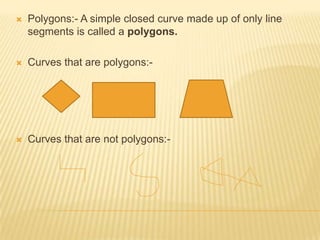
   Polygons:- A simple closed curve made up of only line
    segments is called a polygons.

   Curves that are polygons:-


   Curves that are not polygons:-
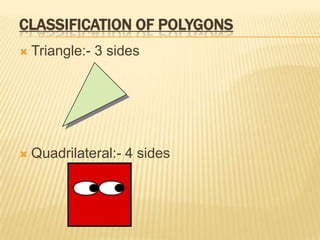
CLASSIFICATION OF POLYGONS
   Triangle:- 3 sides


   Quadrilateral:- 4 sides
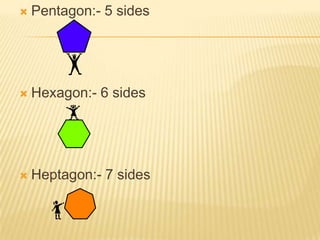
   Pentagon:- 5 sides


   Hexagon:- 6 sides


   Heptagon:- 7 sides
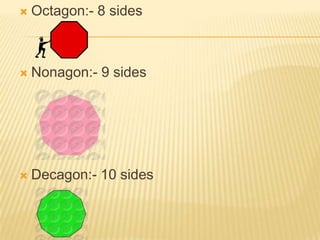
   Octagon:- 8 sides


   Nonagon:- 9 sides


   Decagon:- 10 sides
DIAGONALS
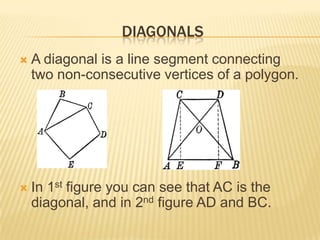
   A diagonal is a line segment connecting
    two non-consecutive vertices of a polygon.


   In 1st figure you can see that AC is the
    diagonal, and in 2nd figure AD and BC.
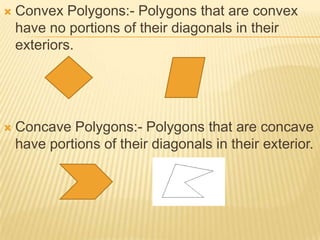
   Convex Polygons:- Polygons that are convex
    have no portions of their diagonals in their
    exteriors.


   Concave Polygons:- Polygons that are concave
    have portions of their diagonals in their exterior.
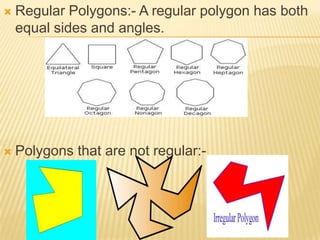
   Regular Polygons:- A regular polygon has both
    equal sides and angles.


   Polygons that are not regular:-
ANGLE SUM PROPERTY
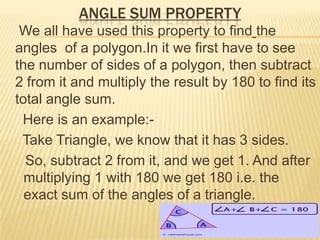
 We all have used this property to find the
angles of a polygon.In it we first have to see
the number of sides of a polygon, then subtract
2 from it and multiply the result by 180 to find its
total angle sum.
 Here is an example:-
 Take Triangle, we know that it has 3 sides.
  So, subtract 2 from it, and we get 1. And after
  multiplying 1 with 180 we get 180 i.e. the
  exact sum of the angles of a triangle.
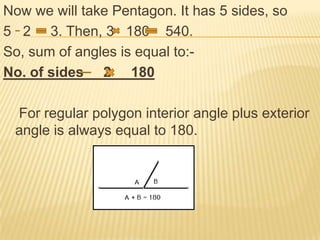
Now we will take Pentagon. It has 5 sides, so
5 2 3. Then, 3 180 540.
So, sum of angles is equal to:-
No. of sides 2 180

 For regular polygon interior angle plus exterior
 angle is always equal to 180.
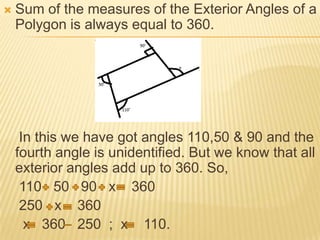
   Sum of the measures of the Exterior Angles of a
    Polygon is always equal to 360.


     In this we have got angles 110,50 & 90 and the
    fourth angle is unidentified. But we know that all
    exterior angles add up to 360. So,
     110 50 90 x 360
     250 x 360
      x 360 250 ; x 110.
KINDS OF QUADRILATERALS:-
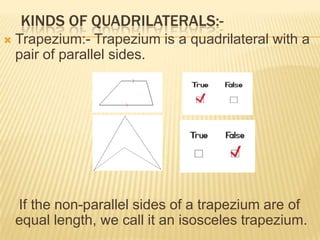
   Trapezium:- Trapezium is a quadrilateral with a
    pair of parallel sides.


    If the non-parallel sides of a trapezium are of
    equal length, we call it an isosceles trapezium.
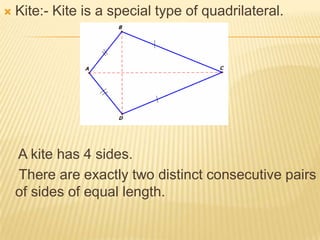
   Kite:- Kite is a special type of quadrilateral.


    A kite has 4 sides.
    There are exactly two distinct consecutive pairs
    of sides of equal length.
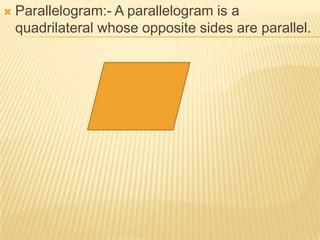
   Parallelogram:- A parallelogram is a
    quadrilateral whose opposite sides are parallel.
ELEMENTS OF A PARALLELOGRAM


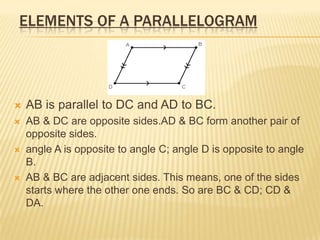
   AB is parallel to DC and AD to BC.
   AB & DC are opposite sides.AD & BC form another pair of
    opposite sides.
   angle A is opposite to angle C; angle D is opposite to angle
    B.
   AB & BC are adjacent sides. This means, one of the sides
    starts where the other one ends. So are BC & CD; CD &
    DA.
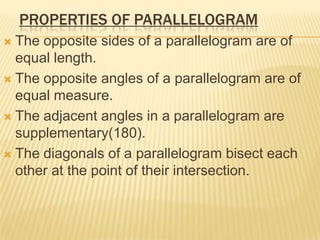
PROPERTIES OF PARALLELOGRAM
 The opposite sides of a parallelogram are of
  equal length.
 The opposite angles of a parallelogram are of
  equal measure.
 The adjacent angles in a parallelogram are
  supplementary(180).
 The diagonals of a parallelogram bisect each
  other at the point of their intersection.
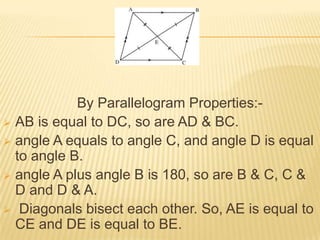
By Parallelogram Properties:-
 AB is equal to DC, so are AD & BC.
 angle A equals to angle C, and angle D is equal
  to angle B.
 angle A plus angle B is 180, so are B & C, C &
  D and D & A.
 Diagonals bisect each other. So, AE is equal to
  CE and DE is equal to BE.
SOME SPECIAL PARALLELOGRAMS

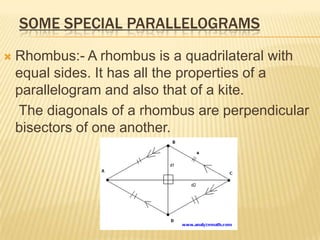
   Rhombus:- A rhombus is a quadrilateral with
    equal sides. It has all the properties of a
    parallelogram and also that of a kite.
    The diagonals of a rhombus are perpendicular
    bisectors of one another.
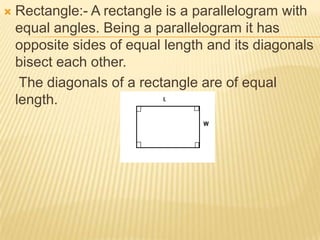
   Rectangle:- A rectangle is a parallelogram with
    equal angles. Being a parallelogram it has
    opposite sides of equal length and its diagonals
    bisect each other.
     The diagonals of a rectangle are of equal
    length.
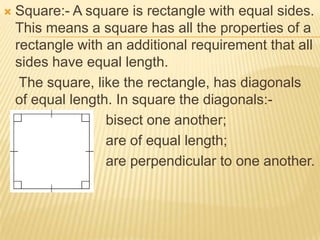
   Square:- A square is rectangle with equal sides.
    This means a square has all the properties of a
    rectangle with an additional requirement that all
    sides have equal length.
     The square, like the rectangle, has diagonals
    of equal length. In square the diagonals:-
                   bisect one another;
                   are of equal length;
                   are perpendicular to one another.

Understanding Quadrilaterals

  • 1.
  • 2.
    Polygons:- A simple closed curve made up of only line segments is called a polygons.  Curves that are polygons:-  Curves that are not polygons:-
  • 3.
    CLASSIFICATION OF POLYGONS  Triangle:- 3 sides  Quadrilateral:- 4 sides
  • 4.
    Pentagon:- 5 sides  Hexagon:- 6 sides  Heptagon:- 7 sides
  • 5.
    Octagon:- 8 sides  Nonagon:- 9 sides  Decagon:- 10 sides
  • 6.
    DIAGONALS  A diagonal is a line segment connecting two non-consecutive vertices of a polygon.  In 1st figure you can see that AC is the diagonal, and in 2nd figure AD and BC.
  • 7.
    Convex Polygons:- Polygons that are convex have no portions of their diagonals in their exteriors.  Concave Polygons:- Polygons that are concave have portions of their diagonals in their exterior.
  • 8.
    Regular Polygons:- A regular polygon has both equal sides and angles.  Polygons that are not regular:-
  • 9.
    ANGLE SUM PROPERTY We all have used this property to find the angles of a polygon.In it we first have to see the number of sides of a polygon, then subtract 2 from it and multiply the result by 180 to find its total angle sum. Here is an example:- Take Triangle, we know that it has 3 sides. So, subtract 2 from it, and we get 1. And after multiplying 1 with 180 we get 180 i.e. the exact sum of the angles of a triangle.
  • 10.
    Now we willtake Pentagon. It has 5 sides, so 5 2 3. Then, 3 180 540. So, sum of angles is equal to:- No. of sides 2 180 For regular polygon interior angle plus exterior angle is always equal to 180.
  • 11.
    Sum of the measures of the Exterior Angles of a Polygon is always equal to 360. In this we have got angles 110,50 & 90 and the fourth angle is unidentified. But we know that all exterior angles add up to 360. So, 110 50 90 x 360 250 x 360 x 360 250 ; x 110.
  • 12.
    KINDS OF QUADRILATERALS:-  Trapezium:- Trapezium is a quadrilateral with a pair of parallel sides. If the non-parallel sides of a trapezium are of equal length, we call it an isosceles trapezium.
  • 13.
    Kite:- Kite is a special type of quadrilateral. A kite has 4 sides. There are exactly two distinct consecutive pairs of sides of equal length.
  • 14.
    Parallelogram:- A parallelogram is a quadrilateral whose opposite sides are parallel.
  • 15.
    ELEMENTS OF APARALLELOGRAM  AB is parallel to DC and AD to BC.  AB & DC are opposite sides.AD & BC form another pair of opposite sides.  angle A is opposite to angle C; angle D is opposite to angle B.  AB & BC are adjacent sides. This means, one of the sides starts where the other one ends. So are BC & CD; CD & DA.
  • 16.
    PROPERTIES OF PARALLELOGRAM The opposite sides of a parallelogram are of equal length.  The opposite angles of a parallelogram are of equal measure.  The adjacent angles in a parallelogram are supplementary(180).  The diagonals of a parallelogram bisect each other at the point of their intersection.
  • 17.
    By Parallelogram Properties:- AB is equal to DC, so are AD & BC.  angle A equals to angle C, and angle D is equal to angle B.  angle A plus angle B is 180, so are B & C, C & D and D & A.  Diagonals bisect each other. So, AE is equal to CE and DE is equal to BE.
  • 18.
    SOME SPECIAL PARALLELOGRAMS  Rhombus:- A rhombus is a quadrilateral with equal sides. It has all the properties of a parallelogram and also that of a kite. The diagonals of a rhombus are perpendicular bisectors of one another.
  • 19.
    Rectangle:- A rectangle is a parallelogram with equal angles. Being a parallelogram it has opposite sides of equal length and its diagonals bisect each other. The diagonals of a rectangle are of equal length.
  • 20.
    Square:- A square is rectangle with equal sides. This means a square has all the properties of a rectangle with an additional requirement that all sides have equal length. The square, like the rectangle, has diagonals of equal length. In square the diagonals:- bisect one another; are of equal length; are perpendicular to one another.