MOHAMMAD IMRAN 
DEPARTMENT OF APPLIED SCIENCES 
JAHANGIRABAD EDUCATIONAL GROUP OF INSTITUTES 
www.jit.edu.in
Matrix Mathematics 
• Matrices are very useful in engineering 
calculations. For example, matrices are used to: 
– Efficiently store a large number of values (as we have 
done with arrays in MATLAB) 
– Solve systems of linear simultaneous equations 
– Transform quantities from one coordinate system to 
another 
• Several mathematical operations involving 
matrices are important
Outline 
 Basics: 
Operations on matrices 
 Transpose of the matrices 
 Types of matrices 
 Determinant of matrix 
 Linear systems of algebraic equations 
Matrix rank, existence of a solution 
Inverse of a matrix 
Normal form of the matrix 
Rank of matrix by using the normal form 
 Non-singular matrices P & Q which makes normal form with given matrix A 
as PAQ
Outline cont’ 
 Consistency 
 Eigen values and Eigenvectors
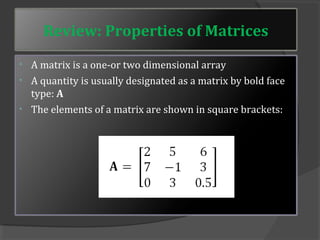
Review: Properties of Matrices 
• A matrix is a one-or two dimensional array 
• A quantity is usually designated as a matrix by bold face 
type: A 
• The elements of a matrix are shown in square brackets:
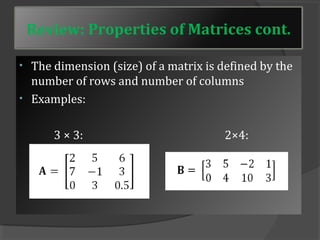
Review: Properties of Matrices cont. 
• The dimension (size) of a matrix is defined by the 
number of rows and number of columns 
• Examples: 
3 × 3: 2×4:
Review: Properties of Matrices cont. 
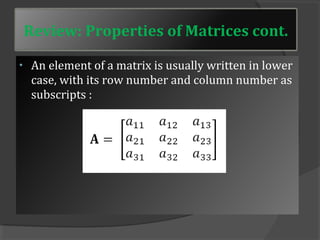
• An element of a matrix is usually written in lower 
case, with its row number and column number as 
subscripts :
Matrix Operations 
• Matrix Addition 
• Multiplication of a Matrix by a Scalar 
• Matrix Multiplication 
• Matrix Transposition 
• Finding the Determinate of a Matrix 
• Matrix Inversion
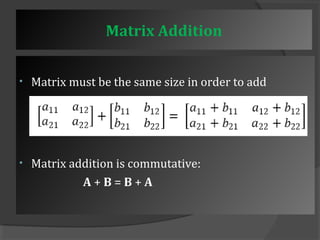
Matrix Addition 
• Matrix must be the same size in order to add 
• Matrix addition is commutative: 
A + B = B + A
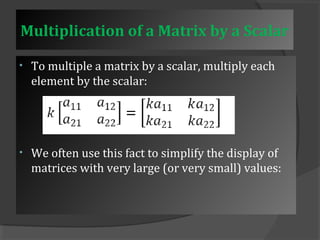
Multiplication of a Matrix by a Scalar 
• To multiple a matrix by a scalar, multiply each 
element by the scalar: 
• We often use this fact to simplify the display of 
matrices with very large (or very small) values:
Multiplication of Matrices 
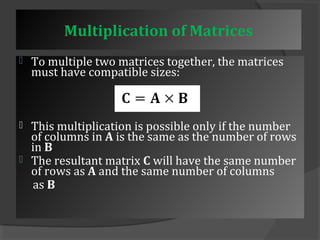
 To multiple two matrices together, the matrices 
must have compatible sizes: 
 This multiplication is possible only if the number 
of columns in A is the same as the number of rows 
in B 
 The resultant matrix C will have the same number 
of rows as A and the same number of columns 
as B
Multiplication of Matrices 
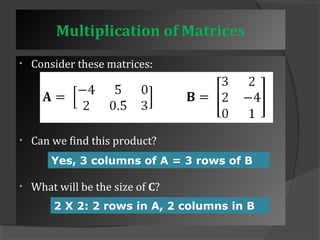
• Consider these matrices: 
• Can we find this product? 
Yes, 3 columns of A = 3 rows of B 
• What will be the size of C? 
2 X 2: 2 rows in A, 2 columns in B
Multiplication of Matrices 
• Element ij of the product matrix is computed 
by multiplying each element of row i of the 
first matrix by the corresponding element of 
column j of the second matrix, and summing 
the results 
• This is best illustrated by example
Example – Matrix Multiplication 
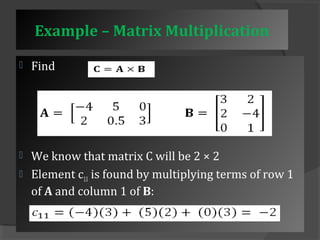
 Find 
 We know that matrix C will be 2 × 2 
 Element c11 is found by multiplying terms of row 1 
of A and column 1 of B:
Example – Matrix Multiplication 
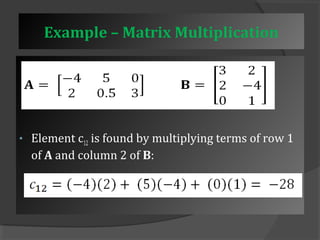
• Element c12 is found by multiplying terms of row 1 
of A and column 2 of B:
Example – Matrix Multiplication 
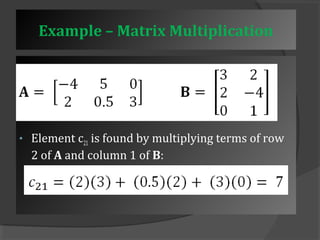
• Element c21 is found by multiplying terms of row 
2 of A and column 1 of B:
Example – Matrix Multiplication 
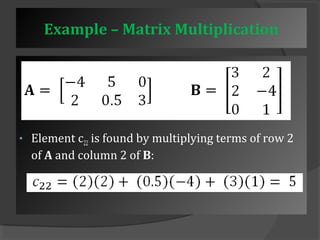
• Element c22 is found by multiplying terms of row 2 
of A and column 2 of B:
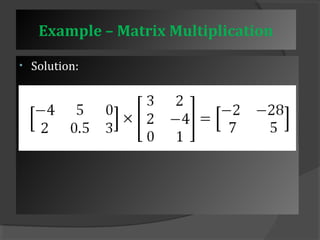
Example – Matrix Multiplication 
• Solution:
Matrix Multiplication 
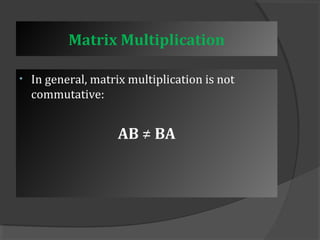
• In general, matrix multiplication is not 
commutative: 
AB ≠ BA
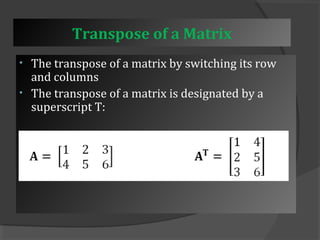
Transpose of a Matrix 
• The transpose of a matrix by switching its row 
and columns 
• The transpose of a matrix is designated by a 
superscript T:
Types of Matrices 
1. Row Matrix : A matrix which has only one row and n 
numbers of columns called “Row Matrix”. 
Ex : - [ 3 4 6 7 8 ………………n] 
2. Column Matrix : A Matrix which has only one column 
and n numbers of rows called “column Matrix”. 
3567....n
Types of Matrices 
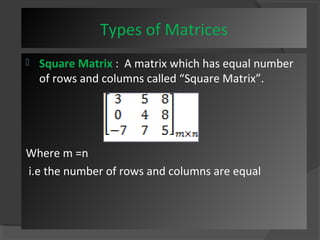
 Square Matrix : A matrix which has equal number 
of rows and columns called “Square Matrix”. 
Where m =n 
i.e the number of rows and columns are equal
Types of Matrices 
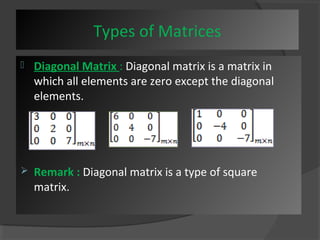
 Diagonal Matrix : Diagonal matrix is a matrix in 
which all elements are zero except the diagonal 
elements. 
 Remark : Diagonal matrix is a type of square 
matrix.
Types of Matrices 
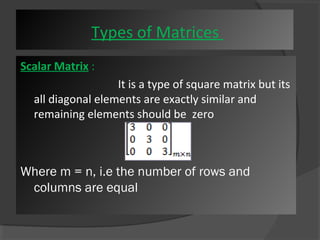
Scalar Matrix : 
It is a type of square matrix but its 
all diagonal elements are exactly similar and 
remaining elements should be zero 
Where m = n, i.e the number of rows and 
columns are equal
Ty Tpyepse so fo fM Maattrriicceess 
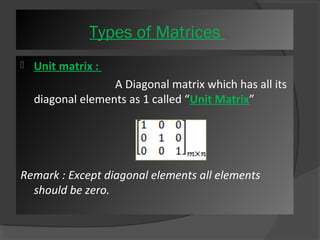
 Unit matrix : 
A Diagonal matrix which has all its 
diagonal elements as 1 called “Unit Matrix” 
Remark : Except diagonal elements all elements 
should be zero.
Types of Matrices 
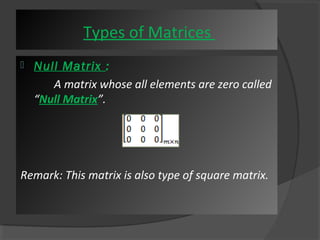
 Null Matrix : 
A matrix whose all elements are zero called 
“Null Matrix”. 
Remark: This matrix is also type of square matrix.
Types of Matrices 
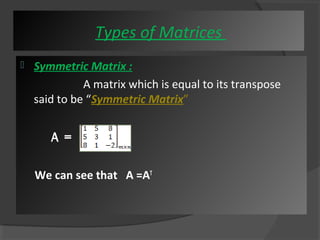
 Symmetric Matrix : 
A matrix which is equal to its transpose 
said to be “Symmetric Matrix” 
A = 
We can see that A =AT
T yTpyepse os fo Mf Mataritcreicse s 
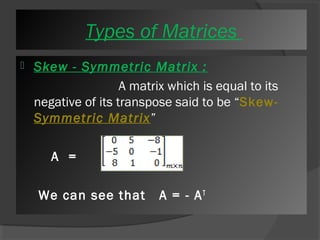
 Skew - Symmetric Matrix : 
A matrix which is equal to its 
negative of its transpose said to be “Skew- 
Symmetric Matrix” 
A = 
We can see that A = - AT
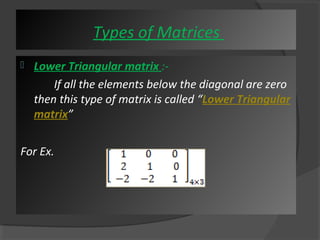
 Lower Triangular matrix :- 
If all the elements below the diagonal are zero 
then this type of matrix is called “Lower Triangular 
matrix” 
For Ex. 
Types of Matrices
Types of Matrices 
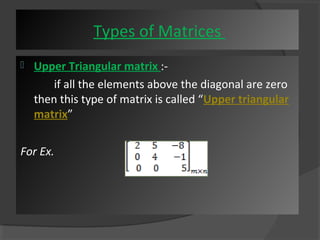
 Upper Triangular matrix :- 
if all the elements above the diagonal are zero 
then this type of matrix is called “Upper triangular 
matrix” 
For Ex.
Types of Matrices 
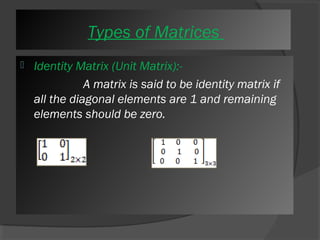
 Identity Matrix (Unit Matrix):- 
A matrix is said to be identity matrix if 
all the diagonal elements are 1 and remaining 
elements should be zero.
Types of Matrices 
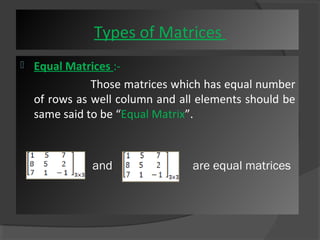
 Equal Matrices :- 
Those matrices which has equal number 
of rows as well column and all elements should be 
same said to be “Equal Matrix”. 
and are equal matrices
Types of Matrices 
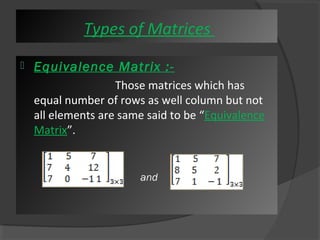
 Equivalence Matrix :- 
Those matrices which has 
equal number of rows as well column but not 
all elements are same said to be “Equivalence 
Matrix”. 
and
Types of Matrices 
Orthogonal matrix :- 
An orthogonal matrix is one 
whose transpose is also its inverse. 
AT = A-1
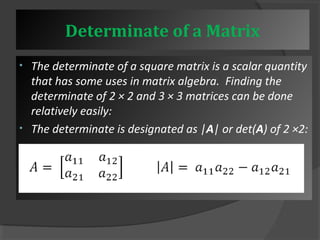
Determinate of a Matrix 
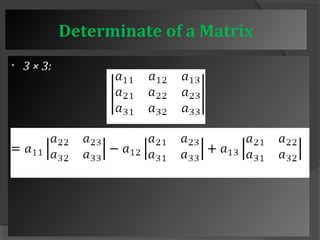
• The determinate of a square matrix is a scalar quantity 
that has some uses in matrix algebra. Finding the 
determinate of 2 × 2 and 3 × 3 matrices can be done 
relatively easily: 
• The determinate is designated as |A| or det(A) of 2 ×2:
Determinate of a Matrix 
• 3 × 3:
Matrix Rank 
 The rank of a matrix is simply the number of 
independent row vectors in that matrix. 
or 
The number of non-zero rows in the matrix. 
 The transpose of a matrix has the same rank as the 
original matrix. 
 To find the rank of a matrix by hand, use Gauss 
elimination and the linearly dependant row vectors 
will fall out, leaving only the linearly independent 
vectors, the number of which is the rank.
Matrix inverse 
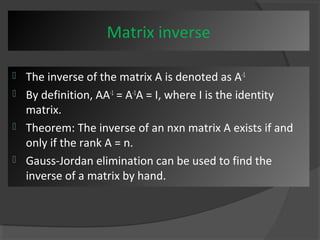
 The inverse of the matrix A is denoted as A-1 
 By definition, AA-1 = A-1A = I, where I is the identity 
matrix. 
 Theorem: The inverse of an nxn matrix A exists if and 
only if the rank A = n. 
 Gauss-Jordan elimination can be used to find the 
inverse of a matrix by hand.
Inverse of a 2 x 2 matrix 
Procedure 
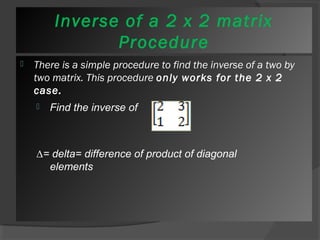
 There is a simple procedure to find the inverse of a two by 
two matrix. This procedure only works for the 2 x 2 
case. 
 Find the inverse of 
Δ= delta= difference of product of diagonal 
elements
Inverse of a 2 x 2 matrix 
Procedure 
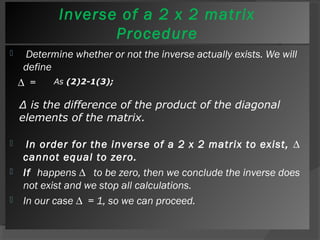
 Determine whether or not the inverse actually exists. We will 
define 
Δ = 
As (2)2-1(3); 
Δ is the difference of the product of the diagonal 
elements of the matrix. 
 In order for the inverse of a 2 x 2 matrix to exist, Δ 
cannot equal to zero. 
 If happens Δ to be zero, then we conclude the inverse does 
not exist and we stop all calculations. 
 In our case Δ = 1, so we can proceed.
Inverse of a 2 x 2 matrix 
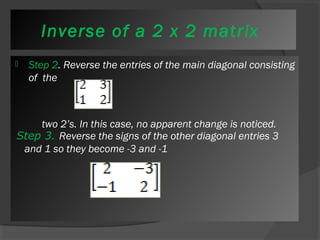
 Step 2. Reverse the entries of the main diagonal consisting 
of the 
two 2’s. In this case, no apparent change is noticed. 
Step 3. Reverse the signs of the other diagonal entries 3 
and 1 so they become -3 and -1
Inverse of a 2 x 2 matrix 
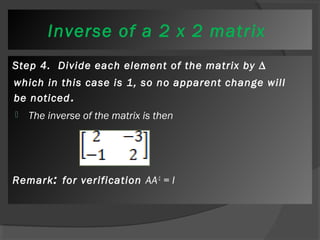
Step 4. Divide each element of the matrix by Δ 
which in this case is 1, so no apparent change will 
be noticed. 
 The inverse of the matrix is then 
Remark: for verification AA-1 = I
Inverse of a 3 x 3 matrix 
Procedure 
We use a more general procedure to find the inverse of a 3 x 3 
matrix. 
1. Augment this matrix with the 3 x 3 identity matrix. 
2. Use elementary row operations to transform the matrix on the 
left side of the vertical line to the 3 x 3 identity matrix. The row 
operation is used for the entire row so that the matrix on the 
right hand side of the vertical line will also change. 
3. When the matrix on the left is transformed to the 3 x 3 identity 
matrix, the matrix on the right of the vertical line is the 
inverse.
ProcInevdeurrsee of a 3 x 3 matrix 
Procedure 
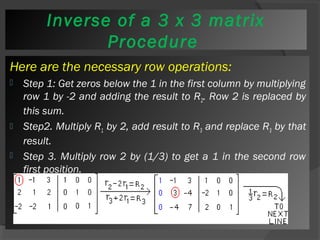
Here are the necessary row operations: 
 Step 1: Get zeros below the 1 in the first column by multiplying 
row 1 by -2 and adding the result to R2. Row 2 is replaced by 
this sum. 
 Step2. Multiply R1 by 2, add result to R3 and replace R3 by that 
result. 
 Step 3. Multiply row 2 by (1/3) to get a 1 in the second row 
first position.
Inverse of a 3 x 3 matrix 
Continuation of Procedure 
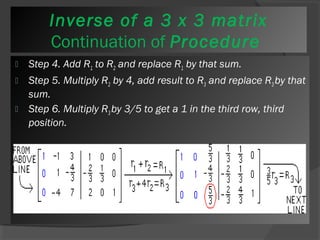
 Step 4. Add R1 to R2 and replace R1 by that sum. 
 Step 5. Multiply R2 by 4, add result to R3 and replace R3 by that 
sum. 
 Step 6. Multiply R3 by 3/5 to get a 1 in the third row, third 
position.
Inverse of a 3 x 3 matrix 
Final result 
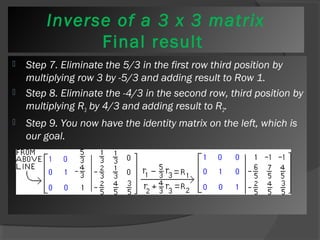
 Step 7. Eliminate the 5/3 in the first row third position by 
multiplying row 3 by -5/3 and adding result to Row 1. 
 Step 8. Eliminate the -4/3 in the second row, third position by 
multiplying R3 by 4/3 and adding result to R2. 
 Step 9. You now have the identity matrix on the left, which is 
our goal.
Normal form of a matrix 
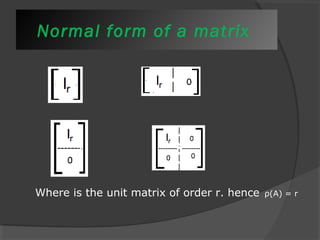
Where is the unit matrix of order r. hence ρ(A) = r
Square Matrices P & Q of Orders m & n 
respectively , such that PAQ is in the normal 
form 
Working rule:- 
1. write A = I A I 
2. Reduce the matrix on L.H.S.to normal form by applying 
elementary row or column operation. 
Remark : 
* if row operation is applied on L.H.S. then this operation is 
applied on pre-factor of A on R.H.S 
* if column operation is applied on L.H.S. then this operation 
is applied on post-factor of A on R.H.S 
 The matrices P and Q are not unique
Consistent and Inconsistent Systems of 
Equations 
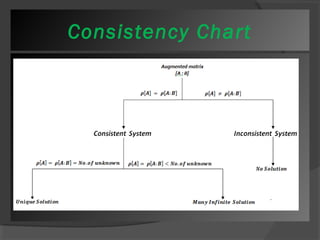
 All the systems of equations that we have seen in this 
section so far have had unique solutions. These are 
referred to as Consistent Systems of Equations, meaning 
that for a given system, there exists one solution set for 
the different variables in the system or infinitely many sets 
of solution. In other words, as long as we can find a 
solution for the system of equations, we refer to that 
system as being consistent 
 Inconsistent systems arise when the lines or planes 
formed from the systems of equations don't meet at any 
point.
Consistency Chart
Eigen values and Eigen 
vectors 
Origin of Eigen values and Eigen vectors 
 Eigen values and eigenvectors have their origins 
in physics, in particular in problems where 
motion is involved, although their uses extend 
from solutions to stress and strain problems to 
differential equations and quantum mechanics. 
we can use matrices to deform a body - the 
concept of STRAIN. Eigenvectors are vectors that 
point in directions where there is no rotation. 
Eigen values are the change in length of the 
eigenvector from the original length.
Eigen values and Eigen vectors 
 Let A be an nxn matrix and consider the vector 
equation: 
Ax = lx 
 A value of l for which this equation has a solution x≠0 
is called an Eigen value of the matrix A. 
 The corresponding solutions x are called the Eigen 
vectors of the matrix A.
Solving for Eigen Values 
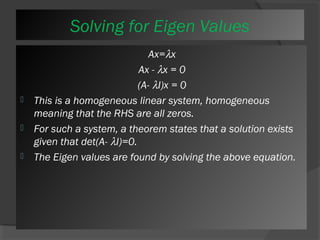
Ax=lx 
Ax - lx = 0 
(A- lI)x = 0 
 This is a homogeneous linear system, homogeneous 
meaning that the RHS are all zeros. 
 For such a system, a theorem states that a solution exists 
given that det(A- lI)=0. 
 The Eigen values are found by solving the above equation.
Solving for Eigen values cont’ 
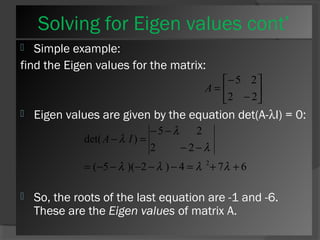
 Simple example: 
find the Eigen values for the matrix: 
ù 
úû 
é 
- 
= 
2 2 
êë 
5 2 
- 
A 
 Eigen values are given by the equation det(A-lI) = 0: 
- - 
l 
5 2 
A l I 
- = 
l l l l 
det( ) 
2 - 2 
- 
l 
= - - - - - = 2+ + 
( 5 )( 2 ) 4 7 6 
 So, the roots of the last equation are -1 and -6. 
These are the Eigen values of matrix A.
Eigenvectors 
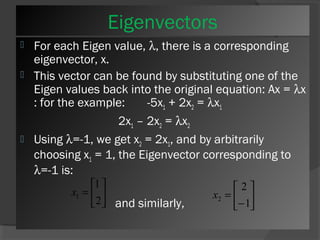
 For each Eigen value, l, there is a corresponding 
eigenvector, x. 
 This vector can be found by substituting one of the 
Eigen values back into the original equation: Ax = lx 
: for the example: -5x1 + 2x2 = lx1 
2x1 – 2x2 = lx2 
 Using l=-1, we get x2 = 2x1, and by arbitrarily 
choosing x1 = 1, the Eigenvector corresponding to 
l=-1 is: 
2 
é 
- 
x 1 and similarly, 
úû 
ù 
úû 
1 
é 
= 
2 
êë 
ù 
êë 
= 
1 
2 x
Special matrices 
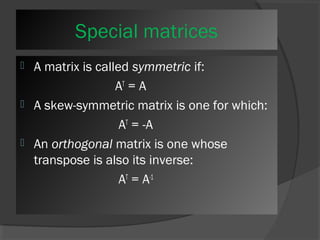
 A matrix is called symmetric if: 
AT = A 
 A skew-symmetric matrix is one for which: 
AT = -A 
 An orthogonal matrix is one whose 
transpose is also its inverse: 
AT = A-1

Matrix and its applications by mohammad imran

  • 1.
    MOHAMMAD IMRAN DEPARTMENTOF APPLIED SCIENCES JAHANGIRABAD EDUCATIONAL GROUP OF INSTITUTES www.jit.edu.in
  • 2.
    Matrix Mathematics •Matrices are very useful in engineering calculations. For example, matrices are used to: – Efficiently store a large number of values (as we have done with arrays in MATLAB) – Solve systems of linear simultaneous equations – Transform quantities from one coordinate system to another • Several mathematical operations involving matrices are important
  • 3.
    Outline  Basics: Operations on matrices  Transpose of the matrices  Types of matrices  Determinant of matrix  Linear systems of algebraic equations Matrix rank, existence of a solution Inverse of a matrix Normal form of the matrix Rank of matrix by using the normal form  Non-singular matrices P & Q which makes normal form with given matrix A as PAQ
  • 4.
    Outline cont’ Consistency  Eigen values and Eigenvectors
  • 5.
    Review: Properties ofMatrices • A matrix is a one-or two dimensional array • A quantity is usually designated as a matrix by bold face type: A • The elements of a matrix are shown in square brackets:
  • 6.
    Review: Properties ofMatrices cont. • The dimension (size) of a matrix is defined by the number of rows and number of columns • Examples: 3 × 3: 2×4:
  • 7.
    Review: Properties ofMatrices cont. • An element of a matrix is usually written in lower case, with its row number and column number as subscripts :
  • 8.
    Matrix Operations •Matrix Addition • Multiplication of a Matrix by a Scalar • Matrix Multiplication • Matrix Transposition • Finding the Determinate of a Matrix • Matrix Inversion
  • 9.
    Matrix Addition •Matrix must be the same size in order to add • Matrix addition is commutative: A + B = B + A
  • 10.
    Multiplication of aMatrix by a Scalar • To multiple a matrix by a scalar, multiply each element by the scalar: • We often use this fact to simplify the display of matrices with very large (or very small) values:
  • 11.
    Multiplication of Matrices  To multiple two matrices together, the matrices must have compatible sizes:  This multiplication is possible only if the number of columns in A is the same as the number of rows in B  The resultant matrix C will have the same number of rows as A and the same number of columns as B
  • 12.
    Multiplication of Matrices • Consider these matrices: • Can we find this product? Yes, 3 columns of A = 3 rows of B • What will be the size of C? 2 X 2: 2 rows in A, 2 columns in B
  • 13.
    Multiplication of Matrices • Element ij of the product matrix is computed by multiplying each element of row i of the first matrix by the corresponding element of column j of the second matrix, and summing the results • This is best illustrated by example
  • 14.
    Example – MatrixMultiplication  Find  We know that matrix C will be 2 × 2  Element c11 is found by multiplying terms of row 1 of A and column 1 of B:
  • 15.
    Example – MatrixMultiplication • Element c12 is found by multiplying terms of row 1 of A and column 2 of B:
  • 16.
    Example – MatrixMultiplication • Element c21 is found by multiplying terms of row 2 of A and column 1 of B:
  • 17.
    Example – MatrixMultiplication • Element c22 is found by multiplying terms of row 2 of A and column 2 of B:
  • 18.
    Example – MatrixMultiplication • Solution:
  • 19.
    Matrix Multiplication •In general, matrix multiplication is not commutative: AB ≠ BA
  • 20.
    Transpose of aMatrix • The transpose of a matrix by switching its row and columns • The transpose of a matrix is designated by a superscript T:
  • 21.
    Types of Matrices 1. Row Matrix : A matrix which has only one row and n numbers of columns called “Row Matrix”. Ex : - [ 3 4 6 7 8 ………………n] 2. Column Matrix : A Matrix which has only one column and n numbers of rows called “column Matrix”. 3567....n
  • 22.
    Types of Matrices  Square Matrix : A matrix which has equal number of rows and columns called “Square Matrix”. Where m =n i.e the number of rows and columns are equal
  • 23.
    Types of Matrices  Diagonal Matrix : Diagonal matrix is a matrix in which all elements are zero except the diagonal elements.  Remark : Diagonal matrix is a type of square matrix.
  • 24.
    Types of Matrices Scalar Matrix : It is a type of square matrix but its all diagonal elements are exactly similar and remaining elements should be zero Where m = n, i.e the number of rows and columns are equal
  • 25.
    Ty Tpyepse sofo fM Maattrriicceess  Unit matrix : A Diagonal matrix which has all its diagonal elements as 1 called “Unit Matrix” Remark : Except diagonal elements all elements should be zero.
  • 26.
    Types of Matrices  Null Matrix : A matrix whose all elements are zero called “Null Matrix”. Remark: This matrix is also type of square matrix.
  • 27.
    Types of Matrices  Symmetric Matrix : A matrix which is equal to its transpose said to be “Symmetric Matrix” A = We can see that A =AT
  • 28.
    T yTpyepse osfo Mf Mataritcreicse s  Skew - Symmetric Matrix : A matrix which is equal to its negative of its transpose said to be “Skew- Symmetric Matrix” A = We can see that A = - AT
  • 29.
     Lower Triangularmatrix :- If all the elements below the diagonal are zero then this type of matrix is called “Lower Triangular matrix” For Ex. Types of Matrices
  • 30.
    Types of Matrices  Upper Triangular matrix :- if all the elements above the diagonal are zero then this type of matrix is called “Upper triangular matrix” For Ex.
  • 31.
    Types of Matrices  Identity Matrix (Unit Matrix):- A matrix is said to be identity matrix if all the diagonal elements are 1 and remaining elements should be zero.
  • 32.
    Types of Matrices  Equal Matrices :- Those matrices which has equal number of rows as well column and all elements should be same said to be “Equal Matrix”. and are equal matrices
  • 33.
    Types of Matrices  Equivalence Matrix :- Those matrices which has equal number of rows as well column but not all elements are same said to be “Equivalence Matrix”. and
  • 34.
    Types of Matrices Orthogonal matrix :- An orthogonal matrix is one whose transpose is also its inverse. AT = A-1
  • 35.
    Determinate of aMatrix • The determinate of a square matrix is a scalar quantity that has some uses in matrix algebra. Finding the determinate of 2 × 2 and 3 × 3 matrices can be done relatively easily: • The determinate is designated as |A| or det(A) of 2 ×2:
  • 36.
    Determinate of aMatrix • 3 × 3:
  • 37.
    Matrix Rank The rank of a matrix is simply the number of independent row vectors in that matrix. or The number of non-zero rows in the matrix.  The transpose of a matrix has the same rank as the original matrix.  To find the rank of a matrix by hand, use Gauss elimination and the linearly dependant row vectors will fall out, leaving only the linearly independent vectors, the number of which is the rank.
  • 38.
    Matrix inverse The inverse of the matrix A is denoted as A-1  By definition, AA-1 = A-1A = I, where I is the identity matrix.  Theorem: The inverse of an nxn matrix A exists if and only if the rank A = n.  Gauss-Jordan elimination can be used to find the inverse of a matrix by hand.
  • 39.
    Inverse of a2 x 2 matrix Procedure  There is a simple procedure to find the inverse of a two by two matrix. This procedure only works for the 2 x 2 case.  Find the inverse of Δ= delta= difference of product of diagonal elements
  • 40.
    Inverse of a2 x 2 matrix Procedure  Determine whether or not the inverse actually exists. We will define Δ = As (2)2-1(3); Δ is the difference of the product of the diagonal elements of the matrix.  In order for the inverse of a 2 x 2 matrix to exist, Δ cannot equal to zero.  If happens Δ to be zero, then we conclude the inverse does not exist and we stop all calculations.  In our case Δ = 1, so we can proceed.
  • 41.
    Inverse of a2 x 2 matrix  Step 2. Reverse the entries of the main diagonal consisting of the two 2’s. In this case, no apparent change is noticed. Step 3. Reverse the signs of the other diagonal entries 3 and 1 so they become -3 and -1
  • 42.
    Inverse of a2 x 2 matrix Step 4. Divide each element of the matrix by Δ which in this case is 1, so no apparent change will be noticed.  The inverse of the matrix is then Remark: for verification AA-1 = I
  • 43.
    Inverse of a3 x 3 matrix Procedure We use a more general procedure to find the inverse of a 3 x 3 matrix. 1. Augment this matrix with the 3 x 3 identity matrix. 2. Use elementary row operations to transform the matrix on the left side of the vertical line to the 3 x 3 identity matrix. The row operation is used for the entire row so that the matrix on the right hand side of the vertical line will also change. 3. When the matrix on the left is transformed to the 3 x 3 identity matrix, the matrix on the right of the vertical line is the inverse.
  • 44.
    ProcInevdeurrsee of a3 x 3 matrix Procedure Here are the necessary row operations:  Step 1: Get zeros below the 1 in the first column by multiplying row 1 by -2 and adding the result to R2. Row 2 is replaced by this sum.  Step2. Multiply R1 by 2, add result to R3 and replace R3 by that result.  Step 3. Multiply row 2 by (1/3) to get a 1 in the second row first position.
  • 45.
    Inverse of a3 x 3 matrix Continuation of Procedure  Step 4. Add R1 to R2 and replace R1 by that sum.  Step 5. Multiply R2 by 4, add result to R3 and replace R3 by that sum.  Step 6. Multiply R3 by 3/5 to get a 1 in the third row, third position.
  • 46.
    Inverse of a3 x 3 matrix Final result  Step 7. Eliminate the 5/3 in the first row third position by multiplying row 3 by -5/3 and adding result to Row 1.  Step 8. Eliminate the -4/3 in the second row, third position by multiplying R3 by 4/3 and adding result to R2.  Step 9. You now have the identity matrix on the left, which is our goal.
  • 47.
    Normal form ofa matrix Where is the unit matrix of order r. hence ρ(A) = r
  • 48.
    Square Matrices P& Q of Orders m & n respectively , such that PAQ is in the normal form Working rule:- 1. write A = I A I 2. Reduce the matrix on L.H.S.to normal form by applying elementary row or column operation. Remark : * if row operation is applied on L.H.S. then this operation is applied on pre-factor of A on R.H.S * if column operation is applied on L.H.S. then this operation is applied on post-factor of A on R.H.S  The matrices P and Q are not unique
  • 49.
    Consistent and InconsistentSystems of Equations  All the systems of equations that we have seen in this section so far have had unique solutions. These are referred to as Consistent Systems of Equations, meaning that for a given system, there exists one solution set for the different variables in the system or infinitely many sets of solution. In other words, as long as we can find a solution for the system of equations, we refer to that system as being consistent  Inconsistent systems arise when the lines or planes formed from the systems of equations don't meet at any point.
  • 50.
  • 51.
    Eigen values andEigen vectors Origin of Eigen values and Eigen vectors  Eigen values and eigenvectors have their origins in physics, in particular in problems where motion is involved, although their uses extend from solutions to stress and strain problems to differential equations and quantum mechanics. we can use matrices to deform a body - the concept of STRAIN. Eigenvectors are vectors that point in directions where there is no rotation. Eigen values are the change in length of the eigenvector from the original length.
  • 52.
    Eigen values andEigen vectors  Let A be an nxn matrix and consider the vector equation: Ax = lx  A value of l for which this equation has a solution x≠0 is called an Eigen value of the matrix A.  The corresponding solutions x are called the Eigen vectors of the matrix A.
  • 53.
    Solving for EigenValues Ax=lx Ax - lx = 0 (A- lI)x = 0  This is a homogeneous linear system, homogeneous meaning that the RHS are all zeros.  For such a system, a theorem states that a solution exists given that det(A- lI)=0.  The Eigen values are found by solving the above equation.
  • 54.
    Solving for Eigenvalues cont’  Simple example: find the Eigen values for the matrix: ù úû é - = 2 2 êë 5 2 - A  Eigen values are given by the equation det(A-lI) = 0: - - l 5 2 A l I - = l l l l det( ) 2 - 2 - l = - - - - - = 2+ + ( 5 )( 2 ) 4 7 6  So, the roots of the last equation are -1 and -6. These are the Eigen values of matrix A.
  • 55.
    Eigenvectors  Foreach Eigen value, l, there is a corresponding eigenvector, x.  This vector can be found by substituting one of the Eigen values back into the original equation: Ax = lx : for the example: -5x1 + 2x2 = lx1 2x1 – 2x2 = lx2  Using l=-1, we get x2 = 2x1, and by arbitrarily choosing x1 = 1, the Eigenvector corresponding to l=-1 is: 2 é - x 1 and similarly, úû ù úû 1 é = 2 êë ù êë = 1 2 x
  • 56.
    Special matrices A matrix is called symmetric if: AT = A  A skew-symmetric matrix is one for which: AT = -A  An orthogonal matrix is one whose transpose is also its inverse: AT = A-1