Presentation 
on 
Matrices and some 
special matrices 
In partial fulfillment of the subject 
Vector calculus and linear algebra 
(2110015) 
Submitted by: 
Agarwal Ritika (130120116001) /IT/C-1 
Akabari Nirali (130120116002) /IT/C-1 
Akanksha Sharma (130120116003) /IT/C-1 
GANDHINAGAR INSTITUTE OF 
TECHNOLOGY
INTRODUCTION: 
 A matrix is a rectangular table of elements which may be 
numbers or abstract quantities that can be added and 
multiplied . 
 Matrices are used to describe linear equations, record 
data that depends on multiple parameters. 
 There are many applications of matrices in maths viz. 
graph theory, probality theory, statistics , computer 
graphics, geometrical optics,etc
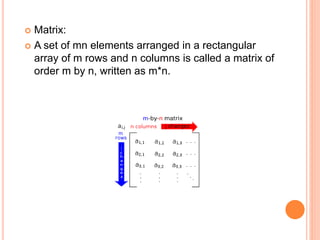
 Matrix: 
 A set of mn elements arranged in a rectangular 
array of m rows and n columns is called a matrix of 
order m by n, written as m*n.
SOME DEFINITIONS ASSOCIATED WITH 
MATRICES: 
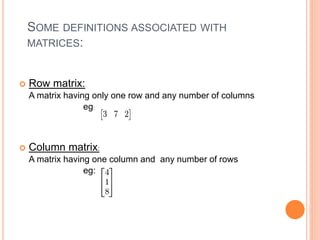
 Row matrix: 
A matrix having only one row and any number of columns 
eg: 
 Column matrix: 
A matrix having one column and any number of rows 
eg:
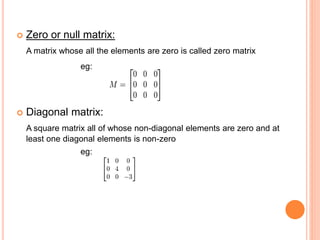
 Zero or null matrix: 
A matrix whose all the elements are zero is called zero matrix 
eg: 
 Diagonal matrix: 
A square matrix all of whose non-diagonal elements are zero and at 
least one diagonal elements is non-zero 
eg:
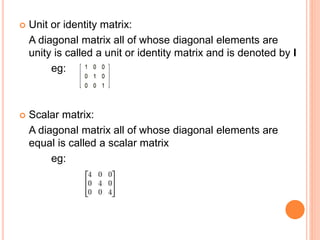
 Unit or identity matrix: 
A diagonal matrix all of whose diagonal elements are 
unity is called a unit or identity matrix and is denoted by I 
eg: 
 Scalar matrix: 
A diagonal matrix all of whose diagonal elements are 
equal is called a scalar matrix 
eg:
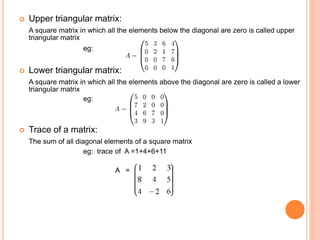
 Upper triangular matrix: 
A square matrix in which all the elements below the diagonal are zero is called upper 
triangular matrix 
eg: 
 Lower triangular matrix: 
A square matrix in which all the elements above the diagonal are zero is called a lower 
triangular matrix 
eg: 
 Trace of a matrix: 
The sum of all diagonal elements of a square matrix 
eg: trace of A =1+4+6+11 
A =
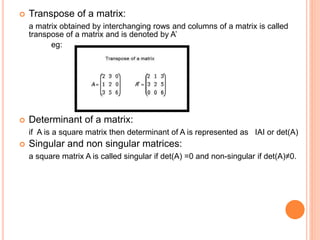
 Transpose of a matrix: 
a matrix obtained by interchanging rows and columns of a matrix is called 
transpose of a matrix and is denoted by A’ 
eg: 
 Determinant of a matrix: 
if A is a square matrix then determinant of A is represented as IAI or det(A) 
 Singular and non singular matrices: 
a square matrix A is called singular if det(A) =0 and non-singular if det(A)≠0.
Some special matrices: 
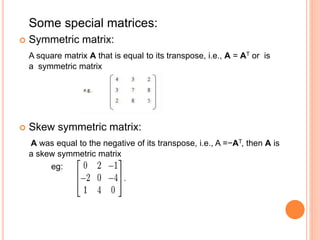
 Symmetric matrix: 
A square matrix A that is equal to its transpose, i.e., A = AT or is 
a symmetric matrix 
 Skew symmetric matrix: 
A was equal to the negative of its transpose, i.e., A =−AT, then A is 
a skew symmetric matrix 
eg:
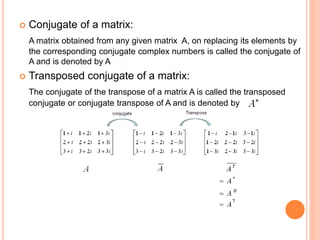
 Conjugate of a matrix: 
A matrix obtained from any given matrix A, on replacing its elements by 
the corresponding conjugate complex numbers is called the conjugate of 
A and is denoted by A 
 Transposed conjugate of a matrix: 
The conjugate of the transpose of a matrix A is called the transposed 
conjugate or conjugate transpose of A and is denoted by
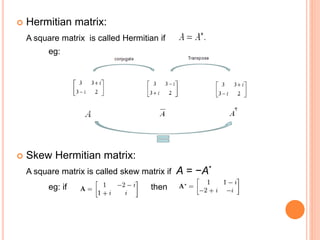
 Hermitian matrix: 
A square matrix is called Hermitian if 
eg: 
 Skew Hermitian matrix: 
A square matrix is called skew matrix if A = −A* 
eg: if then
 Unitary matrix: 
A square matrix is called unitary if AA*= A*A=I 
 Orthogonal matrix: 
A square matrix A is called orthogonal if AT A=AAT =I.
ppt of VCLA

ppt of VCLA

  • 1.
    Presentation on Matricesand some special matrices In partial fulfillment of the subject Vector calculus and linear algebra (2110015) Submitted by: Agarwal Ritika (130120116001) /IT/C-1 Akabari Nirali (130120116002) /IT/C-1 Akanksha Sharma (130120116003) /IT/C-1 GANDHINAGAR INSTITUTE OF TECHNOLOGY
  • 3.
    INTRODUCTION:  Amatrix is a rectangular table of elements which may be numbers or abstract quantities that can be added and multiplied .  Matrices are used to describe linear equations, record data that depends on multiple parameters.  There are many applications of matrices in maths viz. graph theory, probality theory, statistics , computer graphics, geometrical optics,etc
  • 4.
     Matrix: A set of mn elements arranged in a rectangular array of m rows and n columns is called a matrix of order m by n, written as m*n.
  • 5.
    SOME DEFINITIONS ASSOCIATEDWITH MATRICES:  Row matrix: A matrix having only one row and any number of columns eg:  Column matrix: A matrix having one column and any number of rows eg:
  • 6.
     Zero ornull matrix: A matrix whose all the elements are zero is called zero matrix eg:  Diagonal matrix: A square matrix all of whose non-diagonal elements are zero and at least one diagonal elements is non-zero eg:
  • 7.
     Unit oridentity matrix: A diagonal matrix all of whose diagonal elements are unity is called a unit or identity matrix and is denoted by I eg:  Scalar matrix: A diagonal matrix all of whose diagonal elements are equal is called a scalar matrix eg:
  • 8.
     Upper triangularmatrix: A square matrix in which all the elements below the diagonal are zero is called upper triangular matrix eg:  Lower triangular matrix: A square matrix in which all the elements above the diagonal are zero is called a lower triangular matrix eg:  Trace of a matrix: The sum of all diagonal elements of a square matrix eg: trace of A =1+4+6+11 A =
  • 9.
     Transpose ofa matrix: a matrix obtained by interchanging rows and columns of a matrix is called transpose of a matrix and is denoted by A’ eg:  Determinant of a matrix: if A is a square matrix then determinant of A is represented as IAI or det(A)  Singular and non singular matrices: a square matrix A is called singular if det(A) =0 and non-singular if det(A)≠0.
  • 10.
    Some special matrices:  Symmetric matrix: A square matrix A that is equal to its transpose, i.e., A = AT or is a symmetric matrix  Skew symmetric matrix: A was equal to the negative of its transpose, i.e., A =−AT, then A is a skew symmetric matrix eg:
  • 11.
     Conjugate ofa matrix: A matrix obtained from any given matrix A, on replacing its elements by the corresponding conjugate complex numbers is called the conjugate of A and is denoted by A  Transposed conjugate of a matrix: The conjugate of the transpose of a matrix A is called the transposed conjugate or conjugate transpose of A and is denoted by
  • 12.
     Hermitian matrix: A square matrix is called Hermitian if eg:  Skew Hermitian matrix: A square matrix is called skew matrix if A = −A* eg: if then
  • 13.
     Unitary matrix: A square matrix is called unitary if AA*= A*A=I  Orthogonal matrix: A square matrix A is called orthogonal if AT A=AAT =I.