There are two ways to count the number of possible outcomes of an experiment:
1) Using a tree diagram to list out all the combinations
2) Using the Fundamental Counting Principle, which involves multiplying the number of choices for each event together.
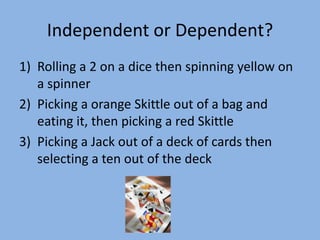
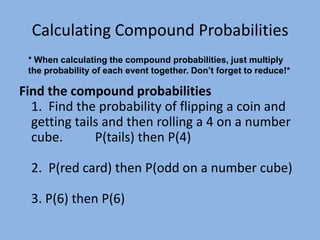
To calculate the probability of compound events (events made up of two or more simple events), you first determine if the events are independent or dependent. For independent events, the probability of one event does not affect the other event. You calculate the probability by multiplying the individual probabilities together.