1
CRYPTOGRAPHIC TOOLS
ITSY3104 COMPUTER SECURITY - A - LECTURE 2 - Cryptographic Tools
Mr. RAJASEKAR RAMALINGAM Department of
IT, College of Applied Sciences, Sur.
Sultanate of Oman.
http://vrrsekar.wixsite.com/raja
Based on
William Stallings, Lawrie Brown, Computer Security:
Principles and Practice, Third Edition
CONTENT
2.1 Symmetric Encryption
2.2 Message Authentication and Hash Functions
2.3 Public-Key Encryption
2.4 Digital Signatures and Key Management
2.5 Random and Pseudorandom Numbers
2.6 Practical Application: Encryption of Stored Data
2.7 Symmetric vs Asymmetric
ITSY3104 COMPUTER SECURITY - A - LECTURE 2 - Cryptographic Tools 2
2.1 Symmetric Encryption
• universal technique for providing confidentiality
• also referred to as single-key encryption
• two requirements for secure use:
– need a strong encryption algorithm
– sender and receiver must have obtained copies of the secret
key in a secure fashion
• and must keep the key secure
ITSY3104 COMPUTER SECURITY - A - LECTURE 2 - Cryptographic Tools 3
Symmetric Encryption
ITSY3104 COMPUTER SECURITY - A - LECTURE 2 - Cryptographic Tools 4
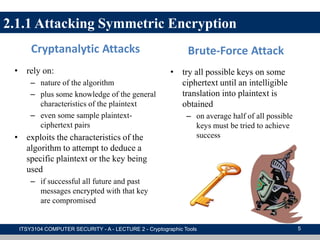
Cryptanalytic Attacks
• rely on:
– nature of the algorithm
– plus some knowledge of the general
characteristics of the plaintext
– even some sample plaintext-
ciphertext pairs
• exploits the characteristics of the
algorithm to attempt to deduce a
specific plaintext or the key being
used
– if successful all future and past
messages encrypted with that key
are compromised
Brute-Force Attack
• try all possible keys on some
ciphertext until an intelligible
translation into plaintext is
obtained
– on average half of all possible
keys must be tried to achieve
success
2.1.1 Attacking Symmetric Encryption
ITSY3104 COMPUTER SECURITY - A - LECTURE 2 - Cryptographic Tools 5
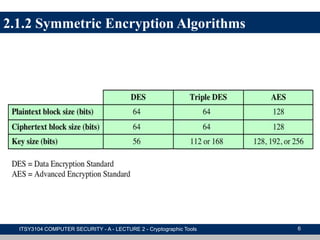
2.1.2 Symmetric Encryption Algorithms
ITSY3104 COMPUTER SECURITY - A - LECTURE 2 - Cryptographic Tools 6
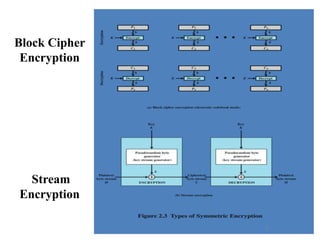
Block Cipher
Encryption
Stream
Encryption
7
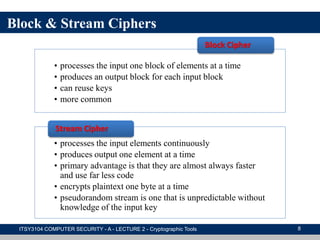
Block & Stream Ciphers
• processes the input one block of elements at a time
• produces an output block for each input block
• can reuse keys
• more common
Block Cipher
• processes the input elements continuously
• produces output one element at a time
• primary advantage is that they are almost always faster
and use far less code
• encrypts plaintext one byte at a time
• pseudorandom stream is one that is unpredictable without
knowledge of the input key
Stream Cipher
ITSY3104 COMPUTER SECURITY - A - LECTURE 2 - Cryptographic Tools 8
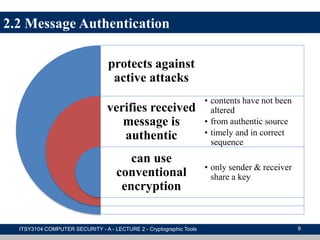
2.2 Message Authentication
protects against
active attacks
verifies received
message is
authentic
can use
conventional
encryption
• contents have not been
altered
• from authentic source
• timely and in correct
sequence
• only sender & receiver
share a key
ITSY3104 COMPUTER SECURITY - A - LECTURE 2 - Cryptographic Tools 9
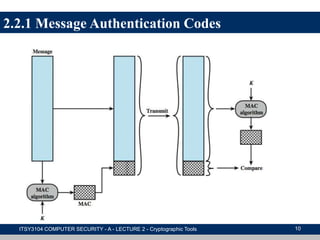
2.2.1 Message Authentication Codes
ITSY3104 COMPUTER SECURITY - A - LECTURE 2 - Cryptographic Tools 10
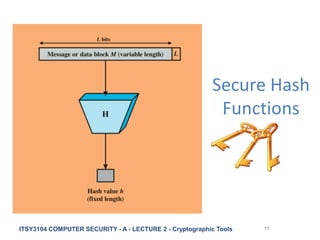
Secure Hash
Functions
ITSY3104 COMPUTER SECURITY - A - LECTURE 2 - Cryptographic Tools 11
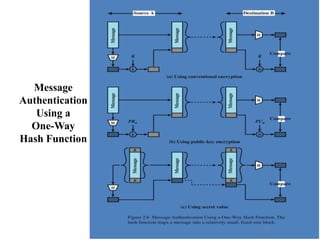
Message
Authentication
Using a
One-Way
Hash Function
12
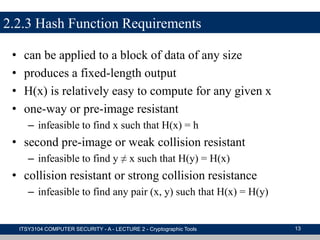
2.2.3 Hash Function Requirements
• can be applied to a block of data of any size
• produces a fixed-length output
• H(x) is relatively easy to compute for any given x
• one-way or pre-image resistant
– infeasible to find x such that H(x) = h
• second pre-image or weak collision resistant
– infeasible to find y ≠ x such that H(y) = H(x)
• collision resistant or strong collision resistance
– infeasible to find any pair (x, y) such that H(x) = H(y)
ITSY3104 COMPUTER SECURITY - A - LECTURE 2 - Cryptographic Tools 13
2.2.4 Security of Hash Functions
• approaches to attack a secure hash function
– cryptanalysis
• exploit logical weaknesses in the algorithm
– brute-force attack
• strength of hash function depends solely on the length of the hash
code produced by the algorithm
• additional secure hash function applications:
– Passwords: hash of a password is stored by an operating
system
– intrusion detection: store H(F) for each file on a system and
secure the hash values
ITSY3104 COMPUTER SECURITY - A - LECTURE 2 - Cryptographic Tools 14
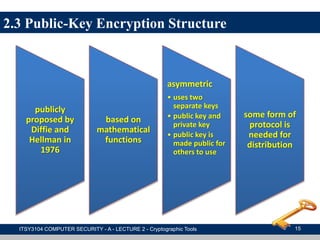
2.3 Public-Key Encryption Structure
publicly
proposed by
Diffie and
Hellman in
1976
based on
mathematical
functions
asymmetric
• uses two
separate keys
• public key and
private key
• public key is
made public for
others to use
some form of
protocol is
needed for
distribution
ITSY3104 COMPUTER SECURITY - A - LECTURE 2 - Cryptographic Tools 15
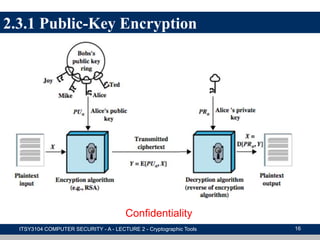
2.3.1 Public-Key Encryption
Confidentiality
ITSY3104 COMPUTER SECURITY - A - LECTURE 2 - Cryptographic Tools 16
Private-Key Encryption
Authentication
ITSY3104 COMPUTER SECURITY - A - LECTURE 2 - Cryptographic Tools 17
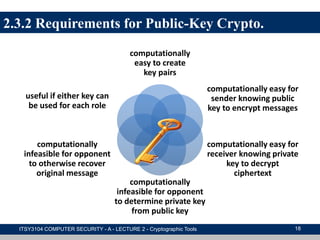
2.3.2 Requirements for Public-Key Crypto.
computationally
easy to create
key pairs
computationally easy for
sender knowing public
key to encrypt messages
computationally easy for
receiver knowing private
key to decrypt
ciphertext
computationally
infeasible for opponent
to determine private key
from public key
computationally
infeasible for opponent
to otherwise recover
original message
useful if either key can
be used for each role
ITSY3104 COMPUTER SECURITY - A - LECTURE 2 - Cryptographic Tools 18
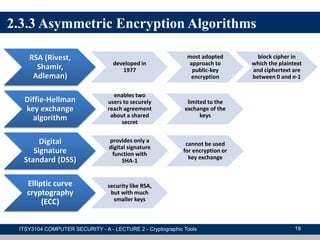
2.3.3 Asymmetric Encryption Algorithms
RSA (Rivest,
Shamir,
Adleman)
developed in
1977
most adopted
approach to
public-key
encryption
block cipher in
which the plaintext
and ciphertext are
between 0 and n-1
Diffie-Hellman
key exchange
algorithm
enables two
users to securely
reach agreement
about a shared
secret
limited to the
exchange of the
keys
Digital
Signature
Standard (DSS)
provides only a
digital signature
function with
SHA-1
cannot be used
for encryption or
key exchange
Elliptic curve
cryptography
(ECC)
security like RSA,
but with much
smaller keys
ITSY3104 COMPUTER SECURITY - A - LECTURE 2 - Cryptographic Tools 19
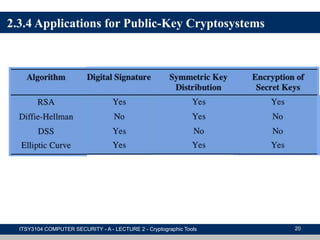
2.3.4 Applications for Public-Key Cryptosystems
ITSY3104 COMPUTER SECURITY - A - LECTURE 2 - Cryptographic Tools 20
2.4 Digital Signatures
• used for authenticating both source and data integrity
• created by encrypting hash code with private key
• does not provide confidentiality
– even in the case of complete encryption
– message is safe from alteration but not eavesdropping
ITSY3104 COMPUTER SECURITY - A - LECTURE 2 - Cryptographic Tools 21
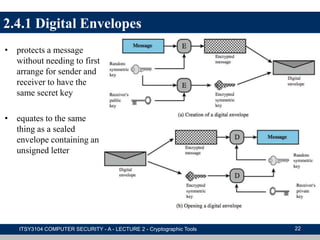
2.4.1 Digital Envelopes
• protects a message
without needing to first
arrange for sender and
receiver to have the
same secret key
• equates to the same
thing as a sealed
envelope containing an
unsigned letter
ITSY3104 COMPUTER SECURITY - A - LECTURE 2 - Cryptographic Tools 22
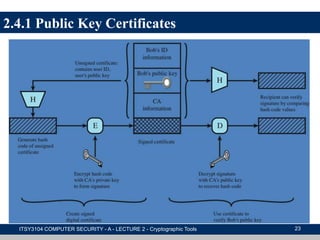
2.4.1 Public Key Certificates
ITSY3104 COMPUTER SECURITY - A - LECTURE 2 - Cryptographic Tools 23
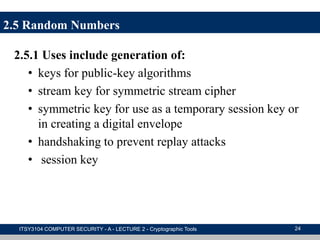
2.5.1 Uses include generation of:
• keys for public-key algorithms
• stream key for symmetric stream cipher
• symmetric key for use as a temporary session key or
in creating a digital envelope
• handshaking to prevent replay attacks
• session key
ITSY3104 COMPUTER SECURITY - A - LECTURE 2 - Cryptographic Tools 24
2.5 Random Numbers
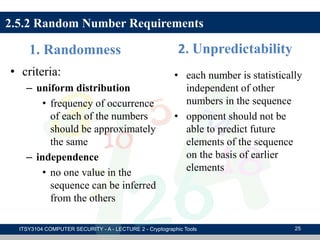
1. Randomness
• criteria:
– uniform distribution
• frequency of occurrence
of each of the numbers
should be approximately
the same
– independence
• no one value in the
sequence can be inferred
from the others
2. Unpredictability
• each number is statistically
independent of other
numbers in the sequence
• opponent should not be
able to predict future
elements of the sequence
on the basis of earlier
elements
2.5.2 Random Number Requirements
ITSY3104 COMPUTER SECURITY - A - LECTURE 2 - Cryptographic Tools 25
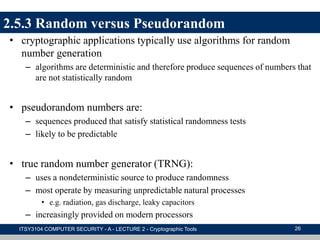
2.5.3 Random versus Pseudorandom
• cryptographic applications typically use algorithms for random
number generation
– algorithms are deterministic and therefore produce sequences of numbers that
are not statistically random
• pseudorandom numbers are:
– sequences produced that satisfy statistical randomness tests
– likely to be predictable
• true random number generator (TRNG):
– uses a nondeterministic source to produce randomness
– most operate by measuring unpredictable natural processes
• e.g. radiation, gas discharge, leaky capacitors
– increasingly provided on modern processors
ITSY3104 COMPUTER SECURITY - A - LECTURE 2 - Cryptographic Tools 26
2.6 Application: Encryption of Stored Data
Common to encrypt transmitted data
Much less common for stored datathere is often little
protection beyond
domain authentication
and operating system
access controls
data are archived for
indefinite periods
even though erased,
until disk sectors are
reused data are
recoverable
Approaches to encrypt stored data:
use a
commercially
available
encryption
package
back-end
appliance
library based
tape encryption
background
laptop/PC data
encryption
ITSY3104 COMPUTER SECURITY - A - LECTURE 2 - Cryptographic Tools 27
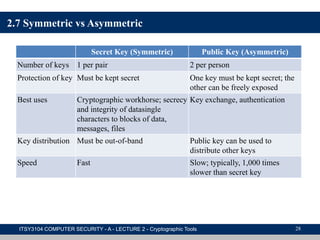
2.7 Symmetric vs Asymmetric
Secret Key (Symmetric) Public Key (Asymmetric)
Number of keys 1 per pair 2 per person
Protection of key Must be kept secret One key must be kept secret; the
other can be freely exposed
Best uses Cryptographic workhorse; secrecy
and integrity of datasingle
characters to blocks of data,
messages, files
Key exchange, authentication
Key distribution Must be out-of-band Public key can be used to
distribute other keys
Speed Fast Slow; typically, 1,000 times
slower than secret key
28ITSY3104 COMPUTER SECURITY - A - LECTURE 2 - Cryptographic Tools

Cryptographic tools

  • 1.
    1 CRYPTOGRAPHIC TOOLS ITSY3104 COMPUTERSECURITY - A - LECTURE 2 - Cryptographic Tools Mr. RAJASEKAR RAMALINGAM Department of IT, College of Applied Sciences, Sur. Sultanate of Oman. http://vrrsekar.wixsite.com/raja Based on William Stallings, Lawrie Brown, Computer Security: Principles and Practice, Third Edition
  • 2.
    CONTENT 2.1 Symmetric Encryption 2.2Message Authentication and Hash Functions 2.3 Public-Key Encryption 2.4 Digital Signatures and Key Management 2.5 Random and Pseudorandom Numbers 2.6 Practical Application: Encryption of Stored Data 2.7 Symmetric vs Asymmetric ITSY3104 COMPUTER SECURITY - A - LECTURE 2 - Cryptographic Tools 2
  • 3.
    2.1 Symmetric Encryption •universal technique for providing confidentiality • also referred to as single-key encryption • two requirements for secure use: – need a strong encryption algorithm – sender and receiver must have obtained copies of the secret key in a secure fashion • and must keep the key secure ITSY3104 COMPUTER SECURITY - A - LECTURE 2 - Cryptographic Tools 3
  • 4.
    Symmetric Encryption ITSY3104 COMPUTERSECURITY - A - LECTURE 2 - Cryptographic Tools 4
  • 5.
    Cryptanalytic Attacks • relyon: – nature of the algorithm – plus some knowledge of the general characteristics of the plaintext – even some sample plaintext- ciphertext pairs • exploits the characteristics of the algorithm to attempt to deduce a specific plaintext or the key being used – if successful all future and past messages encrypted with that key are compromised Brute-Force Attack • try all possible keys on some ciphertext until an intelligible translation into plaintext is obtained – on average half of all possible keys must be tried to achieve success 2.1.1 Attacking Symmetric Encryption ITSY3104 COMPUTER SECURITY - A - LECTURE 2 - Cryptographic Tools 5
  • 6.
    2.1.2 Symmetric EncryptionAlgorithms ITSY3104 COMPUTER SECURITY - A - LECTURE 2 - Cryptographic Tools 6
  • 7.
  • 8.
    Block & StreamCiphers • processes the input one block of elements at a time • produces an output block for each input block • can reuse keys • more common Block Cipher • processes the input elements continuously • produces output one element at a time • primary advantage is that they are almost always faster and use far less code • encrypts plaintext one byte at a time • pseudorandom stream is one that is unpredictable without knowledge of the input key Stream Cipher ITSY3104 COMPUTER SECURITY - A - LECTURE 2 - Cryptographic Tools 8
  • 9.
    2.2 Message Authentication protectsagainst active attacks verifies received message is authentic can use conventional encryption • contents have not been altered • from authentic source • timely and in correct sequence • only sender & receiver share a key ITSY3104 COMPUTER SECURITY - A - LECTURE 2 - Cryptographic Tools 9
  • 10.
    2.2.1 Message AuthenticationCodes ITSY3104 COMPUTER SECURITY - A - LECTURE 2 - Cryptographic Tools 10
  • 11.
    Secure Hash Functions ITSY3104 COMPUTERSECURITY - A - LECTURE 2 - Cryptographic Tools 11
  • 12.
  • 13.
    2.2.3 Hash FunctionRequirements • can be applied to a block of data of any size • produces a fixed-length output • H(x) is relatively easy to compute for any given x • one-way or pre-image resistant – infeasible to find x such that H(x) = h • second pre-image or weak collision resistant – infeasible to find y ≠ x such that H(y) = H(x) • collision resistant or strong collision resistance – infeasible to find any pair (x, y) such that H(x) = H(y) ITSY3104 COMPUTER SECURITY - A - LECTURE 2 - Cryptographic Tools 13
  • 14.
    2.2.4 Security ofHash Functions • approaches to attack a secure hash function – cryptanalysis • exploit logical weaknesses in the algorithm – brute-force attack • strength of hash function depends solely on the length of the hash code produced by the algorithm • additional secure hash function applications: – Passwords: hash of a password is stored by an operating system – intrusion detection: store H(F) for each file on a system and secure the hash values ITSY3104 COMPUTER SECURITY - A - LECTURE 2 - Cryptographic Tools 14
  • 15.
    2.3 Public-Key EncryptionStructure publicly proposed by Diffie and Hellman in 1976 based on mathematical functions asymmetric • uses two separate keys • public key and private key • public key is made public for others to use some form of protocol is needed for distribution ITSY3104 COMPUTER SECURITY - A - LECTURE 2 - Cryptographic Tools 15
  • 16.
    2.3.1 Public-Key Encryption Confidentiality ITSY3104COMPUTER SECURITY - A - LECTURE 2 - Cryptographic Tools 16
  • 17.
    Private-Key Encryption Authentication ITSY3104 COMPUTERSECURITY - A - LECTURE 2 - Cryptographic Tools 17
  • 18.
    2.3.2 Requirements forPublic-Key Crypto. computationally easy to create key pairs computationally easy for sender knowing public key to encrypt messages computationally easy for receiver knowing private key to decrypt ciphertext computationally infeasible for opponent to determine private key from public key computationally infeasible for opponent to otherwise recover original message useful if either key can be used for each role ITSY3104 COMPUTER SECURITY - A - LECTURE 2 - Cryptographic Tools 18
  • 19.
    2.3.3 Asymmetric EncryptionAlgorithms RSA (Rivest, Shamir, Adleman) developed in 1977 most adopted approach to public-key encryption block cipher in which the plaintext and ciphertext are between 0 and n-1 Diffie-Hellman key exchange algorithm enables two users to securely reach agreement about a shared secret limited to the exchange of the keys Digital Signature Standard (DSS) provides only a digital signature function with SHA-1 cannot be used for encryption or key exchange Elliptic curve cryptography (ECC) security like RSA, but with much smaller keys ITSY3104 COMPUTER SECURITY - A - LECTURE 2 - Cryptographic Tools 19
  • 20.
    2.3.4 Applications forPublic-Key Cryptosystems ITSY3104 COMPUTER SECURITY - A - LECTURE 2 - Cryptographic Tools 20
  • 21.
    2.4 Digital Signatures •used for authenticating both source and data integrity • created by encrypting hash code with private key • does not provide confidentiality – even in the case of complete encryption – message is safe from alteration but not eavesdropping ITSY3104 COMPUTER SECURITY - A - LECTURE 2 - Cryptographic Tools 21
  • 22.
    2.4.1 Digital Envelopes •protects a message without needing to first arrange for sender and receiver to have the same secret key • equates to the same thing as a sealed envelope containing an unsigned letter ITSY3104 COMPUTER SECURITY - A - LECTURE 2 - Cryptographic Tools 22
  • 23.
    2.4.1 Public KeyCertificates ITSY3104 COMPUTER SECURITY - A - LECTURE 2 - Cryptographic Tools 23
  • 24.
    2.5.1 Uses includegeneration of: • keys for public-key algorithms • stream key for symmetric stream cipher • symmetric key for use as a temporary session key or in creating a digital envelope • handshaking to prevent replay attacks • session key ITSY3104 COMPUTER SECURITY - A - LECTURE 2 - Cryptographic Tools 24 2.5 Random Numbers
  • 25.
    1. Randomness • criteria: –uniform distribution • frequency of occurrence of each of the numbers should be approximately the same – independence • no one value in the sequence can be inferred from the others 2. Unpredictability • each number is statistically independent of other numbers in the sequence • opponent should not be able to predict future elements of the sequence on the basis of earlier elements 2.5.2 Random Number Requirements ITSY3104 COMPUTER SECURITY - A - LECTURE 2 - Cryptographic Tools 25
  • 26.
    2.5.3 Random versusPseudorandom • cryptographic applications typically use algorithms for random number generation – algorithms are deterministic and therefore produce sequences of numbers that are not statistically random • pseudorandom numbers are: – sequences produced that satisfy statistical randomness tests – likely to be predictable • true random number generator (TRNG): – uses a nondeterministic source to produce randomness – most operate by measuring unpredictable natural processes • e.g. radiation, gas discharge, leaky capacitors – increasingly provided on modern processors ITSY3104 COMPUTER SECURITY - A - LECTURE 2 - Cryptographic Tools 26
  • 27.
    2.6 Application: Encryptionof Stored Data Common to encrypt transmitted data Much less common for stored datathere is often little protection beyond domain authentication and operating system access controls data are archived for indefinite periods even though erased, until disk sectors are reused data are recoverable Approaches to encrypt stored data: use a commercially available encryption package back-end appliance library based tape encryption background laptop/PC data encryption ITSY3104 COMPUTER SECURITY - A - LECTURE 2 - Cryptographic Tools 27
  • 28.
    2.7 Symmetric vsAsymmetric Secret Key (Symmetric) Public Key (Asymmetric) Number of keys 1 per pair 2 per person Protection of key Must be kept secret One key must be kept secret; the other can be freely exposed Best uses Cryptographic workhorse; secrecy and integrity of datasingle characters to blocks of data, messages, files Key exchange, authentication Key distribution Must be out-of-band Public key can be used to distribute other keys Speed Fast Slow; typically, 1,000 times slower than secret key 28ITSY3104 COMPUTER SECURITY - A - LECTURE 2 - Cryptographic Tools