One-time Pad: Encryption
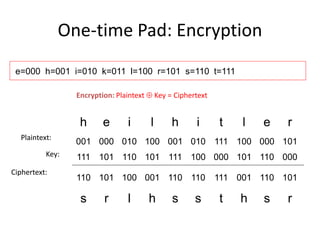
e=000 h=001 i=010 k=011 l=100 r=101 s=110 t=111
h e i l h i t l e r
001 000 010 100 001 010 111 100 000 101
111 101 110 101 111 100 000 101 110 000
110 101 100 001 110 110 111 001 110 101
s r l h s s t h s r
Encryption: Plaintext  Key = Ciphertext
Plaintext:
Key:
Ciphertext:
One-time Pad: Decryption
e=000 h=001 i=010 k=011 l=100 r=101 s=110 t=111
s r l h s s t h s r
110 101 100 001 110 110 111 001 110 101
111 101 110 101 111 100 000 101 110 000
001 000 010 100 001 010 111 100 000 101
h e i l h i t l e r
Decryption: Ciphertext  Key = Plaintext
Ciphertext:
Key:
Plaintext:
One-time Pad
e=000 h=001 i=010 k=011 l=100 r=101 s=110 t=111
s r l h s s t h s r
110 101 100 001 110 110 111 001 110 101
101 111 000 101 111 100 000 101 110 000
011 010 100 100 001 010 111 100 000 101
k i l l h i t l e r
Ciphertext:
“key”:
“Plaintext”:
Double agent claims sender used following “key”
One-time Pad
e=000 h=001 i=010 k=011 l=100 r=101 s=110 t=111
s r l h s s t h s r
110 101 100 001 110 110 111 001 110 101
111 101 000 011 101 110 001 011 101 101
001 000 100 010 011 000 110 010 011 000
h e l i k e s i k e
Ciphertext:
“Key”:
“Plaintext”:
Or sender is captured and claims the key is…
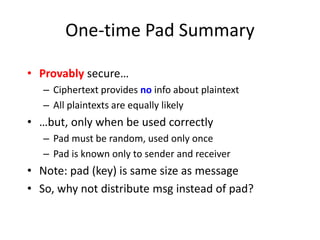
One-time Pad Summary
• Provably secure…
– Ciphertext provides no info about plaintext
– All plaintexts are equally likely
• …but, only when be used correctly
– Pad must be random, used only once
– Pad is known only to sender and receiver
• Note: pad (key) is same size as message
• So, why not distribute msg instead of pad?
Codebook Cipher
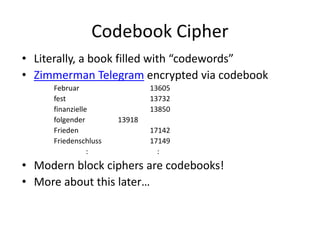
• Literally, a book filled with “codewords”
• Zimmerman Telegram encrypted via codebook
Februar 13605
fest 13732
finanzielle 13850
folgender 13918
Frieden 17142
Friedenschluss 17149
: :
• Modern block ciphers are codebooks!
• More about this later…
Codebook Cipher: Additive
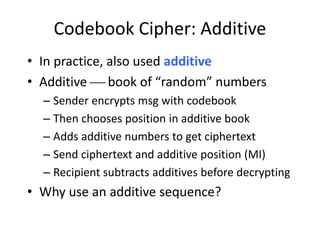
• In practice, also used additive
• Additive  book of “random” numbers
– Sender encrypts msg with codebook
– Then chooses position in additive book
– Adds additive numbers to get ciphertext
– Send ciphertext and additive position (MI)
– Recipient subtracts additives before decrypting
• Why use an additive sequence?
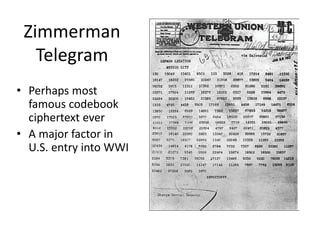
Zimmerman
Telegram
• Perhaps most
famous codebook
ciphertext ever
• A major factor in
U.S. entry into WWI
Zimmerman
Telegram
Decrypted
 British had
recovered partial
codebook
 Then able to fill in
missing parts
Post-WWII History
• Claude Shannon  father of the science of
information theory
• Computer revolution  lots of data to protect
• Data Encryption Standard (DES), 70’s
• Public Key cryptography, 70’s
• CRYPTO conferences, 80’s
• Advanced Encryption Standard (AES), 90’s
• The crypto genie is out of the bottle…
Claude Shannon
• The founder of Information Theory
• 1949 paper: Comm. Thy. of Secrecy Systems
• Fundamental concepts
– Confusion  obscure relationship between plaintext
and ciphertext, substitution ciphers
– Diffusion  spread plaintext statistics through the
ciphertext, transposition ciphers
• Proved one-time pad is secure
• One-time pad is confusion-only, while transposition
is diffusion-only
Steganography
• an alternative to encryption
• hides existence of message
– using only a subset of letters/words in a longer
message marked in some way
– using invisible ink
– hiding in LSB in graphic image or sound file
• has drawbacks
– high overhead to hide relatively few info bits
Modern Block Ciphers
• will now look at modern block ciphers
• one of the most widely used types of
cryptographic algorithms
• provide secrecy and/or authentication
services
• in particular will introduce DES (Data
Encryption Standard)
Stream Cipher
 There is a plain text stream
 P = P1P2P3. . .
 There is a cipher text stream
 C = C1C2C3. . .
 There is a key stream
 K = (k1, k2, k3, . . . )
Stream Cipher
Stream cipher
 Examples
 Additive cipher
 K = (k, k, k, . . . )
 Monoalphabetic substitution cipher
 K = mapping of the current PT char to CT char,
. . .
 Vigenere cipher
 K = (k1, k2, . . . , km, k1, k2, . . .)
Block cipher
Block cipher
 Examples
 Play fair cipher (block size = 2)
 DES, AES
Block Cipher Principles
• most symmetric block ciphers are based on a Feistel
Cipher Structure
• needed since must be able to decrypt ciphertext to
recover messages efficiently
• block ciphers look like an extremely large
substitution
• would need table of 264 entries for a 64-bit block
• instead create from smaller building blocks
• using idea of a product cipher
Claude Shannon and Substitution-
Permutation Ciphers
• in 1949 Claude Shannon introduced idea of
substitution-permutation (S-P) networks
– modern substitution-transposition product cipher
• these form the basis of modern block ciphers
• S-P networks are based on the two primitive
cryptographic operations we have seen before:
– substitution (S-box)
– permutation (P-box)
• provide confusion and diffusion of message
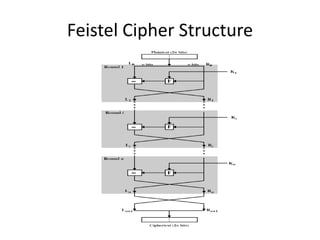
Feistel Cipher Structure
• Horst Feistel devised the feistel cipher
– based on concept of invertible product cipher
• partitions input block into two halves
– process through multiple rounds which
– perform a substitution on left data half
– based on round function of right half & subkey
– then have permutation swapping halves
• implements Shannon’s substitution-
permutation network concept
Feistel Cipher Structure
Feistel Cipher Design Principles
• block size
– increasing size improves security, but slows cipher
• key size
– increasing size improves security, makes exhaustive key searching
harder, but may slow cipher
• number of rounds
– increasing number improves security, but slows cipher
• subkey generation
– greater complexity can make analysis harder, but slows cipher
• round function
– greater complexity can make analysis harder, but slows cipher
• fast software en/decryption & ease of analysis
– are more recent concerns for practical use and testing
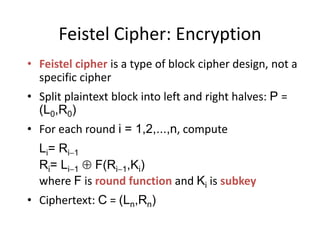
Feistel Cipher: Encryption
• Feistel cipher is a type of block cipher design, not a
specific cipher
• Split plaintext block into left and right halves: P =
(L0,R0)
• For each round i = 1,2,...,n, compute
Li= Ri1
Ri= Li1  F(Ri1,Ki)
where F is round function and Ki is subkey
• Ciphertext: C = (Ln,Rn)
Feistel Cipher: Decryption
• Start with ciphertext C = (Ln,Rn)
• For each round i = n,n1,…,1, compute
Ri1 = Li
Li1 = Ri  F(Ri1,Ki)
where F is round function and Ki is subkey
• Plaintext: P = (L0,R0)
• Formula “works” for any function F
– But only secure for certain functions F
Feistel Cipher Decryption

One time pad Encryption:

  • 1.
    One-time Pad: Encryption e=000h=001 i=010 k=011 l=100 r=101 s=110 t=111 h e i l h i t l e r 001 000 010 100 001 010 111 100 000 101 111 101 110 101 111 100 000 101 110 000 110 101 100 001 110 110 111 001 110 101 s r l h s s t h s r Encryption: Plaintext  Key = Ciphertext Plaintext: Key: Ciphertext:
  • 2.
    One-time Pad: Decryption e=000h=001 i=010 k=011 l=100 r=101 s=110 t=111 s r l h s s t h s r 110 101 100 001 110 110 111 001 110 101 111 101 110 101 111 100 000 101 110 000 001 000 010 100 001 010 111 100 000 101 h e i l h i t l e r Decryption: Ciphertext  Key = Plaintext Ciphertext: Key: Plaintext:
  • 3.
    One-time Pad e=000 h=001i=010 k=011 l=100 r=101 s=110 t=111 s r l h s s t h s r 110 101 100 001 110 110 111 001 110 101 101 111 000 101 111 100 000 101 110 000 011 010 100 100 001 010 111 100 000 101 k i l l h i t l e r Ciphertext: “key”: “Plaintext”: Double agent claims sender used following “key”
  • 4.
    One-time Pad e=000 h=001i=010 k=011 l=100 r=101 s=110 t=111 s r l h s s t h s r 110 101 100 001 110 110 111 001 110 101 111 101 000 011 101 110 001 011 101 101 001 000 100 010 011 000 110 010 011 000 h e l i k e s i k e Ciphertext: “Key”: “Plaintext”: Or sender is captured and claims the key is…
  • 5.
    One-time Pad Summary •Provably secure… – Ciphertext provides no info about plaintext – All plaintexts are equally likely • …but, only when be used correctly – Pad must be random, used only once – Pad is known only to sender and receiver • Note: pad (key) is same size as message • So, why not distribute msg instead of pad?
  • 6.
    Codebook Cipher • Literally,a book filled with “codewords” • Zimmerman Telegram encrypted via codebook Februar 13605 fest 13732 finanzielle 13850 folgender 13918 Frieden 17142 Friedenschluss 17149 : : • Modern block ciphers are codebooks! • More about this later…
  • 7.
    Codebook Cipher: Additive •In practice, also used additive • Additive  book of “random” numbers – Sender encrypts msg with codebook – Then chooses position in additive book – Adds additive numbers to get ciphertext – Send ciphertext and additive position (MI) – Recipient subtracts additives before decrypting • Why use an additive sequence?
  • 8.
    Zimmerman Telegram • Perhaps most famouscodebook ciphertext ever • A major factor in U.S. entry into WWI
  • 9.
    Zimmerman Telegram Decrypted  British had recoveredpartial codebook  Then able to fill in missing parts
  • 10.
    Post-WWII History • ClaudeShannon  father of the science of information theory • Computer revolution  lots of data to protect • Data Encryption Standard (DES), 70’s • Public Key cryptography, 70’s • CRYPTO conferences, 80’s • Advanced Encryption Standard (AES), 90’s • The crypto genie is out of the bottle…
  • 11.
    Claude Shannon • Thefounder of Information Theory • 1949 paper: Comm. Thy. of Secrecy Systems • Fundamental concepts – Confusion  obscure relationship between plaintext and ciphertext, substitution ciphers – Diffusion  spread plaintext statistics through the ciphertext, transposition ciphers • Proved one-time pad is secure • One-time pad is confusion-only, while transposition is diffusion-only
  • 12.
    Steganography • an alternativeto encryption • hides existence of message – using only a subset of letters/words in a longer message marked in some way – using invisible ink – hiding in LSB in graphic image or sound file • has drawbacks – high overhead to hide relatively few info bits
  • 13.
    Modern Block Ciphers •will now look at modern block ciphers • one of the most widely used types of cryptographic algorithms • provide secrecy and/or authentication services • in particular will introduce DES (Data Encryption Standard)
  • 14.
    Stream Cipher  Thereis a plain text stream  P = P1P2P3. . .  There is a cipher text stream  C = C1C2C3. . .  There is a key stream  K = (k1, k2, k3, . . . )
  • 15.
  • 16.
    Stream cipher  Examples Additive cipher  K = (k, k, k, . . . )  Monoalphabetic substitution cipher  K = mapping of the current PT char to CT char, . . .  Vigenere cipher  K = (k1, k2, . . . , km, k1, k2, . . .)
  • 17.
  • 18.
    Block cipher  Examples Play fair cipher (block size = 2)  DES, AES
  • 19.
    Block Cipher Principles •most symmetric block ciphers are based on a Feistel Cipher Structure • needed since must be able to decrypt ciphertext to recover messages efficiently • block ciphers look like an extremely large substitution • would need table of 264 entries for a 64-bit block • instead create from smaller building blocks • using idea of a product cipher
  • 20.
    Claude Shannon andSubstitution- Permutation Ciphers • in 1949 Claude Shannon introduced idea of substitution-permutation (S-P) networks – modern substitution-transposition product cipher • these form the basis of modern block ciphers • S-P networks are based on the two primitive cryptographic operations we have seen before: – substitution (S-box) – permutation (P-box) • provide confusion and diffusion of message
  • 21.
    Feistel Cipher Structure •Horst Feistel devised the feistel cipher – based on concept of invertible product cipher • partitions input block into two halves – process through multiple rounds which – perform a substitution on left data half – based on round function of right half & subkey – then have permutation swapping halves • implements Shannon’s substitution- permutation network concept
  • 22.
  • 23.
    Feistel Cipher DesignPrinciples • block size – increasing size improves security, but slows cipher • key size – increasing size improves security, makes exhaustive key searching harder, but may slow cipher • number of rounds – increasing number improves security, but slows cipher • subkey generation – greater complexity can make analysis harder, but slows cipher • round function – greater complexity can make analysis harder, but slows cipher • fast software en/decryption & ease of analysis – are more recent concerns for practical use and testing
  • 24.
    Feistel Cipher: Encryption •Feistel cipher is a type of block cipher design, not a specific cipher • Split plaintext block into left and right halves: P = (L0,R0) • For each round i = 1,2,...,n, compute Li= Ri1 Ri= Li1  F(Ri1,Ki) where F is round function and Ki is subkey • Ciphertext: C = (Ln,Rn)
  • 25.
    Feistel Cipher: Decryption •Start with ciphertext C = (Ln,Rn) • For each round i = n,n1,…,1, compute Ri1 = Li Li1 = Ri  F(Ri1,Ki) where F is round function and Ki is subkey • Plaintext: P = (L0,R0) • Formula “works” for any function F – But only secure for certain functions F
  • 26.