INTRODUCTION
NETWORK is an interconnected collection of
 autonomous computers

Two computers are said to be interconnected,
  if they are able to exchange information

If one computer can forcibly start or stop or
 control another one, then the computers are not
 autonomous.
A typical Computer Network
ADVANTAGE OF NETWORKS
 Information can be send quickly through different
  computers and can share data
 For Example, A Company can share files or data
  without need to use some external devices to carry the
  data.
DIS-ADVANTAGE OF NETWORKS
 When we are sending the data between the computers
  any other person may watches or modifies confidential
  message.
 For Example, some unauthorized user may get access
  over the network and may perform any illegal
  functions like deleting those data etc…
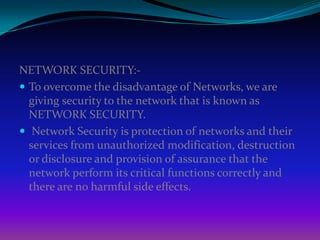
NETWORK SECURITY:-
 To overcome the disadvantage of Networks, we are
  giving security to the network that is known as
  NETWORK SECURITY.
 Network Security is protection of networks and their
  services from unauthorized modification, destruction
  or disclosure and provision of assurance that the
  network perform its critical functions correctly and
  there are no harmful side effects.
IMPORTANCE OF SECURITY
 Enforcing data security is top priority for both
  governments and businesses worldwide.
 Recent legislation in many countries has set new
  standards for protecting customer information.
 There are standards for the security of medical records
  and standards for the financial industry regarding
  privacy and security of customers’ personal financial
  information.
TERMINOLOGY IN NETWORK
SECURITY
 CRYPTOGRAPHY:-
Study of all encryption and decryption algorithms.
ENCRYPTION:-
 A process of encoding a message so that its meaning is
  not obvious.
DECRYPTION:-
• A process of decoding the encoded message i.e it’s the
  reverse process of Encryption.
TERMINOLOGY IN NETWORK
SECURITY
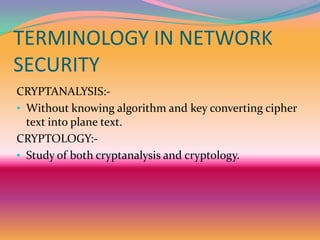
CRYPTANALYSIS:-
• Without knowing algorithm and key converting cipher
  text into plane text.
CRYPTOLOGY:-
• Study of both cryptanalysis and cryptology.
DIMENSIONS OF CRYPTOGRAPHY
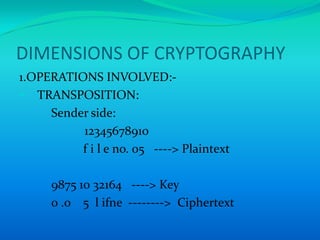
1.OPERATIONS INVOLVED:-
 TRANSPOSITION:
     Sender side:
          12345678910
          f i l e no. 05 ----> Plaintext

      9875 10 32164 ----> Key
      0 .o 5 l ifne --------> Ciphertext
DIMENSIONS OF CRYPTOGRAPHY
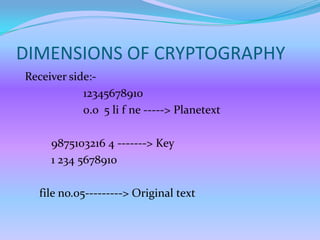
Receiver side:-
            12345678910
            0.o 5 li f ne -----> Planetext

     9875103216 4 -------> Key
     1 234 5678910

   file no.05---------> Original text
DIMENSIONS OF CRYPTOGRAPHY
•     SUBSTITUTION:-
        Simple Substitution:-
    Substitution    A    B    C   D   E   F   ……. X    Y    Z
    Table--------> 1     2    3   4   5   6   ……. 24   25   26


     Example:-
         A     C     E
         1     3     5
DIMENSIONS OF CRYPTOGRAPHY
 Substituting a character in plane text by new character
 in cipher text is called Substitution.

 Substitution is done by using Substitution table.


 Substitution table should be there at sender and
 receiver then only substitution can be done.
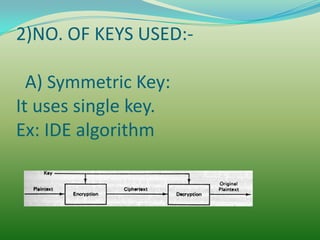
2)NO. OF KEYS USED:-

  A) Symmetric Key:
It uses single key.
Ex: IDE algorithm
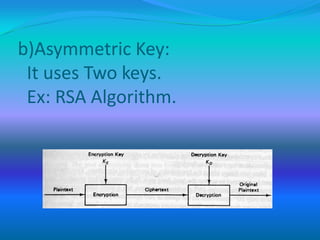
b)Asymmetric Key:
 It uses Two keys.
 Ex: RSA Algorithm.
3.The Way By which Plaintext Is Processed:-
 a)Stream-Bit Oriented:
• Data is send as bit by bit.
• Bit= 0 or 1
 b)Character Oriented:-
• Data is send character through character.
c)Blocks:-
Data is send through blocks(Group of characters).
Padding:
A string, typically added when the plaintext block is
    short. For example, if the block length is 4 bytes and
    the cipher requires 16 bytes, then 12 bytes of padding
    must be added. The padding string may contain
    zeros, alternating zeros and ones, or some other
    pattern.
Concepts in Network Security
1) AUTHENTICATION:
    Sending the message from authorized person.
    Ex: Sending message from mail
2)   CONFIDENTIALITY:
    Unauthorized person (unknown person) cannot know
     what is going between two
     persons.(Coding/Decoding)
3)   NON-REPUTATION:
    Providing third person between two
     persons.(Delaying)
Concepts in Network Security
4) AVAILABILITY:
 The person is authorized but the person can’t use or
  access the data.
5) ACCESS CONTROL:
 The person cannot change or modify the data.
6) DATA INTEGRITY:
 Sender and Receiver receives same message.
SECURITY ATTACKS
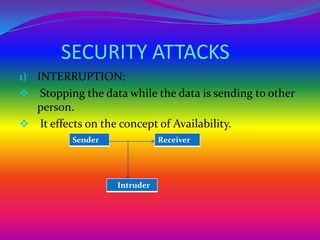
1) INTERRUPTION:
 Stopping the data while the data is sending to other
  person.
 It effects on the concept of Availability.
          Sender              Receiver


                   Intruder
SECURITY ATTACKS
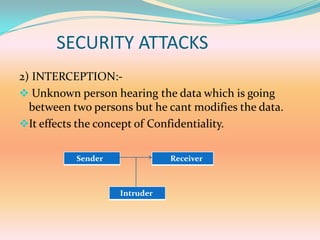
2) INTERCEPTION:-
 Unknown person hearing the data which is going
  between two persons but he cant modifies the data.
It effects the concept of Confidentiality.


           Sender              Receiver


                    Intruder
SECURITY ATTACKS
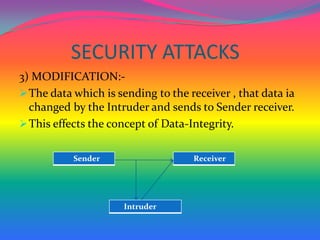
3) MODIFICATION:-
 The data which is sending to the receiver , that data ia
  changed by the Intruder and sends to Sender receiver.
 This effects the concept of Data-Integrity.


           Sender                   Receiver


                      Intruder
SECURITY ATTACKS
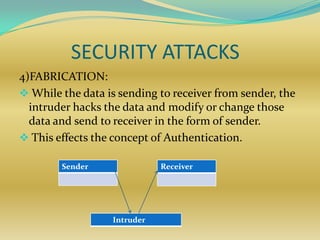
4)FABRICATION:
 While the data is sending to receiver from sender, the
  intruder hacks the data and modify or change those
  data and send to receiver in the form of sender.
 This effects the concept of Authentication.

        Sender               Receiver


                  Intruder
SERVICES OF NETWORK SECURITY
1) PASSIVE ATTACK:
     Here Intruder does not modifies the data but they
    listens the data.

2) ACTIVE ATTACK:
   Here Intruder changes the data or information.
RSA ALGORITHM
  by Rivest, Shamir & Adleman of MIT in 1977

  best known & widely used public-key scheme

       uses large integers (e.g., 1024 bits)

 This is Asymmetric key i.e it consists two keys
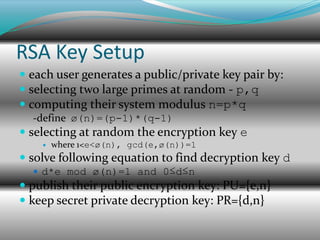
RSA Key Setup
 each user generates a public/private key pair by:
 selecting two large primes at random - p,q
 computing their system modulus n=p*q
  -define ø(n)=(p-1)*(q-1)
 selecting at random the encryption key e
       where 1<e<ø(n), gcd(e,ø(n))=1
 solve following equation to find decryption key d
   d*e mod ø(n)=1 and 0≤d≤n
 publish their public encryption key: PU={e,n}
 keep secret private decryption key: PR={d,n}
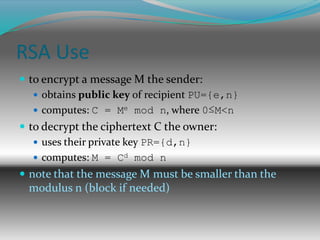
RSA Use
 to encrypt a message M the sender:
    obtains public key of recipient PU={e,n}
    computes: C = Me mod n, where 0≤M<n
 to decrypt the ciphertext C the owner:
    uses their private key PR={d,n}
    computes: M = Cd mod n
 note that the message M must be smaller than the
 modulus n (block if needed)
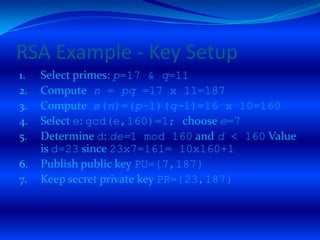
RSA Example - Key Setup
1.   Select primes: p=17 & q=11
2.   Compute n = pq =17 x 11=187
3.   Compute ø(n)=(p–1)(q-1)=16 x 10=160
4.   Select e: gcd(e,160)=1; choose e=7
5.   Determine d: de=1 mod 160 and d < 160 Value
     is d=23 since 23x7=161= 10x160+1
6.   Publish public key PU={7,187}
7.   Keep secret private key PR={23,187}
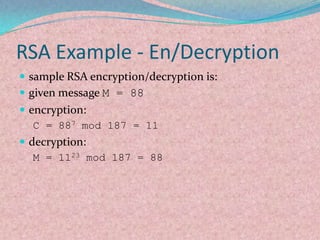
RSA Example - En/Decryption
 sample RSA encryption/decryption is:
 given message M = 88
 encryption:
   C = 887 mod 187 = 11
 decryption:
   M = 1123 mod 187 = 88
IDEA ALGORITHM
 Acronym for IDEA is International Data Encryption
  Algorithm
 Designed in 1991 by Swiss Federal Institute of
  Technology
 Uses 128-bit key
 IDEA was used as the symmetric cipher in early
 versions of the Pretty Good Privacy cryptosystem
DESCRIPTION
 In this algorithm, we use 3 operations:
   1.XOR
   2.MOD ADDITION
   3.MOD MULTIPLICATION
 IDEA is a block cipher which uses a 128-bit length key
  to encrypt successive 64-bit blocks of plaintext.
DESCRIPTION
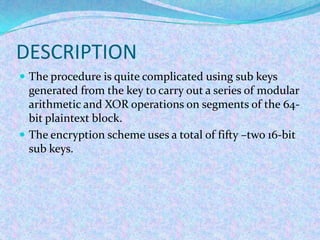
 The procedure is quite complicated using sub keys
  generated from the key to carry out a series of modular
  arithmetic and XOR operations on segments of the 64-
  bit plaintext block.
 The encryption scheme uses a total of fifty –two 16-bit
  sub keys.
OPERATIONS
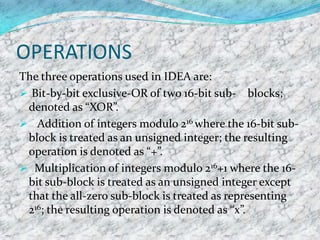
The three operations used in IDEA are:
 Bit-by-bit exclusive-OR of two 16-bit sub- blocks;
 denoted as “XOR”.
 Addition of integers modulo 216 where the 16-bit sub-
 block is treated as an unsigned integer; the resulting
 operation is denoted as “+”.
 Multiplication of integers modulo 216+1 where the 16-
 bit sub-block is treated as an unsigned integer except
 that the all-zero sub-block is treated as representing
 216; the resulting operation is denoted as “x”.
DESCRIPTION
These are generated from the 128-bit sub key as follows:
 The 128-bit key is split into eight 16-bit keys which are the first
  eight sub keys.
 The digits of the 128-bit key are shifted 25 bits to the left to make
  a new key which is split into the next eight 16-bit sub keys
 The second step is repeated until the fifty two sub keys have
  been generated.
 The encryption involves modular multiplication with a modules
  of ((2^16) + 1) and addition with a modules of (2^16).
 The 64-bit plaintext block is split into four 16-bit segments
  which we’ll call x1, x2, x3 and x4.
 The sub keys are z1, z2, z3, z4………z52.
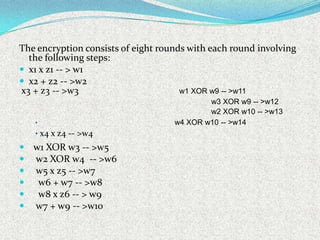
The encryption consists of eight rounds with each round involving
  the following steps:
 x1 x z1 -- > w1
 x2 + z2 -- >w2
x3 + z3 -- >w3                        w1 XOR w9 -- >w11
                                            w3 XOR w9 -- >w12
                                            w2 XOR w10 -- >w13
   •                                w4 XOR w10 -- >w14
   • x4 x z4 -- >w4
 w1 XOR w3 -- >w5
 w2 XOR w4 -- >w6
 w5 x z5 -- >w7
  w6 + w7 -- >w8
  w8 x z6 -- > w9
 w7 + w9 -- >w10
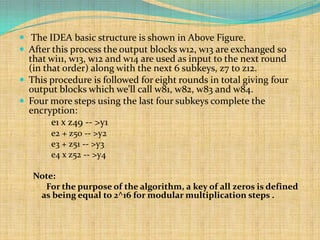
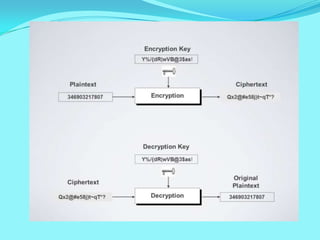
 The IDEA basic structure is shown in Above Figure.
 After this process the output blocks w12, w13 are exchanged so
  that wi11, w13, w12 and w14 are used as input to the next round
  (in that order) along with the next 6 subkeys, z7 to z12.
 This procedure is followed for eight rounds in total giving four
  output blocks which we’ll call w81, w82, w83 and w84.
 Four more steps using the last four subkeys complete the
  encryption:
        e1 x z49 -- >y1
       e2 + z50 -- >y2
       e3 + z51 -- >y3
       e4 x z52 -- >y4

   Note:
     For the purpose of the algorithm, a key of all zeros is defined
    as being equal to 2^16 for modular multiplication steps .
Conclusion Of IDEA Algorithm
 As electronic communications grow in
  importance, there is also an increasing need for data
  protection
 When PGP was designed, the developers were looking
  for maximum security. IDEA was their first choice for
  data encryption
 The fundamental criteria for the development of IDEA
  were military strength for all security requirements
  and easy hardware and software implementation .
Message Sending using Secret key
Exchange
1.   KEY EXCHANGE:-
     (a) At Sender:-
     Take 128 bit key(binary bits) from keyboard.
    Divide them into 16 rows and 8 columns.
    Each row convert into decimal value, we will get 16
     elements.
    Apply RSA Encryption Algorithm(C=Me mod n) on
     each element we will get 16 cipher values which is
     known as KEY.
    Send this KEY to receiver.
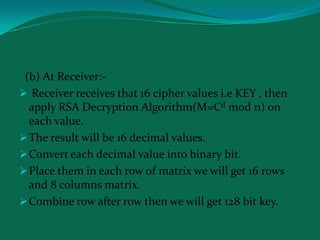
(b) At Receiver:-
 Receiver receives that 16 cipher values i.e KEY , then
  apply RSA Decryption Algorithm(M=Cd mod n) on
  each value.
 The result will be 16 decimal values.
 Convert each decimal value into binary bit.
 Place them in each row of matrix we will get 16 rows
  and 8 columns matrix.
 Combine row after row then we will get 128 bit key.
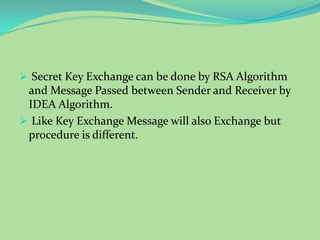
 Secret Key Exchange can be done by RSA Algorithm
 and Message Passed between Sender and Receiver by
 IDEA Algorithm.
 Like Key Exchange Message will also Exchange but
 procedure is different.
CONCLUSION
 IDEA is a well-known cipher that has been analyzed by
  many researchers for the past decade, and, yet, no attack
  against five or more of its 8.5 rounds has been found.
 Due to its strength against cryptanalytic attacks and due to
  its inclusion in several popular cryptographic
  packages, IDEA is widely used.
 The system was developed to offer the industry a set of
  well-proven and tested crypto tools for faster and
  optimized implementation of IDEA into security products.
  It supports standard programming languages and allows
  the implementation of the IDEA algorithm without
  extensive knowledge in cryptography.
 The system provides fast and well – known algorithm
  covering all aspects of cryptography with optimized
  modules for encryption/decryption.
CONCLUSION
 The system comes with key generator.
 The system is specified with respect to secret key
  cryptography standards.
 The system is suitable for use in a wide range of
  application.
 The system allows for faster implementations of
  encryption into security products.
 The project can be extended to provide encryption to
  videos, photos and audio to enable security exchange
  of information through them.
 In this way providing security to various means of
  communication can be possible and helps in effective
  communication through a network.
Net

Net

  • 2.
    INTRODUCTION NETWORK is aninterconnected collection of autonomous computers Two computers are said to be interconnected, if they are able to exchange information If one computer can forcibly start or stop or control another one, then the computers are not autonomous.
  • 3.
  • 4.
    ADVANTAGE OF NETWORKS Information can be send quickly through different computers and can share data  For Example, A Company can share files or data without need to use some external devices to carry the data.
  • 5.
    DIS-ADVANTAGE OF NETWORKS When we are sending the data between the computers any other person may watches or modifies confidential message.  For Example, some unauthorized user may get access over the network and may perform any illegal functions like deleting those data etc…
  • 6.
    NETWORK SECURITY:-  Toovercome the disadvantage of Networks, we are giving security to the network that is known as NETWORK SECURITY.  Network Security is protection of networks and their services from unauthorized modification, destruction or disclosure and provision of assurance that the network perform its critical functions correctly and there are no harmful side effects.
  • 7.
    IMPORTANCE OF SECURITY Enforcing data security is top priority for both governments and businesses worldwide.  Recent legislation in many countries has set new standards for protecting customer information.  There are standards for the security of medical records and standards for the financial industry regarding privacy and security of customers’ personal financial information.
  • 8.
    TERMINOLOGY IN NETWORK SECURITY CRYPTOGRAPHY:- Study of all encryption and decryption algorithms. ENCRYPTION:-  A process of encoding a message so that its meaning is not obvious. DECRYPTION:- • A process of decoding the encoded message i.e it’s the reverse process of Encryption.
  • 9.
    TERMINOLOGY IN NETWORK SECURITY CRYPTANALYSIS:- •Without knowing algorithm and key converting cipher text into plane text. CRYPTOLOGY:- • Study of both cryptanalysis and cryptology.
  • 10.
    DIMENSIONS OF CRYPTOGRAPHY 1.OPERATIONSINVOLVED:-  TRANSPOSITION: Sender side: 12345678910 f i l e no. 05 ----> Plaintext 9875 10 32164 ----> Key 0 .o 5 l ifne --------> Ciphertext
  • 11.
    DIMENSIONS OF CRYPTOGRAPHY Receiverside:- 12345678910 0.o 5 li f ne -----> Planetext 9875103216 4 -------> Key 1 234 5678910 file no.05---------> Original text
  • 12.
    DIMENSIONS OF CRYPTOGRAPHY • SUBSTITUTION:- Simple Substitution:- Substitution A B C D E F ……. X Y Z Table--------> 1 2 3 4 5 6 ……. 24 25 26 Example:- A C E 1 3 5
  • 13.
    DIMENSIONS OF CRYPTOGRAPHY Substituting a character in plane text by new character in cipher text is called Substitution.  Substitution is done by using Substitution table.  Substitution table should be there at sender and receiver then only substitution can be done.
  • 14.
    2)NO. OF KEYSUSED:- A) Symmetric Key: It uses single key. Ex: IDE algorithm
  • 15.
    b)Asymmetric Key: Ituses Two keys. Ex: RSA Algorithm.
  • 16.
    3.The Way Bywhich Plaintext Is Processed:- a)Stream-Bit Oriented: • Data is send as bit by bit. • Bit= 0 or 1 b)Character Oriented:- • Data is send character through character. c)Blocks:- Data is send through blocks(Group of characters). Padding: A string, typically added when the plaintext block is short. For example, if the block length is 4 bytes and the cipher requires 16 bytes, then 12 bytes of padding must be added. The padding string may contain zeros, alternating zeros and ones, or some other pattern.
  • 17.
    Concepts in NetworkSecurity 1) AUTHENTICATION:  Sending the message from authorized person.  Ex: Sending message from mail 2) CONFIDENTIALITY:  Unauthorized person (unknown person) cannot know what is going between two persons.(Coding/Decoding) 3) NON-REPUTATION:  Providing third person between two persons.(Delaying)
  • 18.
    Concepts in NetworkSecurity 4) AVAILABILITY:  The person is authorized but the person can’t use or access the data. 5) ACCESS CONTROL:  The person cannot change or modify the data. 6) DATA INTEGRITY:  Sender and Receiver receives same message.
  • 19.
    SECURITY ATTACKS 1) INTERRUPTION: Stopping the data while the data is sending to other person.  It effects on the concept of Availability. Sender Receiver Intruder
  • 20.
    SECURITY ATTACKS 2) INTERCEPTION:- Unknown person hearing the data which is going between two persons but he cant modifies the data. It effects the concept of Confidentiality. Sender Receiver Intruder
  • 21.
    SECURITY ATTACKS 3) MODIFICATION:- The data which is sending to the receiver , that data ia changed by the Intruder and sends to Sender receiver.  This effects the concept of Data-Integrity. Sender Receiver Intruder
  • 22.
    SECURITY ATTACKS 4)FABRICATION:  Whilethe data is sending to receiver from sender, the intruder hacks the data and modify or change those data and send to receiver in the form of sender.  This effects the concept of Authentication. Sender Receiver Intruder
  • 23.
    SERVICES OF NETWORKSECURITY 1) PASSIVE ATTACK:  Here Intruder does not modifies the data but they listens the data. 2) ACTIVE ATTACK:  Here Intruder changes the data or information.
  • 24.
    RSA ALGORITHM by Rivest, Shamir & Adleman of MIT in 1977 best known & widely used public-key scheme uses large integers (e.g., 1024 bits) This is Asymmetric key i.e it consists two keys
  • 25.
    RSA Key Setup each user generates a public/private key pair by:  selecting two large primes at random - p,q  computing their system modulus n=p*q -define ø(n)=(p-1)*(q-1)  selecting at random the encryption key e  where 1<e<ø(n), gcd(e,ø(n))=1  solve following equation to find decryption key d  d*e mod ø(n)=1 and 0≤d≤n  publish their public encryption key: PU={e,n}  keep secret private decryption key: PR={d,n}
  • 26.
    RSA Use  toencrypt a message M the sender:  obtains public key of recipient PU={e,n}  computes: C = Me mod n, where 0≤M<n  to decrypt the ciphertext C the owner:  uses their private key PR={d,n}  computes: M = Cd mod n  note that the message M must be smaller than the modulus n (block if needed)
  • 27.
    RSA Example -Key Setup 1. Select primes: p=17 & q=11 2. Compute n = pq =17 x 11=187 3. Compute ø(n)=(p–1)(q-1)=16 x 10=160 4. Select e: gcd(e,160)=1; choose e=7 5. Determine d: de=1 mod 160 and d < 160 Value is d=23 since 23x7=161= 10x160+1 6. Publish public key PU={7,187} 7. Keep secret private key PR={23,187}
  • 28.
    RSA Example -En/Decryption  sample RSA encryption/decryption is:  given message M = 88  encryption: C = 887 mod 187 = 11  decryption: M = 1123 mod 187 = 88
  • 29.
    IDEA ALGORITHM  Acronymfor IDEA is International Data Encryption Algorithm  Designed in 1991 by Swiss Federal Institute of Technology  Uses 128-bit key  IDEA was used as the symmetric cipher in early versions of the Pretty Good Privacy cryptosystem
  • 30.
    DESCRIPTION  In thisalgorithm, we use 3 operations: 1.XOR 2.MOD ADDITION 3.MOD MULTIPLICATION  IDEA is a block cipher which uses a 128-bit length key to encrypt successive 64-bit blocks of plaintext.
  • 31.
    DESCRIPTION  The procedureis quite complicated using sub keys generated from the key to carry out a series of modular arithmetic and XOR operations on segments of the 64- bit plaintext block.  The encryption scheme uses a total of fifty –two 16-bit sub keys.
  • 32.
    OPERATIONS The three operationsused in IDEA are:  Bit-by-bit exclusive-OR of two 16-bit sub- blocks; denoted as “XOR”.  Addition of integers modulo 216 where the 16-bit sub- block is treated as an unsigned integer; the resulting operation is denoted as “+”.  Multiplication of integers modulo 216+1 where the 16- bit sub-block is treated as an unsigned integer except that the all-zero sub-block is treated as representing 216; the resulting operation is denoted as “x”.
  • 33.
    DESCRIPTION These are generatedfrom the 128-bit sub key as follows:  The 128-bit key is split into eight 16-bit keys which are the first eight sub keys.  The digits of the 128-bit key are shifted 25 bits to the left to make a new key which is split into the next eight 16-bit sub keys  The second step is repeated until the fifty two sub keys have been generated.  The encryption involves modular multiplication with a modules of ((2^16) + 1) and addition with a modules of (2^16).  The 64-bit plaintext block is split into four 16-bit segments which we’ll call x1, x2, x3 and x4.  The sub keys are z1, z2, z3, z4………z52.
  • 34.
    The encryption consistsof eight rounds with each round involving the following steps:  x1 x z1 -- > w1  x2 + z2 -- >w2 x3 + z3 -- >w3 w1 XOR w9 -- >w11 w3 XOR w9 -- >w12 w2 XOR w10 -- >w13 • w4 XOR w10 -- >w14 • x4 x z4 -- >w4  w1 XOR w3 -- >w5  w2 XOR w4 -- >w6  w5 x z5 -- >w7  w6 + w7 -- >w8  w8 x z6 -- > w9  w7 + w9 -- >w10
  • 36.
     The IDEAbasic structure is shown in Above Figure.  After this process the output blocks w12, w13 are exchanged so that wi11, w13, w12 and w14 are used as input to the next round (in that order) along with the next 6 subkeys, z7 to z12.  This procedure is followed for eight rounds in total giving four output blocks which we’ll call w81, w82, w83 and w84.  Four more steps using the last four subkeys complete the encryption: e1 x z49 -- >y1 e2 + z50 -- >y2 e3 + z51 -- >y3 e4 x z52 -- >y4 Note: For the purpose of the algorithm, a key of all zeros is defined as being equal to 2^16 for modular multiplication steps .
  • 37.
    Conclusion Of IDEAAlgorithm  As electronic communications grow in importance, there is also an increasing need for data protection  When PGP was designed, the developers were looking for maximum security. IDEA was their first choice for data encryption  The fundamental criteria for the development of IDEA were military strength for all security requirements and easy hardware and software implementation .
  • 39.
    Message Sending usingSecret key Exchange 1. KEY EXCHANGE:- (a) At Sender:-  Take 128 bit key(binary bits) from keyboard.  Divide them into 16 rows and 8 columns.  Each row convert into decimal value, we will get 16 elements.  Apply RSA Encryption Algorithm(C=Me mod n) on each element we will get 16 cipher values which is known as KEY.  Send this KEY to receiver.
  • 40.
    (b) At Receiver:- Receiver receives that 16 cipher values i.e KEY , then apply RSA Decryption Algorithm(M=Cd mod n) on each value.  The result will be 16 decimal values.  Convert each decimal value into binary bit.  Place them in each row of matrix we will get 16 rows and 8 columns matrix.  Combine row after row then we will get 128 bit key.
  • 41.
     Secret KeyExchange can be done by RSA Algorithm and Message Passed between Sender and Receiver by IDEA Algorithm.  Like Key Exchange Message will also Exchange but procedure is different.
  • 42.
    CONCLUSION  IDEA isa well-known cipher that has been analyzed by many researchers for the past decade, and, yet, no attack against five or more of its 8.5 rounds has been found.  Due to its strength against cryptanalytic attacks and due to its inclusion in several popular cryptographic packages, IDEA is widely used.  The system was developed to offer the industry a set of well-proven and tested crypto tools for faster and optimized implementation of IDEA into security products. It supports standard programming languages and allows the implementation of the IDEA algorithm without extensive knowledge in cryptography.  The system provides fast and well – known algorithm covering all aspects of cryptography with optimized modules for encryption/decryption.
  • 43.
    CONCLUSION  The systemcomes with key generator.  The system is specified with respect to secret key cryptography standards.  The system is suitable for use in a wide range of application.  The system allows for faster implementations of encryption into security products.
  • 44.
     The projectcan be extended to provide encryption to videos, photos and audio to enable security exchange of information through them.  In this way providing security to various means of communication can be possible and helps in effective communication through a network.