Understanding Cryptography
by Christof Paar and JanPelzl
www.crypto-textbook.com
Chapter 4 – The Advanced Encryption
Standard (AES)
ver. October 28, 2009
These slides were prepared by Daehyun Strobel, Christof Paar and Jan Pelzl
Modified by Sam Bowne
Chapter 4 of Understanding Cryptography by Christof Paar and Jan Pelzl2
Some legal stuff (sorry): Terms of Use
• The slides can used free of charge. All copyrights for the slides remain with
Christof Paar and Jan Pelzl.
• The title of the accompanying book “Understanding Cryptography” by
Springer and the author’s names must remain on eachslide.
• If the slides are modified, appropriate credits to the book authorsand the
book title must remain within the slides.
• It is not permitted to reproduce parts or all of the slides in printedform
whatsoever without written consent by the authors.
Chapter 3 of Understanding Cryptography by Christof Paar and Jan Pelzl3
Contents of this Chapter
• 4.1 Introduction
• 4.2 Overview of the AES Algorithm
• 4.3 Galois Fields (SKIP)
• 4.4 Internal Structure of AES
• 4.5 Decryption (SKIP)
• 4.6 Implementation
4.1 Introduction
Chapter 4 of Understanding Cryptography by Christof Paar and Jan Pelzl5
•AES is the most widely used symmetric ciphertoday
•The algorithm for AES was chosen by the US National
Institute of Standards and Technology (NIST) in a
multi-year selection process
• The requirements for all AES candidate submissions
were:
•Block cipher with 128-bit block size
•Three supported key lengths: 128, 192 and 256 bit
•Security relative to other submitted algorithms
•Efficiency in software and hardware
Some Basic Facts
Chapter 4 of Understanding Cryptography by Christof Paar and Jan Pelzl6
•The need for a new block cipher announced by NIST
in January, 1997
•15 candidates algorithms accepted in August, 1998
•5 finalists announced in August, 1999:
•Mars – IBM Corporation
•RC6 – RSA Laboratories
•Rijndael – J. Daemen & V. Rijmen
•Serpent – Eli Biham et al.
•Twofish – B. Schneier etal.
•In October 2000, Rijndael was chosen as the AES
Chronology of AES Selection
Chapter 4 of Understanding Cryptography by Christof Paar and Jan Pelzl7
•AES was formally approved as a US federal
standard in November 2001
•In 1993, the NSA allows AES to encrypt classified
documents
•Up to SECRET for all key lengths
•Up to TOP SECRET for 192 and 256-bit keys
Chronology of AES Selection
4.2 Overview of the AES Algorithm
Chapter 4 of Understanding Cryptography by Christof Paar and Jan Pelzl
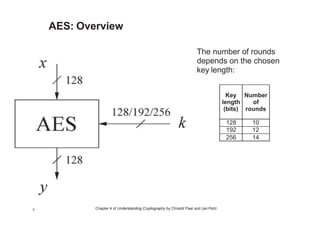
AES: Overview
The number of rounds
depends on the chosen
key length:
Key
length
(bits)
Number
of
rounds
128 10
192 12
256 14
9
Chapter 4 of Understanding Cryptography by Christof Paar and Jan Pelzl
AES: Overview
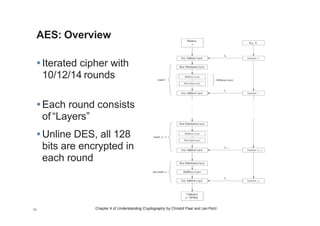
•Iterated cipher with
10/12/14 rounds
•Each round consists
of “Layers”
•Unline DES, all 128
bits are encrypted in
each round
10
Chapter 4 of Understanding Cryptography by Christof Paar and Jan Pelzl
Three Layer Types
•Key Addition Layer
•A 128-bit round key (or subkey)
•Derived from the main key in the key schedule
•XORed to the state
•Byte Substitution Layer (S-Box)
•Nonlinear transformation using lookup tables
•Introduces confusion to the data
•(Obscures relationship between key and
ciphertext)
11
Chapter 4 of Understanding Cryptography by Christof Paar and Jan Pelzl
Three Layer Types
•Diffusion Layer
•Two sublayers: ShiftRows and MixColumn
•(Makes sure that changing one plaintext bit
affects many ciphertext bits)
12
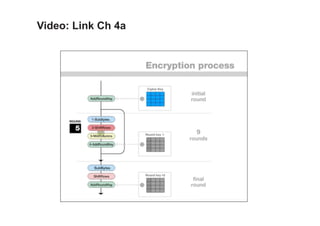
Video: Link Ch 4a
4.4 Internal Structure of AES
Chapter 4 of Understanding Cryptography by Christof Paar and Jan Pelzl16
Internal Structure of AES
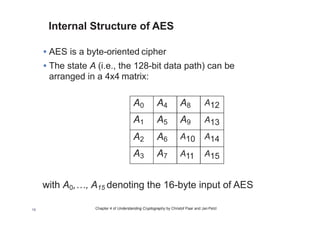
• AES is a byte-oriented cipher
• The state A (i.e., the 128-bit data path) can be
arranged in a 4x4 matrix:
with A0,…, A15 denoting the 16-byte input of AES
A0 A4 A8 A12
A1 A5 A9 A13
A2 A6 A10 A14
A3 A7 A11 A15
Chapter 4 of Understanding Cryptography by Christof Paar and Jan Pelzl
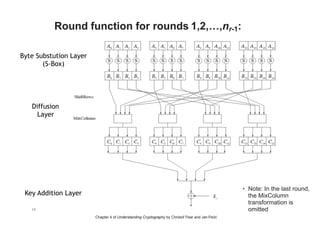
Round function for rounds 1,2,…,nr-1:
17
• Note: In the last round,
the MixColumn
transformation is
omitted
Diffusion
Layer
Byte Substution Layer
(S-Box)
Key Addition Layer
Chapter 4 of Understanding Cryptography by Christof Paar and Jan Pelzl
Byte Substitution Layer
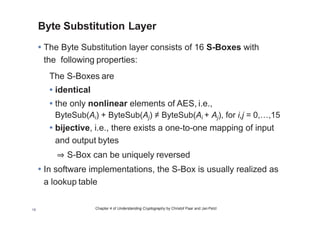
• The Byte Substitution layer consists of 16 S-Boxes with
the following properties:
The S-Boxes are
• identical
• the only nonlinear elements of AES, i.e.,
ByteSub(Ai) + ByteSub(Aj) ≠ ByteSub(Ai + Aj), for i,j = 0,…,15
• bijective, i.e., there exists a one-to-one mapping of input
and output bytes
S-Box can be uniquely reversed
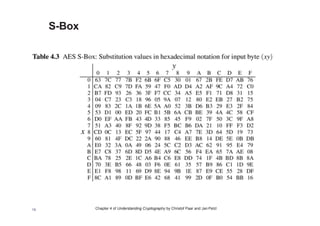
• In software implementations, the S-Box is usually realized as
a lookup table
18
Chapter 4 of Understanding Cryptography by Christof Paar and Jan Pelzl
S-Box
19
Chapter 4 of Understanding Cryptography by Christof Paar and Jan Pelzl
Diffusion Layer
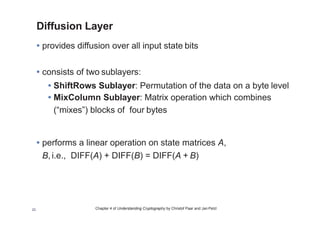
• provides diffusion over all input state bits
• consists of two sublayers:
• ShiftRows Sublayer: Permutation of the data on a byte level
• MixColumn Sublayer: Matrix operation which combines
(“mixes”) blocks of four bytes
• performs a linear operation on state matrices A,
B,i.e., DIFF(A) + DIFF(B) = DIFF(A + B)
20
Chapter 4 of Understanding Cryptography by Christof Paar and Jan Pelzl
ShiftRows Sublayer
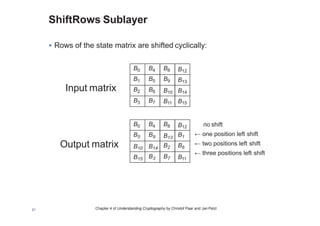
• Rows of the state matrix are shifted cyclically:
Output matrix
B0 B4 B8 B12
B1 B5 B9 B13
B2 B6 B10 B14
B3 B7 B11 B15
21
B0 B4 B8 B12
B5 B9 B13
B1
B10 B14
B2 B6
B15 B3 B7 B11
no shift
← one position left shift
← two positions left shift
← three positions left shift
Input matrix
Chapter 4 of Understanding Cryptography by Christof Paar and Jan Pelzl
MixColumn Sublayer
• Linear transformation which mixes each column of the state
matrix
• Each 4-byte column is considered as a vector and multiplied by
a fixed 4x4 matrix, e.g.,
22
Chapter 4 of Understanding Cryptography by Christof Paar and Jan Pelzl
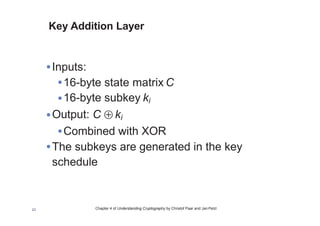
Key Addition Layer
•Inputs:
•16-byte state matrix C
•16-byte subkey ki
•Output: C ⊕ ki
•Combined with XOR
•The subkeys are generated in the key
schedule
23
Chapter 4 of Understanding Cryptography by Christof Paar and Jan Pelzl
24
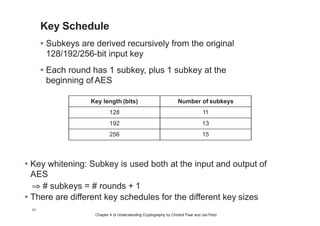
Key Schedule
• Subkeys are derived recursively from the original
128/192/256-bit input key
• Each round has 1 subkey, plus 1 subkey at the
beginning ofAES
• Key whitening: Subkey is used both at the input and output of
AES
⇒ # subkeys = # rounds + 1
• There are different key schedules for the different key sizes
Key length (bits) Number of subkeys
128 11
192 13
256 15
Chapter 4 of Understanding Cryptography by Christof Paar and Jan Pelzl
Key Schedule
Example: Key schedule for 128-bit keyAES
• Word-oriented: 1 word =
32 bits
• 11 subkeys are stored
in W[0]…W[3], W[4]…
W[7], … , W[40]…W[43]
• First subkey W[0]…W[3]
is the original AES key
25
Chapter 4 of Understanding Cryptography by Christof Paar and Jan Pelzl
Key Schedule
• Function g rotates its four input bytes and performs a
bytewise 

S-Box substitution
⇒ nonlinearity
• The round coefficient RC is only added
to the leftmost byte and varies from
round to round:
RC[1] = x0 = (00000001)2
RC[2] = x1 = (00000010)2
RC[3] = x2 = (00000100)2
...
RC[10] = x9 = (00110110)2
26
4.6 Implementation
Chapter 4 of Understanding Cryptography by Christof Paar and Jan Pelzl28
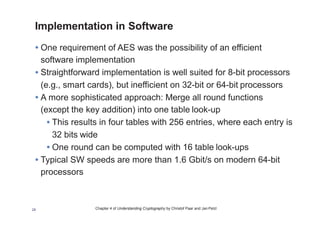
Implementation in Software
• One requirement of AES was the possibility of an efficient
software implementation
• Straightforward implementation is well suited for 8-bit processors
(e.g., smart cards), but inefficient on 32-bit or 64-bit processors
• A more sophisticated approach: Merge all round functions
(except the key addition) into one table look-up
• This results in four tables with 256 entries, where each entry is
32 bits wide
• One round can be computed with 16 table look-ups
• Typical SW speeds are more than 1.6 Gbit/s on modern 64-bit
processors
Chapter 4 of Understanding Cryptography by Christof Paar and Jan Pelzl29
Security
• Brute-force attack: Due to the key length of 128, 192
or 256 bits, a brute-force attack is not possible
• Analytical attacks: There is no analytical attack known
that is better than brute-force
• Side-channel attacks:
• Several side-channel attacks have been published
• Note that side-channel attacks do not attack the
underlying algorithm but the implementation of it
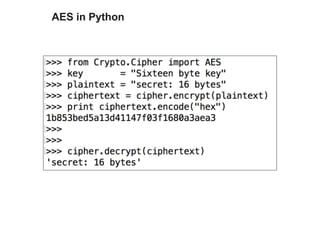
AES in Python
4. The Advanced Encryption Standard (AES)

4. The Advanced Encryption Standard (AES)

  • 1.
    Understanding Cryptography by ChristofPaar and JanPelzl www.crypto-textbook.com Chapter 4 – The Advanced Encryption Standard (AES) ver. October 28, 2009 These slides were prepared by Daehyun Strobel, Christof Paar and Jan Pelzl Modified by Sam Bowne
  • 2.
    Chapter 4 ofUnderstanding Cryptography by Christof Paar and Jan Pelzl2 Some legal stuff (sorry): Terms of Use • The slides can used free of charge. All copyrights for the slides remain with Christof Paar and Jan Pelzl. • The title of the accompanying book “Understanding Cryptography” by Springer and the author’s names must remain on eachslide. • If the slides are modified, appropriate credits to the book authorsand the book title must remain within the slides. • It is not permitted to reproduce parts or all of the slides in printedform whatsoever without written consent by the authors.
  • 3.
    Chapter 3 ofUnderstanding Cryptography by Christof Paar and Jan Pelzl3 Contents of this Chapter • 4.1 Introduction • 4.2 Overview of the AES Algorithm • 4.3 Galois Fields (SKIP) • 4.4 Internal Structure of AES • 4.5 Decryption (SKIP) • 4.6 Implementation
  • 4.
  • 5.
    Chapter 4 ofUnderstanding Cryptography by Christof Paar and Jan Pelzl5 •AES is the most widely used symmetric ciphertoday •The algorithm for AES was chosen by the US National Institute of Standards and Technology (NIST) in a multi-year selection process • The requirements for all AES candidate submissions were: •Block cipher with 128-bit block size •Three supported key lengths: 128, 192 and 256 bit •Security relative to other submitted algorithms •Efficiency in software and hardware Some Basic Facts
  • 6.
    Chapter 4 ofUnderstanding Cryptography by Christof Paar and Jan Pelzl6 •The need for a new block cipher announced by NIST in January, 1997 •15 candidates algorithms accepted in August, 1998 •5 finalists announced in August, 1999: •Mars – IBM Corporation •RC6 – RSA Laboratories •Rijndael – J. Daemen & V. Rijmen •Serpent – Eli Biham et al. •Twofish – B. Schneier etal. •In October 2000, Rijndael was chosen as the AES Chronology of AES Selection
  • 7.
    Chapter 4 ofUnderstanding Cryptography by Christof Paar and Jan Pelzl7 •AES was formally approved as a US federal standard in November 2001 •In 1993, the NSA allows AES to encrypt classified documents •Up to SECRET for all key lengths •Up to TOP SECRET for 192 and 256-bit keys Chronology of AES Selection
  • 8.
    4.2 Overview ofthe AES Algorithm
  • 9.
    Chapter 4 ofUnderstanding Cryptography by Christof Paar and Jan Pelzl AES: Overview The number of rounds depends on the chosen key length: Key length (bits) Number of rounds 128 10 192 12 256 14 9
  • 10.
    Chapter 4 ofUnderstanding Cryptography by Christof Paar and Jan Pelzl AES: Overview •Iterated cipher with 10/12/14 rounds •Each round consists of “Layers” •Unline DES, all 128 bits are encrypted in each round 10
  • 11.
    Chapter 4 ofUnderstanding Cryptography by Christof Paar and Jan Pelzl Three Layer Types •Key Addition Layer •A 128-bit round key (or subkey) •Derived from the main key in the key schedule •XORed to the state •Byte Substitution Layer (S-Box) •Nonlinear transformation using lookup tables •Introduces confusion to the data •(Obscures relationship between key and ciphertext) 11
  • 12.
    Chapter 4 ofUnderstanding Cryptography by Christof Paar and Jan Pelzl Three Layer Types •Diffusion Layer •Two sublayers: ShiftRows and MixColumn •(Makes sure that changing one plaintext bit affects many ciphertext bits) 12
  • 13.
  • 15.
  • 16.
    Chapter 4 ofUnderstanding Cryptography by Christof Paar and Jan Pelzl16 Internal Structure of AES • AES is a byte-oriented cipher • The state A (i.e., the 128-bit data path) can be arranged in a 4x4 matrix: with A0,…, A15 denoting the 16-byte input of AES A0 A4 A8 A12 A1 A5 A9 A13 A2 A6 A10 A14 A3 A7 A11 A15
  • 17.
    Chapter 4 ofUnderstanding Cryptography by Christof Paar and Jan Pelzl Round function for rounds 1,2,…,nr-1: 17 • Note: In the last round, the MixColumn transformation is omitted Diffusion Layer Byte Substution Layer (S-Box) Key Addition Layer
  • 18.
    Chapter 4 ofUnderstanding Cryptography by Christof Paar and Jan Pelzl Byte Substitution Layer • The Byte Substitution layer consists of 16 S-Boxes with the following properties: The S-Boxes are • identical • the only nonlinear elements of AES, i.e., ByteSub(Ai) + ByteSub(Aj) ≠ ByteSub(Ai + Aj), for i,j = 0,…,15 • bijective, i.e., there exists a one-to-one mapping of input and output bytes S-Box can be uniquely reversed • In software implementations, the S-Box is usually realized as a lookup table 18
  • 19.
    Chapter 4 ofUnderstanding Cryptography by Christof Paar and Jan Pelzl S-Box 19
  • 20.
    Chapter 4 ofUnderstanding Cryptography by Christof Paar and Jan Pelzl Diffusion Layer • provides diffusion over all input state bits • consists of two sublayers: • ShiftRows Sublayer: Permutation of the data on a byte level • MixColumn Sublayer: Matrix operation which combines (“mixes”) blocks of four bytes • performs a linear operation on state matrices A, B,i.e., DIFF(A) + DIFF(B) = DIFF(A + B) 20
  • 21.
    Chapter 4 ofUnderstanding Cryptography by Christof Paar and Jan Pelzl ShiftRows Sublayer • Rows of the state matrix are shifted cyclically: Output matrix B0 B4 B8 B12 B1 B5 B9 B13 B2 B6 B10 B14 B3 B7 B11 B15 21 B0 B4 B8 B12 B5 B9 B13 B1 B10 B14 B2 B6 B15 B3 B7 B11 no shift ← one position left shift ← two positions left shift ← three positions left shift Input matrix
  • 22.
    Chapter 4 ofUnderstanding Cryptography by Christof Paar and Jan Pelzl MixColumn Sublayer • Linear transformation which mixes each column of the state matrix • Each 4-byte column is considered as a vector and multiplied by a fixed 4x4 matrix, e.g., 22
  • 23.
    Chapter 4 ofUnderstanding Cryptography by Christof Paar and Jan Pelzl Key Addition Layer •Inputs: •16-byte state matrix C •16-byte subkey ki •Output: C ⊕ ki •Combined with XOR •The subkeys are generated in the key schedule 23
  • 24.
    Chapter 4 ofUnderstanding Cryptography by Christof Paar and Jan Pelzl 24 Key Schedule • Subkeys are derived recursively from the original 128/192/256-bit input key • Each round has 1 subkey, plus 1 subkey at the beginning ofAES • Key whitening: Subkey is used both at the input and output of AES ⇒ # subkeys = # rounds + 1 • There are different key schedules for the different key sizes Key length (bits) Number of subkeys 128 11 192 13 256 15
  • 25.
    Chapter 4 ofUnderstanding Cryptography by Christof Paar and Jan Pelzl Key Schedule Example: Key schedule for 128-bit keyAES • Word-oriented: 1 word = 32 bits • 11 subkeys are stored in W[0]…W[3], W[4]… W[7], … , W[40]…W[43] • First subkey W[0]…W[3] is the original AES key 25
  • 26.
    Chapter 4 ofUnderstanding Cryptography by Christof Paar and Jan Pelzl Key Schedule • Function g rotates its four input bytes and performs a bytewise 
 S-Box substitution ⇒ nonlinearity • The round coefficient RC is only added to the leftmost byte and varies from round to round: RC[1] = x0 = (00000001)2 RC[2] = x1 = (00000010)2 RC[3] = x2 = (00000100)2 ... RC[10] = x9 = (00110110)2 26
  • 27.
  • 28.
    Chapter 4 ofUnderstanding Cryptography by Christof Paar and Jan Pelzl28 Implementation in Software • One requirement of AES was the possibility of an efficient software implementation • Straightforward implementation is well suited for 8-bit processors (e.g., smart cards), but inefficient on 32-bit or 64-bit processors • A more sophisticated approach: Merge all round functions (except the key addition) into one table look-up • This results in four tables with 256 entries, where each entry is 32 bits wide • One round can be computed with 16 table look-ups • Typical SW speeds are more than 1.6 Gbit/s on modern 64-bit processors
  • 29.
    Chapter 4 ofUnderstanding Cryptography by Christof Paar and Jan Pelzl29 Security • Brute-force attack: Due to the key length of 128, 192 or 256 bits, a brute-force attack is not possible • Analytical attacks: There is no analytical attack known that is better than brute-force • Side-channel attacks: • Several side-channel attacks have been published • Note that side-channel attacks do not attack the underlying algorithm but the implementation of it
  • 30.