Encryption
• It iseasy to intercept and read an unprotected packet of data traveling
over a public network.
• In some cases, that data might contain user or password information.
• In other cases, the data might contain other sensitive information you
don’t want anyone else to see, such as credit card numbers or
company secrets.
• The fact is that even if the data isn’t particularly secret, many users are
justifiably uncomfortable with the prospect of eavesdroppers listening
in on their electronic communication.
2
3.
Encryption
• The securitymethods discussed later in this topic are
designed to make the network more secret.
• Many of these methods use a concept known as encryption.
• Encryption is the process of systematically altering data to
make it unreadable to unauthorized users.
• Data is encrypted by the sender.
• The data then travels over the network in coded, unreadable
form.
• The receiving computer then decrypts the data to read it.
3
4.
Encryption
• In fact,encryption does not require a computer at all.
• Encryption methods have been around for centuries.
• As long as people have written secret messages, they have looked for codes
or tricks to keep those messages secret.
• In the computer age, however, encryption has gotten much more
sophisticated because of the ease with which computers can manipulate
huge, messy numbers.
• Most computer encryption algorithms result from the manipulation of large
prime numbers.
• The algorithms themselves are intensely mathematical.
4
5.
Algorithms and Keys
•As you learned, encryption is a process for rendering data
unreadable to everything and everyone who doesn’t have the
secret for unlocking the encryption code.
• For encryption to work, the two communicating entities must
have the following:
– A process for making the data unreadable (encryption)
– A process for restoring the unreadable data to its original, readable
form (decryption)
5
6.
Algorithms and Keys
•When programmers first began to write encryption software,
they realized they must contend with the following problems:
– If every computer used the exact same process for encrypting and
decrypting data, the program would not be acceptably secure because
any eavesdropper could just obtain a copy of the program and start
decrypting messages.
– If every computer used a totally different and unrelated process for
encrypting and decrypting data, every computer would need a totally
different and unrelated program. Each pair of computers that wanted
to communicate would need separate software. This would be highly
expensive and impossible to manage on large, diverse networks.
6
7.
Algorithms and Keys
•Intractable as these problems might seem, the large minds
who develop encryption techniques quickly saw a solution.
• The solution is that the process for encrypting or decrypting
the data must be divided into a standard, reproducible part
(which is always the same) and a unique part (which forces a
secret relationship between the communicating parties).
7
8.
Algorithms and Keys
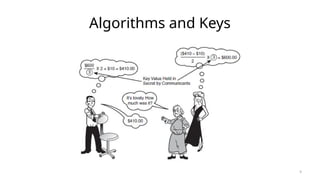
•The standard part of the encryption process is called the encryption
algorithm.
• The encryption algorithm is essentially a set of mathematical steps used to
transform the data into its unreadable form.
• The unique and secret part of the process is called the encryption key.
• The science of encryption is extremely complex, but for purposes of
discussion, you can think of the key as a large number that is used within
the algorithm as a variable.
• The result of the encryption process depends on the value of the key.
• Therefore, as long as the value of the key is kept secret, unauthorized users
will not be able to read the data even if they have the necessary decryption
software. 8
Symmetric (Secret Key)Encryption
• Symmetric encryption is sometimes called conventional
encryption or secret key because it preceded the development
of newer, asymmetric techniques.
• Symmetric encryption is still the most common form, although
public key asymmetric encryption (discussed later) has recently
received considerable attention.
• Symmetric encryption is called symmetric because the
decryption process is exactly the reverse of the encryption
process.
10
11.
Symmetric (Secret Key)Encryption
• Figure below describes a symmetric encryption/decryption process.
• The steps are as follows:
1. A secret key is made known to both the sending and receiving
computers.
2. The sending computer encrypts the data using a prearranged encryption
algorithm and the secret key.
3. The encrypted (unreadable) text is delivered to the destination computer.
4. The receiving computer uses a decryption algorithm that is exactly the
reverse of the encryption algorithm in step 2 (along with the secret key)
to decrypt the data.
11
Symmetric (Secret Key)Encryption
• Symmetric encryption can be extremely secure if it is
performed carefully.
• The most important considerations for the security of any
encryption scheme (symmetric or asymmetric) are as follows:
– The strength of the encryption algorithm
– The strength of the key(s)
– The secrecy of the key(s)
13
14.
Symmetric (Secret Key)Encryption
• Breaking through an encryption algorithm that uses a 128-bit key might
seem completely impossible, but it can happen.
• Key-cracking utilities are freely available on the Internet, and some 128-
bit encryption algorithms that were once considered unbreakable are
now considered insecure.
• Another way to steal encrypted data is to steal the key.
• The software must provide some secure means for delivering the key to
the receiving computer.
• In the case of symmetric encryption, the secret key is the whole secret.
14
15.
Symmetric (Secret Key)Encryption
• If you capture the key, you have everything. Most systems,
therefore, call for a periodic renewal of the key.
• The unique key used by a pair of communicating computers
might be re-created with every session or after a given time
interval.
• Key renewal increases the number of keys crossing the
network, which compounds the need for effective key
protection.
15
16.
Symmetric (Secret Key)Encryption
• Several common encryption algorithms make use of symmetric
encryption.
• Data Encryption Standard (DES) was once a popular option, but its
56-bit key is now considered too short.
• Modern encryption techniques often allow for a variable key length.
• A descendent of DES known as the Advanced Encryption Standard
(AES) supports keys of 128, 192, or 256 bits.
• The Blowfish symmetric algorithm provides a key length of up to
448 bits.
16
17.
Asymmetric (Public Key)Encryption
• An alternative encryption method that has emerged over the
last 30 years provides an answer to some of the key
distribution problems implicit with symmetric encryption.
• Asymmetric encryption is called asymmetric because the key
used to encrypt the data is different from the key used to
decrypt the data.
• This process is shown in Figure below.
17
Asymmetric (Public Key)Encryption
• Asymmetric encryption is commonly associated with an
encryption method known as public key encryption.
• In public key encryption, one of the two keys (called the
private key) is held securely on a single computer.
• The other key (the public key) is made available to computers
that want to send data to the holder of the private key.
19
20.
Asymmetric (Public Key)Encryption
• This process is depicted in Figure above. The steps are as
follows:
1. Computer A attempts to establish a connection with Computer B.
2. The encryption software on Computer B generates a private key
and a public key. The private key is shared with no one. The public
key is made available to Computer A.
3. Computer A encrypts the data with the public key received from
Computer B and transmits the data. The public key from Computer
B is stored on Computer A for future reference.
4. Computer B receives the data and decrypts it using the private key.
20
21.
Asymmetric (Public Key)Encryption
• An important aspect of public key methods is that the encryption
performed through the public key is a one-way function.
• The public key can be used to encrypt the data, but only the
private key can decrypt the data after it is encrypted.
• An eavesdropper who intercepts the public key will still not be
able to read messages encrypted using the public key.
• Public key encryption methods are commonly used for protected
Internet transactions.
21