CS8792 - Cryptography and
Network Security
VKP
Unit – I INTRODUCTION
• Security trends - Legal, Ethical and
Professional Aspects of Security, Need for
Security at Multiple levels, Security Policies -
Model of network security – Security attacks,
services and mechanisms – OSI security
architecture – Classical encryption techniques:
substitution techniques, transposition
techniques, steganography- Foundations of
modern cryptography: perfect security –
information theory – product cryptosystem –
What security is about in general?
• Security is about protection of assets
– Prevention
– Detection
– Reaction
Internet shopping example
• Prevention
– encrypt your order and card number, enforce
merchants to do some extra checks, using PIN
even for Internet transactions, don’t send card
number via Internet
• Detection
– an unauthorized transaction appears on your
credit card statement
• Reaction
– complain, dispute, ask for a new card number etc
Information security in past &
present
• Traditional Information Security
– keep the cabinets locked
– put them in a secure room
– human guards
– electronic surveillance systems
– in general: physical and administrative
mechanisms
• Modern World
– Data are in computers
– Computers are interconnected
Definitions
• Computer Security - generic name for the collection
of tools designed to protect data and to thwart
hackers
• Network Security - measures to protect data during
their transmission
• Internet Security - measures to protect data during
their transmission over a collection of interconnected
networks
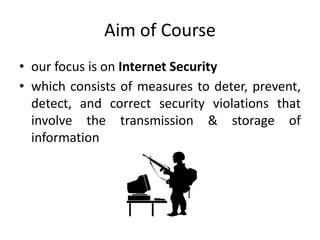
Aim of Course
• our focus is on Internet Security
• which consists of measures to deter, prevent,
detect, and correct security violations that
involve the transmission & storage of
information
OSI Security Architecture
• ITU-T X.800 “Security Architecture for OSI”
• defines a systematic way of defining and
providing security requirements
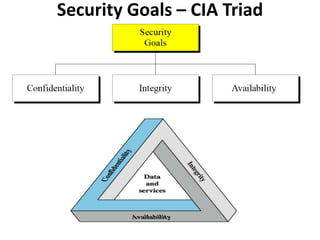
Security Goals – CIA Triad
Confidentiality
• Confidentiality is probably the most common
aspect of information security. We need to
protect our confidential information. An

organization needs to guard against those
malicious actions that endanger the
confidentiality of its information.
Integrity
• Information needs to be changed constantly.
Integrity means that changes need to be done
only by authorized entities and through
authorized mechanisms.
Availability
• The information created and stored by an
organization needs to be available to
authorized entities. Information needs to be
constantly changed, which means it must be
accessible to authorized entities.
Aspects of Security
• consider 3 aspects of information security:
– security attack
– security services
– security mechanism
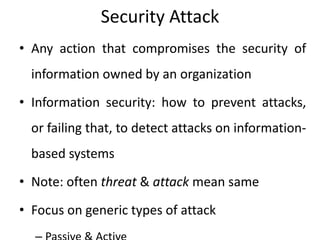
Security Attack
• Any action that compromises the security of
information owned by an organization
• Information security: how to prevent attacks,
or failing that, to detect attacks on information-
based systems
• Note: often threat & attack mean same
• Focus on generic types of attack
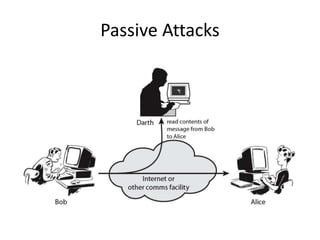
Passive Attacks
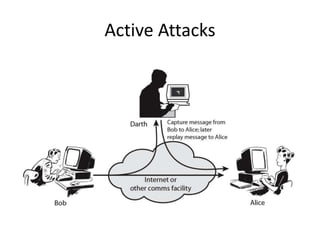
Active Attacks
ATTACKS
The three goals of
securityconfidentiality, integrity, and
availabilitycan be threatened by security
attacks.
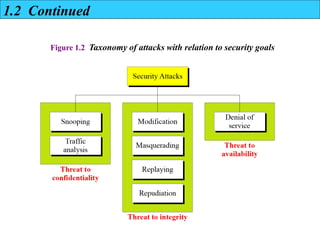
Figure 1.2 Taxonomy of attacks with relation to security goals
1.2 Continued
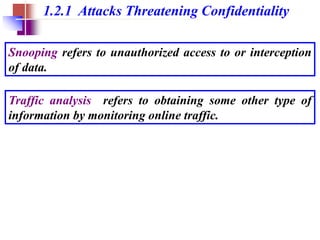
1.2.1 Attacks Threatening Confidentiality
Snooping refers to unauthorized access to or interception
of data.
Traffic analysis refers to obtaining some other type of
information by monitoring online traffic.
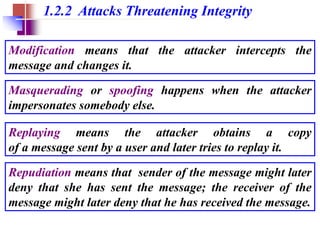
1.2.2 Attacks Threatening Integrity
Modification means that the attacker intercepts the
message and changes it.
Masquerading or spoofing happens when the attacker
impersonates somebody else.
Replaying means the attacker obtains a copy
of a message sent by a user and later tries to replay it.
Repudiation means that sender of the message might later
deny that she has sent the message; the receiver of the
message might later deny that he has received the message.
1.2.3 Attacks Threatening Availability
Denial of service (DoS) is a very common attack. It may
slow down or totally interrupt the service of a system.
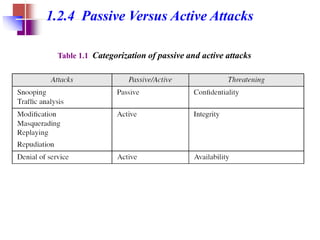
1.2.4 Passive Versus Active Attacks
Table 1.1 Categorization of passive and active attacks
SERVICES AND MECHANISMS
ITU-T provides some security services and some
mechanisms to implement those services. Security
services and mechanisms are closely related because a
mechanism or combination of mechanisms are used to
provide a service..
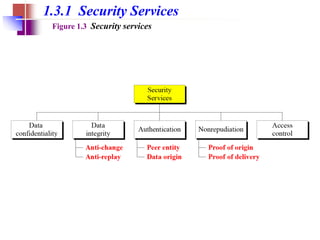
1.3.1 Security Services
Figure 1.3 Security services
Security Services (X.800)
• Authentication - assurance that the communicating
entity is the one claimed
• Access Control - prevention of the unauthorized use
of a resource
• Data Confidentiality –protection of data from
unauthorized disclosure
• Data Integrity - assurance that data received is as
sent by an authorized entity
• Non-Repudiation - protection against denial by one
of the parties in a communication
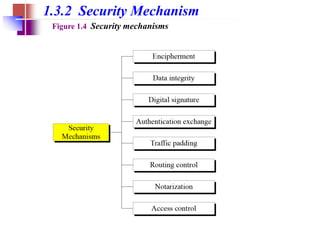
1.3.2 Security Mechanism
Figure 1.4 Security mechanisms
Security Mechanism
• feature designed to detect, prevent, or
recover from a security attack
• no single mechanism that will support all
services required
• however one particular element underlies
many of the security mechanisms in use:
– cryptographic techniques
Crypto
Secret Writing
graphy
Security Mechanisms (X.800)
• specific security mechanisms:
– encipherment, digital signatures, access controls,
data integrity, authentication exchange, traffic
padding, routing control, notarization
• pervasive security mechanisms:
– trusted functionality, security labels, event
detection, security audit trails, security recovery
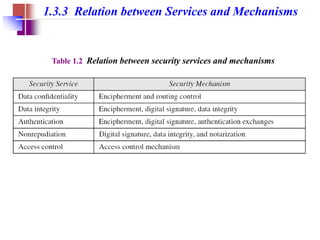
1.3.3 Relation between Services and Mechanisms
Table 1.2 Relation between security services and mechanisms
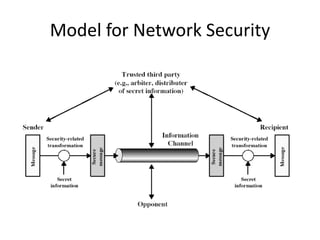
Model for Network Security
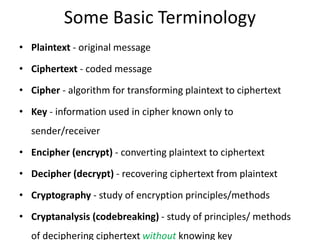
Some Basic Terminology
• Plaintext - original message
• Ciphertext - coded message
• Cipher - algorithm for transforming plaintext to ciphertext
• Key - information used in cipher known only to
sender/receiver
• Encipher (encrypt) - converting plaintext to ciphertext
• Decipher (decrypt) - recovering ciphertext from plaintext
• Cryptography - study of encryption principles/methods
• Cryptanalysis (codebreaking) - study of principles/ methods
of deciphering ciphertext without knowing key
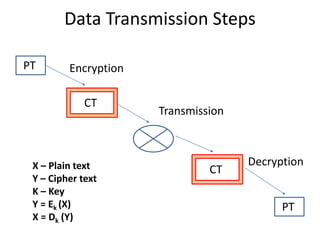
Data Transmission Steps
PT
PT
CT
CT
Encryption
Transmission
DecryptionX – Plain text
Y – Cipher text
K – Key
Y = Ek (X)
X = Dk (Y)
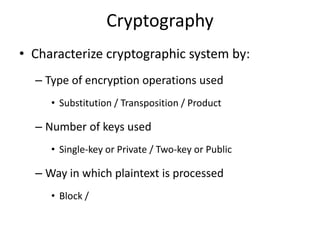
Cryptography
• Characterize cryptographic system by:
– Type of encryption operations used
• Substitution / Transposition / Product
– Number of keys used
• Single-key or Private / Two-key or Public
– Way in which plaintext is processed
• Block /
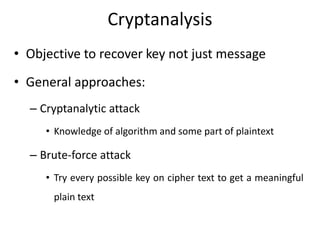
Cryptanalysis
• Objective to recover key not just message
• General approaches:
– Cryptanalytic attack
• Knowledge of algorithm and some part of plaintext
– Brute-force attack
• Try every possible key on cipher text to get a meaningful
plain text
CS8792 - Cryptography and Network Security

CS8792 - Cryptography and Network Security

  • 1.
    CS8792 - Cryptographyand Network Security VKP
  • 2.
    Unit – IINTRODUCTION • Security trends - Legal, Ethical and Professional Aspects of Security, Need for Security at Multiple levels, Security Policies - Model of network security – Security attacks, services and mechanisms – OSI security architecture – Classical encryption techniques: substitution techniques, transposition techniques, steganography- Foundations of modern cryptography: perfect security – information theory – product cryptosystem –
  • 3.
    What security isabout in general? • Security is about protection of assets – Prevention – Detection – Reaction
  • 4.
    Internet shopping example •Prevention – encrypt your order and card number, enforce merchants to do some extra checks, using PIN even for Internet transactions, don’t send card number via Internet • Detection – an unauthorized transaction appears on your credit card statement • Reaction – complain, dispute, ask for a new card number etc
  • 5.
    Information security inpast & present • Traditional Information Security – keep the cabinets locked – put them in a secure room – human guards – electronic surveillance systems – in general: physical and administrative mechanisms • Modern World – Data are in computers – Computers are interconnected
  • 6.
    Definitions • Computer Security- generic name for the collection of tools designed to protect data and to thwart hackers • Network Security - measures to protect data during their transmission • Internet Security - measures to protect data during their transmission over a collection of interconnected networks
  • 7.
    Aim of Course •our focus is on Internet Security • which consists of measures to deter, prevent, detect, and correct security violations that involve the transmission & storage of information
  • 8.
    OSI Security Architecture •ITU-T X.800 “Security Architecture for OSI” • defines a systematic way of defining and providing security requirements
  • 9.
  • 10.
    Confidentiality • Confidentiality isprobably the most common aspect of information security. We need to protect our confidential information. An organization needs to guard against those malicious actions that endanger the confidentiality of its information.
  • 11.
    Integrity • Information needsto be changed constantly. Integrity means that changes need to be done only by authorized entities and through authorized mechanisms.
  • 12.
    Availability • The informationcreated and stored by an organization needs to be available to authorized entities. Information needs to be constantly changed, which means it must be accessible to authorized entities.
  • 13.
    Aspects of Security •consider 3 aspects of information security: – security attack – security services – security mechanism
  • 14.
    Security Attack • Anyaction that compromises the security of information owned by an organization • Information security: how to prevent attacks, or failing that, to detect attacks on information- based systems • Note: often threat & attack mean same • Focus on generic types of attack
  • 15.
  • 16.
  • 17.
    ATTACKS The three goalsof securityconfidentiality, integrity, and availabilitycan be threatened by security attacks.
  • 18.
    Figure 1.2 Taxonomyof attacks with relation to security goals 1.2 Continued
  • 19.
    1.2.1 Attacks ThreateningConfidentiality Snooping refers to unauthorized access to or interception of data. Traffic analysis refers to obtaining some other type of information by monitoring online traffic.
  • 20.
    1.2.2 Attacks ThreateningIntegrity Modification means that the attacker intercepts the message and changes it. Masquerading or spoofing happens when the attacker impersonates somebody else. Replaying means the attacker obtains a copy of a message sent by a user and later tries to replay it. Repudiation means that sender of the message might later deny that she has sent the message; the receiver of the message might later deny that he has received the message.
  • 21.
    1.2.3 Attacks ThreateningAvailability Denial of service (DoS) is a very common attack. It may slow down or totally interrupt the service of a system.
  • 22.
    1.2.4 Passive VersusActive Attacks Table 1.1 Categorization of passive and active attacks
  • 23.
    SERVICES AND MECHANISMS ITU-Tprovides some security services and some mechanisms to implement those services. Security services and mechanisms are closely related because a mechanism or combination of mechanisms are used to provide a service..
  • 24.
    1.3.1 Security Services Figure1.3 Security services
  • 25.
    Security Services (X.800) •Authentication - assurance that the communicating entity is the one claimed • Access Control - prevention of the unauthorized use of a resource • Data Confidentiality –protection of data from unauthorized disclosure • Data Integrity - assurance that data received is as sent by an authorized entity • Non-Repudiation - protection against denial by one of the parties in a communication
  • 26.
    1.3.2 Security Mechanism Figure1.4 Security mechanisms
  • 27.
    Security Mechanism • featuredesigned to detect, prevent, or recover from a security attack • no single mechanism that will support all services required • however one particular element underlies many of the security mechanisms in use: – cryptographic techniques Crypto Secret Writing graphy
  • 28.
    Security Mechanisms (X.800) •specific security mechanisms: – encipherment, digital signatures, access controls, data integrity, authentication exchange, traffic padding, routing control, notarization • pervasive security mechanisms: – trusted functionality, security labels, event detection, security audit trails, security recovery
  • 29.
    1.3.3 Relation betweenServices and Mechanisms Table 1.2 Relation between security services and mechanisms
  • 30.
  • 31.
    Some Basic Terminology •Plaintext - original message • Ciphertext - coded message • Cipher - algorithm for transforming plaintext to ciphertext • Key - information used in cipher known only to sender/receiver • Encipher (encrypt) - converting plaintext to ciphertext • Decipher (decrypt) - recovering ciphertext from plaintext • Cryptography - study of encryption principles/methods • Cryptanalysis (codebreaking) - study of principles/ methods of deciphering ciphertext without knowing key
  • 32.
    Data Transmission Steps PT PT CT CT Encryption Transmission DecryptionX– Plain text Y – Cipher text K – Key Y = Ek (X) X = Dk (Y)
  • 33.
    Cryptography • Characterize cryptographicsystem by: – Type of encryption operations used • Substitution / Transposition / Product – Number of keys used • Single-key or Private / Two-key or Public – Way in which plaintext is processed • Block /
  • 34.
    Cryptanalysis • Objective torecover key not just message • General approaches: – Cryptanalytic attack • Knowledge of algorithm and some part of plaintext – Brute-force attack • Try every possible key on cipher text to get a meaningful plain text