
Chapter 5: 
Transport Layer 
Network Fundamentals 
© 2008 Cisco Systems, Inc. All Presentation_ID rights reserved. Cisco Confidential 1
Chapter 5 
5.1 Transport Layer Protocols 
5.2 TCP and UDP 
5.3 Summary 
Presentation_ID © 2008 Cisco Systems, Inc. All rights reserved. Cisco Confidential 2
Chapter 5: Objectives 
 Explain the need for the transport layer. 
 Identify the role of the transport layer as it provides the 
end-to-end transfer of data between applications. 
 Describe the role of two TCP/IP transport layer protocols: 
TCP and UDP. 
 Explain the key functions of the transport layer, including 
reliability, port addressing, and segmentation. 
 Explain how TCP and UDP each handle key functions. 
 Identify when it is appropriate to use TCP or UDP and 
provide examples of applications that use each protocol 
Presentation_ID © 2008 Cisco Systems, Inc. All rights reserved. Cisco Confidential 3
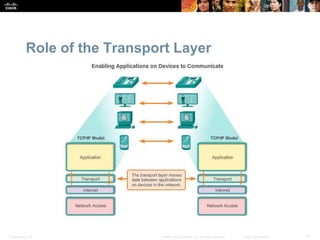
Role of the Transport Layer 
Presentation_ID © 2008 Cisco Systems, Inc. All rights reserved. Cisco Confidential 4
Transportation of Data 
Role of the Transport Layer 
The Transport Layer is responsible for establishing a temporary 
communication session between two applications and delivering data 
between them. TCP/IP uses two protocols to achieve this: 
 Transmission Control Protocol (TCP) 
 User Datagram Protocol (UDP) 
Primary Responsibilities of Transport layer Protocols 
 Tracking the individual communication between applications on the 
source and destination hosts 
 Segmenting data for manageability and reassembling segmented 
data into streams of application data at the destination 
 Identifying the proper application for each communication stream 
Presentation_ID © 2008 Cisco Systems, Inc. All rights reserved. Cisco Confidential 5
Transportation of Data 
Conversation Multiplexing 
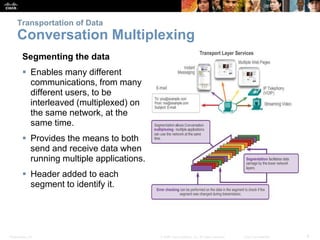
Segmenting the data 
 Enables many different 
communications, from many 
different users, to be 
interleaved (multiplexed) on 
the same network, at the 
same time. 
 Provides the means to both 
send and receive data when 
running multiple applications. 
 Header added to each 
segment to identify it. 
Presentation_ID © 2008 Cisco Systems, Inc. All rights reserved. Cisco Confidential 6
Transportation of Data 
Transport Layer Reliability 
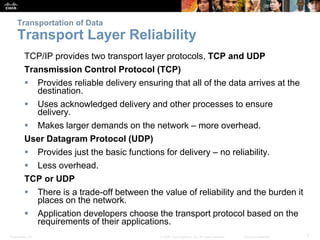
TCP/IP provides two transport layer protocols, TCP and UDP 
Transmission Control Protocol (TCP) 
 Provides reliable delivery ensuring that all of the data arrives at the 
destination. 
 Uses acknowledged delivery and other processes to ensure 
delivery. 
 Makes larger demands on the network – more overhead. 
User Datagram Protocol (UDP) 
 Provides just the basic functions for delivery – no reliability. 
 Less overhead. 
TCP or UDP 
 There is a trade-off between the value of reliability and the burden it 
places on the network. 
 Application developers choose the transport protocol based on the 
requirements of their applications. 
Presentation_ID © 2008 Cisco Systems, Inc. All rights reserved. Cisco Confidential 7
Introducing TCP and UDP 
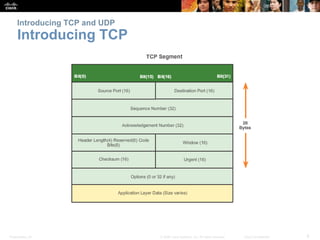
Introducing TCP 
Presentation_ID © 2008 Cisco Systems, Inc. All rights reserved. Cisco Confidential 8
Introducing TCP and UDP 
Introducing TCP 
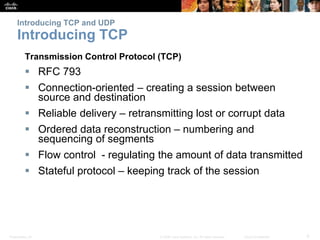
Transmission Control Protocol (TCP) 
 RFC 793 
 Connection-oriented – creating a session between 
source and destination 
 Reliable delivery – retransmitting lost or corrupt data 
 Ordered data reconstruction – numbering and 
sequencing of segments 
 Flow control - regulating the amount of data transmitted 
 Stateful protocol – keeping track of the session 
Presentation_ID © 2008 Cisco Systems, Inc. All rights reserved. Cisco Confidential 9
Introducing TCP and UDP 
Introducing UDP 
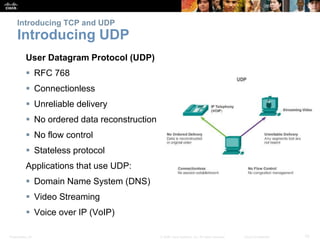
User Datagram Protocol (UDP) 
 RFC 768 
 Connectionless 
 Unreliable delivery 
 No ordered data reconstruction 
 No flow control 
 Stateless protocol 
Applications that use UDP: 
 Domain Name System (DNS) 
 Video Streaming 
 Voice over IP (VoIP) 
Presentation_ID © 2008 Cisco Systems, Inc. All rights reserved. Cisco Confidential 10
Introducing TCP and UDP 
Separating Multiple Communications 
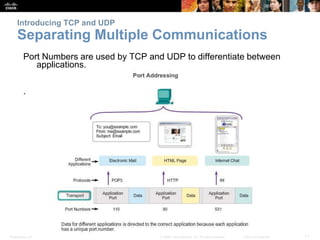
Port Numbers are used by TCP and UDP to differentiate between 
applications. 
. 
Presentation_ID © 2008 Cisco Systems, Inc. All rights reserved. Cisco Confidential 11
Introducing TCP and UDP 
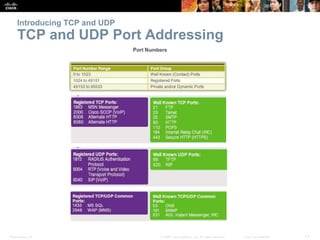
TCP and UDP Port Addressing 
Presentation_ID © 2008 Cisco Systems, Inc. All rights reserved. Cisco Confidential 12
Introducing TCP and UDP 
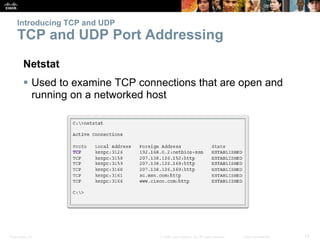
TCP and UDP Port Addressing 
Netstat 
 Used to examine TCP connections that are open and 
running on a networked host 
Presentation_ID © 2008 Cisco Systems, Inc. All rights reserved. Cisco Confidential 13
TCP Communication 
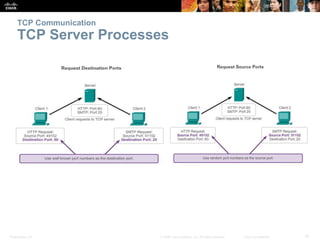
TCP Server Processes 
Presentation_ID © 2008 Cisco Systems, Inc. All rights reserved. Cisco Confidential 14
TCP Communication 
TCP Connection, Establishment and 
Termination 
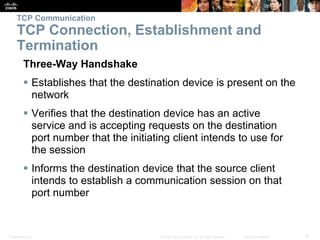
Three-Way Handshake 
 Establishes that the destination device is present on the 
network 
 Verifies that the destination device has an active 
service and is accepting requests on the destination 
port number that the initiating client intends to use for 
the session 
 Informs the destination device that the source client 
intends to establish a communication session on that 
port number 
Presentation_ID © 2008 Cisco Systems, Inc. All rights reserved. Cisco Confidential 15
TCP Communication 
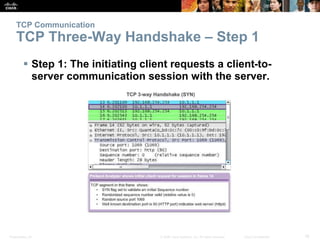
TCP Three-Way Handshake – Step 1 
 Step 1: The initiating client requests a client-to-server 
communication session with the server. 
Presentation_ID © 2008 Cisco Systems, Inc. All rights reserved. Cisco Confidential 16
TCP Communication 
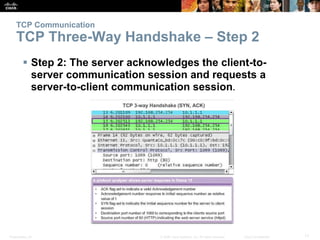
TCP Three-Way Handshake – Step 2 
 Step 2: The server acknowledges the client-to-server 
communication session and requests a 
server-to-client communication session. 
Presentation_ID © 2008 Cisco Systems, Inc. All rights reserved. Cisco Confidential 17
TCP Communication 
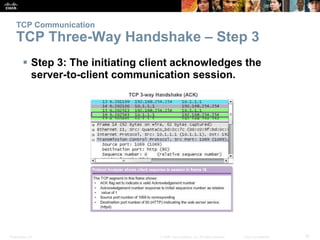
TCP Three-Way Handshake – Step 3 
 Step 3: The initiating client acknowledges the 
server-to-client communication session. 
Presentation_ID © 2008 Cisco Systems, Inc. All rights reserved. Cisco Confidential 18
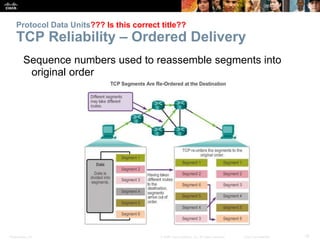
Protocol Data Units??? Is this correct title?? 
TCP Reliability – Ordered Delivery 
Sequence numbers used to reassemble segments into 
original order 
Presentation_ID © 2008 Cisco Systems, Inc. All rights reserved. Cisco Confidential 19
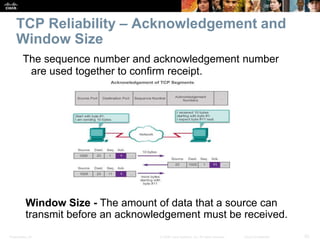
TCP Reliability – Acknowledgement and 
Window Size 
The sequence number and acknowledgement number 
are used together to confirm receipt. 
Window Size - The amount of data that a source can 
transmit before an acknowledgement must be received. 
Presentation_ID © 2008 Cisco Systems, Inc. All rights reserved. Cisco Confidential 20
Protocol Data Units 
TCP Reliability and Flow Control 
Data Loss and Retransmission 
 When TCP at the source host has not received an 
acknowledgement after a predetermined amount of time, it will go 
back to the last acknowledgement number that it received and 
retransmit data from that point forward 
Flow Control 
 Uses the window size field in the TCP header to specify the 
amount of data that can be transmitted before an acknowledgement 
must be received. 
 Adjusts the effective rate of data transmission to the maximum flow 
that the network and destination device can support without loss. 
 Manages the rate of transmission so that all data will be received 
and retransmissions will be minimized. 
Presentation_ID © 2008 Cisco Systems, Inc. All rights reserved. Cisco Confidential 21
Protocol Data Units 
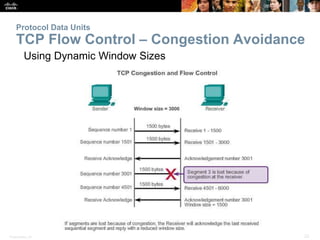
TCP Flow Control – Congestion Avoidance 
Using Dynamic Window Sizes 
Presentation_ID © 2008 Cisco Systems, Inc. All rights reserved. Cisco Confidential 22
TCP and UDP 
TCP Reliability - Acknowledgements 
 TCP uses a combination of sequence numbers and 
acknowledgements to ensure all requested data has 
been received. 
 Can be inefficient when there is loss of one or more 
segments 
 Selective Acknowledgements (SACK) – 
implementation of TCP that overcomes the inefficiency 
of TCP acknowledgements 
Presentation_ID © 2008 Cisco Systems, Inc. All rights reserved. Cisco Confidential 23
UDP Communication 
UDP Low Overhead vs. Reliability 
UDP 
 Simple protocol that provides the basic transport layer function 
 Used by applications that can tolerate small loss of data 
 Used by applications that cannot tolerate delay 
Used by 
 Domain Name System (DNS) 
 Simple Network Management Protocol (SNMP) 
 Dynamic Host Configuration Protocol (DHCP) 
 Trivial File Transfer Protocol (TFTP) 
 IP telephony or Voice over IP (VoIP) 
 Online games 
Presentation_ID © 2008 Cisco Systems, Inc. All rights reserved. Cisco Confidential 24
UDP Communication 
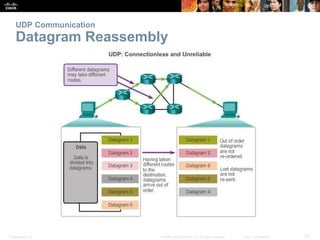
Datagram Reassembly 
Presentation_ID © 2008 Cisco Systems, Inc. All rights reserved. Cisco Confidential 25
UDP Communication 
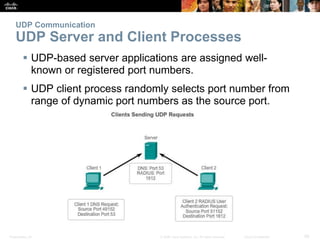
UDP Server and Client Processes 
 UDP-based server applications are assigned well-known 
or registered port numbers. 
 UDP client process randomly selects port number from 
range of dynamic port numbers as the source port. 
Presentation_ID © 2008 Cisco Systems, Inc. All rights reserved. Cisco Confidential 26
TCP or UDP 
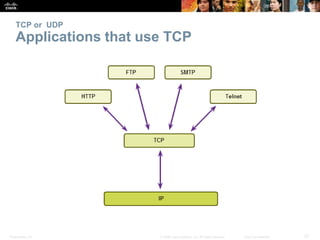
Applications that use TCP 
Presentation_ID © 2008 Cisco Systems, Inc. All rights reserved. Cisco Confidential 27
TCP or UDP 
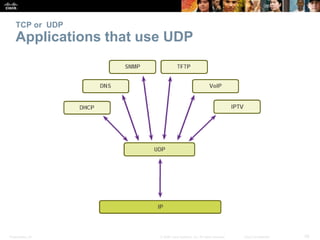
Applications that use UDP 
Presentation_ID © 2008 Cisco Systems, Inc. All rights reserved. Cisco Confidential 28
Chapter 5: Summary 
 The role of the Transport layer is to provide three main 
functions: multiplexing, segmentation and reassembly, 
and error checking. 
 These functions are necessary in order to address 
issues in quality of service and security on networks. 
 Knowing how TCP and UDP operate and which popular 
applications use each protocol will allow the 
implementation of quality of service and build more 
reliable networks. 
 Ports provide a “tunnel” for data to get from the Transport 
layer to the appropriate application at the destination. 
Presentation_ID © 2008 Cisco Systems, Inc. All rights reserved. Cisco Confidential 29
Presentation_ID © 2008 Cisco Systems, Inc. All rights reserved. Cisco Confidential 30

CCNA RS_NB - Chapter 5

  • 1.
    Chapter 5: TransportLayer Network Fundamentals © 2008 Cisco Systems, Inc. All Presentation_ID rights reserved. Cisco Confidential 1
  • 2.
    Chapter 5 5.1Transport Layer Protocols 5.2 TCP and UDP 5.3 Summary Presentation_ID © 2008 Cisco Systems, Inc. All rights reserved. Cisco Confidential 2
  • 3.
    Chapter 5: Objectives  Explain the need for the transport layer.  Identify the role of the transport layer as it provides the end-to-end transfer of data between applications.  Describe the role of two TCP/IP transport layer protocols: TCP and UDP.  Explain the key functions of the transport layer, including reliability, port addressing, and segmentation.  Explain how TCP and UDP each handle key functions.  Identify when it is appropriate to use TCP or UDP and provide examples of applications that use each protocol Presentation_ID © 2008 Cisco Systems, Inc. All rights reserved. Cisco Confidential 3
  • 4.
    Role of theTransport Layer Presentation_ID © 2008 Cisco Systems, Inc. All rights reserved. Cisco Confidential 4
  • 5.
    Transportation of Data Role of the Transport Layer The Transport Layer is responsible for establishing a temporary communication session between two applications and delivering data between them. TCP/IP uses two protocols to achieve this:  Transmission Control Protocol (TCP)  User Datagram Protocol (UDP) Primary Responsibilities of Transport layer Protocols  Tracking the individual communication between applications on the source and destination hosts  Segmenting data for manageability and reassembling segmented data into streams of application data at the destination  Identifying the proper application for each communication stream Presentation_ID © 2008 Cisco Systems, Inc. All rights reserved. Cisco Confidential 5
  • 6.
    Transportation of Data Conversation Multiplexing Segmenting the data  Enables many different communications, from many different users, to be interleaved (multiplexed) on the same network, at the same time.  Provides the means to both send and receive data when running multiple applications.  Header added to each segment to identify it. Presentation_ID © 2008 Cisco Systems, Inc. All rights reserved. Cisco Confidential 6
  • 7.
    Transportation of Data Transport Layer Reliability TCP/IP provides two transport layer protocols, TCP and UDP Transmission Control Protocol (TCP)  Provides reliable delivery ensuring that all of the data arrives at the destination.  Uses acknowledged delivery and other processes to ensure delivery.  Makes larger demands on the network – more overhead. User Datagram Protocol (UDP)  Provides just the basic functions for delivery – no reliability.  Less overhead. TCP or UDP  There is a trade-off between the value of reliability and the burden it places on the network.  Application developers choose the transport protocol based on the requirements of their applications. Presentation_ID © 2008 Cisco Systems, Inc. All rights reserved. Cisco Confidential 7
  • 8.
    Introducing TCP andUDP Introducing TCP Presentation_ID © 2008 Cisco Systems, Inc. All rights reserved. Cisco Confidential 8
  • 9.
    Introducing TCP andUDP Introducing TCP Transmission Control Protocol (TCP)  RFC 793  Connection-oriented – creating a session between source and destination  Reliable delivery – retransmitting lost or corrupt data  Ordered data reconstruction – numbering and sequencing of segments  Flow control - regulating the amount of data transmitted  Stateful protocol – keeping track of the session Presentation_ID © 2008 Cisco Systems, Inc. All rights reserved. Cisco Confidential 9
  • 10.
    Introducing TCP andUDP Introducing UDP User Datagram Protocol (UDP)  RFC 768  Connectionless  Unreliable delivery  No ordered data reconstruction  No flow control  Stateless protocol Applications that use UDP:  Domain Name System (DNS)  Video Streaming  Voice over IP (VoIP) Presentation_ID © 2008 Cisco Systems, Inc. All rights reserved. Cisco Confidential 10
  • 11.
    Introducing TCP andUDP Separating Multiple Communications Port Numbers are used by TCP and UDP to differentiate between applications. . Presentation_ID © 2008 Cisco Systems, Inc. All rights reserved. Cisco Confidential 11
  • 12.
    Introducing TCP andUDP TCP and UDP Port Addressing Presentation_ID © 2008 Cisco Systems, Inc. All rights reserved. Cisco Confidential 12
  • 13.
    Introducing TCP andUDP TCP and UDP Port Addressing Netstat  Used to examine TCP connections that are open and running on a networked host Presentation_ID © 2008 Cisco Systems, Inc. All rights reserved. Cisco Confidential 13
  • 14.
    TCP Communication TCPServer Processes Presentation_ID © 2008 Cisco Systems, Inc. All rights reserved. Cisco Confidential 14
  • 15.
    TCP Communication TCPConnection, Establishment and Termination Three-Way Handshake  Establishes that the destination device is present on the network  Verifies that the destination device has an active service and is accepting requests on the destination port number that the initiating client intends to use for the session  Informs the destination device that the source client intends to establish a communication session on that port number Presentation_ID © 2008 Cisco Systems, Inc. All rights reserved. Cisco Confidential 15
  • 16.
    TCP Communication TCPThree-Way Handshake – Step 1  Step 1: The initiating client requests a client-to-server communication session with the server. Presentation_ID © 2008 Cisco Systems, Inc. All rights reserved. Cisco Confidential 16
  • 17.
    TCP Communication TCPThree-Way Handshake – Step 2  Step 2: The server acknowledges the client-to-server communication session and requests a server-to-client communication session. Presentation_ID © 2008 Cisco Systems, Inc. All rights reserved. Cisco Confidential 17
  • 18.
    TCP Communication TCPThree-Way Handshake – Step 3  Step 3: The initiating client acknowledges the server-to-client communication session. Presentation_ID © 2008 Cisco Systems, Inc. All rights reserved. Cisco Confidential 18
  • 19.
    Protocol Data Units???Is this correct title?? TCP Reliability – Ordered Delivery Sequence numbers used to reassemble segments into original order Presentation_ID © 2008 Cisco Systems, Inc. All rights reserved. Cisco Confidential 19
  • 20.
    TCP Reliability –Acknowledgement and Window Size The sequence number and acknowledgement number are used together to confirm receipt. Window Size - The amount of data that a source can transmit before an acknowledgement must be received. Presentation_ID © 2008 Cisco Systems, Inc. All rights reserved. Cisco Confidential 20
  • 21.
    Protocol Data Units TCP Reliability and Flow Control Data Loss and Retransmission  When TCP at the source host has not received an acknowledgement after a predetermined amount of time, it will go back to the last acknowledgement number that it received and retransmit data from that point forward Flow Control  Uses the window size field in the TCP header to specify the amount of data that can be transmitted before an acknowledgement must be received.  Adjusts the effective rate of data transmission to the maximum flow that the network and destination device can support without loss.  Manages the rate of transmission so that all data will be received and retransmissions will be minimized. Presentation_ID © 2008 Cisco Systems, Inc. All rights reserved. Cisco Confidential 21
  • 22.
    Protocol Data Units TCP Flow Control – Congestion Avoidance Using Dynamic Window Sizes Presentation_ID © 2008 Cisco Systems, Inc. All rights reserved. Cisco Confidential 22
  • 23.
    TCP and UDP TCP Reliability - Acknowledgements  TCP uses a combination of sequence numbers and acknowledgements to ensure all requested data has been received.  Can be inefficient when there is loss of one or more segments  Selective Acknowledgements (SACK) – implementation of TCP that overcomes the inefficiency of TCP acknowledgements Presentation_ID © 2008 Cisco Systems, Inc. All rights reserved. Cisco Confidential 23
  • 24.
    UDP Communication UDPLow Overhead vs. Reliability UDP  Simple protocol that provides the basic transport layer function  Used by applications that can tolerate small loss of data  Used by applications that cannot tolerate delay Used by  Domain Name System (DNS)  Simple Network Management Protocol (SNMP)  Dynamic Host Configuration Protocol (DHCP)  Trivial File Transfer Protocol (TFTP)  IP telephony or Voice over IP (VoIP)  Online games Presentation_ID © 2008 Cisco Systems, Inc. All rights reserved. Cisco Confidential 24
  • 25.
    UDP Communication DatagramReassembly Presentation_ID © 2008 Cisco Systems, Inc. All rights reserved. Cisco Confidential 25
  • 26.
    UDP Communication UDPServer and Client Processes  UDP-based server applications are assigned well-known or registered port numbers.  UDP client process randomly selects port number from range of dynamic port numbers as the source port. Presentation_ID © 2008 Cisco Systems, Inc. All rights reserved. Cisco Confidential 26
  • 27.
    TCP or UDP Applications that use TCP Presentation_ID © 2008 Cisco Systems, Inc. All rights reserved. Cisco Confidential 27
  • 28.
    TCP or UDP Applications that use UDP Presentation_ID © 2008 Cisco Systems, Inc. All rights reserved. Cisco Confidential 28
  • 29.
    Chapter 5: Summary  The role of the Transport layer is to provide three main functions: multiplexing, segmentation and reassembly, and error checking.  These functions are necessary in order to address issues in quality of service and security on networks.  Knowing how TCP and UDP operate and which popular applications use each protocol will allow the implementation of quality of service and build more reliable networks.  Ports provide a “tunnel” for data to get from the Transport layer to the appropriate application at the destination. Presentation_ID © 2008 Cisco Systems, Inc. All rights reserved. Cisco Confidential 29
  • 30.
    Presentation_ID © 2008Cisco Systems, Inc. All rights reserved. Cisco Confidential 30