Chapter 7: 
Transport Layer 
Introduction to Networking 
© 2008 Cisco Systems, Inc. All Presentation_ID rights reserved. Cisco Confidential 1
Chapter 7 
7.0 Introduction 
7.1 Transport Layer Protocols 
7.2 TCP and UDP 
7.3 Summary 
Presentation_ID © 2008 Cisco Systems, Inc. All rights reserved. Cisco Confidential 2
Chapter 7: Objectives 
 Describe the purpose of the transport layer in managing the 
transportation of data in end-to-end communication. 
 Describe characteristics of the TCP and UDP protocols, including 
port numbers and their uses. 
 Explain how TCP session establishment and termination 
processes facilitate reliable communication. 
 Explain how TCP protocol data units are transmitted and 
acknowledged to guarantee delivery. 
 Explain the UDP client processes to establish communication with 
a server. 
 Determine whether high-reliability TCP transmissions, or non-guaranteed 
UDP transmissions, are best suited for common 
applications. 
Presentation_ID © 2008 Cisco Systems, Inc. All rights reserved. Cisco Confidential 3
7.1: Transport Layer 
Protocols 
© 2008 Cisco Systems, Inc. All Presentation_ID rights reserved. Cisco Confidential 4
Transportation of Data 
Role of the Transport Layer 
The transport layer is responsible for establishing a temporary 
communication session between two applications and delivering data 
between them. 
TCP/IP uses two protocols to achieve this: 
 Transmission Control Protocol (TCP) 
 User Datagram Protocol (UDP) 
Primary Responsibilities of Transport Layer Protocols 
 Tracking the individual communication between applications on the 
source and destination hosts 
 Segmenting data for manageability and reassembling segmented 
data into streams of application data at the destination 
 Identifying the proper application for each communication stream 
Presentation_ID © 2008 Cisco Systems, Inc. All rights reserved. Cisco Confidential 5
Transportation of Data 
Role of the Transport Layer (Cont.) 
Presentation_ID © 2008 Cisco Systems, Inc. All rights reserved. Cisco Confidential 6
Transportation of Data 
Conversation Multiplexing 
Segmenting the Data 
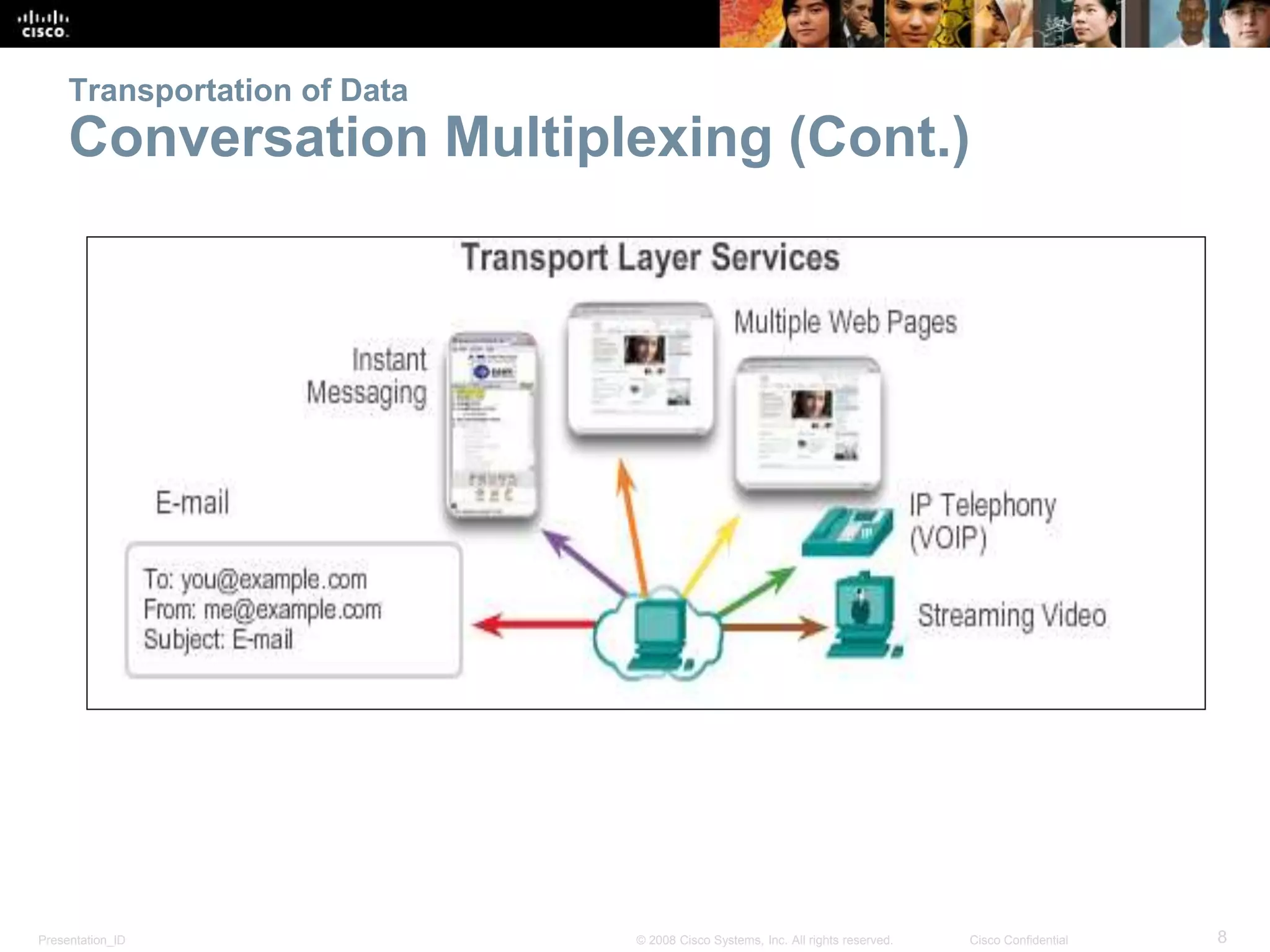
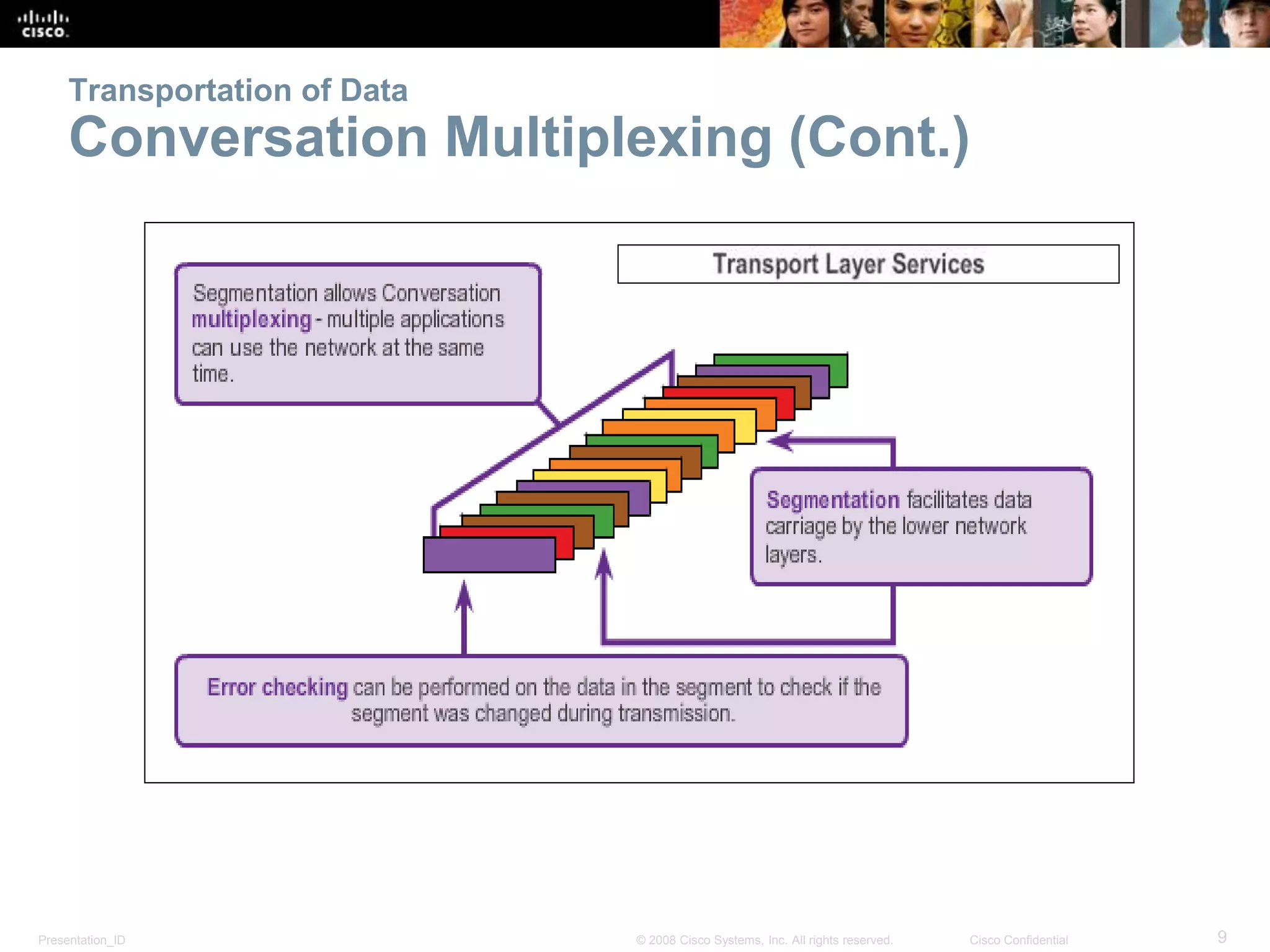
 Enables many different communications, from many different 
users, to be interleaved (multiplexed) on the same network, at the 
same time. 
 Provides the means to both send and receive data when running 
multiple applications. 
 Header added to each segment to identify it. 
Presentation_ID © 2008 Cisco Systems, Inc. All rights reserved. Cisco Confidential 7
Transportation of Data 
Conversation Multiplexing (Cont.) 
Presentation_ID © 2008 Cisco Systems, Inc. All rights reserved. Cisco Confidential 8
Transportation of Data 
Conversation Multiplexing (Cont.) 
Presentation_ID © 2008 Cisco Systems, Inc. All rights reserved. Cisco Confidential 9
Transportation of Data 
Transport Layer Reliability 
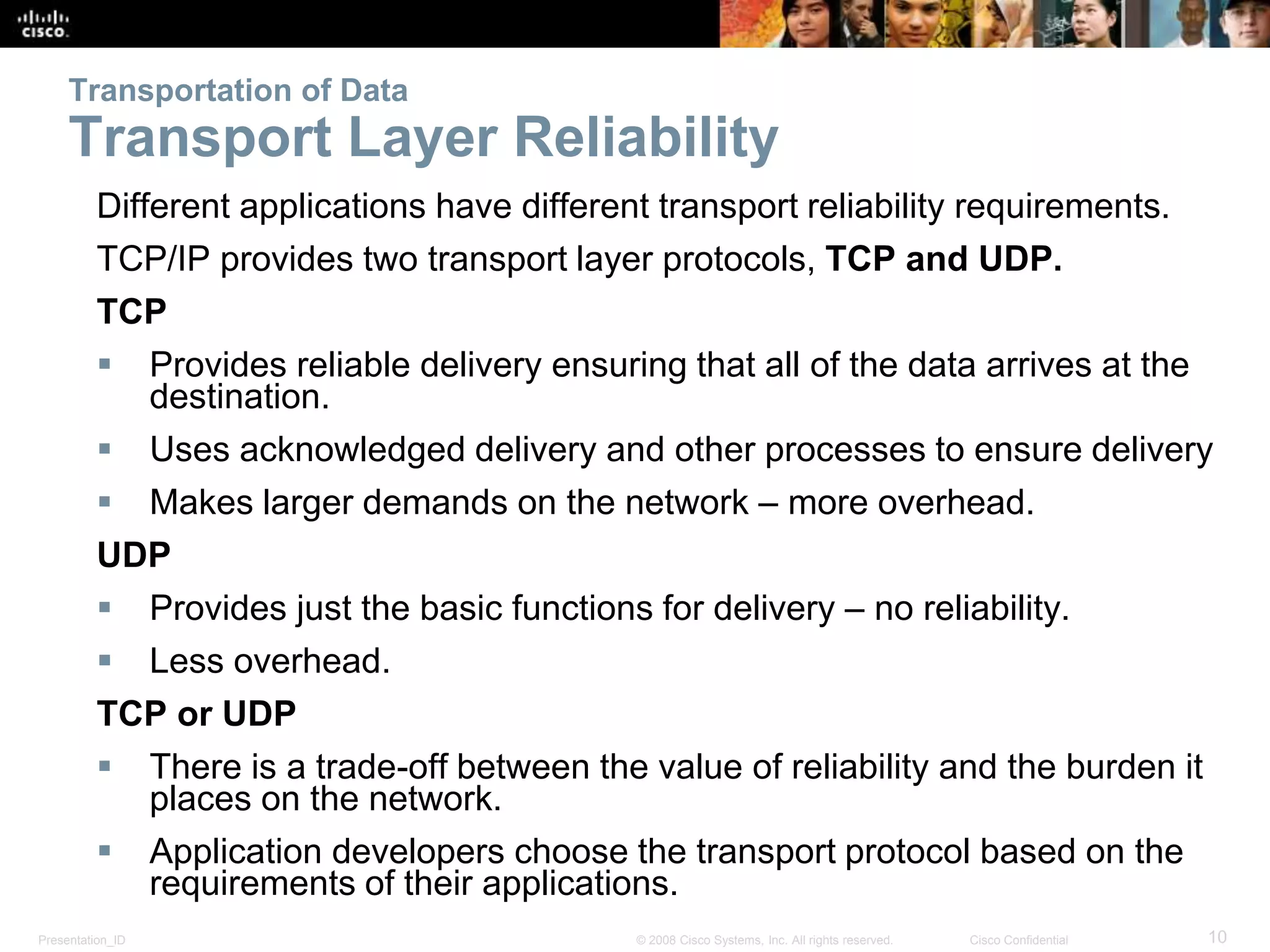
Different applications have different transport reliability requirements. 
TCP/IP provides two transport layer protocols, TCP and UDP. 
TCP 
 Provides reliable delivery ensuring that all of the data arrives at the 
destination. 
 Uses acknowledged delivery and other processes to ensure delivery 
 Makes larger demands on the network – more overhead. 
UDP 
 Provides just the basic functions for delivery – no reliability. 
 Less overhead. 
TCP or UDP 
 There is a trade-off between the value of reliability and the burden it 
places on the network. 
 Application developers choose the transport protocol based on the 
requirements of their applications. 
Presentation_ID © 2008 Cisco Systems, Inc. All rights reserved. Cisco Confidential 10
Introducing TCP and UDP 
Introducing TCP 
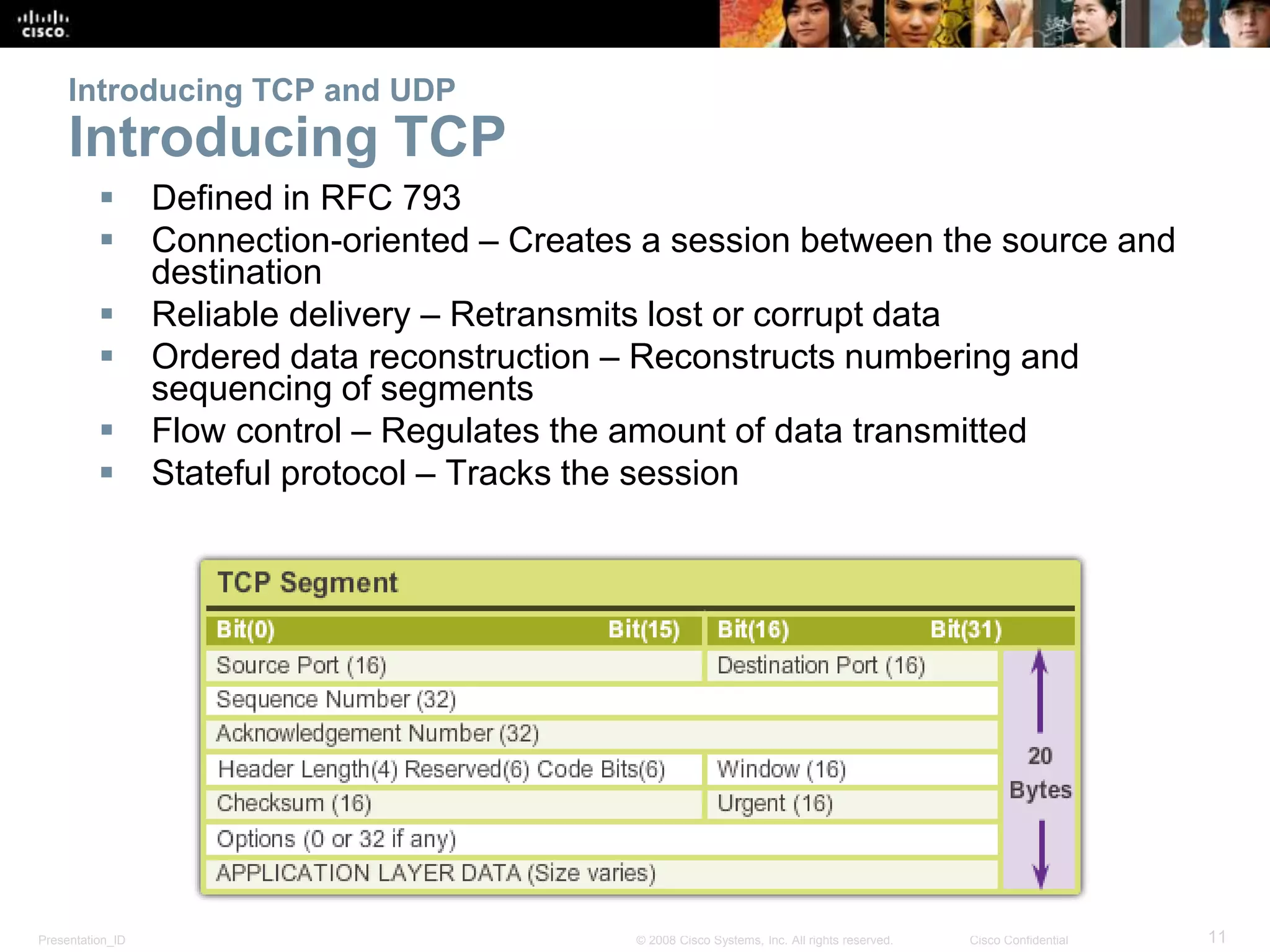
 Defined in RFC 793 
 Connection-oriented – Creates a session between the source and 
destination 
 Reliable delivery – Retransmits lost or corrupt data 
 Ordered data reconstruction – Reconstructs numbering and 
sequencing of segments 
 Flow control – Regulates the amount of data transmitted 
 Stateful protocol – Tracks the session 
Presentation_ID © 2008 Cisco Systems, Inc. All rights reserved. Cisco Confidential 11
Introducing TCP and UDP 
Introducing UDP 
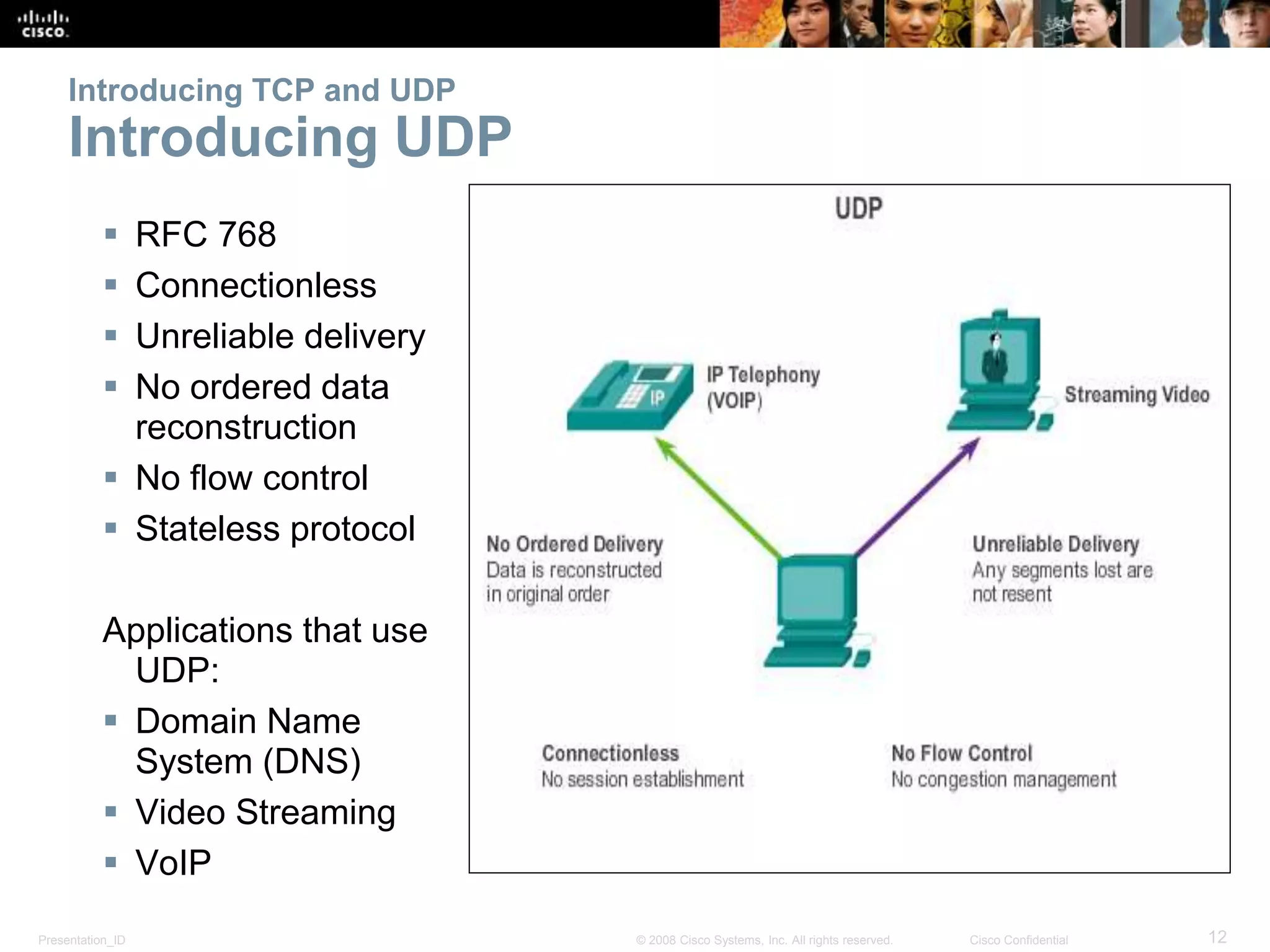
 RFC 768 
 Connectionless 
 Unreliable delivery 
 No ordered data 
reconstruction 
 No flow control 
 Stateless protocol 
Applications that use 
UDP: 
 Domain Name 
System (DNS) 
 Video Streaming 
 VoIP 
Presentation_ID © 2008 Cisco Systems, Inc. All rights reserved. Cisco Confidential 12
Introducing TCP and UDP 
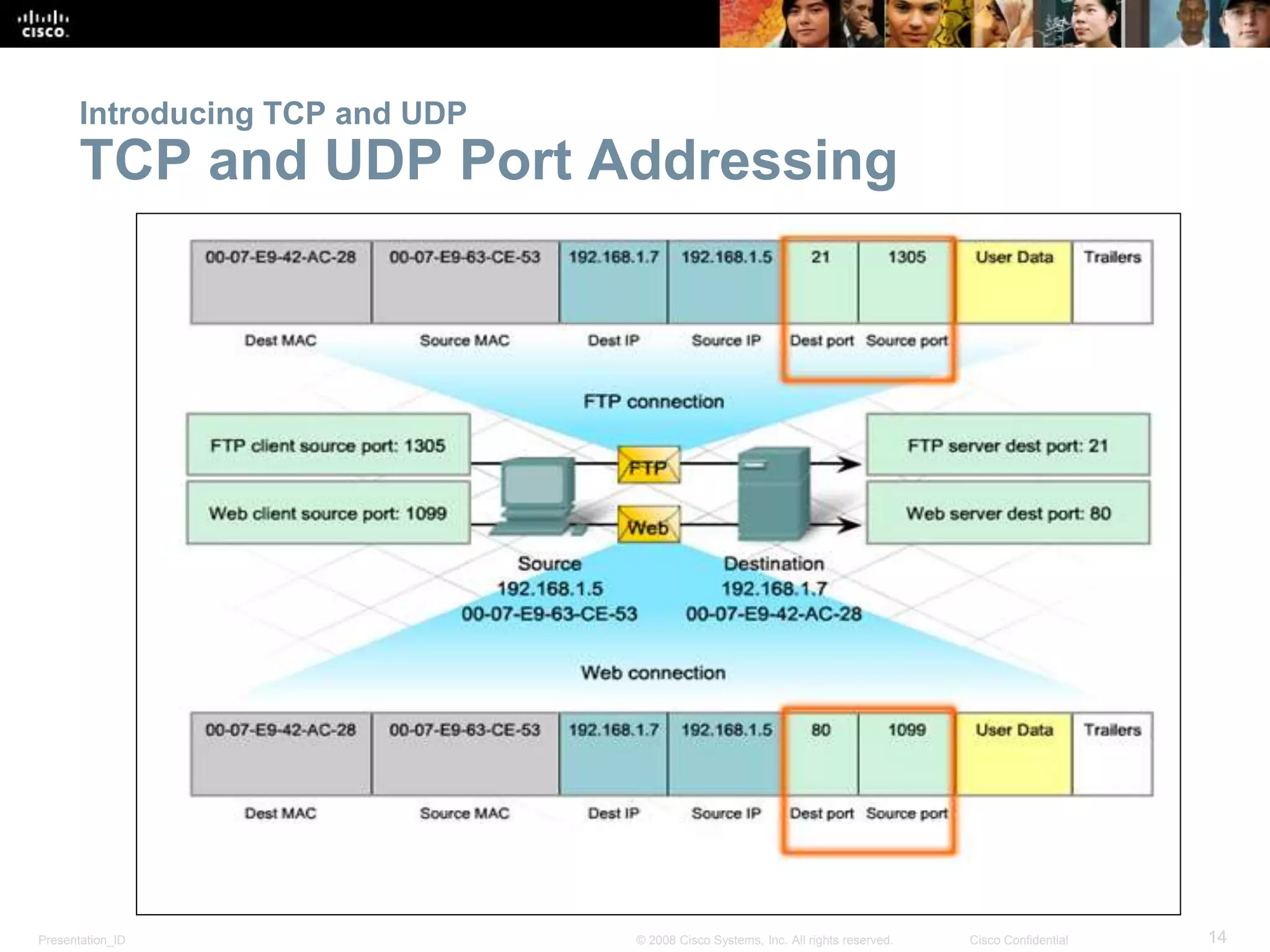
Separating Multiple Communications 
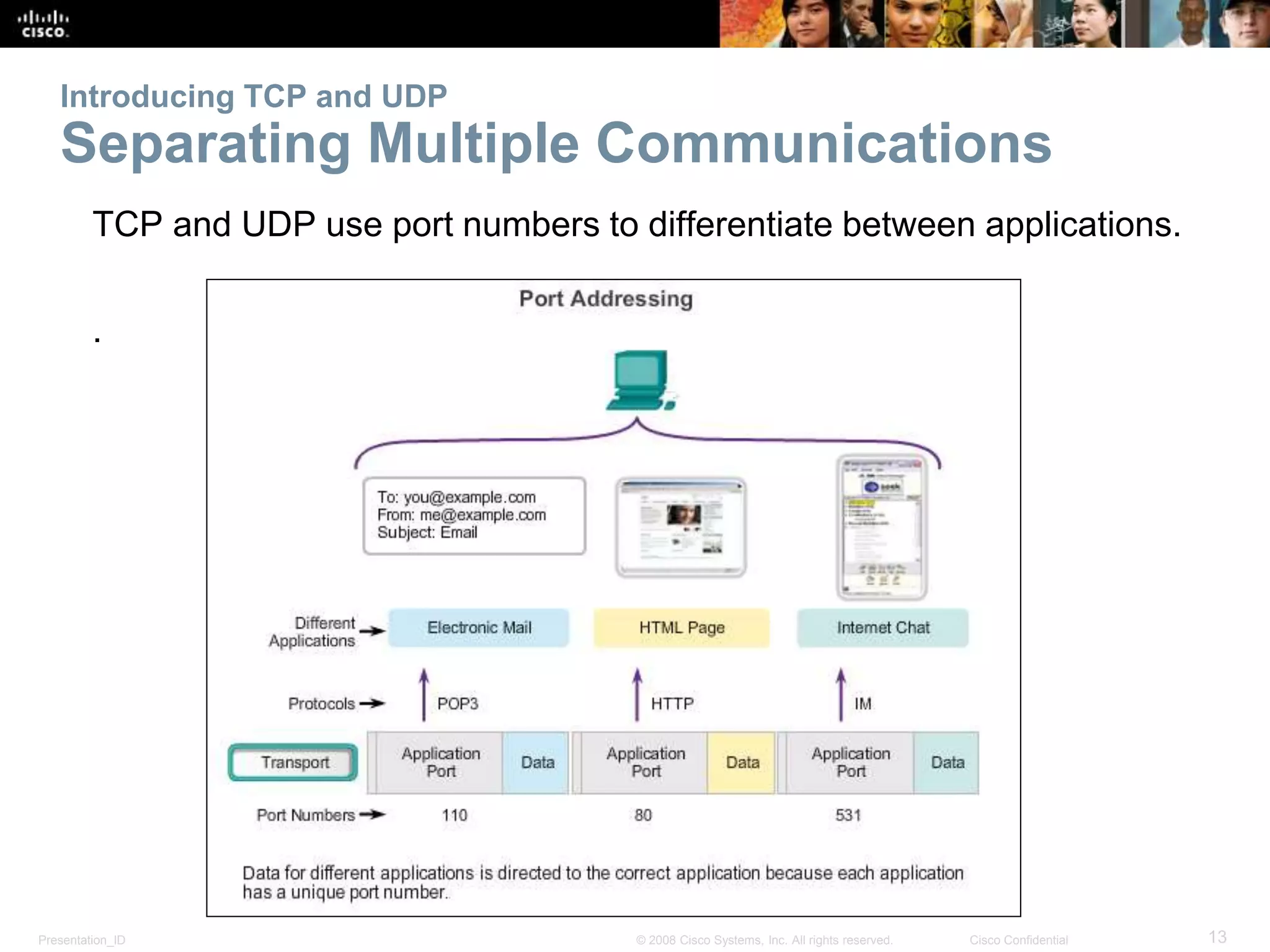
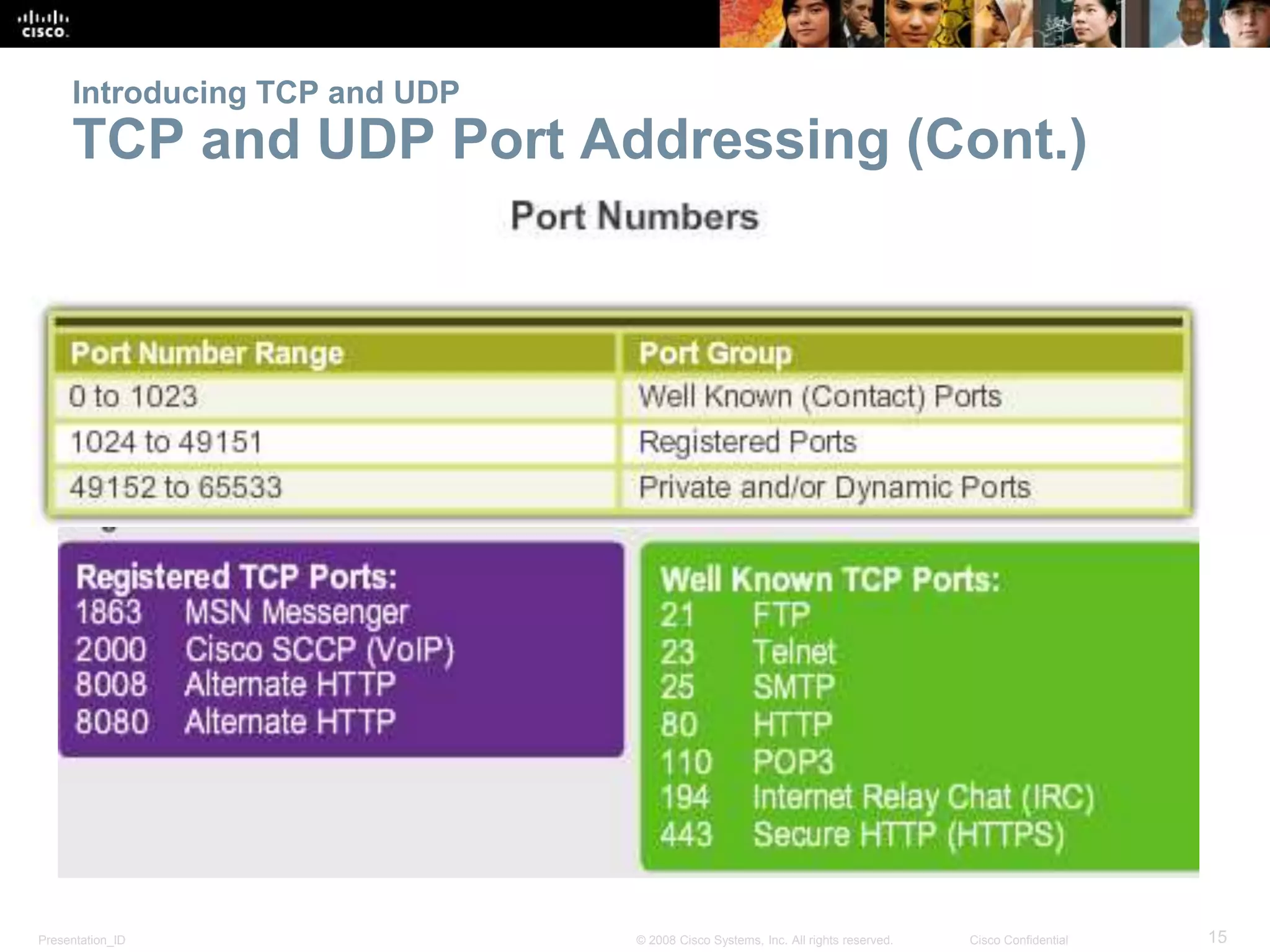
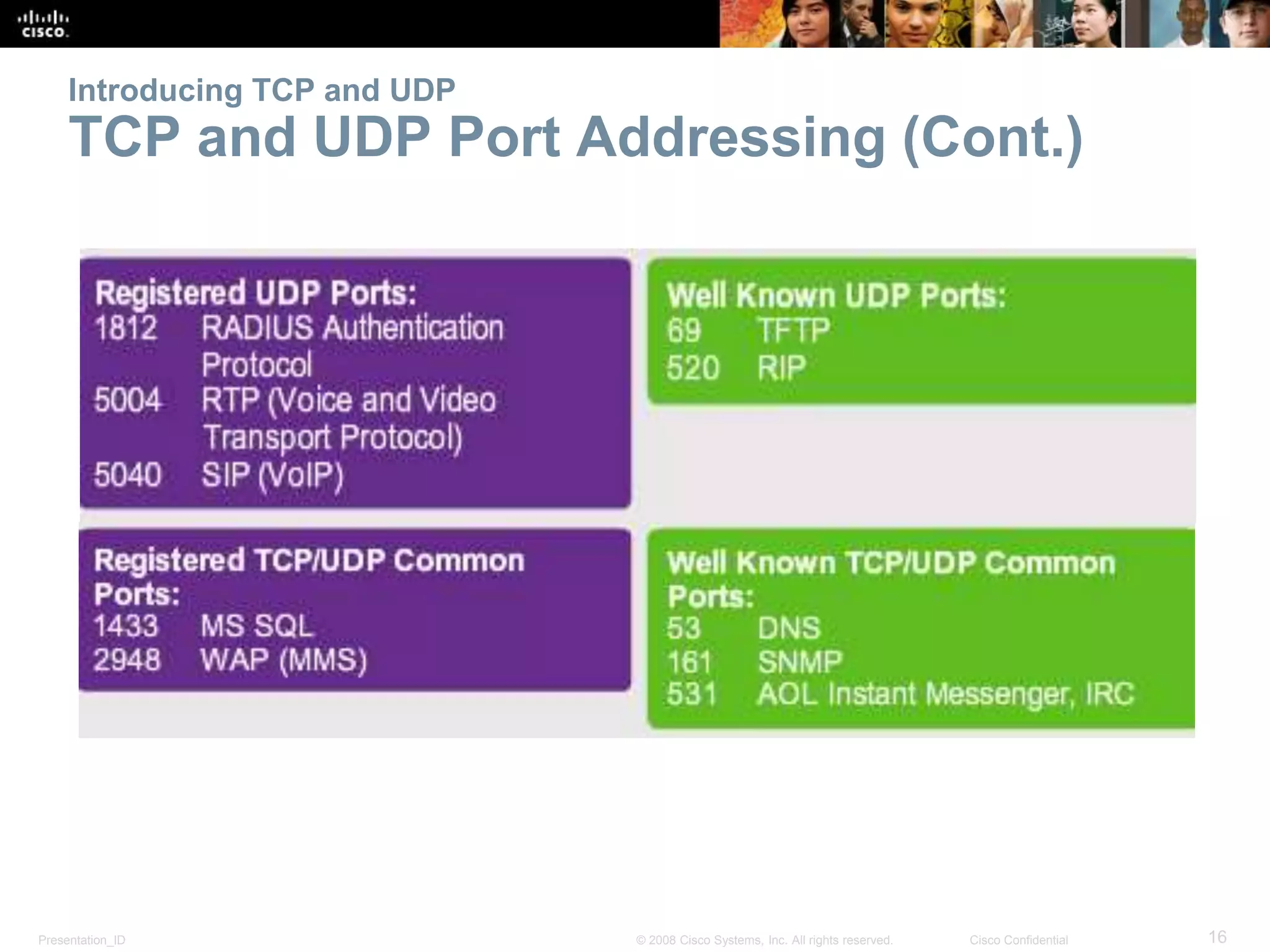
TCP and UDP use port numbers to differentiate between applications. 
. 
Presentation_ID © 2008 Cisco Systems, Inc. All rights reserved. Cisco Confidential 13
Introducing TCP and UDP 
TCP and UDP Port Addressing 
Presentation_ID © 2008 Cisco Systems, Inc. All rights reserved. Cisco Confidential 14
Introducing TCP and UDP 
TCP and UDP Port Addressing (Cont.) 
Presentation_ID © 2008 Cisco Systems, Inc. All rights reserved. Cisco Confidential 15
Introducing TCP and UDP 
TCP and UDP Port Addressing (Cont.) 
Presentation_ID © 2008 Cisco Systems, Inc. All rights reserved. Cisco Confidential 16
Introducing TCP and UDP 
TCP and UDP Port Addressing (Cont.) 
Netstat is used to examine TCP connections that are 
open and running on a networked host. 
Presentation_ID © 2008 Cisco Systems, Inc. All rights reserved. Cisco Confidential 17
Introducing TCP and UDP 
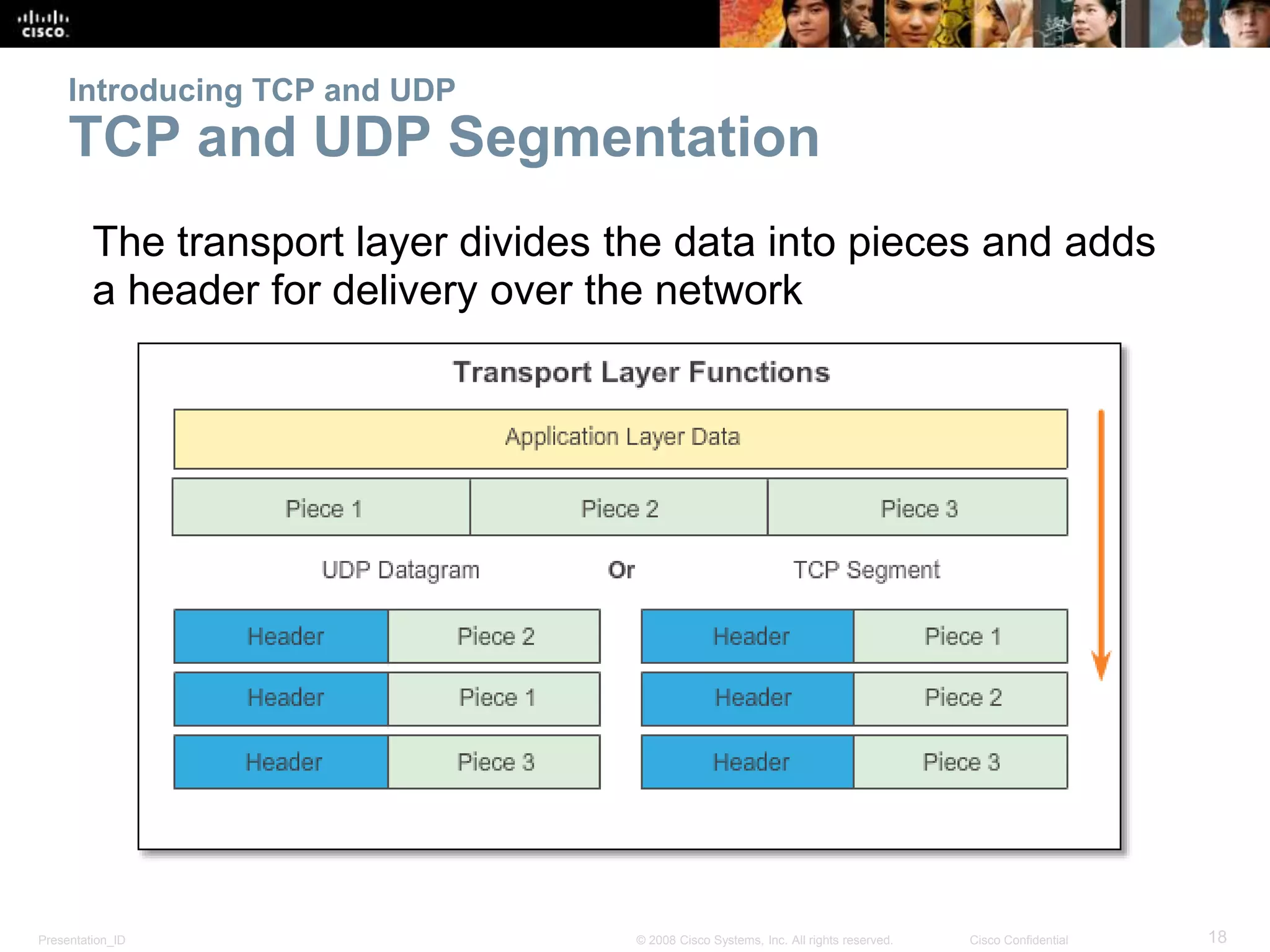
TCP and UDP Segmentation 
The transport layer divides the data into pieces and adds 
a header for delivery over the network 
Presentation_ID © 2008 Cisco Systems, Inc. All rights reserved. Cisco Confidential 18
7.2 TCP and UDP 
© 2008 Cisco Systems, Inc. All Presentation_ID rights reserved. Cisco Confidential 19
TCP Communication 
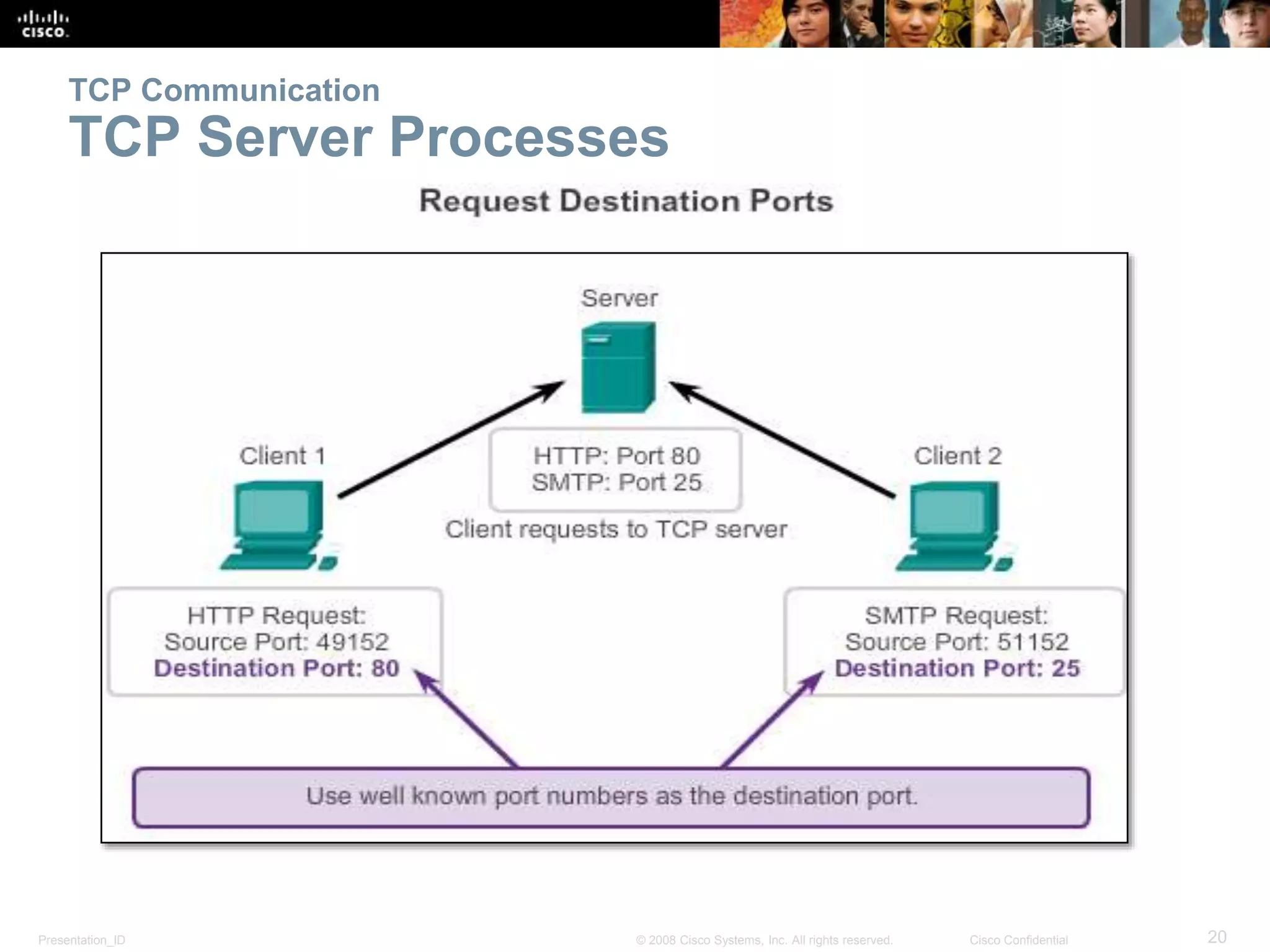
TCP Server Processes 
Presentation_ID © 2008 Cisco Systems, Inc. All rights reserved. Cisco Confidential 20
TCP Communication 
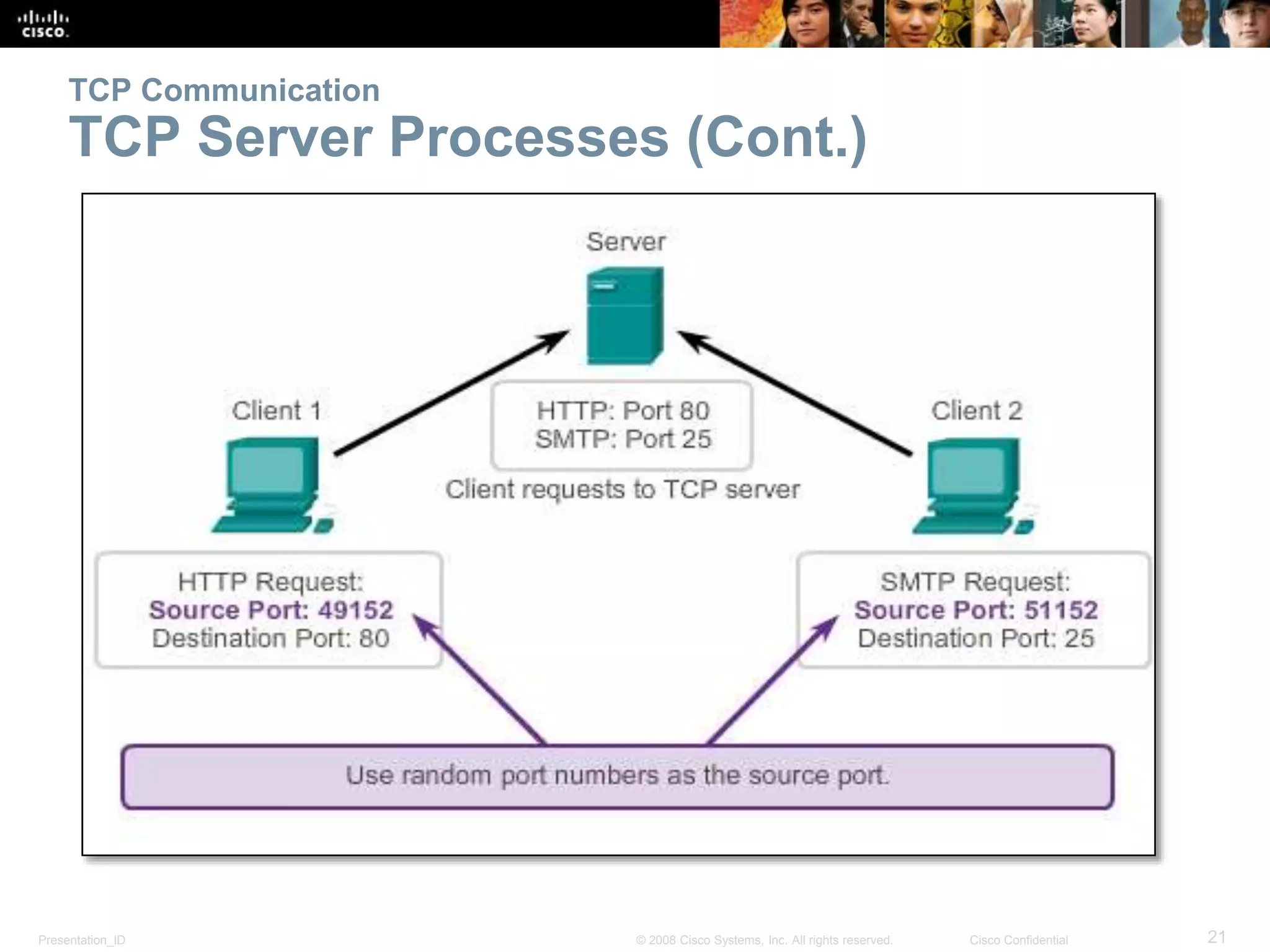
TCP Server Processes (Cont.) 
Presentation_ID © 2008 Cisco Systems, Inc. All rights reserved. Cisco Confidential 21
TCP Communication 
TCP Connection, Establishment and Termination 
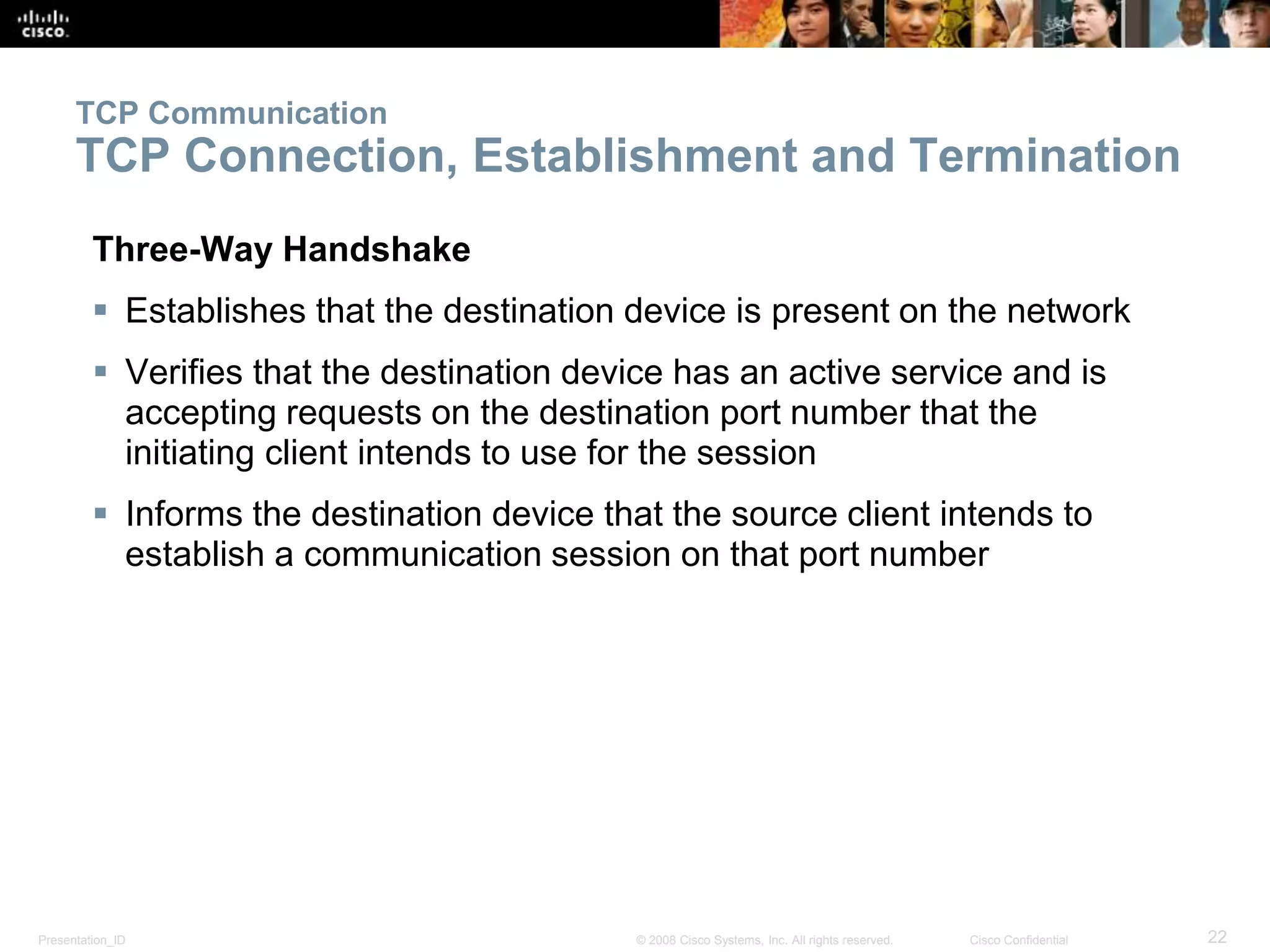
Three-Way Handshake 
 Establishes that the destination device is present on the network 
 Verifies that the destination device has an active service and is 
accepting requests on the destination port number that the 
initiating client intends to use for the session 
 Informs the destination device that the source client intends to 
establish a communication session on that port number 
Presentation_ID © 2008 Cisco Systems, Inc. All rights reserved. Cisco Confidential 22
TCP Communication 
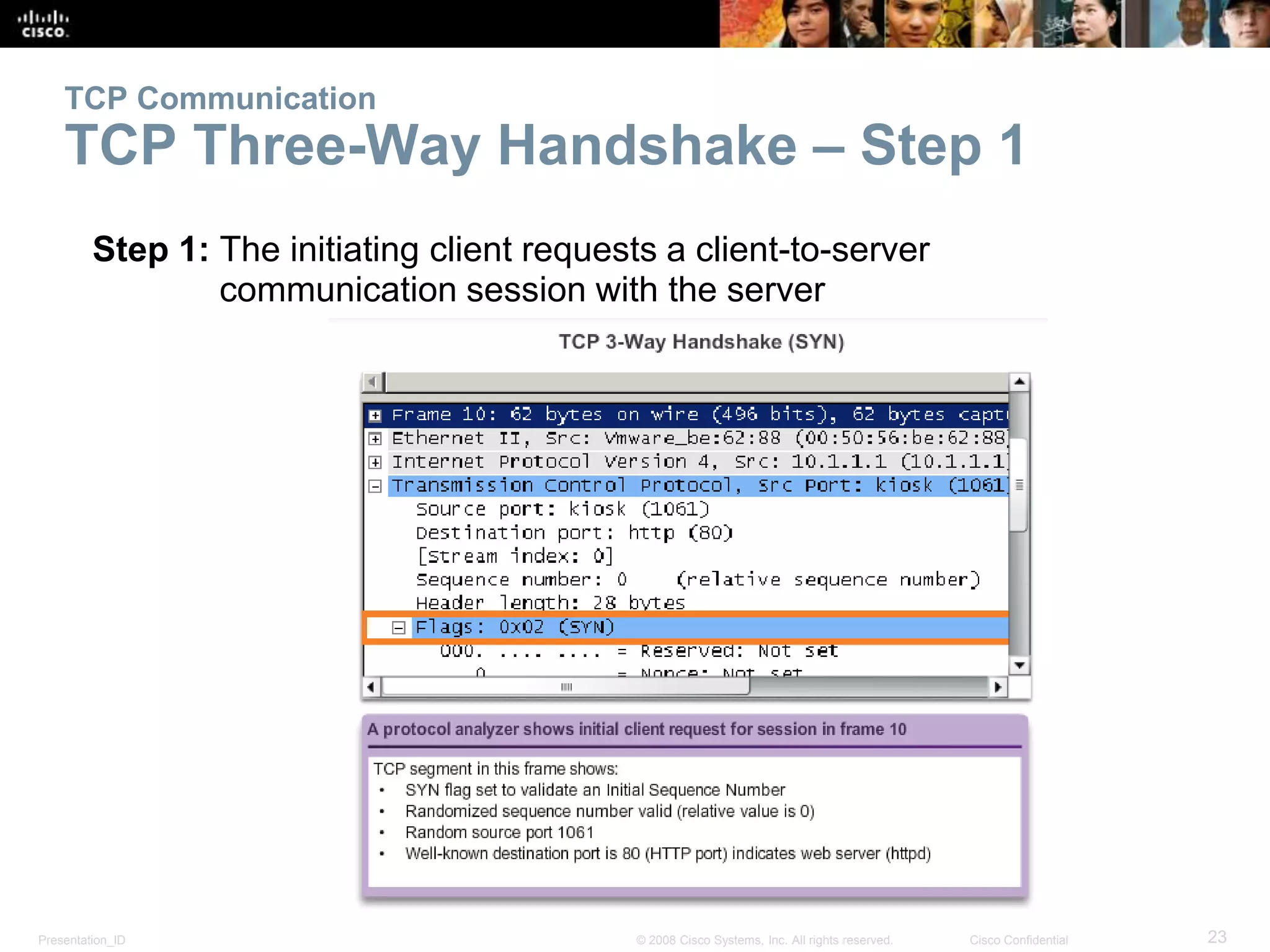
TCP Three-Way Handshake – Step 1 
Step 1: The initiating client requests a client-to-server 
communication session with the server 
Presentation_ID © 2008 Cisco Systems, Inc. All rights reserved. Cisco Confidential 23
TCP Communication 
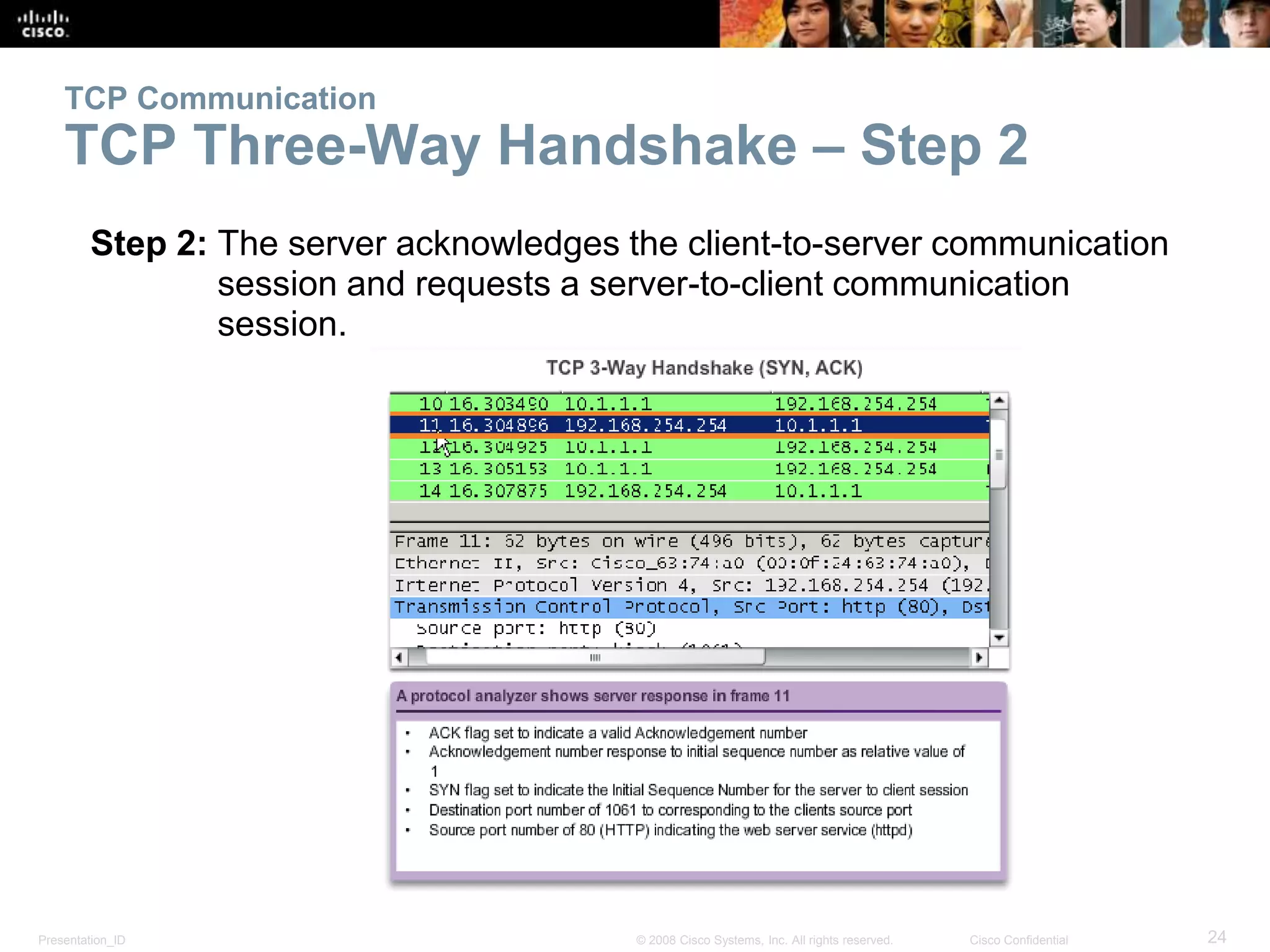
TCP Three-Way Handshake – Step 2 
Step 2: The server acknowledges the client-to-server communication 
session and requests a server-to-client communication 
session. 
Presentation_ID © 2008 Cisco Systems, Inc. All rights reserved. Cisco Confidential 24
TCP Communication 
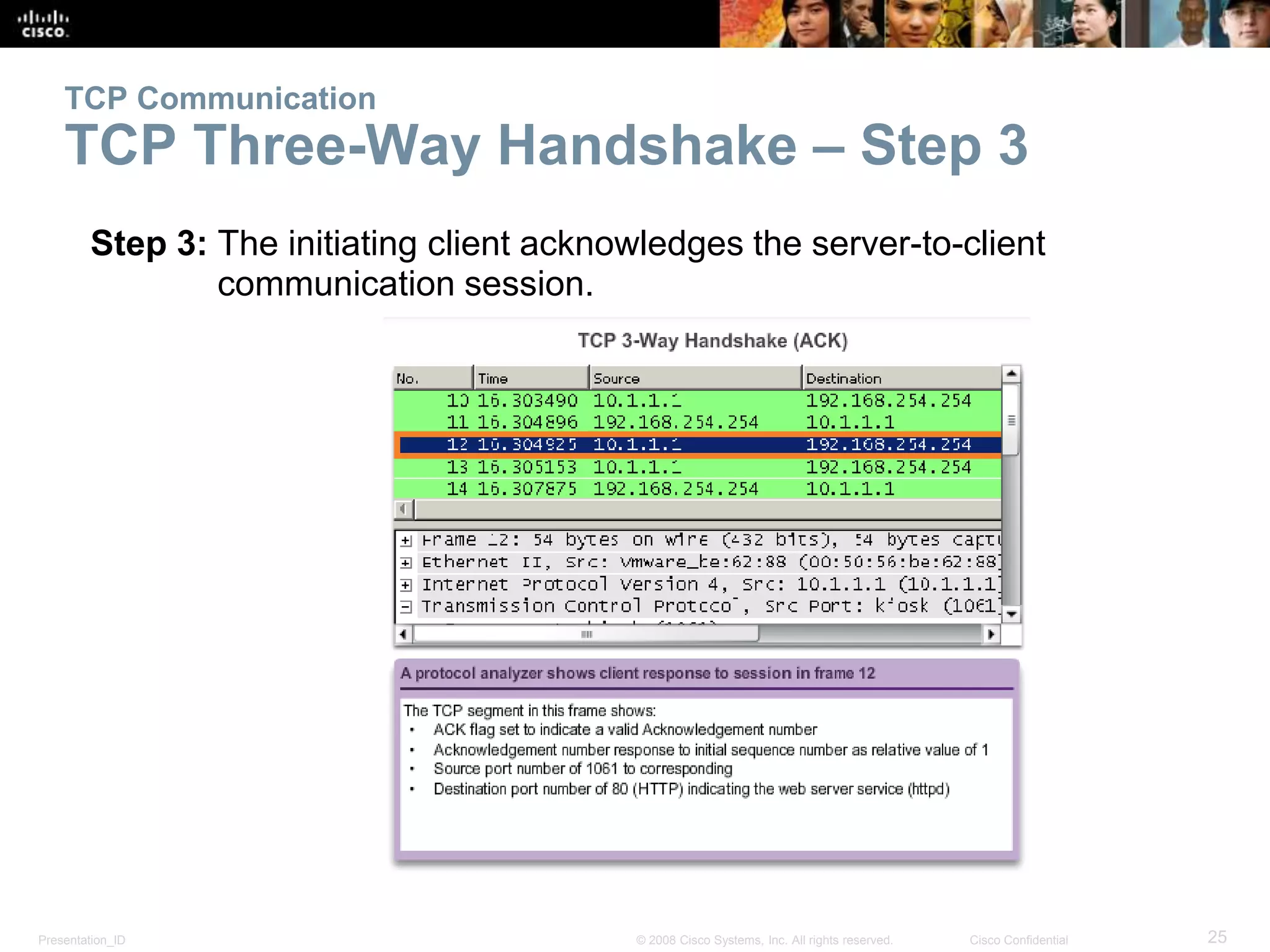
TCP Three-Way Handshake – Step 3 
Step 3: The initiating client acknowledges the server-to-client 
communication session. 
Presentation_ID © 2008 Cisco Systems, Inc. All rights reserved. Cisco Confidential 25
TCP Communication 
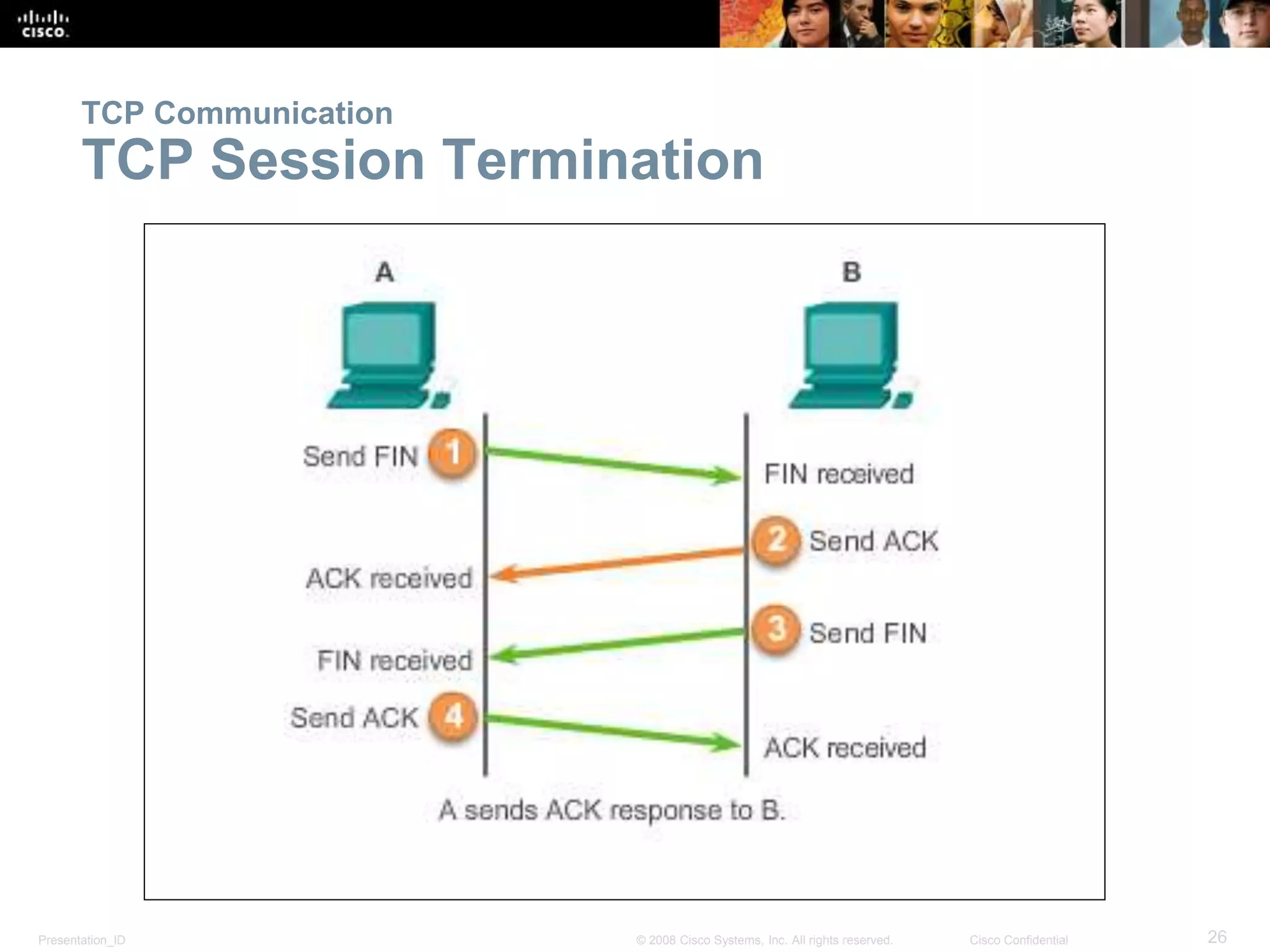
TCP Session Termination 
Presentation_ID © 2008 Cisco Systems, Inc. All rights reserved. Cisco Confidential 26
Reliability and Flow Control 
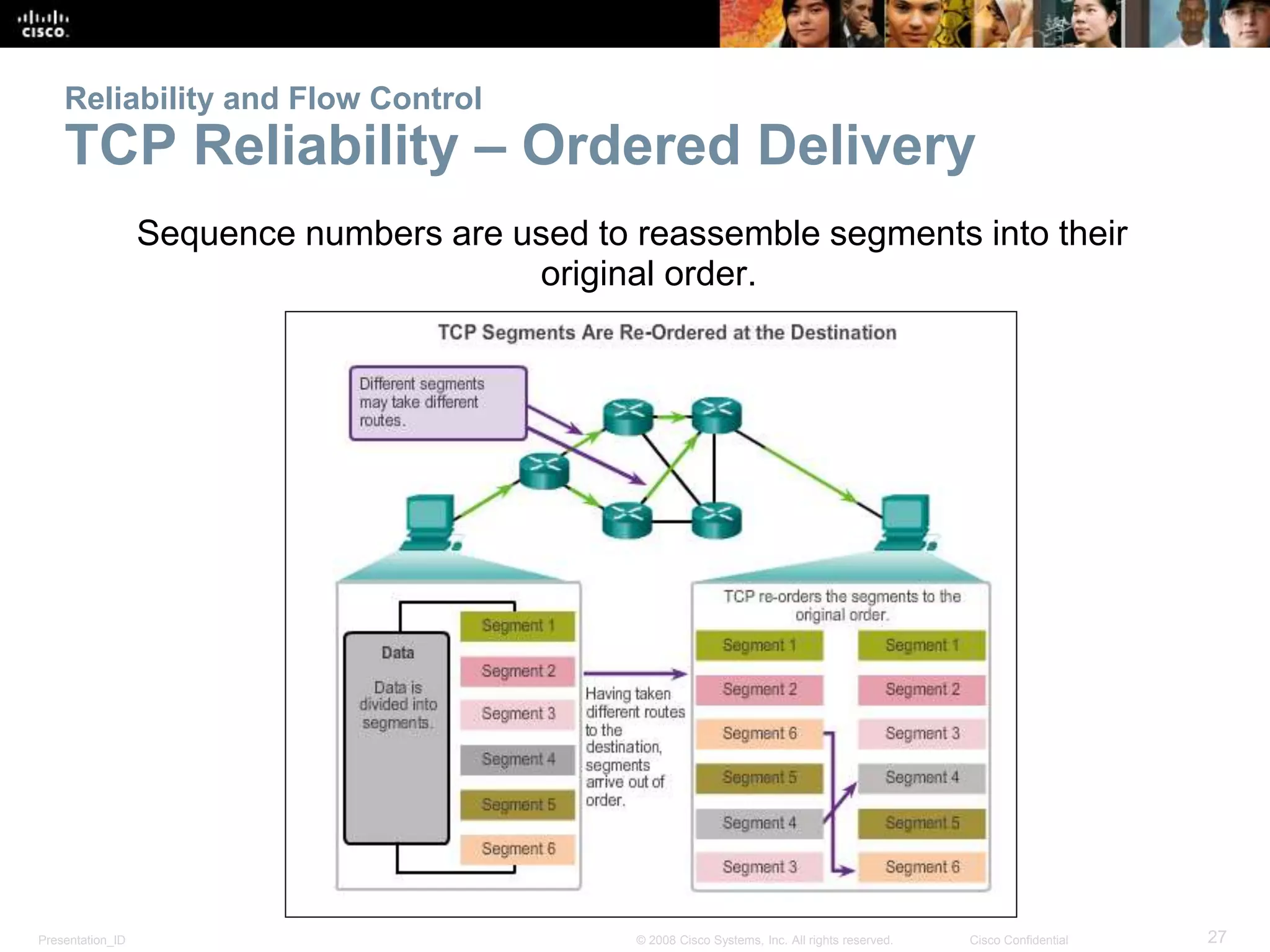
TCP Reliability – Ordered Delivery 
Sequence numbers are used to reassemble segments into their 
original order. 
Presentation_ID © 2008 Cisco Systems, Inc. All rights reserved. Cisco Confidential 27
Reliability and Flow Control 
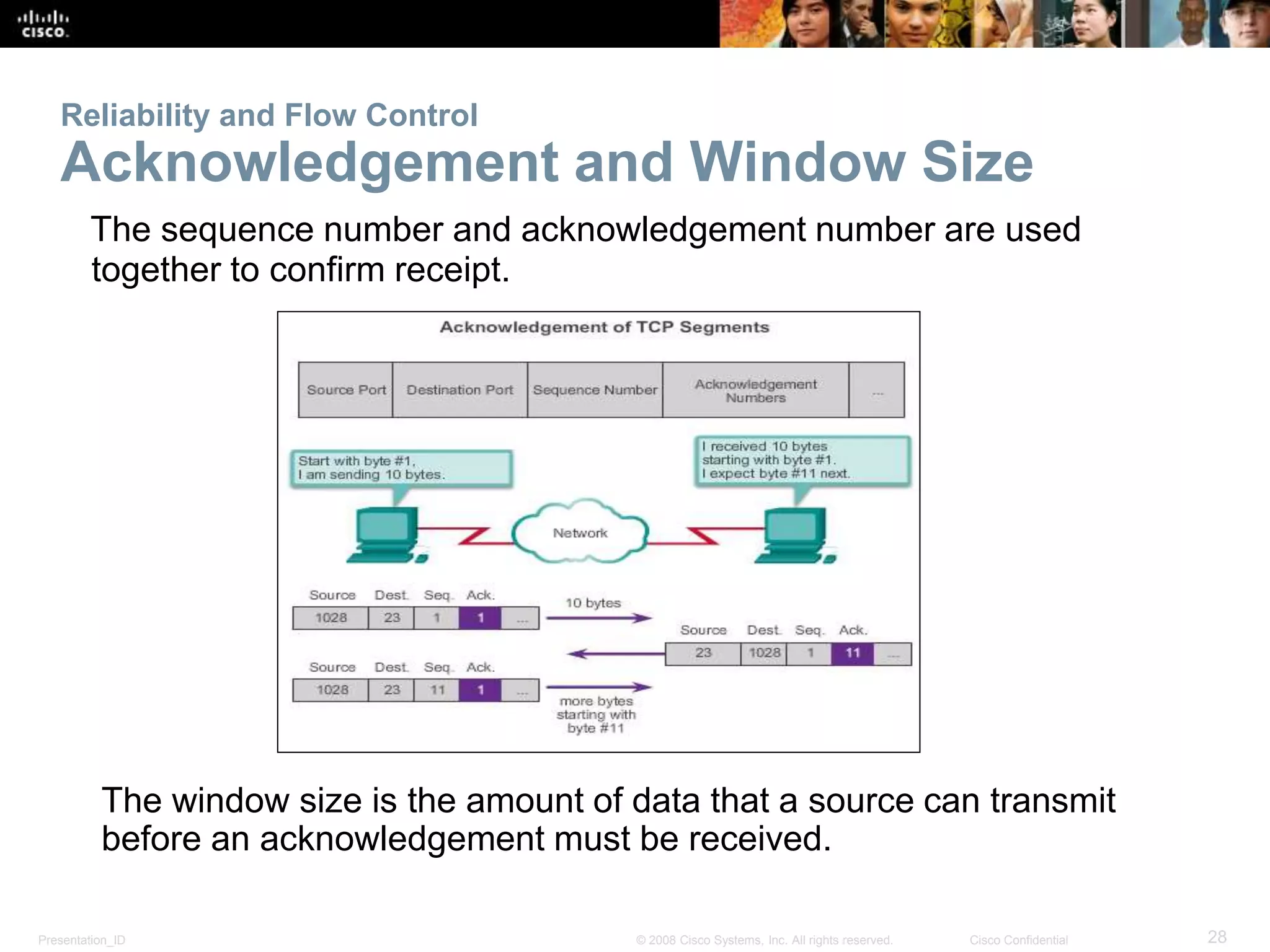
Acknowledgement and Window Size 
The sequence number and acknowledgement number are used 
together to confirm receipt. 
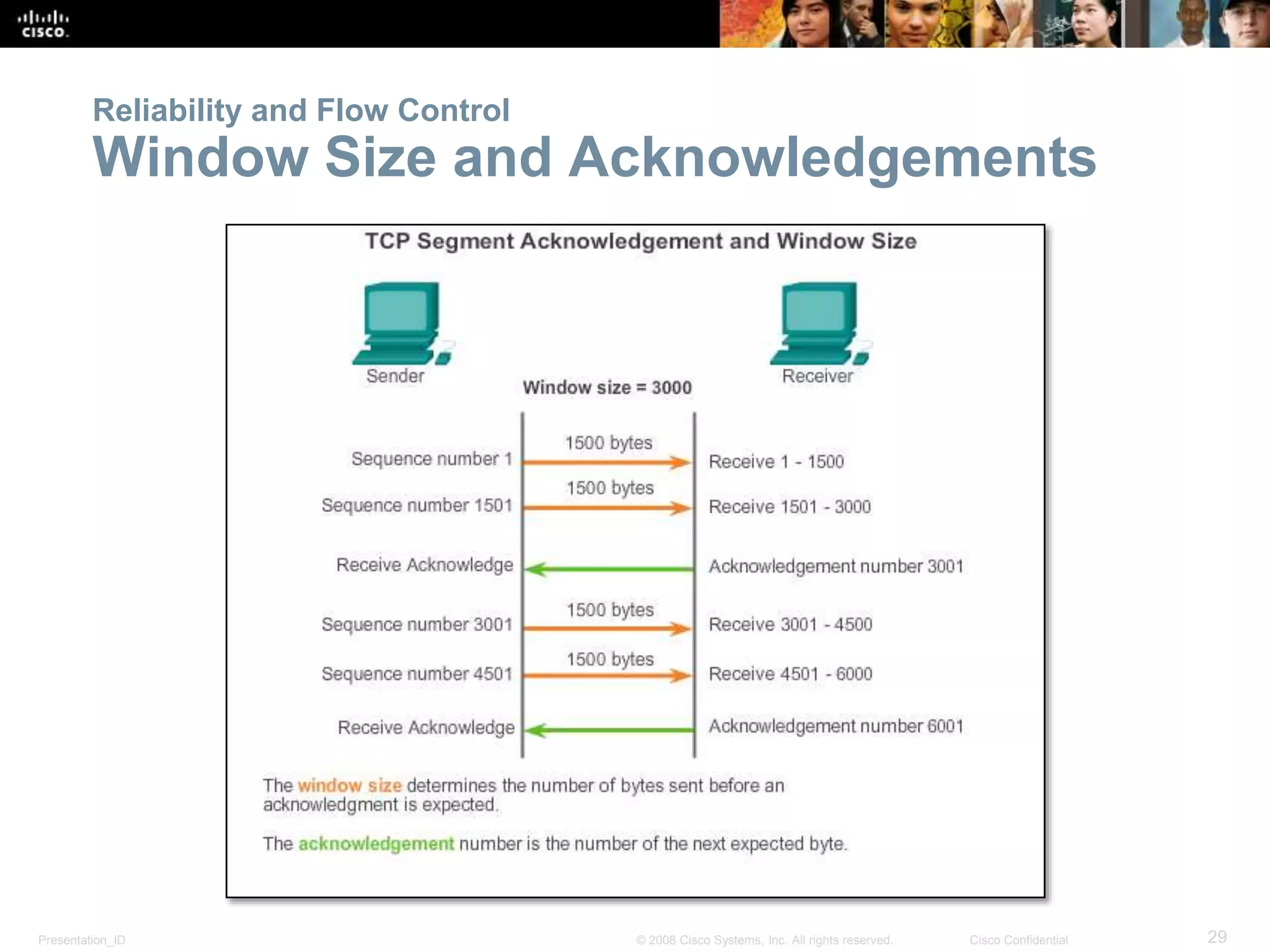
The window size is the amount of data that a source can transmit 
before an acknowledgement must be received. 
Presentation_ID © 2008 Cisco Systems, Inc. All rights reserved. Cisco Confidential 28
Reliability and Flow Control 
Window Size and Acknowledgements 
Presentation_ID © 2008 Cisco Systems, Inc. All rights reserved. Cisco Confidential 29
Reliability and Flow Control 
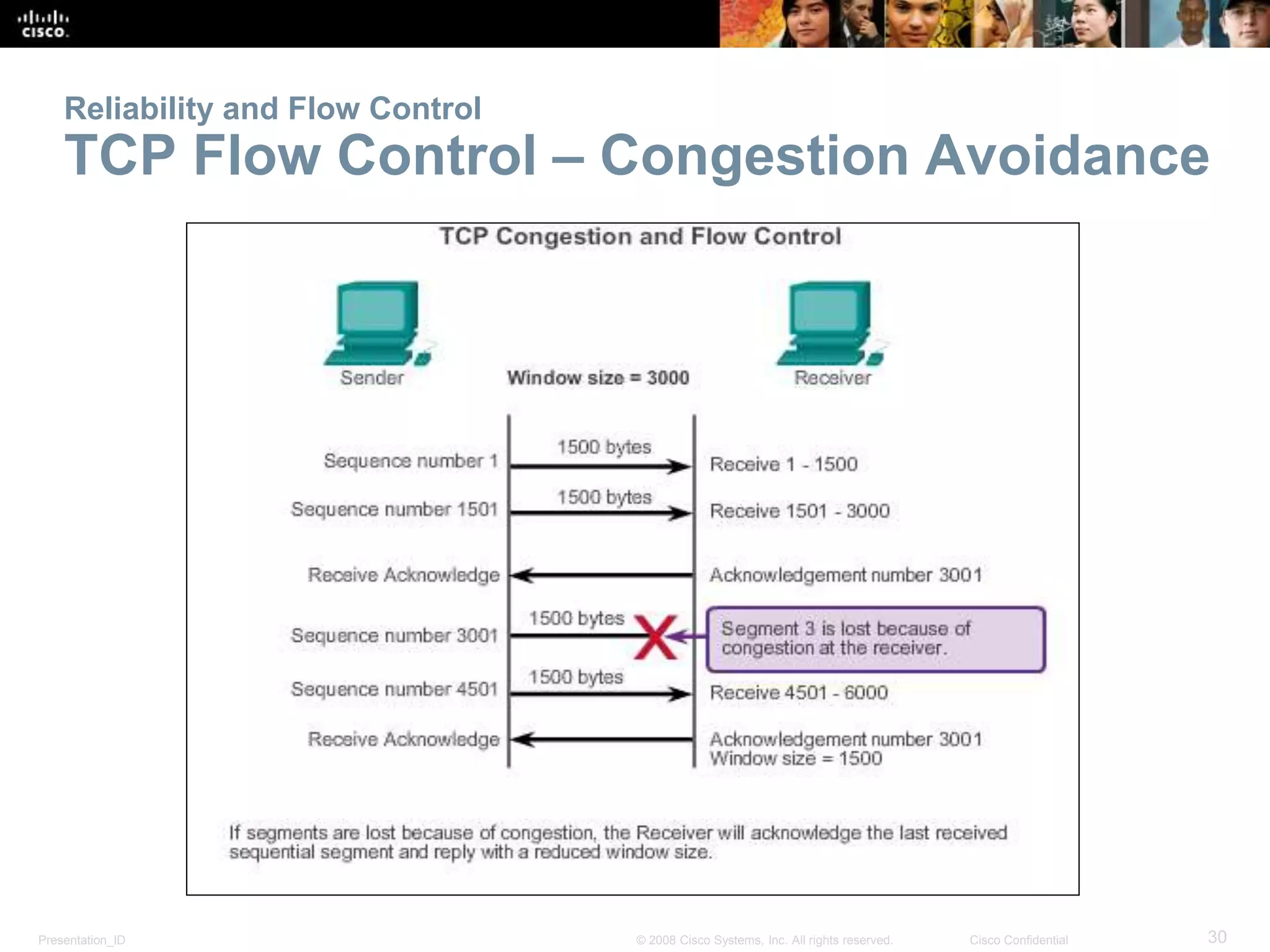
TCP Flow Control – Congestion Avoidance 
Presentation_ID © 2008 Cisco Systems, Inc. All rights reserved. Cisco Confidential 30
Reliability and Flow Control 
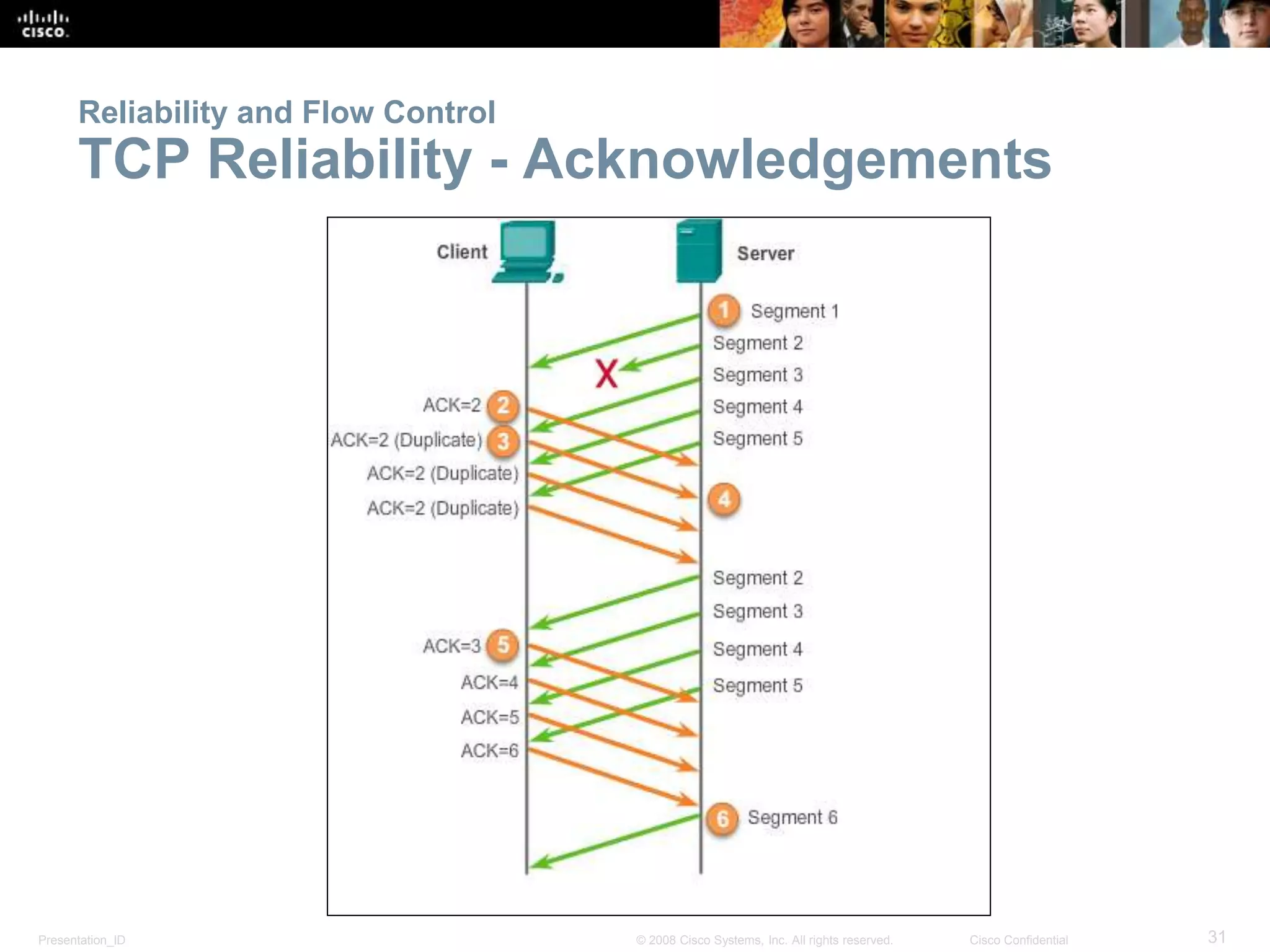
TCP Reliability - Acknowledgements 
Presentation_ID © 2008 Cisco Systems, Inc. All rights reserved. Cisco Confidential 31
UDP Communication 
UDP Low Overhead vs. Reliability 
UDP 
 Simple protocol that provides the basic transport layer function 
 Used by applications that can tolerate small loss of data 
 Used by applications that cannot tolerate delay 
Used by 
 DNS 
 Simple Network Management Protocol (SNMP) 
 Dynamic Host Configuration Protocol (DHCP) 
 Trivial File Transfer Protocol (TFTP) 
 IP telephony or VoIP 
 Online games 
Presentation_ID © 2008 Cisco Systems, Inc. All rights reserved. Cisco Confidential 32
UDP Communication 
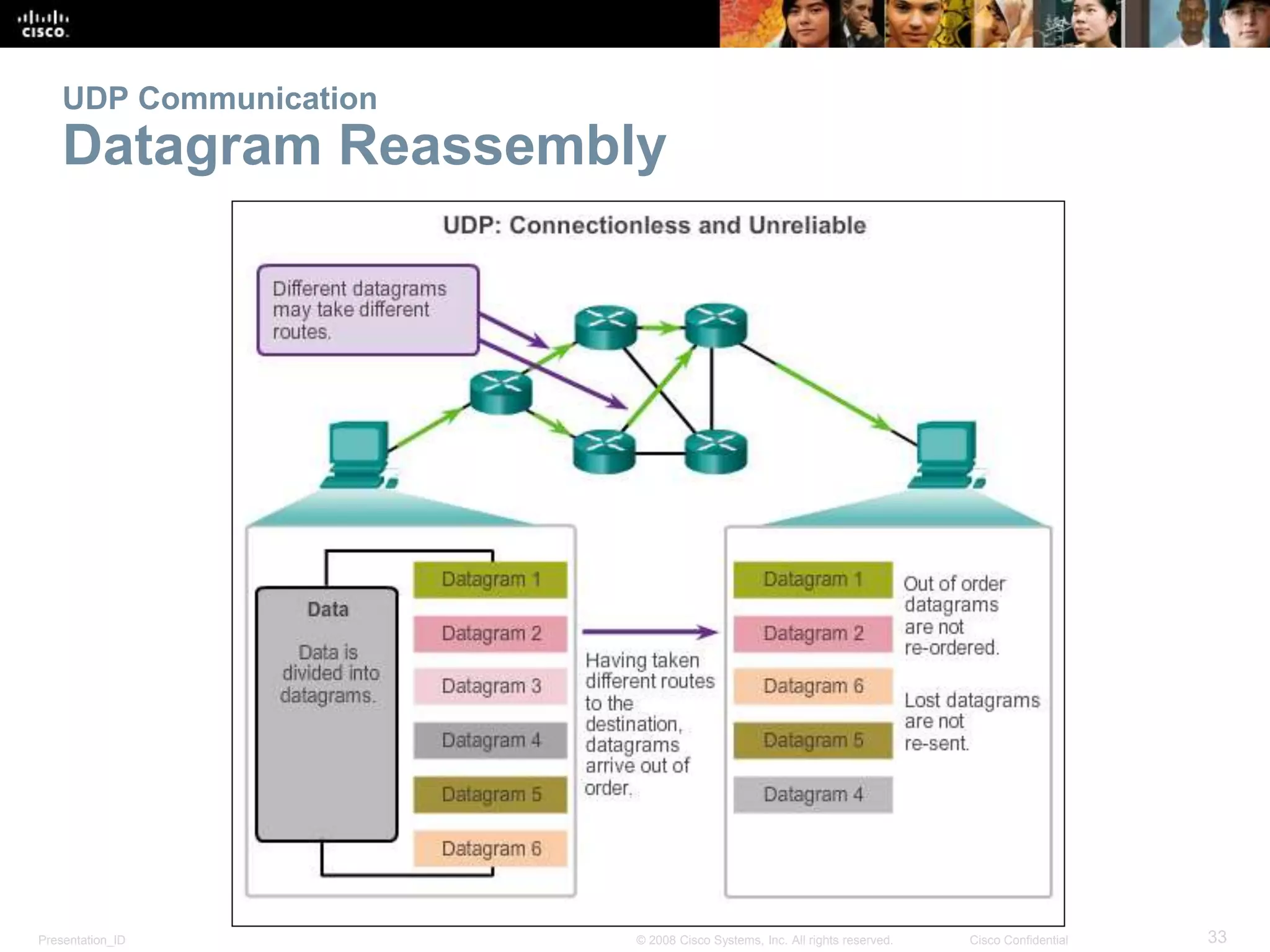
Datagram Reassembly 
Presentation_ID © 2008 Cisco Systems, Inc. All rights reserved. Cisco Confidential 33
UDP Communication 
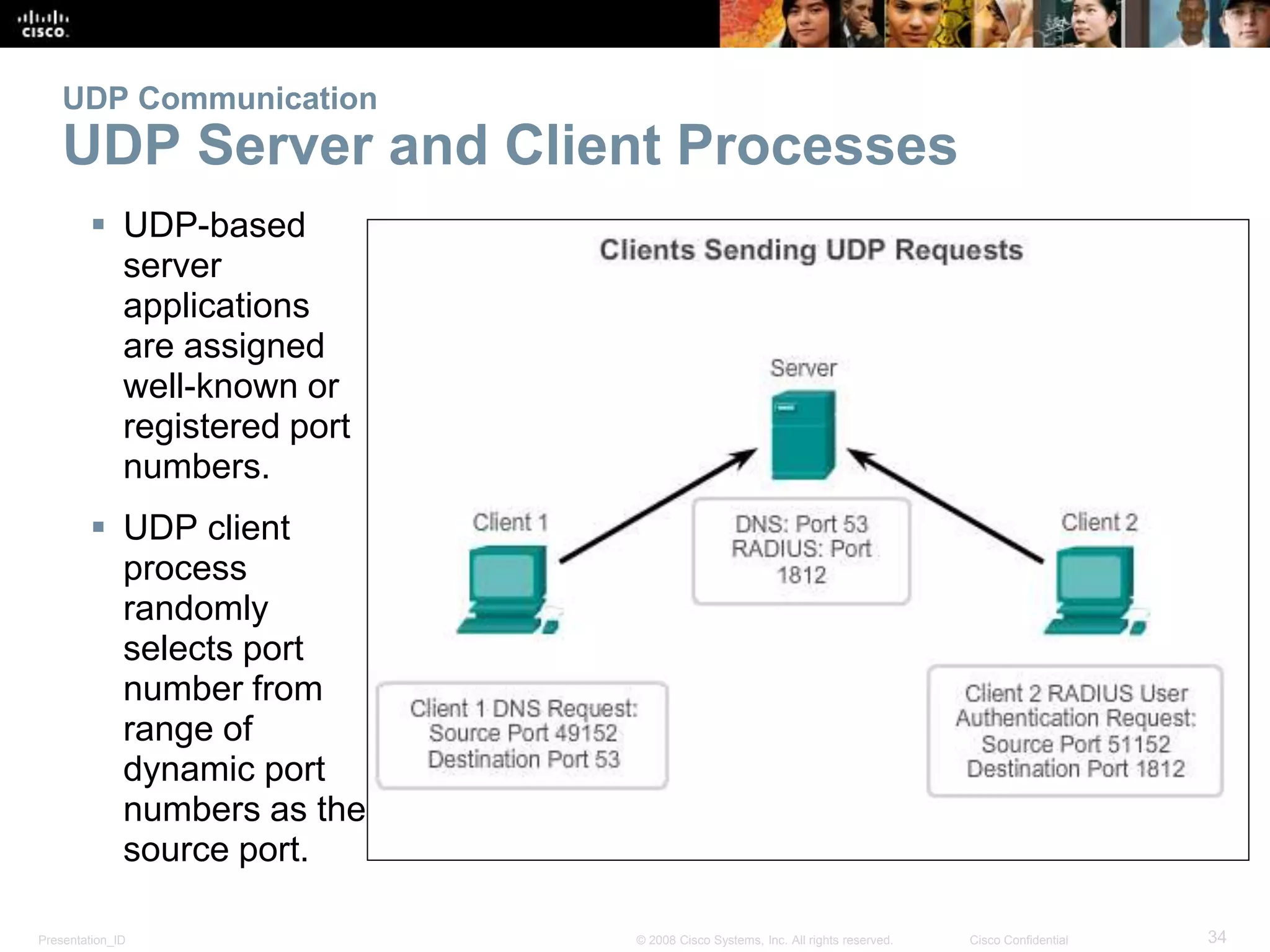
UDP Server and Client Processes 
 UDP-based 
server 
applications 

are assigned 
well-known or 
registered port 
numbers. 
 UDP client 
process 
randomly 
selects port 
number from 
range of 
dynamic port 
numbers as the 
source port. 
Presentation_ID © 2008 Cisco Systems, Inc. All rights reserved. Cisco Confidential 34
TCP or UDP 
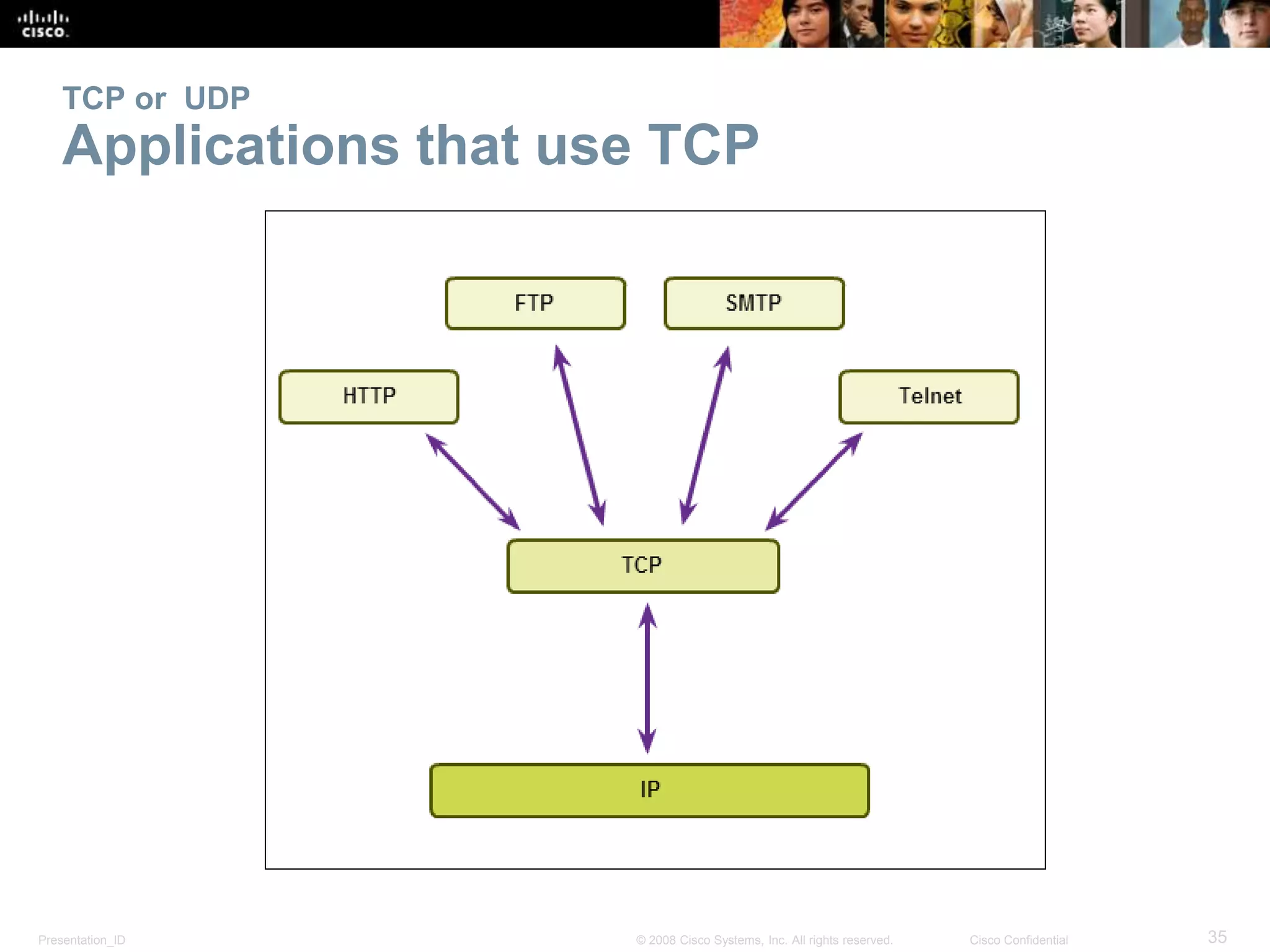
Applications that use TCP 
Presentation_ID © 2008 Cisco Systems, Inc. All rights reserved. Cisco Confidential 35
TCP or UDP 
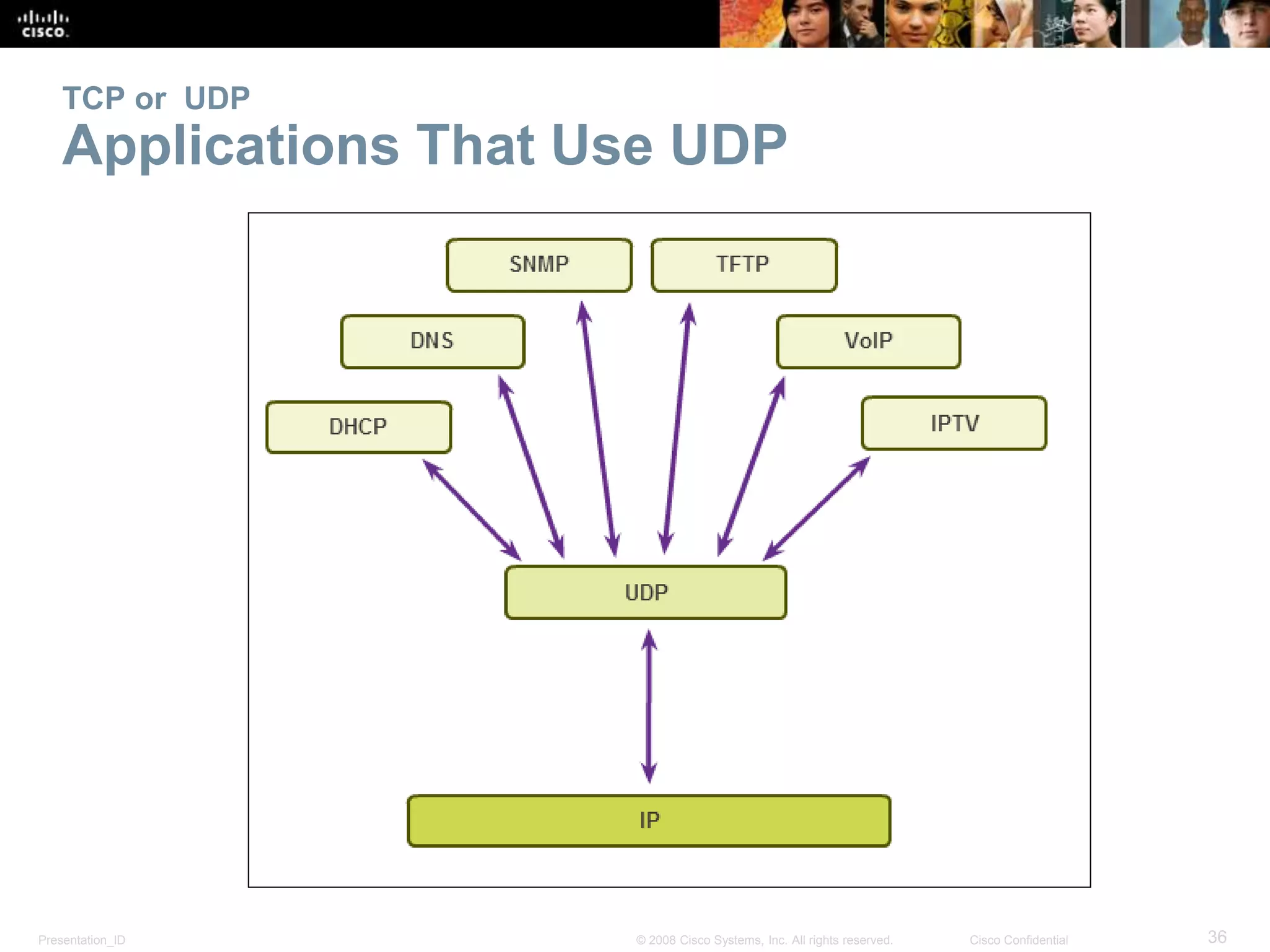
Applications That Use UDP 
Presentation_ID © 2008 Cisco Systems, Inc. All rights reserved. Cisco Confidential 36
7.3 Summary 
© 2008 Cisco Systems, Inc. All Presentation_ID rights reserved. Cisco Confidential 37
Chapter 7: Summary 
In this chapter, you learned: 
 The role of the transport layer is to provide three main services: 
multiplexing, segmentation and reassembly, and error checking. It 
does this by: 
• Dividing data received from an application into segments. 
•Adding a header to identify and manage each segment. 
•Using the header information to reassemble the segments back 
into application data. 
•Passing the assembled data to the correct application. 
 How TCP and UDP operate and which popular applications use 
each protocol. 
 Transport Layer functions are necessary to address issues in QoS 
and security in networks. 
 Ports provide a “tunnel” for data to get from the transport layer to 
the appropriate application at the destination. 
Presentation_ID © 2008 Cisco Systems, Inc. All rights reserved. Cisco Confidential 38
Presentation_ID © 2008 Cisco Systems, Inc. All rights reserved. Cisco Confidential 39

CCNA 1 Routing and Switching v5.0 Chapter 7

  • 1.
    Chapter 7: TransportLayer Introduction to Networking © 2008 Cisco Systems, Inc. All Presentation_ID rights reserved. Cisco Confidential 1
  • 2.
    Chapter 7 7.0Introduction 7.1 Transport Layer Protocols 7.2 TCP and UDP 7.3 Summary Presentation_ID © 2008 Cisco Systems, Inc. All rights reserved. Cisco Confidential 2
  • 3.
    Chapter 7: Objectives  Describe the purpose of the transport layer in managing the transportation of data in end-to-end communication.  Describe characteristics of the TCP and UDP protocols, including port numbers and their uses.  Explain how TCP session establishment and termination processes facilitate reliable communication.  Explain how TCP protocol data units are transmitted and acknowledged to guarantee delivery.  Explain the UDP client processes to establish communication with a server.  Determine whether high-reliability TCP transmissions, or non-guaranteed UDP transmissions, are best suited for common applications. Presentation_ID © 2008 Cisco Systems, Inc. All rights reserved. Cisco Confidential 3
  • 4.
    7.1: Transport Layer Protocols © 2008 Cisco Systems, Inc. All Presentation_ID rights reserved. Cisco Confidential 4
  • 5.
    Transportation of Data Role of the Transport Layer The transport layer is responsible for establishing a temporary communication session between two applications and delivering data between them. TCP/IP uses two protocols to achieve this:  Transmission Control Protocol (TCP)  User Datagram Protocol (UDP) Primary Responsibilities of Transport Layer Protocols  Tracking the individual communication between applications on the source and destination hosts  Segmenting data for manageability and reassembling segmented data into streams of application data at the destination  Identifying the proper application for each communication stream Presentation_ID © 2008 Cisco Systems, Inc. All rights reserved. Cisco Confidential 5
  • 6.
    Transportation of Data Role of the Transport Layer (Cont.) Presentation_ID © 2008 Cisco Systems, Inc. All rights reserved. Cisco Confidential 6
  • 7.
    Transportation of Data Conversation Multiplexing Segmenting the Data  Enables many different communications, from many different users, to be interleaved (multiplexed) on the same network, at the same time.  Provides the means to both send and receive data when running multiple applications.  Header added to each segment to identify it. Presentation_ID © 2008 Cisco Systems, Inc. All rights reserved. Cisco Confidential 7
  • 8.
    Transportation of Data Conversation Multiplexing (Cont.) Presentation_ID © 2008 Cisco Systems, Inc. All rights reserved. Cisco Confidential 8
  • 9.
    Transportation of Data Conversation Multiplexing (Cont.) Presentation_ID © 2008 Cisco Systems, Inc. All rights reserved. Cisco Confidential 9
  • 10.
    Transportation of Data Transport Layer Reliability Different applications have different transport reliability requirements. TCP/IP provides two transport layer protocols, TCP and UDP. TCP  Provides reliable delivery ensuring that all of the data arrives at the destination.  Uses acknowledged delivery and other processes to ensure delivery  Makes larger demands on the network – more overhead. UDP  Provides just the basic functions for delivery – no reliability.  Less overhead. TCP or UDP  There is a trade-off between the value of reliability and the burden it places on the network.  Application developers choose the transport protocol based on the requirements of their applications. Presentation_ID © 2008 Cisco Systems, Inc. All rights reserved. Cisco Confidential 10
  • 11.
    Introducing TCP andUDP Introducing TCP  Defined in RFC 793  Connection-oriented – Creates a session between the source and destination  Reliable delivery – Retransmits lost or corrupt data  Ordered data reconstruction – Reconstructs numbering and sequencing of segments  Flow control – Regulates the amount of data transmitted  Stateful protocol – Tracks the session Presentation_ID © 2008 Cisco Systems, Inc. All rights reserved. Cisco Confidential 11
  • 12.
    Introducing TCP andUDP Introducing UDP  RFC 768  Connectionless  Unreliable delivery  No ordered data reconstruction  No flow control  Stateless protocol Applications that use UDP:  Domain Name System (DNS)  Video Streaming  VoIP Presentation_ID © 2008 Cisco Systems, Inc. All rights reserved. Cisco Confidential 12
  • 13.
    Introducing TCP andUDP Separating Multiple Communications TCP and UDP use port numbers to differentiate between applications. . Presentation_ID © 2008 Cisco Systems, Inc. All rights reserved. Cisco Confidential 13
  • 14.
    Introducing TCP andUDP TCP and UDP Port Addressing Presentation_ID © 2008 Cisco Systems, Inc. All rights reserved. Cisco Confidential 14
  • 15.
    Introducing TCP andUDP TCP and UDP Port Addressing (Cont.) Presentation_ID © 2008 Cisco Systems, Inc. All rights reserved. Cisco Confidential 15
  • 16.
    Introducing TCP andUDP TCP and UDP Port Addressing (Cont.) Presentation_ID © 2008 Cisco Systems, Inc. All rights reserved. Cisco Confidential 16
  • 17.
    Introducing TCP andUDP TCP and UDP Port Addressing (Cont.) Netstat is used to examine TCP connections that are open and running on a networked host. Presentation_ID © 2008 Cisco Systems, Inc. All rights reserved. Cisco Confidential 17
  • 18.
    Introducing TCP andUDP TCP and UDP Segmentation The transport layer divides the data into pieces and adds a header for delivery over the network Presentation_ID © 2008 Cisco Systems, Inc. All rights reserved. Cisco Confidential 18
  • 19.
    7.2 TCP andUDP © 2008 Cisco Systems, Inc. All Presentation_ID rights reserved. Cisco Confidential 19
  • 20.
    TCP Communication TCPServer Processes Presentation_ID © 2008 Cisco Systems, Inc. All rights reserved. Cisco Confidential 20
  • 21.
    TCP Communication TCPServer Processes (Cont.) Presentation_ID © 2008 Cisco Systems, Inc. All rights reserved. Cisco Confidential 21
  • 22.
    TCP Communication TCPConnection, Establishment and Termination Three-Way Handshake  Establishes that the destination device is present on the network  Verifies that the destination device has an active service and is accepting requests on the destination port number that the initiating client intends to use for the session  Informs the destination device that the source client intends to establish a communication session on that port number Presentation_ID © 2008 Cisco Systems, Inc. All rights reserved. Cisco Confidential 22
  • 23.
    TCP Communication TCPThree-Way Handshake – Step 1 Step 1: The initiating client requests a client-to-server communication session with the server Presentation_ID © 2008 Cisco Systems, Inc. All rights reserved. Cisco Confidential 23
  • 24.
    TCP Communication TCPThree-Way Handshake – Step 2 Step 2: The server acknowledges the client-to-server communication session and requests a server-to-client communication session. Presentation_ID © 2008 Cisco Systems, Inc. All rights reserved. Cisco Confidential 24
  • 25.
    TCP Communication TCPThree-Way Handshake – Step 3 Step 3: The initiating client acknowledges the server-to-client communication session. Presentation_ID © 2008 Cisco Systems, Inc. All rights reserved. Cisco Confidential 25
  • 26.
    TCP Communication TCPSession Termination Presentation_ID © 2008 Cisco Systems, Inc. All rights reserved. Cisco Confidential 26
  • 27.
    Reliability and FlowControl TCP Reliability – Ordered Delivery Sequence numbers are used to reassemble segments into their original order. Presentation_ID © 2008 Cisco Systems, Inc. All rights reserved. Cisco Confidential 27
  • 28.
    Reliability and FlowControl Acknowledgement and Window Size The sequence number and acknowledgement number are used together to confirm receipt. The window size is the amount of data that a source can transmit before an acknowledgement must be received. Presentation_ID © 2008 Cisco Systems, Inc. All rights reserved. Cisco Confidential 28
  • 29.
    Reliability and FlowControl Window Size and Acknowledgements Presentation_ID © 2008 Cisco Systems, Inc. All rights reserved. Cisco Confidential 29
  • 30.
    Reliability and FlowControl TCP Flow Control – Congestion Avoidance Presentation_ID © 2008 Cisco Systems, Inc. All rights reserved. Cisco Confidential 30
  • 31.
    Reliability and FlowControl TCP Reliability - Acknowledgements Presentation_ID © 2008 Cisco Systems, Inc. All rights reserved. Cisco Confidential 31
  • 32.
    UDP Communication UDPLow Overhead vs. Reliability UDP  Simple protocol that provides the basic transport layer function  Used by applications that can tolerate small loss of data  Used by applications that cannot tolerate delay Used by  DNS  Simple Network Management Protocol (SNMP)  Dynamic Host Configuration Protocol (DHCP)  Trivial File Transfer Protocol (TFTP)  IP telephony or VoIP  Online games Presentation_ID © 2008 Cisco Systems, Inc. All rights reserved. Cisco Confidential 32
  • 33.
    UDP Communication DatagramReassembly Presentation_ID © 2008 Cisco Systems, Inc. All rights reserved. Cisco Confidential 33
  • 34.
    UDP Communication UDPServer and Client Processes  UDP-based server applications are assigned well-known or registered port numbers.  UDP client process randomly selects port number from range of dynamic port numbers as the source port. Presentation_ID © 2008 Cisco Systems, Inc. All rights reserved. Cisco Confidential 34
  • 35.
    TCP or UDP Applications that use TCP Presentation_ID © 2008 Cisco Systems, Inc. All rights reserved. Cisco Confidential 35
  • 36.
    TCP or UDP Applications That Use UDP Presentation_ID © 2008 Cisco Systems, Inc. All rights reserved. Cisco Confidential 36
  • 37.
    7.3 Summary ©2008 Cisco Systems, Inc. All Presentation_ID rights reserved. Cisco Confidential 37
  • 38.
    Chapter 7: Summary In this chapter, you learned:  The role of the transport layer is to provide three main services: multiplexing, segmentation and reassembly, and error checking. It does this by: • Dividing data received from an application into segments. •Adding a header to identify and manage each segment. •Using the header information to reassemble the segments back into application data. •Passing the assembled data to the correct application.  How TCP and UDP operate and which popular applications use each protocol.  Transport Layer functions are necessary to address issues in QoS and security in networks.  Ports provide a “tunnel” for data to get from the transport layer to the appropriate application at the destination. Presentation_ID © 2008 Cisco Systems, Inc. All rights reserved. Cisco Confidential 38
  • 39.
    Presentation_ID © 2008Cisco Systems, Inc. All rights reserved. Cisco Confidential 39