

Chapter 3: 
Network Protocols and 
Communications 
Introduction to Networks 
© 2008 Cisco Systems, Inc. All Presentation_ID rights reserved. Cisco Confidential 1
Chapter 3: Objectives 
Students will be able to: 
 Explain how rules are used to facilitate communication. 
 Explain the role of protocols and standards 
organizations in facilitating interoperability in network 
communications. 
 Explain how devices on a LAN access resources in a 
small to medium-sized business network. 
Presentation_ID © 2008 Cisco Systems, Inc. All rights reserved. Cisco Confidential 2
Chapter 3 
3.1 Rules of Communication 
3.2 Network Protocols and Standards 
3.3 Moving Data in the Network 
3.4 Summary 
Presentation_ID © 2008 Cisco Systems, Inc. All rights reserved. Cisco Confidential 3
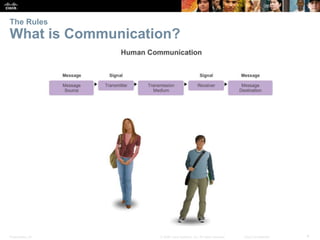
The Rules 
What is Communication? 
Presentation_ID © 2008 Cisco Systems, Inc. All rights reserved. Cisco Confidential 4
The Rules 
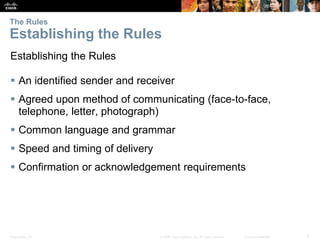
Establishing the Rules 
 An identified sender and receiver 
 Agreed upon method of communicating (face-to-face, 
telephone, letter, photograph) 
 Common language and grammar 
 Speed and timing of delivery 
 Confirmation or acknowledgement requirements 
Presentation_ID © 2008 Cisco Systems, Inc. All rights reserved. Cisco Confidential 5
The Rules 
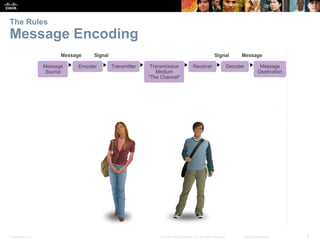
Message Encoding 
Presentation_ID © 2008 Cisco Systems, Inc. All rights reserved. Cisco Confidential 6
The Rules 
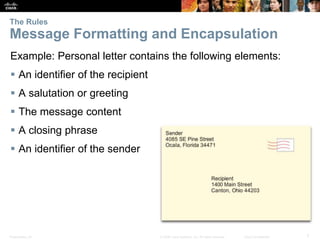
Message Formatting and Encapsulation 
Example: Personal letter contains the following elements: 
 An identifier of the recipient 
 A salutation or greeting 
 The message content 
 A closing phrase 
 An identifier of the sender 
Presentation_ID © 2008 Cisco Systems, Inc. All rights reserved. Cisco Confidential 7
The Rules 
Message Size 
The size restrictions of frames require the source host to break 
a long message into individual pieces that meet both the 
minimum and maximum size requirements. 
This is known as segmenting. 
Each segment is encapsulated in a separate frame with the 
address information, and is sent over the network. 
At the receiving host, the messages are de-encapsulated and 
put back together to be processed and interpreted. 
Presentation_ID © 2008 Cisco Systems, Inc. All rights reserved. Cisco Confidential 8
The Rules 
Message Timing 
 Access Method 
 Flow Control 
 Response Timeout 
Presentation_ID © 2008 Cisco Systems, Inc. All rights reserved. Cisco Confidential 9
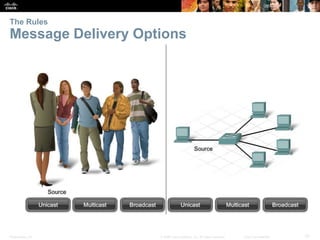
The Rules 
Message Delivery Options 
Presentation_ID © 2008 Cisco Systems, Inc. All rights reserved. Cisco Confidential 10
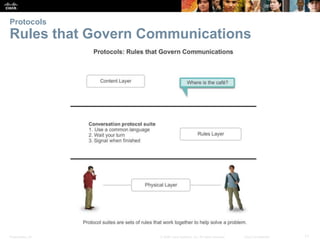
Protocols 
Rules that Govern Communications 
Presentation_ID © 2008 Cisco Systems, Inc. All rights reserved. Cisco Confidential 11
Protocols 
Network Protocols 
 How the message is formatted or structured 
 The process by which networking devices share information 
about pathways with other networks 
 How and when error and system messages are passed 
between devices 
 The setup and termination of data transfer sessions 
Presentation_ID © 2008 Cisco Systems, Inc. All rights reserved. Cisco Confidential 12
Protocols 
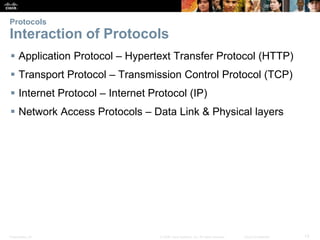
Interaction of Protocols 
 Application Protocol – Hypertext Transfer Protocol (HTTP) 
 Transport Protocol – Transmission Control Protocol (TCP) 
 Internet Protocol – Internet Protocol (IP) 
 Network Access Protocols – Data Link & Physical layers 
Presentation_ID © 2008 Cisco Systems, Inc. All rights reserved. Cisco Confidential 13
Protocol Suites 
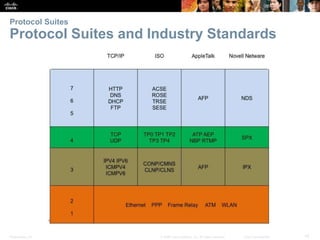
Protocol Suites and Industry Standards 
Presentation_ID © 2008 Cisco Systems, Inc. All rights reserved. Cisco Confidential 14
Protocol Suites 
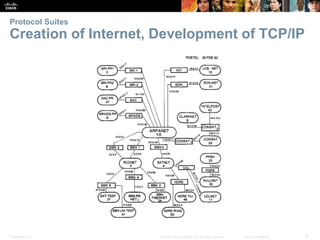
Creation of Internet, Development of TCP/IP 
Presentation_ID © 2008 Cisco Systems, Inc. All rights reserved. Cisco Confidential 15
Protocol Suites 
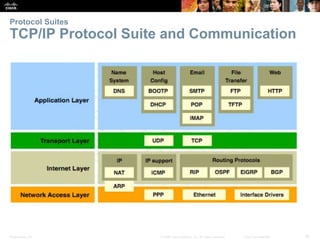
TCP/IP Protocol Suite and Communication 
Presentation_ID © 2008 Cisco Systems, Inc. All rights reserved. Cisco Confidential 16
Network Protocols and Standards 
Standards Organizations 
Presentation_ID © 2008 Cisco Systems, Inc. All rights reserved. Cisco Confidential 17
Standards Organizations 
Open Standards 
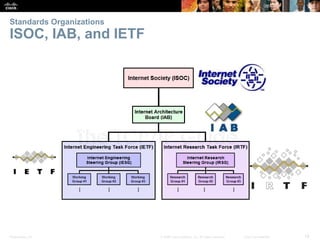
 The Internet Society (ISOC) 
 The Internet Architecture Board (IAB) 
 The Internet Engineering Task Force (IETF) 
 Institute of Electrical and Electronics Engineers (IEEE) 
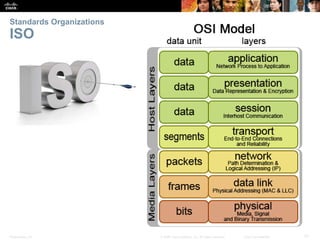
 The International Organization for Standards (ISO) 
Presentation_ID © 2008 Cisco Systems, Inc. All rights reserved. Cisco Confidential 18
Standards Organizations 
ISOC, IAB, and IETF 
Presentation_ID © 2008 Cisco Systems, Inc. All rights reserved. Cisco Confidential 19
Standards Organizations 
IEEE 
 38 societies 
 130 journals 
 1,300 conferences each year 
 1,300 standards and projects 
 400,000 members 
 160 countries 
 IEEE 802.3 
 IEEE 802.11 
Presentation_ID © 2008 Cisco Systems, Inc. All rights reserved. Cisco Confidential 20
Standards Organizations 
ISO 
Presentation_ID © 2008 Cisco Systems, Inc. All rights reserved. Cisco Confidential 21
Standards Organizations 
Other Standards Organization 
 The Electronic Industries Alliance (EIA) 
 The Telecommunications Industry Association (TIA) 
 The International Telecommunications Union – 
Telecommunications Standardization Sector (ITU-T) 
 The Internet Corporation for Assigned Names and Numbers 
(ICANN) 
 The Internet Assigned Numbers Authority (IANA) 
Presentation_ID © 2008 Cisco Systems, Inc. All rights reserved. Cisco Confidential 22
Reference Models 
The Benefits of Using a Layered Model 
Presentation_ID © 2008 Cisco Systems, Inc. All rights reserved. Cisco Confidential 23
Reference Models 
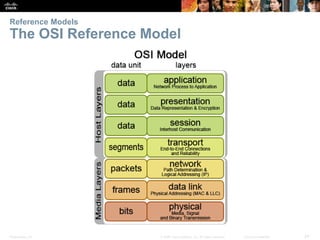
The OSI Reference Model 
Presentation_ID © 2008 Cisco Systems, Inc. All rights reserved. Cisco Confidential 24
Reference Models 
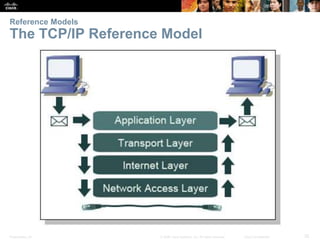
The TCP/IP Reference Model 
Presentation_ID © 2008 Cisco Systems, Inc. All rights reserved. Cisco Confidential 25
Reference Models 
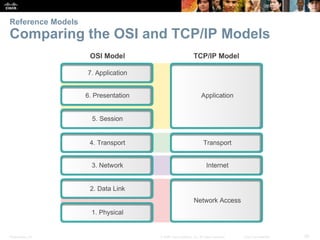
Comparing the OSI and TCP/IP Models 
Presentation_ID © 2008 Cisco Systems, Inc. All rights reserved. Cisco Confidential 26
Data Encapsulation 
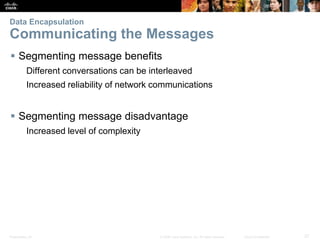
Communicating the Messages 
 Segmenting message benefits 
Different conversations can be interleaved 
Increased reliability of network communications 
 Segmenting message disadvantage 
Increased level of complexity 
Presentation_ID © 2008 Cisco Systems, Inc. All rights reserved. Cisco Confidential 27
Data Encapsulation 
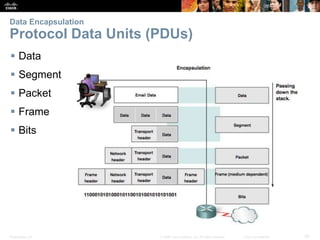
Protocol Data Units (PDUs) 
 Data 
 Segment 
 Packet 
 Frame 
 Bits 
Presentation_ID © 2008 Cisco Systems, Inc. All rights reserved. Cisco Confidential 28
Data Encapsulation 
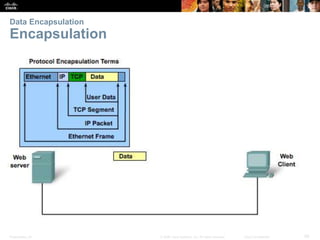
Encapsulation 
Presentation_ID © 2008 Cisco Systems, Inc. All rights reserved. Cisco Confidential 29
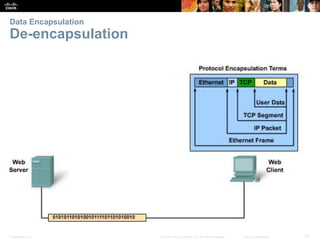
Data Encapsulation 
De-encapsulation 
Presentation_ID © 2008 Cisco Systems, Inc. All rights reserved. Cisco Confidential 30
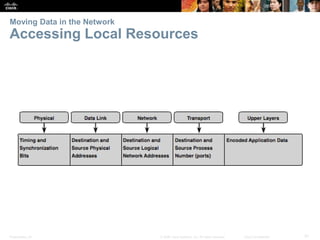
Moving Data in the Network 
Accessing Local Resources 
Presentation_ID © 2008 Cisco Systems, Inc. All rights reserved. Cisco Confidential 31
Accessing Local Resources 
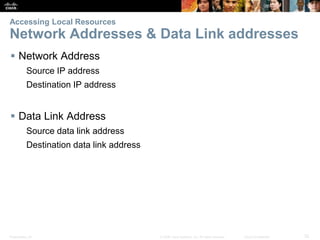
Network Addresses & Data Link addresses 
 Network Address 
Source IP address 
Destination IP address 
 Data Link Address 
Source data link address 
Destination data link address 
Presentation_ID © 2008 Cisco Systems, Inc. All rights reserved. Cisco Confidential 32
Accessing Local Resources 
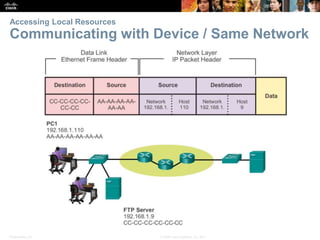
Communicating with Device / Same Network 
Presentation_ID © 2008 Cisco Systems, Inc. All rights reserved. Cisco Confidential 33
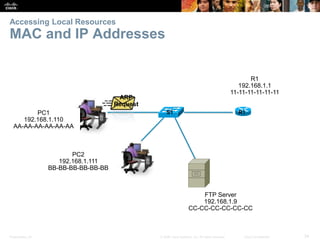
Accessing Local Resources 
MAC and IP Addresses 
PC1 
192.168.1.110 
AA-AA-AA-AA-AA-AA 
PC2 
192.168.1.111 
BB-BB-BB-BB-BB-BB 
11-11-11-11-11-11 
S1 R1 
FTP Server 
192.168.1.9 
R1 
192.168.1.1 
CC-CC-CC-CC-CC-CC 
ARP 
Request 
Presentation_ID © 2008 Cisco Systems, Inc. All rights reserved. Cisco Confidential 34
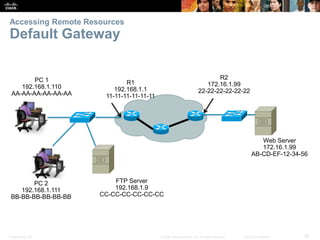
Accessing Remote Resources 
Default Gateway 
PC 1 
192.168.1.110 
AA-AA-AA-AA-AA-AA 
PC 2 
192.168.1.111 
BB-BB-BB-BB-BB-BB 
R1 
192.168.1.1 
11-11-11-11-11-11 
FTP Server 
192.168.1.9 
CC-CC-CC-CC-CC-CC 
R2 
172.16.1.99 
22-22-22-22-22-22 
Web Server 
172.16.1.99 
AB-CD-EF-12-34-56 
Presentation_ID © 2008 Cisco Systems, Inc. All rights reserved. Cisco Confidential 35
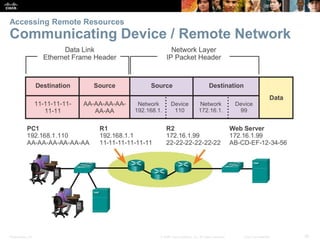
Accessing Remote Resources 
Communicating Device / Remote Network 
Presentation_ID © 2008 Cisco Systems, Inc. All rights reserved. Cisco Confidential 36
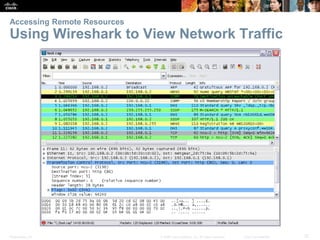
Accessing Remote Resources 
Using Wireshark to View Network Traffic 
Presentation_ID © 2008 Cisco Systems, Inc. All rights reserved. Cisco Confidential 37
Network Protocols and Communications 
Summary 
In this chapter, you learned: 
 Data networks are systems of end devices, intermediary 
devices, and the media connecting the devices. For 
communication to occur, these devices must know how to 
communicate. 
 These devices must comply with communication rules and 
protocols. TCP/IP is an example of a protocol suite. 
 Most protocols are created by a standards organization such 
as the IETF or IEEE. 
 The most widely-used networking models are the OSI and 
TCP/IP models. 
Presentation_ID © 2008 Cisco Systems, Inc. All rights reserved. Cisco Confidential 38
Network Protocols and Communications 
Summary 
In this chapter, you learned: 
 Data that passes down the stack of the OSI model is 
segmented into pieces and encapsulated with addresses and 
other labels. The process is reversed as the pieces are de-encapsulated 
and passed up the destination protocol stack. 
 The OSI model describes the processes of encoding, 
formatting, segmenting, and encapsulating data for 
transmission over the network. 
 The TCP/IP protocol suite is an open standard protocol that 
has been endorsed by the networking industry and ratified, or 
approved, by a standards organization. 
Presentation_ID © 2008 Cisco Systems, Inc. All rights reserved. Cisco Confidential 39
Network Protocols and Communications 
Summary 
In this chapter, you learned: 
 The Internet Protocol Suite is a suite of protocols required for 
transmitting and receiving information using the Internet. 
 Protocol Data Units (PDUs) are named according to the 
protocols of the TCP/IP suite: data, segment, packet, frame, 
and bits. 
 Applying models allows individuals, companies, and trade 
associations to analyze current networks and plan the 
networks of the future. 
Presentation_ID © 2008 Cisco Systems, Inc. All rights reserved. Cisco Confidential 40
Presentation_ID © 2008 Cisco Systems, Inc. All rights reserved. Cisco Confidential 41

CCNA RS_ITN - Chapter 3

  • 1.
    Chapter 3: NetworkProtocols and Communications Introduction to Networks © 2008 Cisco Systems, Inc. All Presentation_ID rights reserved. Cisco Confidential 1
  • 2.
    Chapter 3: Objectives Students will be able to:  Explain how rules are used to facilitate communication.  Explain the role of protocols and standards organizations in facilitating interoperability in network communications.  Explain how devices on a LAN access resources in a small to medium-sized business network. Presentation_ID © 2008 Cisco Systems, Inc. All rights reserved. Cisco Confidential 2
  • 3.
    Chapter 3 3.1Rules of Communication 3.2 Network Protocols and Standards 3.3 Moving Data in the Network 3.4 Summary Presentation_ID © 2008 Cisco Systems, Inc. All rights reserved. Cisco Confidential 3
  • 4.
    The Rules Whatis Communication? Presentation_ID © 2008 Cisco Systems, Inc. All rights reserved. Cisco Confidential 4
  • 5.
    The Rules Establishingthe Rules Establishing the Rules  An identified sender and receiver  Agreed upon method of communicating (face-to-face, telephone, letter, photograph)  Common language and grammar  Speed and timing of delivery  Confirmation or acknowledgement requirements Presentation_ID © 2008 Cisco Systems, Inc. All rights reserved. Cisco Confidential 5
  • 6.
    The Rules MessageEncoding Presentation_ID © 2008 Cisco Systems, Inc. All rights reserved. Cisco Confidential 6
  • 7.
    The Rules MessageFormatting and Encapsulation Example: Personal letter contains the following elements:  An identifier of the recipient  A salutation or greeting  The message content  A closing phrase  An identifier of the sender Presentation_ID © 2008 Cisco Systems, Inc. All rights reserved. Cisco Confidential 7
  • 8.
    The Rules MessageSize The size restrictions of frames require the source host to break a long message into individual pieces that meet both the minimum and maximum size requirements. This is known as segmenting. Each segment is encapsulated in a separate frame with the address information, and is sent over the network. At the receiving host, the messages are de-encapsulated and put back together to be processed and interpreted. Presentation_ID © 2008 Cisco Systems, Inc. All rights reserved. Cisco Confidential 8
  • 9.
    The Rules MessageTiming  Access Method  Flow Control  Response Timeout Presentation_ID © 2008 Cisco Systems, Inc. All rights reserved. Cisco Confidential 9
  • 10.
    The Rules MessageDelivery Options Presentation_ID © 2008 Cisco Systems, Inc. All rights reserved. Cisco Confidential 10
  • 11.
    Protocols Rules thatGovern Communications Presentation_ID © 2008 Cisco Systems, Inc. All rights reserved. Cisco Confidential 11
  • 12.
    Protocols Network Protocols  How the message is formatted or structured  The process by which networking devices share information about pathways with other networks  How and when error and system messages are passed between devices  The setup and termination of data transfer sessions Presentation_ID © 2008 Cisco Systems, Inc. All rights reserved. Cisco Confidential 12
  • 13.
    Protocols Interaction ofProtocols  Application Protocol – Hypertext Transfer Protocol (HTTP)  Transport Protocol – Transmission Control Protocol (TCP)  Internet Protocol – Internet Protocol (IP)  Network Access Protocols – Data Link & Physical layers Presentation_ID © 2008 Cisco Systems, Inc. All rights reserved. Cisco Confidential 13
  • 14.
    Protocol Suites ProtocolSuites and Industry Standards Presentation_ID © 2008 Cisco Systems, Inc. All rights reserved. Cisco Confidential 14
  • 15.
    Protocol Suites Creationof Internet, Development of TCP/IP Presentation_ID © 2008 Cisco Systems, Inc. All rights reserved. Cisco Confidential 15
  • 16.
    Protocol Suites TCP/IPProtocol Suite and Communication Presentation_ID © 2008 Cisco Systems, Inc. All rights reserved. Cisco Confidential 16
  • 17.
    Network Protocols andStandards Standards Organizations Presentation_ID © 2008 Cisco Systems, Inc. All rights reserved. Cisco Confidential 17
  • 18.
    Standards Organizations OpenStandards  The Internet Society (ISOC)  The Internet Architecture Board (IAB)  The Internet Engineering Task Force (IETF)  Institute of Electrical and Electronics Engineers (IEEE)  The International Organization for Standards (ISO) Presentation_ID © 2008 Cisco Systems, Inc. All rights reserved. Cisco Confidential 18
  • 19.
    Standards Organizations ISOC,IAB, and IETF Presentation_ID © 2008 Cisco Systems, Inc. All rights reserved. Cisco Confidential 19
  • 20.
    Standards Organizations IEEE  38 societies  130 journals  1,300 conferences each year  1,300 standards and projects  400,000 members  160 countries  IEEE 802.3  IEEE 802.11 Presentation_ID © 2008 Cisco Systems, Inc. All rights reserved. Cisco Confidential 20
  • 21.
    Standards Organizations ISO Presentation_ID © 2008 Cisco Systems, Inc. All rights reserved. Cisco Confidential 21
  • 22.
    Standards Organizations OtherStandards Organization  The Electronic Industries Alliance (EIA)  The Telecommunications Industry Association (TIA)  The International Telecommunications Union – Telecommunications Standardization Sector (ITU-T)  The Internet Corporation for Assigned Names and Numbers (ICANN)  The Internet Assigned Numbers Authority (IANA) Presentation_ID © 2008 Cisco Systems, Inc. All rights reserved. Cisco Confidential 22
  • 23.
    Reference Models TheBenefits of Using a Layered Model Presentation_ID © 2008 Cisco Systems, Inc. All rights reserved. Cisco Confidential 23
  • 24.
    Reference Models TheOSI Reference Model Presentation_ID © 2008 Cisco Systems, Inc. All rights reserved. Cisco Confidential 24
  • 25.
    Reference Models TheTCP/IP Reference Model Presentation_ID © 2008 Cisco Systems, Inc. All rights reserved. Cisco Confidential 25
  • 26.
    Reference Models Comparingthe OSI and TCP/IP Models Presentation_ID © 2008 Cisco Systems, Inc. All rights reserved. Cisco Confidential 26
  • 27.
    Data Encapsulation Communicatingthe Messages  Segmenting message benefits Different conversations can be interleaved Increased reliability of network communications  Segmenting message disadvantage Increased level of complexity Presentation_ID © 2008 Cisco Systems, Inc. All rights reserved. Cisco Confidential 27
  • 28.
    Data Encapsulation ProtocolData Units (PDUs)  Data  Segment  Packet  Frame  Bits Presentation_ID © 2008 Cisco Systems, Inc. All rights reserved. Cisco Confidential 28
  • 29.
    Data Encapsulation Encapsulation Presentation_ID © 2008 Cisco Systems, Inc. All rights reserved. Cisco Confidential 29
  • 30.
    Data Encapsulation De-encapsulation Presentation_ID © 2008 Cisco Systems, Inc. All rights reserved. Cisco Confidential 30
  • 31.
    Moving Data inthe Network Accessing Local Resources Presentation_ID © 2008 Cisco Systems, Inc. All rights reserved. Cisco Confidential 31
  • 32.
    Accessing Local Resources Network Addresses & Data Link addresses  Network Address Source IP address Destination IP address  Data Link Address Source data link address Destination data link address Presentation_ID © 2008 Cisco Systems, Inc. All rights reserved. Cisco Confidential 32
  • 33.
    Accessing Local Resources Communicating with Device / Same Network Presentation_ID © 2008 Cisco Systems, Inc. All rights reserved. Cisco Confidential 33
  • 34.
    Accessing Local Resources MAC and IP Addresses PC1 192.168.1.110 AA-AA-AA-AA-AA-AA PC2 192.168.1.111 BB-BB-BB-BB-BB-BB 11-11-11-11-11-11 S1 R1 FTP Server 192.168.1.9 R1 192.168.1.1 CC-CC-CC-CC-CC-CC ARP Request Presentation_ID © 2008 Cisco Systems, Inc. All rights reserved. Cisco Confidential 34
  • 35.
    Accessing Remote Resources Default Gateway PC 1 192.168.1.110 AA-AA-AA-AA-AA-AA PC 2 192.168.1.111 BB-BB-BB-BB-BB-BB R1 192.168.1.1 11-11-11-11-11-11 FTP Server 192.168.1.9 CC-CC-CC-CC-CC-CC R2 172.16.1.99 22-22-22-22-22-22 Web Server 172.16.1.99 AB-CD-EF-12-34-56 Presentation_ID © 2008 Cisco Systems, Inc. All rights reserved. Cisco Confidential 35
  • 36.
    Accessing Remote Resources Communicating Device / Remote Network Presentation_ID © 2008 Cisco Systems, Inc. All rights reserved. Cisco Confidential 36
  • 37.
    Accessing Remote Resources Using Wireshark to View Network Traffic Presentation_ID © 2008 Cisco Systems, Inc. All rights reserved. Cisco Confidential 37
  • 38.
    Network Protocols andCommunications Summary In this chapter, you learned:  Data networks are systems of end devices, intermediary devices, and the media connecting the devices. For communication to occur, these devices must know how to communicate.  These devices must comply with communication rules and protocols. TCP/IP is an example of a protocol suite.  Most protocols are created by a standards organization such as the IETF or IEEE.  The most widely-used networking models are the OSI and TCP/IP models. Presentation_ID © 2008 Cisco Systems, Inc. All rights reserved. Cisco Confidential 38
  • 39.
    Network Protocols andCommunications Summary In this chapter, you learned:  Data that passes down the stack of the OSI model is segmented into pieces and encapsulated with addresses and other labels. The process is reversed as the pieces are de-encapsulated and passed up the destination protocol stack.  The OSI model describes the processes of encoding, formatting, segmenting, and encapsulating data for transmission over the network.  The TCP/IP protocol suite is an open standard protocol that has been endorsed by the networking industry and ratified, or approved, by a standards organization. Presentation_ID © 2008 Cisco Systems, Inc. All rights reserved. Cisco Confidential 39
  • 40.
    Network Protocols andCommunications Summary In this chapter, you learned:  The Internet Protocol Suite is a suite of protocols required for transmitting and receiving information using the Internet.  Protocol Data Units (PDUs) are named according to the protocols of the TCP/IP suite: data, segment, packet, frame, and bits.  Applying models allows individuals, companies, and trade associations to analyze current networks and plan the networks of the future. Presentation_ID © 2008 Cisco Systems, Inc. All rights reserved. Cisco Confidential 40
  • 41.
    Presentation_ID © 2008Cisco Systems, Inc. All rights reserved. Cisco Confidential 41