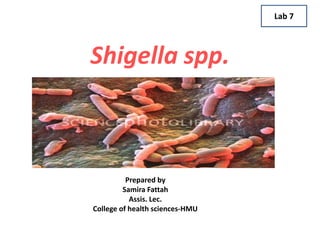
Shigella spp.
Lab 7
Prepared by
Samira Fattah
Assis. Lec.
College of health sciences-HMU
General character:
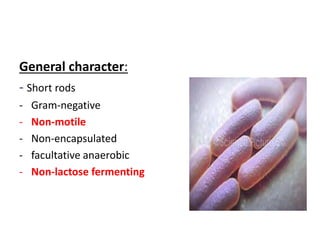
- Short rods
- Gram-negative
- Non-motile
- Non-encapsulated
- facultative anaerobic
- Non-lactose fermenting
Specimen:
• fresh stool.
• Rectal swab.
• Serum
Laboratory diagnosis
• Microscopy:
• Microscopic examination is a gram negative bacilli.
On culture media
On MacConkey agar
Shigellae form non-lactose
fermenting pale colored or
colorless and transparent
colonies
On EMB agar
• Surface of EMB agar plates illustrating a mixed culture of E.
coli (green sheen colonies) and Shigella species. Most Shigella
species do not ferment lactose and, thus produce
nonpigmented, semitranslucent colonies on EMB agar.
On SS agar
• Colonies are transparent,
translucent or opaque and
usually smooth (non lactose
fermenting).
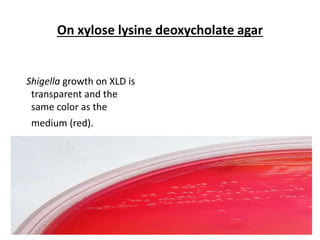
On xylose lysine deoxycholate agar
Shigella growth on XLD is
transparent and the
same color as the
medium (red).
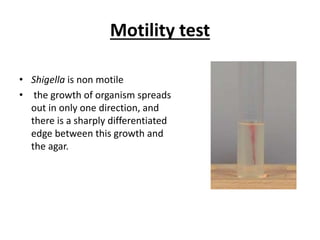
Motility test
• Shigella is non motile
• the growth of organism spreads
out in only one direction, and
there is a sharply differentiated
edge between this growth and
the agar.
Biochemical test
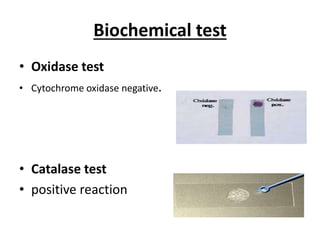
• Oxidase test
• Cytochrome oxidase negative.
• Catalase test
• positive reaction
Biochemical test
• Urease -ve
• H2S -ve.
• lactose -ve
• Citrate -ve
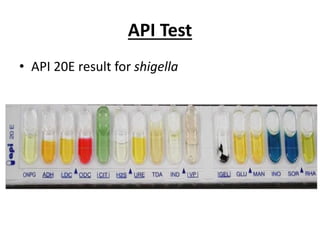
API Test
• API 20E result for shigella
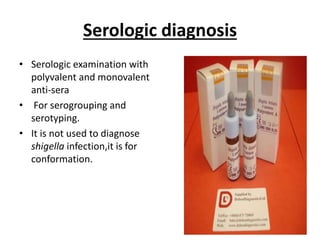
Serologic diagnosis
• Serologic examination with
polyvalent and monovalent
anti-sera
• For serogrouping and
serotyping.
• It is not used to diagnose
shigella infection,it is for
conformation.
serotyping
Shigella species are classified to four serogroups:
• Serogroup A: Shigella dysenteriae (12 serotypes)
• Serogroup B: Shigella flexneri (6 serotypes)
• Serogroup C: Shigella boydii (23 serotypes)
• Serogroup D: Shigella sonnei (1 serotype)

Shigella

  • 1.
    Shigella spp. Lab 7 Preparedby Samira Fattah Assis. Lec. College of health sciences-HMU
  • 2.
    General character: - Shortrods - Gram-negative - Non-motile - Non-encapsulated - facultative anaerobic - Non-lactose fermenting
  • 3.
    Specimen: • fresh stool. •Rectal swab. • Serum Laboratory diagnosis
  • 4.
    • Microscopy: • Microscopicexamination is a gram negative bacilli.
  • 5.
  • 6.
    On MacConkey agar Shigellaeform non-lactose fermenting pale colored or colorless and transparent colonies
  • 7.
    On EMB agar •Surface of EMB agar plates illustrating a mixed culture of E. coli (green sheen colonies) and Shigella species. Most Shigella species do not ferment lactose and, thus produce nonpigmented, semitranslucent colonies on EMB agar.
  • 8.
    On SS agar •Colonies are transparent, translucent or opaque and usually smooth (non lactose fermenting).
  • 9.
    On xylose lysinedeoxycholate agar Shigella growth on XLD is transparent and the same color as the medium (red).
  • 10.
    Motility test • Shigellais non motile • the growth of organism spreads out in only one direction, and there is a sharply differentiated edge between this growth and the agar.
  • 11.
    Biochemical test • Oxidasetest • Cytochrome oxidase negative. • Catalase test • positive reaction
  • 12.
    Biochemical test • Urease-ve • H2S -ve. • lactose -ve • Citrate -ve
  • 13.
    API Test • API20E result for shigella
  • 14.
    Serologic diagnosis • Serologicexamination with polyvalent and monovalent anti-sera • For serogrouping and serotyping. • It is not used to diagnose shigella infection,it is for conformation.
  • 15.
    serotyping Shigella species areclassified to four serogroups: • Serogroup A: Shigella dysenteriae (12 serotypes) • Serogroup B: Shigella flexneri (6 serotypes) • Serogroup C: Shigella boydii (23 serotypes) • Serogroup D: Shigella sonnei (1 serotype)