INTELLIGENCE
Samta Upadhyay
Research Scholar
NET-JRF
Banaras Hindu University
Faculty of Education (K)
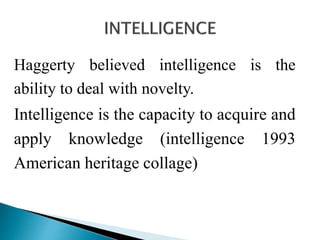
Haggerty believed intelligence is the
ability to deal with novelty.
Intelligence is the capacity to acquire and
apply knowledge (intelligence 1993
American heritage collage)
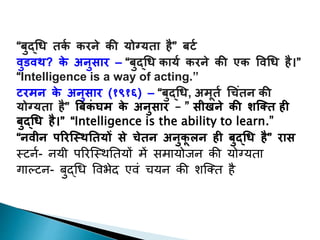
“बुद्धि तर्क र्रने र्ी योग्यता है” बर्क
वुडवथ? र्े अनुसार – “बुद्धि र्ायक र्रने र्ी एर् ववधि है।”
“Intelligence is a way of acting.”
र्रमन र्े अनुसार (१९१६) – “बुद्धि, अमूतक ध िंतन र्ी
योग्यता है” बबर्िं घम र्े अनुसार – ” सीखने र्ी शक्तत ही
बुद्धि है।” “Intelligence is the ability to learn.”
“नवीन पररक्थथततयों से ेतन अनुर्ू लन ही बुद्धि है” रास
स्टर्न- र्यी परिस्स्ितियों में समायोजर् की योग्ययिा
गाल्टर्- बुद्धि विभेद एिं चयर् की शस्ति है
Thurstone (1938) viewed intelligence as consisting of seven
primary mental abilities; verbal comprehension, verbal
fluency, number, spatial visualization, memory, reasoning and
perceptual speed.
To coordinate all the views, one may rely on the definition
given by DAVID WECHSLER(1977);
The global capacity to think rationally, act purposefully, and
deal effectively with the environment. Its mean for Wechsler
intelligence is an effective, rational & goal directed behaviour.
 सीखर्े की योग्ययिा(Ability of learn)
 अमूि धचंिर् की योग्ययिा( Ability of think
abstractly)
 समस्या का समािार् किर्े की योग्ययिा( Ability to
solve problems)
 िािाििण से समायोजर् की योग्ययिा(Ability to
adjust to one’s environment)
इर् परिभाषाओ के अर्ुसाि बुद्धि में के िल एक ििह
की क्षमिा र्ही, बस्ल्क इसमें अर्ेक ििह की क्षमिाये
सस्ममललि होिी है।
Spearman’s Two-Factor Theory:
Theory:
The English psychologist, Charles Spearman
(1863-1945), in 1904 proposed his theory of intelligence
called two-factor theory.
According to him intellectual abilities are comprised of
two factors, namely
the general ability known as G-factor and
specific Abilities known as S-factors.
The performance by the individual is determined by the G-
factor and the S-factors.
The total intelligence of the individual is the sum total of
the G-factor and the S-factors.
The performance of a particular task depends on the ‘G’
factor or general ability and the particular ‘S’ factor or
specific ability.
Spearman also noted most people are best in one or two
particular areas and so he included specific factor “S” that
allow a person to excel on particular task.
For example student who has trouble in math's may excel in
Bio.
The combination of “G” and “S” factors provides the specific
intelligence level of an individual.
I.Q=M,A/C.A * 100
Characteristics of ‘G’ Factor :eristicsof ‘G’
Factor:
It is universal inborn ability.
It is general mental energy.
It is constant.
The amount of ‘g’ differs from individual to individual.
It is used in every activity of life.
Greater the ‘g’ in an individual, greater is his success in
life.
It is learned and acquired in the environment.
It varies from activity to activity in the same individual.
Individuals differ in the amount of ‘S’ ability.
‘G’ factor represents Native Intelligence thus when we
respond to any situation or perform an intellectual task, our
general mental ability or ‘G’ factor is mainly responsible for it
and our specific ability in that particular task is responsible
for the rest.
There are a large number of specific abilities such as ability
to draw inferences, ability to complete sentences, ability to
code message etc.
Different individuals differed both in their ‘G’ as well as ‘S’
factors.
For e.g. an individual’s performance in literature is partly
due to his general intelligence and partly due some specific
aptitude for his language, i.e. G+S1.
In mathematics his performance may be the result of G+S2.
In drawing, it may be due to G+S3 and in social sciences; it
may be due to G+S4 and so on.
Thus the factor ‘G’ is present in all specific activities.
1. The theory gives a better insight to the teacher about the
nature of intelligence.
2. The general ability differs from individual to individual.
3. The specific abilities also differ from individual to
individual.
4. ‘S’ factor varies in degrees. Therefore, it can be modified
by learning or habitual training
5. A child requires different amounts of ‘G’ and ‘S’
factors for achieving success in different Subjects.
6. We require a high quality of ‘G’ factor for our success
in life.
7. Both ‘G’ and ‘S’ have a high correlation.
8. This theory could be used to guide, construction of a
set of ability test

Intelligence and two factor theory

  • 1.
    INTELLIGENCE Samta Upadhyay Research Scholar NET-JRF BanarasHindu University Faculty of Education (K)
  • 2.
    Haggerty believed intelligenceis the ability to deal with novelty. Intelligence is the capacity to acquire and apply knowledge (intelligence 1993 American heritage collage)
  • 3.
    “बुद्धि तर्क र्रनेर्ी योग्यता है” बर्क वुडवथ? र्े अनुसार – “बुद्धि र्ायक र्रने र्ी एर् ववधि है।” “Intelligence is a way of acting.” र्रमन र्े अनुसार (१९१६) – “बुद्धि, अमूतक ध िंतन र्ी योग्यता है” बबर्िं घम र्े अनुसार – ” सीखने र्ी शक्तत ही बुद्धि है।” “Intelligence is the ability to learn.” “नवीन पररक्थथततयों से ेतन अनुर्ू लन ही बुद्धि है” रास स्टर्न- र्यी परिस्स्ितियों में समायोजर् की योग्ययिा गाल्टर्- बुद्धि विभेद एिं चयर् की शस्ति है
  • 4.
    Thurstone (1938) viewedintelligence as consisting of seven primary mental abilities; verbal comprehension, verbal fluency, number, spatial visualization, memory, reasoning and perceptual speed. To coordinate all the views, one may rely on the definition given by DAVID WECHSLER(1977); The global capacity to think rationally, act purposefully, and deal effectively with the environment. Its mean for Wechsler intelligence is an effective, rational & goal directed behaviour.
  • 5.
     सीखर्े कीयोग्ययिा(Ability of learn)  अमूि धचंिर् की योग्ययिा( Ability of think abstractly)  समस्या का समािार् किर्े की योग्ययिा( Ability to solve problems)  िािाििण से समायोजर् की योग्ययिा(Ability to adjust to one’s environment) इर् परिभाषाओ के अर्ुसाि बुद्धि में के िल एक ििह की क्षमिा र्ही, बस्ल्क इसमें अर्ेक ििह की क्षमिाये सस्ममललि होिी है।
  • 6.
    Spearman’s Two-Factor Theory: Theory: TheEnglish psychologist, Charles Spearman (1863-1945), in 1904 proposed his theory of intelligence called two-factor theory. According to him intellectual abilities are comprised of two factors, namely the general ability known as G-factor and specific Abilities known as S-factors.
  • 7.
    The performance bythe individual is determined by the G- factor and the S-factors. The total intelligence of the individual is the sum total of the G-factor and the S-factors. The performance of a particular task depends on the ‘G’ factor or general ability and the particular ‘S’ factor or specific ability.
  • 8.
    Spearman also notedmost people are best in one or two particular areas and so he included specific factor “S” that allow a person to excel on particular task. For example student who has trouble in math's may excel in Bio. The combination of “G” and “S” factors provides the specific intelligence level of an individual. I.Q=M,A/C.A * 100
  • 9.
    Characteristics of ‘G’Factor :eristicsof ‘G’ Factor: It is universal inborn ability. It is general mental energy. It is constant. The amount of ‘g’ differs from individual to individual. It is used in every activity of life. Greater the ‘g’ in an individual, greater is his success in life.
  • 10.
    It is learnedand acquired in the environment. It varies from activity to activity in the same individual. Individuals differ in the amount of ‘S’ ability.
  • 11.
    ‘G’ factor representsNative Intelligence thus when we respond to any situation or perform an intellectual task, our general mental ability or ‘G’ factor is mainly responsible for it and our specific ability in that particular task is responsible for the rest. There are a large number of specific abilities such as ability to draw inferences, ability to complete sentences, ability to code message etc.
  • 12.
    Different individuals differedboth in their ‘G’ as well as ‘S’ factors. For e.g. an individual’s performance in literature is partly due to his general intelligence and partly due some specific aptitude for his language, i.e. G+S1. In mathematics his performance may be the result of G+S2. In drawing, it may be due to G+S3 and in social sciences; it may be due to G+S4 and so on. Thus the factor ‘G’ is present in all specific activities.
  • 13.
    1. The theorygives a better insight to the teacher about the nature of intelligence. 2. The general ability differs from individual to individual. 3. The specific abilities also differ from individual to individual. 4. ‘S’ factor varies in degrees. Therefore, it can be modified by learning or habitual training
  • 14.
    5. A childrequires different amounts of ‘G’ and ‘S’ factors for achieving success in different Subjects. 6. We require a high quality of ‘G’ factor for our success in life. 7. Both ‘G’ and ‘S’ have a high correlation. 8. This theory could be used to guide, construction of a set of ability test