Anjana S Kumar
English
Views on
Secondary Education Commission
Secondary Education Commission(1952-
53)
INTRODUCTION
The Secondary Education Commission known as
Mudaliar Commission was appointed by the Government
of India to examine the existing system of secondary
education in the country.
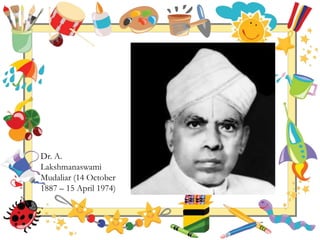
Dr. A. Lakshmanaswami Mudaliar was the Vice
Chancellor of the Madras University.
After the independence, India needed change in
education system.
Dr. A.
Lakshmanaswami
Mudaliar (14 October
1887 – 15 April 1974)
Mudaliar Commission comprised of:
• Appointment- appointed by the Governement
of India on the recommendation of CABE pn
23 September 1952.
• Chairman- Dr. Lakshmanaswami Mudaliar
• Secretary- A. N. Basu
• Report- Submitted on 29 August 1953, 15
chapters of about 240- 250 pages.
Aim of Appointement
• To enquire into the problems of Secondary
education
• To suggest measures for its reorganisation and
improvement with special reference to
• The aims, organisation, and the content of
secondary education
• Its relationship to Primary and Higher
education.
Defects of Secondary Education
• Bookish in content
• Exam oriented
• No qualitative development
• Unilateral and no diversification
• No scope of close contact b/w teacher and
student
• Lack of good teachers
• No proper facility for play and recreation.
Aims of Secondary Education
• Development of democratic citizenship
• Initiation into art of living
• Development of personality
• Improvement of vocational efficiency
• Education for leadership
• Development of true patriotism
• Cultivate discipline, cooperation, social
sensitiveness and tolerance
Recommendations of Mudaliar
Commission
• Organisational Pattern of Secondary Education
• Organisation of Secondary School curriculum
• Text books
• Methods of Teaching
• Discipline
• Moral and Religious education
• Guidance and counselling
• Supervision and Inspection
New organizational pattern of Secondary
Education
• Secondary education should be of 7 years.
• It should be for children of 11 to 17 years.
• Diversification of Courses
• Stress on Agricultural Education in Rural
Schools
• Technical Education
• Education of Girls
Organisation of Secondary School
Curriculum
• flexible curriculum which can be related with
interest, need and life of students
• train the students for work and leisure both
• Productive works should be importance
Subjects for Higher Secondary Stage
 Compulsory
 Mother tongue or Regional Lang
 One other Lang from Hindi, Elementary English,
Advanced English, Modern Indian Lang, Modern
foreign Lang, Classical Lang
 a. Social Studies
 b. Science
 c. Craft
Optional
Any 3 subjects from any one of the groups
 Group 1 Humanities
 Group 2 Science
 Group 3 Technical Subjects
 Group 4 Commercial Subjects
 Group 5 Agriculture
 Group 6 Fine Arts
 Group 7 Home Science
Text Books
• Textbooks should be selected very carefully. There
should be a committee for selection and reforms.
• There should be a definite standard for printing, cover
and front page of the book.
• There should be no such book which spread hatred,
enmity against any community, religion or social
customs.
• There should be more than one textbooks for a
subject.
Teaching methods
• According to the need of moral, social and mental
development of students.
• Activity based. It should not stress on verbalism and
memorisation.
• Teaching method should be adopted in such a way
that it takes care of individual difference.
• There should be more stress on experimental and
demonstration method
Discipline
• (i) The education of character should be
envisaged as the responsibility of all teachers.
• (ii) In order to promote discipline, personal
contact between the teacher and the pupil
should be strengthened
Moral and Religious Education
• Religious and moral instruction plays an important
part in the promotion of character.
• Religious instruction in schools may be given only on
a voluntary basis and after the regular school hours.
• Such instruction should be confined to the children of
the particular faith concerned and be given with the
consent of parents and the management.
Improving Examination system
• Number of external exams should be reduced
• Subjectivity (essay type questions) should be
minimized by introducing objective questions
• The five-point scale of Mudaliar commission :
• students should be evaluated on 5 points
• A-distinction
• B-credit
• C-pass
• D and E-fail or re-exam
Guidance and Counselling
• There should be appointment of guidance
officers and career masters in the schools for
educational, personal and vocational guidance.
• There should be arrangement of film shows,
excursions related to various industries.
Hours of Working and Vacation
• As a rule the total number of working days in a school
should not be less than 200
• The working hours per week should be at least 35
periods about 45 minutes each; the schools should
work regularly for 6 days in the week.
• One of the days being a half day when the teachers
and students might meet informally and work together
on various extra-curricular and social projects.
• Summer vocation of 2 months and breaks of 10 to 15
days at suitable periods during the year.
Teacher Education
• The teacher trainee should receive training in one or
more co-curricular activities.
• Importance should be attached to teaching practice in
schools.
• The training colleges should, as a normal part of their
work, assist to the in-service teacher training by
providing the following:
• (i) Refresher courses(ii) Short intensive courses in
special subjects (iii) Work-shop,(iv) Seminars and(v)
professional conferences.
• Training institutions should be in close with the
Department of Education and the schools.
• Recruitment to training colleges should be carefully
made so as to admit only those who hold the highest
promise of becoming successful teachers.
Education of Character
• Close relationship between the teachers and students
for best discipline.
• There should be self-government in the school run by
House System, Prefects, Monitors and Student
Council should be given important place.
• Co-curricular activities ,extra-curricular activities
should be also included in school education.
• NCC, Scout camps should be encouraged.
• First aid and junior red-cross work should be
encouraged.
CONTRIBUTION IN PROGRESS OF MODERN
INDIAN SECONDARY EDUCATION
• All India Advisory Board of Secondary Education was
formed at centre Education of general science was
made compulsory.
• In some secondary schools NCC was organized.
• Training of teachers, their pay scales & service
conditions.
• Facility of educational & vocational guidance &
counselling was made available in secondary schools
Conclusion
• Report of Secondary Education Commission is truly
called as “Bible for teachers” an is a landmark in the
development of education in India.
• In-spite of its various drawbacks, commission has
paved the golden way to improve the system of
secondary education and major of the
recommendations have been incorporated in to the
present educational system.