Cognition & Language
Instructor; Rustam
Lecture outline
• Cognitive Psychology
• Thinking and Reasoning
• Creativity
• Problem Solving
• Computers and Problem
Solving
• Judgment
• Decision Making
• Language
• Noam Chomsky Work
• (LAD) 1960
• Child Language
Development
• Cognition & Language
Cognitive Psychology
• “The branch of psychology that focuses on the
study of higher mental processes, including
thinking, language, memory, problem solving,
knowing, reasoning, judging, and decision
making.”
• Three major topics of Cognitive Psychology
• Thinking and reasoning,
• Creativity and Problem solving
• Language
Thinking and Reasoning
Thinking
• Thinking is the manipulation of
mental representations of
information.
• The process of considering or
reasoning about something.
• We begin by considering our
use of mental images and
concepts, the building blocks of
thought.
Reasoning
• The process by which information
is used to draw conclusions and
make decisions.
• Reason is the capacity of
consciously applying logic to seek
truth and draw conclusions from
new or existing information.
• Formal reasoning in which people
draw a conclusion from a set of
assumptions.
Creativity
• The creative process involves critical thinking
and problem-solving skills,
• Five steps in creativity
1. Preparation
2. Incubation
3. Illumination
4. Evaluation
5. Verification
Problem Solving
• Problem solving is a process which have been used to
find solutions of difficult and complex issues
• Thus, problem solving is the process of identifying a
problem, developing an algorithm for the identified
problem and finally implementing the algorithm to
develop a computer program
• Three Steps of Problem Solving
1. Preparation: Diagnose Problems
2. Production: Generate solution
3. Judgment: Evaluate solution
Judgment
• An opinion or decision that is based on careful
thought
• The act or process of forming an opinion or
making a decision after careful thought
• The act of judging something or someone
• The ability to make good decisions about what
should be done
Computers and Problem Solving
• Solving problems is the core of computer
science
• Programmers must first understand how a
human solves a problem, then understand how
to translate this
• Artificial Intelligence on this concept
• Work on past of individual
Decision Making
• Decision making is the process of making
choices by identifying a decision, gathering
information, and assessing alternative
resolutions.
• Using a step-by-step decision-making process
can help you make more deliberate,
thoughtful decisions by organizing relevant
information and defining alternative
Language
• Language and language development are
cognitive processes that involve the ability to
understand and express thoughts through spoken
and written words
• A cognitive ability central to communication.
• Closely linked to the way in which we think about
and understand the world
• Without language, our ability to transmit
information, acquire knowledge, and cooperate
with others would become difficult
Noam Chomsky Work
• Children do not learn a new language but
naturally acquire it through an innate
language device
• Neurological system in human brains that
supports language acquisition.
• All humans have a universal Grammar(UG).
• Children are exposed to infinite data and given
data LAD produce a finite set of Grammar
rules.
Language Acquisition Device (LAD) 1960
• Proposed by Noam Chomsky the LAD concept
is an instinctive mental capacity which enables
an infant to acquire and produce language.
• This theory asserts that humans are born with
the instinct or innate facility for acquiring
language.
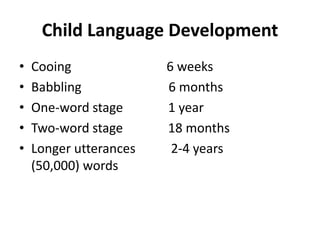
Child Language Development
• Cooing 6 weeks
• Babbling 6 months
• One-word stage 1 year
• Two-word stage 18 months
• Longer utterances 2-4 years
(50,000) words
Language and culture
• Language and culture are intertwined.
• A particular language usually points out to a
specific group of people.
• When you interact with another language, it
means that you are also interacting with the
culture that speaks the language.
• You cannot understand one's culture
without accessing its language
Cognition & Language
• Language and cognition are partners in child
development.
• We use language to learn new ideas, to talk
about our thoughts and fears, and interact
with those around us.
• Language is how thoughts fly through the air
from one mind to another.
• Language skills and cognitive skills are related
to each other.
Thanks

Cognition & language

  • 1.
  • 2.
    Lecture outline • CognitivePsychology • Thinking and Reasoning • Creativity • Problem Solving • Computers and Problem Solving • Judgment • Decision Making • Language • Noam Chomsky Work • (LAD) 1960 • Child Language Development • Cognition & Language
  • 3.
    Cognitive Psychology • “Thebranch of psychology that focuses on the study of higher mental processes, including thinking, language, memory, problem solving, knowing, reasoning, judging, and decision making.” • Three major topics of Cognitive Psychology • Thinking and reasoning, • Creativity and Problem solving • Language
  • 4.
    Thinking and Reasoning Thinking •Thinking is the manipulation of mental representations of information. • The process of considering or reasoning about something. • We begin by considering our use of mental images and concepts, the building blocks of thought. Reasoning • The process by which information is used to draw conclusions and make decisions. • Reason is the capacity of consciously applying logic to seek truth and draw conclusions from new or existing information. • Formal reasoning in which people draw a conclusion from a set of assumptions.
  • 5.
    Creativity • The creativeprocess involves critical thinking and problem-solving skills, • Five steps in creativity 1. Preparation 2. Incubation 3. Illumination 4. Evaluation 5. Verification
  • 6.
    Problem Solving • Problemsolving is a process which have been used to find solutions of difficult and complex issues • Thus, problem solving is the process of identifying a problem, developing an algorithm for the identified problem and finally implementing the algorithm to develop a computer program • Three Steps of Problem Solving 1. Preparation: Diagnose Problems 2. Production: Generate solution 3. Judgment: Evaluate solution
  • 7.
    Judgment • An opinionor decision that is based on careful thought • The act or process of forming an opinion or making a decision after careful thought • The act of judging something or someone • The ability to make good decisions about what should be done
  • 8.
    Computers and ProblemSolving • Solving problems is the core of computer science • Programmers must first understand how a human solves a problem, then understand how to translate this • Artificial Intelligence on this concept • Work on past of individual
  • 9.
    Decision Making • Decisionmaking is the process of making choices by identifying a decision, gathering information, and assessing alternative resolutions. • Using a step-by-step decision-making process can help you make more deliberate, thoughtful decisions by organizing relevant information and defining alternative
  • 10.
    Language • Language andlanguage development are cognitive processes that involve the ability to understand and express thoughts through spoken and written words • A cognitive ability central to communication. • Closely linked to the way in which we think about and understand the world • Without language, our ability to transmit information, acquire knowledge, and cooperate with others would become difficult
  • 11.
    Noam Chomsky Work •Children do not learn a new language but naturally acquire it through an innate language device • Neurological system in human brains that supports language acquisition. • All humans have a universal Grammar(UG). • Children are exposed to infinite data and given data LAD produce a finite set of Grammar rules.
  • 12.
    Language Acquisition Device(LAD) 1960 • Proposed by Noam Chomsky the LAD concept is an instinctive mental capacity which enables an infant to acquire and produce language. • This theory asserts that humans are born with the instinct or innate facility for acquiring language.
  • 13.
    Child Language Development •Cooing 6 weeks • Babbling 6 months • One-word stage 1 year • Two-word stage 18 months • Longer utterances 2-4 years (50,000) words
  • 14.
    Language and culture •Language and culture are intertwined. • A particular language usually points out to a specific group of people. • When you interact with another language, it means that you are also interacting with the culture that speaks the language. • You cannot understand one's culture without accessing its language
  • 15.
    Cognition & Language •Language and cognition are partners in child development. • We use language to learn new ideas, to talk about our thoughts and fears, and interact with those around us. • Language is how thoughts fly through the air from one mind to another. • Language skills and cognitive skills are related to each other.
  • 16.