Personality
Instructor; Rustam
Personality
• The word personality have been derived from the Latin word persona,
which refers to a theatrical mask worn by performers in order to either
project different roles or disguise their identities.
• Personality refers to individual differences in characteristic patterns of
thinking, feeling and behaving.
• The unique, relatively enduring internal and external aspects of a person’s
character that influence behavior indifferent situations.
• The state of being a person
• The characteristics and qualities that form a person’s distinctive character
• The sum total of all the physical, mental, emotional, and social
characteristic of a person
Professional Definitions
• “The characteristics or blend of characteristics that make a
person unique” (Weinberg &Gould, 1999)
• "Personality refers to individuals characteristics patterns of thought
emotion and behaviour together with the Psychological mechanisms -
-hidden or not-- behind those patterns." Funder
• "That which permits a prediction of what a person will do in a given
situation." Cattel
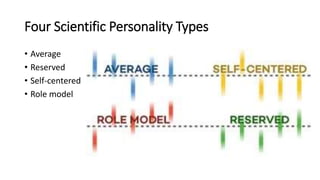
Four Scientific Personality Types
• Average
• Reserved
• Self-centered
• Role model
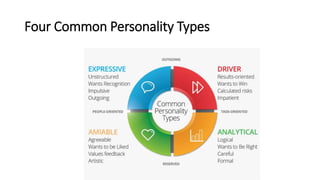
Four Common Personality Types
Four types of Personality By Hippocrates
1 Choleric
• This personality type is passionate,
outspoken, competitive, determined, strong-
willed and adventurous.
• Usually, choleric are goal-oriented and may be
very logical and analytical. They may not be
particularly social.
2. Sanguine
• This type is lively, playful, imaginative,
talkative and sociable.
• Sanguine kids may be carefree, optimistic,
adventurous and not afraid of risks.
• These children might get bored easily and
have a hard time without entertainment.
3. Melancholic
• This personality type is deep, detailed,
respectful, tidy, careful and fond of traditions.
• They are also social and want to be helpful.
• These children are not as fond of adventure
or risks as other personality types.
4. Phlegmatic
• This personality type is thoughtful, attentive,
controlled and diplomatic.
• Kids with phlegmatic personality types often
need close personal relationships.
• They are loyal, avoid conflict and enjoy
helping others.
Personality and the Social Media
• Constant use of the various social media to interact with other people
in a virtual reality rather than in person has led to a great deal of
recent research which attempts to relate our personalities to the
online world in which we now live.
• There are at least three ways in which social media and personality
may interact to affect one another,
1. Do we present our real selves on social media?
2. Does the use of social media influence or change our personalities?
3. Do people with different personalities use social media in different ways?
• Are You the Same Person Online?
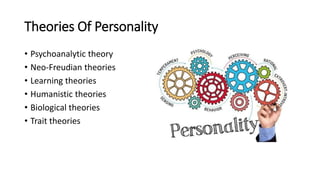
Theories Of Personality
• Psychoanalytic theory
• Neo-Freudian theories
• Learning theories
• Humanistic theories
• Biological theories
• Trait theories
The Psychoanalytic Approach
• The earliest approach to the formal study of personality was
psychoanalysis(Unconscious), the creation of Sigmund Freud,
• Nearly every personality theory developed in the years since Freud’s work
owes a debt to his position—either building on it or opposing it.
• Psychoanalysis as Freud conceived it emphasized unconscious forces,
biologically based drives of sex and aggression, and unavoidable conflicts in
early childhood.
• These were considered the rulers and shapers of our personality.
• Freud’s views had an impact not only on psychology but also on the general
culture.
• He succeeded in redefining the human personality and revolutionizing our
ways of thinking about human nature—about who we are.
The Neo-psychoanalytic Approach
• Several personality theorists, who initially were loyal to Freud and committed to his system of
psychoanalysis, broke away because of their opposition to certain aspects of his approach.
• Carl Jung and Alfred Adler were associates of Freud’s before they rebelled against him and offered
their own views of personality.
• Karen Horney did not have a personal relationship with Freud but was also an orthodox Freudian
before marking out a different path.
• Erik Erikson’s work is also derived from Freudian psychoanalysis.
• These neo-psychoanalytic theorists differ from one another on a number of issues but they were
equally opposed to Freud’s emphasis on instincts as the primary motivators of human behavior, as well
as his deterministic view of personality.
• These neo-psychoanalytic theorists presented more optimistic and flattering images of human nature
than Freud did.
• Their work shows how quickly the field of personality diversified within only a decade after it formally
beg
Crux of All Theories
• Personality in Perspective
• The Genetic Factor
• The Environmental Factor
• The Learning Factor
• The Parental Factor
• The Developmental Factor
• The Consciousness Factor
• The Unconscious Factor
• Cultural factors
• Religious Factors
• Race and Gender
Personality Testing
Personality Testing
• Personality tests are techniques designed to measure one's
personality.
• They are used to diagnose psychological problems as well as to screen
candidates for college and employment.
• Types
 Objective Personality Test
 Projective Personality Test
Types of Personality Testing
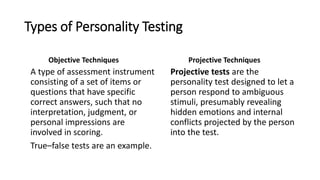
Objective Techniques
A type of assessment instrument
consisting of a set of items or
questions that have specific
correct answers, such that no
interpretation, judgment, or
personal impressions are
involved in scoring.
True–false tests are an example.
Projective Techniques
Projective tests are the
personality test designed to let a
person respond to ambiguous
stimuli, presumably revealing
hidden emotions and internal
conflicts projected by the person
into the test.
Personality Tests
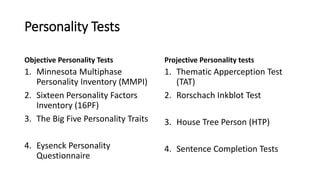
Objective Personality Tests
1. Minnesota Multiphase
Personality Inventory (MMPI)
2. Sixteen Personality Factors
Inventory (16PF)
3. The Big Five Personality Traits
4. Eysenck Personality
Questionnaire
Projective Personality tests
1. Thematic Apperception Test
(TAT)
2. Rorschach Inkblot Test
3. House Tree Person (HTP)
4. Sentence Completion Tests
Difference between Personality Tests
Objective Personality Tests
• Valid
• Reliable
• Standardized scoring system
• Independent
• Less bias
Projective Personality tests
• Less valid
• Less Reliable
• No standardized scoring system
• Dependent
• Bias and beliefs
Tips for taking Personality Tests
• Be honest
• Follow instructions carefully
• Feel Comfort
• Focus on the Test
• Stay Genuine
• Don't try to beat the test
• Don't consider it as game
Thanks

Personality presented by rustam

  • 1.
  • 2.
    Personality • The wordpersonality have been derived from the Latin word persona, which refers to a theatrical mask worn by performers in order to either project different roles or disguise their identities. • Personality refers to individual differences in characteristic patterns of thinking, feeling and behaving. • The unique, relatively enduring internal and external aspects of a person’s character that influence behavior indifferent situations. • The state of being a person • The characteristics and qualities that form a person’s distinctive character • The sum total of all the physical, mental, emotional, and social characteristic of a person
  • 3.
    Professional Definitions • “Thecharacteristics or blend of characteristics that make a person unique” (Weinberg &Gould, 1999) • "Personality refers to individuals characteristics patterns of thought emotion and behaviour together with the Psychological mechanisms - -hidden or not-- behind those patterns." Funder • "That which permits a prediction of what a person will do in a given situation." Cattel
  • 4.
    Four Scientific PersonalityTypes • Average • Reserved • Self-centered • Role model
  • 5.
  • 6.
    Four types ofPersonality By Hippocrates 1 Choleric • This personality type is passionate, outspoken, competitive, determined, strong- willed and adventurous. • Usually, choleric are goal-oriented and may be very logical and analytical. They may not be particularly social. 2. Sanguine • This type is lively, playful, imaginative, talkative and sociable. • Sanguine kids may be carefree, optimistic, adventurous and not afraid of risks. • These children might get bored easily and have a hard time without entertainment. 3. Melancholic • This personality type is deep, detailed, respectful, tidy, careful and fond of traditions. • They are also social and want to be helpful. • These children are not as fond of adventure or risks as other personality types. 4. Phlegmatic • This personality type is thoughtful, attentive, controlled and diplomatic. • Kids with phlegmatic personality types often need close personal relationships. • They are loyal, avoid conflict and enjoy helping others.
  • 7.
    Personality and theSocial Media • Constant use of the various social media to interact with other people in a virtual reality rather than in person has led to a great deal of recent research which attempts to relate our personalities to the online world in which we now live. • There are at least three ways in which social media and personality may interact to affect one another, 1. Do we present our real selves on social media? 2. Does the use of social media influence or change our personalities? 3. Do people with different personalities use social media in different ways? • Are You the Same Person Online?
  • 8.
  • 9.
    Theories Of Personality •Psychoanalytic theory • Neo-Freudian theories • Learning theories • Humanistic theories • Biological theories • Trait theories
  • 10.
    The Psychoanalytic Approach •The earliest approach to the formal study of personality was psychoanalysis(Unconscious), the creation of Sigmund Freud, • Nearly every personality theory developed in the years since Freud’s work owes a debt to his position—either building on it or opposing it. • Psychoanalysis as Freud conceived it emphasized unconscious forces, biologically based drives of sex and aggression, and unavoidable conflicts in early childhood. • These were considered the rulers and shapers of our personality. • Freud’s views had an impact not only on psychology but also on the general culture. • He succeeded in redefining the human personality and revolutionizing our ways of thinking about human nature—about who we are.
  • 11.
    The Neo-psychoanalytic Approach •Several personality theorists, who initially were loyal to Freud and committed to his system of psychoanalysis, broke away because of their opposition to certain aspects of his approach. • Carl Jung and Alfred Adler were associates of Freud’s before they rebelled against him and offered their own views of personality. • Karen Horney did not have a personal relationship with Freud but was also an orthodox Freudian before marking out a different path. • Erik Erikson’s work is also derived from Freudian psychoanalysis. • These neo-psychoanalytic theorists differ from one another on a number of issues but they were equally opposed to Freud’s emphasis on instincts as the primary motivators of human behavior, as well as his deterministic view of personality. • These neo-psychoanalytic theorists presented more optimistic and flattering images of human nature than Freud did. • Their work shows how quickly the field of personality diversified within only a decade after it formally beg
  • 12.
    Crux of AllTheories • Personality in Perspective • The Genetic Factor • The Environmental Factor • The Learning Factor • The Parental Factor • The Developmental Factor • The Consciousness Factor • The Unconscious Factor • Cultural factors • Religious Factors • Race and Gender
  • 13.
  • 14.
    Personality Testing • Personalitytests are techniques designed to measure one's personality. • They are used to diagnose psychological problems as well as to screen candidates for college and employment. • Types  Objective Personality Test  Projective Personality Test
  • 15.
    Types of PersonalityTesting Objective Techniques A type of assessment instrument consisting of a set of items or questions that have specific correct answers, such that no interpretation, judgment, or personal impressions are involved in scoring. True–false tests are an example. Projective Techniques Projective tests are the personality test designed to let a person respond to ambiguous stimuli, presumably revealing hidden emotions and internal conflicts projected by the person into the test.
  • 16.
    Personality Tests Objective PersonalityTests 1. Minnesota Multiphase Personality Inventory (MMPI) 2. Sixteen Personality Factors Inventory (16PF) 3. The Big Five Personality Traits 4. Eysenck Personality Questionnaire Projective Personality tests 1. Thematic Apperception Test (TAT) 2. Rorschach Inkblot Test 3. House Tree Person (HTP) 4. Sentence Completion Tests
  • 17.
    Difference between PersonalityTests Objective Personality Tests • Valid • Reliable • Standardized scoring system • Independent • Less bias Projective Personality tests • Less valid • Less Reliable • No standardized scoring system • Dependent • Bias and beliefs
  • 18.
    Tips for takingPersonality Tests • Be honest • Follow instructions carefully • Feel Comfort • Focus on the Test • Stay Genuine • Don't try to beat the test • Don't consider it as game
  • 19.