Practical Immunology and
Serology
Hawler Medical University
College of Health Sciences
Clinical Biochemistry Dept.
Ass. Lec. Amer Ali Khaleel
(M.Sc. Clinical Immunology)
Lab.3 : Widal test
Copyright © 2016
Introductio
n:• Widal test is a serological method to diagnose enteric or typhoid
fever that is cause by the infection with pathogenic
microorganisms like Salmonella typhi, Salmonella paratyphi a, b
and c.
• The method of diagnostic test is based upon a visible to the
naked eye agglutination (clumps) reaction between antibodies of
patient serum and antigens specifically prepared from
Salmonella sp (KIT).
• Salmonella possess the following 3 antigens:
• Flagellar antigen or H antigen
• Somatic antigen or O antigen
• Surface antigen or Vi antigen
Introduction: (cont.)
•The tests measure agglutinating antibodies directed against
a Salmonella O somatic surface antigen and/or
a Salmonella H flagella antigen of the suspected organism.
•The Widal test detects antibodies against O and H antigens.
•Type of techniques is use direct agglutination.
•Widal test, firstly descried by Fernand Widal in 1896.
Clinical manifestation:
•Chest congestion
•Constipation
•Diarrhea
•Feel week
•Gastroenteritis
•Headache
•High temperature
•Loss of appetite
•Stomach pains
•Weakness
Modes of
transmission :
•Ingestion of contaminated food or water.
•Rarely , from person to person – fecal-oral route.
•Food handlers/ Carriers.
Serodiagnosis of Typhoid
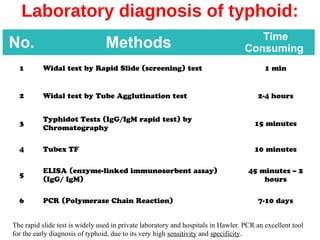
No. Methods Time
Consuming
1 Widal test by Rapid Slide (Screening) test 1 min
2 Widal test by Tube Agglutination test 2-4 hours
3 Typhidot Tests (IgG/IgM rapid test) by Chromatography 15 minutes
4 Tubex TF 10 minutes
5
ELISA (Enzyme-Linked ImmunoSorbent Assay) (IgG/
IgM)
45 minutes –
2 hours
6 ECL (ElectroChemiluminescent immunoassays) (IgG/ IgM)
45 minutes –
2 hours
7 PCR (Polymerase Chain Reaction) 7-10 days
The rapid slide test is widely used in private laboratory and hospitals in Hawler. PCR an excellent tool
for the early diagnosis of typhoid, due to its very high sensitivity and specificity.
Principle of Widal
test:
•Antibody in the serum produced in the response to
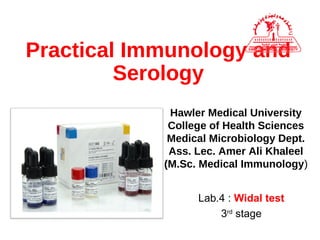
Salmonella organism, the kit contains antigen
suspensions that are killed bacteria and they were
stained to enhance the reading of agglutination
tests.
•The blue stained antigens are specific to the somatic
antigens (O-Ag), while the red stained antigens are
specific to the flagella antigens (H-Ag).
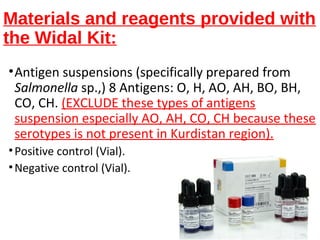
Materials And Reagents Provided With The
Widal Kit:
•Antigen suspensions (specifically prepared from
Salmonella sp.) 8 Antigens: O, H, AO, AH, BO, BH,
CO, CH.
•Positive control (Vial).
•Negative control (Vial).
•Instruction for use (leaflet).
•White Glass slide.
•Stirring Sticks.
Widal
controls:
Widal negative control (-)
•Contains no antibodies against the specific bacteria.
Widal positive control (+)
•The widal positive control contains ready to use standardized goat
antiserum with polyspecific antibodies having specific reactivity towards
S. typhi O and H antigens, S. paratyphi AH and BH, S. paratyphi AO and
BO, S. paratyphi CO and CH antigens and is useful in the validation of
the performance of Widal reagents.
Notes
:
1- A positive and negative control should be run with each test.
2- If the reagent fails to agglutinate with the positive control, or
dose agglutinate with the negative control, it should be discard or
review the procedure and repeat the test with a new test device.
If the problem persists, discontinue using the test kit immediately
and contact your local distributor.
3-Before started the Widal test EXCLUDE these types of antigens
suspension especially AO, AH, CO, CH because these serotypes is
not present in Kurdistan region.
Additional materials and reagents
required for the febrile agglutinins
test:
•Applicator sticks (glass rod or wooden).
•Automatic pipettes or plastic droppers.
•Laboratory alarm clock or Timer.
•Glass plate or card plastic slide or disposable test
slide or reaction slides with white background.
Rapid Slide
(screening) Test:
•Slide Widal test is more popular as it gives rapid results.
Producers:
1- Place 1 drop (or transfer 50 µl) of the serum patient into
each of circle slide.
2- Add 1 drop of well shake Ag. O, H, B (O) & B (H)
respectively into each circle.
3- Spread the contents to fill the whole circle area.
4- Mix & rotate the slide for 1 minute & observe for
agglutination.
5- Report the result.
Observation and
Result:
• No agglutination = Negative
• Result reported as ‘titres’ : Highest dilution where agglutination is
seen:
• If agglutination appear after 15 seconds = (1:640)
• If agglutination appear after 30 seconds = (1:320)
• If agglutination appear after 1 min. = (1:160)
• If agglutination appear after 1.30 min. = (1:80)
• This test is a screening test only for the detection of Widal agglutinins.
If result is positive it must be confirmed by other serological tests for
Widal.
Interpretatio
n:
•Salmonella typhi O (+ve mean recent (acute) infection).
•Salmonella typhi H (+ve mean old (chronic) infection).
•Salmonella paratyphi bO,bH (+ve mean carrier can infect other).
•Test results need to be interpreted carefully in the light of past history
of enteric fever, typhoid vaccination, general level of antibodies in the
populations in endemic areas of the world.
Limitations of Widal test:
• The Widal test has a very low specificity, less sensitive, confusing
and difficult to interpret for the diagnosis of typhoid f ever,
because cross-agglutinating antibodies remaining from past
infections with related salmonella serotypes give false-positive
results.
• Furthermore, in areas where fever due to infectious causes is a
common occurrence. So false positive reactions may occur as a
result of non-typhoid.
• In spite of several limitation many Physicians depend on Widal
Test.
Causes Of False-positive Widal
Agglutination Tests:
1. Previous immunization with Salmonella antigen.
2. Cross-reaction with non- typhoid Salmonella.
3. Variability and poorly standardized commercial
antigen preparation (kit).
4. Infection with malaria.
5. Other Enterobacteriaceae sharing the same s-LPS .
Why We Still Use Widal Test
or
Widal A Deleted Test In Many Nations
• The Widal test is an old serologic assay for detecting antibodies
to the O and H antigens of salmonella.
• Although the test is no longer performed in the U.S. or other
developed countries, it is still in use in many developing
countries because of its low cost and limited resources require
the use of rapid , and it remains in use in many areas throughout the
world.
Prophyla
xis:1. Simple hand hygiene and washing can reduce several
cases of typhoid.
2. All milk and dairy products should be pasteurized.
Summary:
• It is conclude, that even today, the Widal test remains
one of the best, easily accessible, cheap and simple
method for the diagnosis of typhoid fever.
1- Trying to drawing of blood sample from your colleagues.
2- Preparation of serum.
3- Do Widal test for your colleagues.
4- Report the result and interpretation.
Practical Part
Any
Questions??!!!

Widal test

  • 1.
    Practical Immunology and Serology HawlerMedical University College of Health Sciences Clinical Biochemistry Dept. Ass. Lec. Amer Ali Khaleel (M.Sc. Clinical Immunology) Lab.3 : Widal test Copyright © 2016
  • 2.
    Introductio n:• Widal testis a serological method to diagnose enteric or typhoid fever that is cause by the infection with pathogenic microorganisms like Salmonella typhi, Salmonella paratyphi a, b and c. • The method of diagnostic test is based upon a visible to the naked eye agglutination (clumps) reaction between antibodies of patient serum and antigens specifically prepared from Salmonella sp (KIT). • Salmonella possess the following 3 antigens: • Flagellar antigen or H antigen • Somatic antigen or O antigen • Surface antigen or Vi antigen
  • 3.
    Introduction: (cont.) •The testsmeasure agglutinating antibodies directed against a Salmonella O somatic surface antigen and/or a Salmonella H flagella antigen of the suspected organism. •The Widal test detects antibodies against O and H antigens. •Type of techniques is use direct agglutination. •Widal test, firstly descried by Fernand Widal in 1896.
  • 4.
    Clinical manifestation: •Chest congestion •Constipation •Diarrhea •Feelweek •Gastroenteritis •Headache •High temperature •Loss of appetite •Stomach pains •Weakness
  • 5.
    Modes of transmission : •Ingestionof contaminated food or water. •Rarely , from person to person – fecal-oral route. •Food handlers/ Carriers.
  • 6.
    Serodiagnosis of Typhoid No.Methods Time Consuming 1 Widal test by Rapid Slide (Screening) test 1 min 2 Widal test by Tube Agglutination test 2-4 hours 3 Typhidot Tests (IgG/IgM rapid test) by Chromatography 15 minutes 4 Tubex TF 10 minutes 5 ELISA (Enzyme-Linked ImmunoSorbent Assay) (IgG/ IgM) 45 minutes – 2 hours 6 ECL (ElectroChemiluminescent immunoassays) (IgG/ IgM) 45 minutes – 2 hours 7 PCR (Polymerase Chain Reaction) 7-10 days The rapid slide test is widely used in private laboratory and hospitals in Hawler. PCR an excellent tool for the early diagnosis of typhoid, due to its very high sensitivity and specificity.
  • 7.
    Principle of Widal test: •Antibodyin the serum produced in the response to Salmonella organism, the kit contains antigen suspensions that are killed bacteria and they were stained to enhance the reading of agglutination tests. •The blue stained antigens are specific to the somatic antigens (O-Ag), while the red stained antigens are specific to the flagella antigens (H-Ag).
  • 8.
    Materials And ReagentsProvided With The Widal Kit: •Antigen suspensions (specifically prepared from Salmonella sp.) 8 Antigens: O, H, AO, AH, BO, BH, CO, CH. •Positive control (Vial). •Negative control (Vial). •Instruction for use (leaflet). •White Glass slide. •Stirring Sticks.
  • 9.
    Widal controls: Widal negative control(-) •Contains no antibodies against the specific bacteria. Widal positive control (+) •The widal positive control contains ready to use standardized goat antiserum with polyspecific antibodies having specific reactivity towards S. typhi O and H antigens, S. paratyphi AH and BH, S. paratyphi AO and BO, S. paratyphi CO and CH antigens and is useful in the validation of the performance of Widal reagents.
  • 10.
    Notes : 1- A positiveand negative control should be run with each test. 2- If the reagent fails to agglutinate with the positive control, or dose agglutinate with the negative control, it should be discard or review the procedure and repeat the test with a new test device. If the problem persists, discontinue using the test kit immediately and contact your local distributor. 3-Before started the Widal test EXCLUDE these types of antigens suspension especially AO, AH, CO, CH because these serotypes is not present in Kurdistan region.
  • 11.
    Additional materials andreagents required for the febrile agglutinins test: •Applicator sticks (glass rod or wooden). •Automatic pipettes or plastic droppers. •Laboratory alarm clock or Timer. •Glass plate or card plastic slide or disposable test slide or reaction slides with white background.
  • 12.
    Rapid Slide (screening) Test: •SlideWidal test is more popular as it gives rapid results. Producers: 1- Place 1 drop (or transfer 50 µl) of the serum patient into each of circle slide. 2- Add 1 drop of well shake Ag. O, H, B (O) & B (H) respectively into each circle. 3- Spread the contents to fill the whole circle area. 4- Mix & rotate the slide for 1 minute & observe for agglutination. 5- Report the result.
  • 13.
    Observation and Result: • Noagglutination = Negative • Result reported as ‘titres’ : Highest dilution where agglutination is seen: • If agglutination appear after 15 seconds = (1:640) • If agglutination appear after 30 seconds = (1:320) • If agglutination appear after 1 min. = (1:160) • If agglutination appear after 1.30 min. = (1:80) • This test is a screening test only for the detection of Widal agglutinins. If result is positive it must be confirmed by other serological tests for Widal.
  • 14.
    Interpretatio n: •Salmonella typhi O(+ve mean recent (acute) infection). •Salmonella typhi H (+ve mean old (chronic) infection). •Salmonella paratyphi bO,bH (+ve mean carrier can infect other). •Test results need to be interpreted carefully in the light of past history of enteric fever, typhoid vaccination, general level of antibodies in the populations in endemic areas of the world.
  • 15.
    Limitations of Widaltest: • The Widal test has a very low specificity, less sensitive, confusing and difficult to interpret for the diagnosis of typhoid f ever, because cross-agglutinating antibodies remaining from past infections with related salmonella serotypes give false-positive results. • Furthermore, in areas where fever due to infectious causes is a common occurrence. So false positive reactions may occur as a result of non-typhoid. • In spite of several limitation many Physicians depend on Widal Test.
  • 16.
    Causes Of False-positiveWidal Agglutination Tests: 1. Previous immunization with Salmonella antigen. 2. Cross-reaction with non- typhoid Salmonella. 3. Variability and poorly standardized commercial antigen preparation (kit). 4. Infection with malaria. 5. Other Enterobacteriaceae sharing the same s-LPS .
  • 17.
    Why We StillUse Widal Test or Widal A Deleted Test In Many Nations • The Widal test is an old serologic assay for detecting antibodies to the O and H antigens of salmonella. • Although the test is no longer performed in the U.S. or other developed countries, it is still in use in many developing countries because of its low cost and limited resources require the use of rapid , and it remains in use in many areas throughout the world.
  • 18.
    Prophyla xis:1. Simple handhygiene and washing can reduce several cases of typhoid. 2. All milk and dairy products should be pasteurized. Summary: • It is conclude, that even today, the Widal test remains one of the best, easily accessible, cheap and simple method for the diagnosis of typhoid fever.
  • 19.
    1- Trying todrawing of blood sample from your colleagues. 2- Preparation of serum. 3- Do Widal test for your colleagues. 4- Report the result and interpretation. Practical Part
  • 20.

Editor's Notes

  • #2 Prepared By
  • #3 Antibodies appears after a period (2-3 weeks) in the serum of the patient. The term "enteric fever" is a collective term that refers to typhoid and paratyphoid
  • #5 What Are Typhoid Fever Symptoms and Signs?
  • #6 What Are Typhoid Fever Symptoms and Signs?
  • #7 MICROBIOLOGICAL PROCEDURES Diagnosis is made by isolation of S.typhi from bood,bone marrow and stool. Serology level The Widal test is commonly used to diagnose Typhoid. Molecular methods level IDL Tubex test:which detect IgM09 antibodies from patient within a few minutes. Typhidot:is another rapid serological test takes three hours to perform,it detect specific IgM and IgG antibodies against a 50 KD antigen of S.typhi Typhidot M: a new version of typhidot test detect specific IgM antibodies only.
  • #11 Review the procedure and repeat the test with a new test device. If the problem persists, discontinue using the test kit immediately and contact your local distributor.
  • #15 Patient history should be taken into account before giving the result.
  • #18 developing countries الدول النامية developed countries الدول المتقدمة Widal test is Discontinued in all Developed countries, However many in Developed countries still depend on this test which lacks Sensitivity and Specificity
  • #20 How do I interpret my Widal / Typhoid test results?
  • #21 Is There a Vaccine for Typhoid Fever?