Scourge of MRSA
Divya Mathew
Friday, 21st
February 2014
Contents
1. Introduction
2. Evolution of MRSA
3. Genetics of MRSA
4. How do you get MRSA?
5. MRSA statistics
6. Clinical manifestations
7. Diagnosis and treatment
8. Ongoing research
9. Prevention
333
MRSA evolved into a notorious bug through the process of natural
selection.
INTRODUCTION
 Methicillin Resistant Staphylococcus
aureus
 Gram positive cocci in clusters
 Phylum: Firmicutes
 Normal flora of human skin and
respiratory tract
 MRSA: resistant to beta-lactam antibiotics
 ORSA: Oxacillin Resistant S. aureus
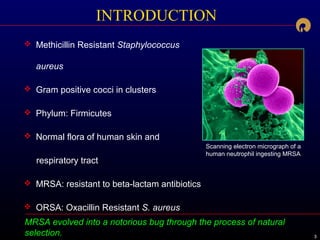
Scanning electron micrograph of a
human neutrophil ingesting MRSA
444
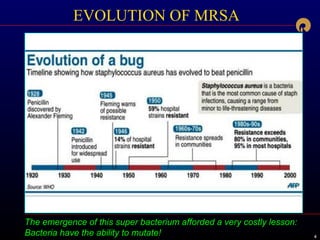
The emergence of this super bacterium afforded a very costly lesson:
Bacteria have the ability to mutate!
EVOLUTION OF MRSA
555
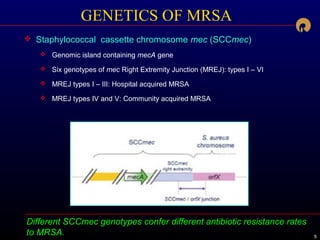
Different SCCmec genotypes confer different antibiotic resistance rates
to MRSA.
GENETICS OF MRSA
 Staphylococcal cassette chromosome mec (SCCmec)
 Genomic island containing mecA gene
 Six genotypes of mec Right Extremity Junction (MREJ): types I – VI
 MREJ types I – III: Hospital acquired MRSA
 MREJ types IV and V: Community acquired MRSA
666
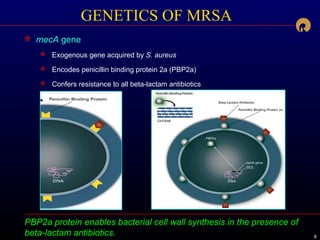
PBP2a protein enables bacterial cell wall synthesis in the presence of
beta-lactam antibiotics.
GENETICS OF MRSA
 mecA gene
 Exogenous gene acquired by S. aureus
 Encodes penicillin binding protein 2a (PBP2a)
 Confers resistance to all beta-lactam antibiotics
777
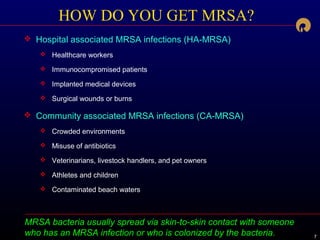
MRSA bacteria usually spread via skin-to-skin contact with someone
who has an MRSA infection or who is colonized by the bacteria.
HOW DO YOU GET MRSA?
 Hospital associated MRSA infections (HA-MRSA)
 Healthcare workers
 Immunocompromised patients
 Implanted medical devices
 Surgical wounds or burns
 Community associated MRSA infections (CA-MRSA)
 Crowded environments
 Misuse of antibiotics
 Veterinarians, livestock handlers, and pet owners
 Athletes and children
 Contaminated beach waters
888
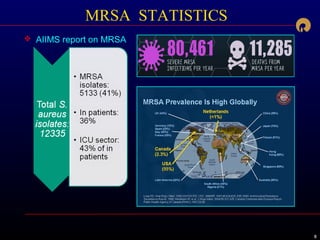
MRSA STATISTICS
 AIIMS report on MRSA
999
CLINICAL MANIFESTATIONS
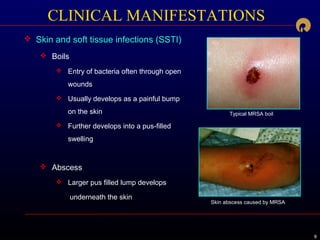
 Skin and soft tissue infections (SSTI)
 Boils
 Entry of bacteria often through open
wounds
 Usually develops as a painful bump
on the skin
 Further develops into a pus-filled
swelling
 Abscess
 Larger pus filled lump develops
underneath the skin
Typical MRSA boil
Skin abscess caused by MRSA
101010
SSTIs are generally picked up from the community.
CLINICAL MANIFESTATIONS
 Skin and soft tissue infections (SSTI)
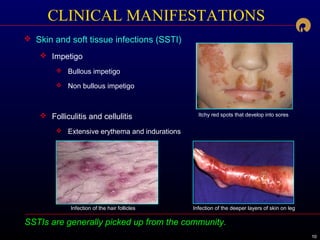
 Impetigo
 Bullous impetigo
 Non bullous impetigo
 Folliculitis and cellulitis
 Extensive erythema and indurations
Itchy red spots that develop into sores
Infection of the hair follicles Infection of the deeper layers of skin on leg
111111
If the MRSA penetrates into the deeper parts of the body or into the
blood, they can cause fatal infections.
CLINICAL MANIFESTATIONS
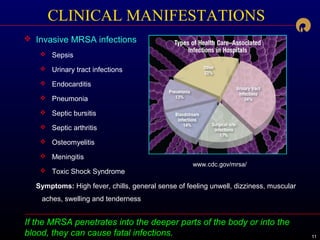
 Invasive MRSA infections
 Sepsis
 Urinary tract infections
 Endocarditis
 Pneumonia
 Septic bursitis
 Septic arthritis
 Osteomyelitis
 Meningitis
 Toxic Shock Syndrome
Symptoms: High fever, chills, general sense of feeling unwell, dizziness, muscular
aches, swelling and tenderness
www.cdc.gov/mrsa/
121212
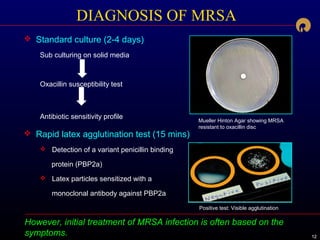
However, initial treatment of MRSA infection is often based on the
symptoms.
DIAGNOSIS OF MRSA
 Standard culture (2-4 days)
Sub culturing on solid media
Oxacillin susceptibility test
Antibiotic sensitivity profile
 Rapid latex agglutination test (15 mins)
 Detection of a variant penicillin binding
protein (PBP2a)
 Latex particles sensitized with a
monoclonal antibody against PBP2a
Mueller Hinton Agar showing MRSA
resistant to oxacillin disc
Positive test: Visible agglutination
131313
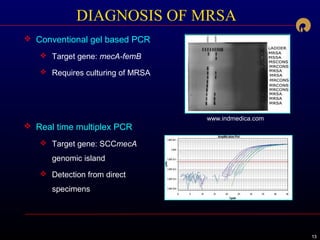
DIAGNOSIS OF MRSA
 Conventional gel based PCR
 Target gene: mecA-femB
 Requires culturing of MRSA
 Real time multiplex PCR
 Target gene: SCCmecA
genomic island
 Detection from direct
specimens
www.indmedica.com
141414
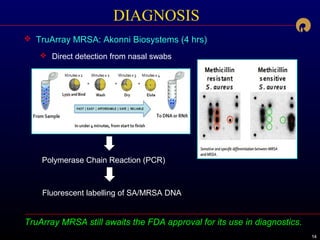
TruArray MRSA still awaits the FDA approval for its use in diagnostics.
DIAGNOSIS
 TruArray MRSA: Akonni Biosystems (4 hrs)
 Direct detection from nasal swabs
Polymerase Chain Reaction (PCR)
Fluorescent labelling of SA/MRSA DNA
151515
The decolonization treatment does not require hospitalization.
TREATMENT
 Screening for MRSA: Swab test
 Before or after hospitalization of a patient
 Before a planned surgery or Caesarean section
 MRSA positive patients Strict isolation
 Suppression or decolonization treatment
 Skin - Antibacterial body wash or powder
 Nose – Antibacterial nasal cream
 Scalp – Antibacterial shampoo
 Decolonization regimen: daily for 5 consecutive days
161616
Once established, MRSA invasive infections are often incurable, even
when appropriate antibiotics are used.
TREATMENT
 Skin and soft tissue infections
 Boils or abscesses: incision and drainage
 Folliculitis or cellulitis: Antibiotic course (5-10 days)
 Surgical wounds or burns: Antibiotic course (7-14 days)
 Invasive MRSA infections
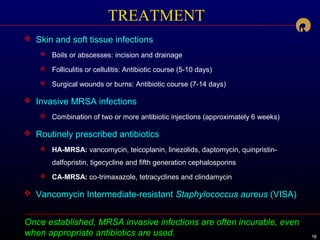
 Combination of two or more antibiotic injections (approximately 6 weeks)
 Routinely prescribed antibiotics
 HA-MRSA: vancomycin, teicoplanin, linezolids, daptomycin, quinpristin-
dalfopristin, tigecycline and fifth generation cephalosporins
 CA-MRSA: co-trimaxazole, tetracyclines and clindamycin
 Vancomycin Intermediate-resistant Staphylococcus aureus (VISA)
171717
ADEP-antibiotic drug combination and super antigen based vaccines
generate hope for complete sterilization in MRSA infections.
ONGOING RESEARCH
 Nature (November 2013)
 Professor Kim Lewis (Boston)
 Combination of conventional antibiotics with acyldepsipeptide
(ADEP)
 Journal of Infectious Diseases (December 2013)
 Microbiologist Patrick Schlievert (Iowa)
 Super antigen based vaccines for MRSA studied in rabbits
 Awaits FDA approval for clinical trials
181818
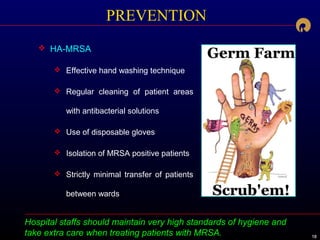
Hospital staffs should maintain very high standards of hygiene and
take extra care when treating patients with MRSA.
PREVENTION
 HA-MRSA
 Effective hand washing technique
 Regular cleaning of patient areas
with antibacterial solutions
 Use of disposable gloves
 Isolation of MRSA positive patients
 Strictly minimal transfer of patients
between wards
191919
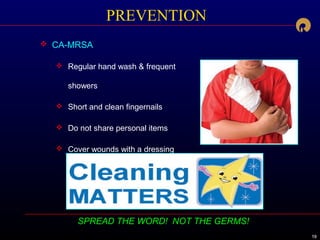
SPREAD THE WORD! NOT THE GERMS!
PREVENTION
 CA-MRSA
 Regular hand wash & frequent
showers
 Short and clean fingernails
 Do not share personal items
 Cover wounds with a dressing
Thank You!

SCOURGE_OF_MRSA_97-2003

  • 1.
    Scourge of MRSA DivyaMathew Friday, 21st February 2014
  • 2.
    Contents 1. Introduction 2. Evolutionof MRSA 3. Genetics of MRSA 4. How do you get MRSA? 5. MRSA statistics 6. Clinical manifestations 7. Diagnosis and treatment 8. Ongoing research 9. Prevention
  • 3.
    333 MRSA evolved intoa notorious bug through the process of natural selection. INTRODUCTION  Methicillin Resistant Staphylococcus aureus  Gram positive cocci in clusters  Phylum: Firmicutes  Normal flora of human skin and respiratory tract  MRSA: resistant to beta-lactam antibiotics  ORSA: Oxacillin Resistant S. aureus Scanning electron micrograph of a human neutrophil ingesting MRSA
  • 4.
    444 The emergence ofthis super bacterium afforded a very costly lesson: Bacteria have the ability to mutate! EVOLUTION OF MRSA
  • 5.
    555 Different SCCmec genotypesconfer different antibiotic resistance rates to MRSA. GENETICS OF MRSA  Staphylococcal cassette chromosome mec (SCCmec)  Genomic island containing mecA gene  Six genotypes of mec Right Extremity Junction (MREJ): types I – VI  MREJ types I – III: Hospital acquired MRSA  MREJ types IV and V: Community acquired MRSA
  • 6.
    666 PBP2a protein enablesbacterial cell wall synthesis in the presence of beta-lactam antibiotics. GENETICS OF MRSA  mecA gene  Exogenous gene acquired by S. aureus  Encodes penicillin binding protein 2a (PBP2a)  Confers resistance to all beta-lactam antibiotics
  • 7.
    777 MRSA bacteria usuallyspread via skin-to-skin contact with someone who has an MRSA infection or who is colonized by the bacteria. HOW DO YOU GET MRSA?  Hospital associated MRSA infections (HA-MRSA)  Healthcare workers  Immunocompromised patients  Implanted medical devices  Surgical wounds or burns  Community associated MRSA infections (CA-MRSA)  Crowded environments  Misuse of antibiotics  Veterinarians, livestock handlers, and pet owners  Athletes and children  Contaminated beach waters
  • 8.
  • 9.
    999 CLINICAL MANIFESTATIONS  Skinand soft tissue infections (SSTI)  Boils  Entry of bacteria often through open wounds  Usually develops as a painful bump on the skin  Further develops into a pus-filled swelling  Abscess  Larger pus filled lump develops underneath the skin Typical MRSA boil Skin abscess caused by MRSA
  • 10.
    101010 SSTIs are generallypicked up from the community. CLINICAL MANIFESTATIONS  Skin and soft tissue infections (SSTI)  Impetigo  Bullous impetigo  Non bullous impetigo  Folliculitis and cellulitis  Extensive erythema and indurations Itchy red spots that develop into sores Infection of the hair follicles Infection of the deeper layers of skin on leg
  • 11.
    111111 If the MRSApenetrates into the deeper parts of the body or into the blood, they can cause fatal infections. CLINICAL MANIFESTATIONS  Invasive MRSA infections  Sepsis  Urinary tract infections  Endocarditis  Pneumonia  Septic bursitis  Septic arthritis  Osteomyelitis  Meningitis  Toxic Shock Syndrome Symptoms: High fever, chills, general sense of feeling unwell, dizziness, muscular aches, swelling and tenderness www.cdc.gov/mrsa/
  • 12.
    121212 However, initial treatmentof MRSA infection is often based on the symptoms. DIAGNOSIS OF MRSA  Standard culture (2-4 days) Sub culturing on solid media Oxacillin susceptibility test Antibiotic sensitivity profile  Rapid latex agglutination test (15 mins)  Detection of a variant penicillin binding protein (PBP2a)  Latex particles sensitized with a monoclonal antibody against PBP2a Mueller Hinton Agar showing MRSA resistant to oxacillin disc Positive test: Visible agglutination
  • 13.
    131313 DIAGNOSIS OF MRSA Conventional gel based PCR  Target gene: mecA-femB  Requires culturing of MRSA  Real time multiplex PCR  Target gene: SCCmecA genomic island  Detection from direct specimens www.indmedica.com
  • 14.
    141414 TruArray MRSA stillawaits the FDA approval for its use in diagnostics. DIAGNOSIS  TruArray MRSA: Akonni Biosystems (4 hrs)  Direct detection from nasal swabs Polymerase Chain Reaction (PCR) Fluorescent labelling of SA/MRSA DNA
  • 15.
    151515 The decolonization treatmentdoes not require hospitalization. TREATMENT  Screening for MRSA: Swab test  Before or after hospitalization of a patient  Before a planned surgery or Caesarean section  MRSA positive patients Strict isolation  Suppression or decolonization treatment  Skin - Antibacterial body wash or powder  Nose – Antibacterial nasal cream  Scalp – Antibacterial shampoo  Decolonization regimen: daily for 5 consecutive days
  • 16.
    161616 Once established, MRSAinvasive infections are often incurable, even when appropriate antibiotics are used. TREATMENT  Skin and soft tissue infections  Boils or abscesses: incision and drainage  Folliculitis or cellulitis: Antibiotic course (5-10 days)  Surgical wounds or burns: Antibiotic course (7-14 days)  Invasive MRSA infections  Combination of two or more antibiotic injections (approximately 6 weeks)  Routinely prescribed antibiotics  HA-MRSA: vancomycin, teicoplanin, linezolids, daptomycin, quinpristin- dalfopristin, tigecycline and fifth generation cephalosporins  CA-MRSA: co-trimaxazole, tetracyclines and clindamycin  Vancomycin Intermediate-resistant Staphylococcus aureus (VISA)
  • 17.
    171717 ADEP-antibiotic drug combinationand super antigen based vaccines generate hope for complete sterilization in MRSA infections. ONGOING RESEARCH  Nature (November 2013)  Professor Kim Lewis (Boston)  Combination of conventional antibiotics with acyldepsipeptide (ADEP)  Journal of Infectious Diseases (December 2013)  Microbiologist Patrick Schlievert (Iowa)  Super antigen based vaccines for MRSA studied in rabbits  Awaits FDA approval for clinical trials
  • 18.
    181818 Hospital staffs shouldmaintain very high standards of hygiene and take extra care when treating patients with MRSA. PREVENTION  HA-MRSA  Effective hand washing technique  Regular cleaning of patient areas with antibacterial solutions  Use of disposable gloves  Isolation of MRSA positive patients  Strictly minimal transfer of patients between wards
  • 19.
    191919 SPREAD THE WORD!NOT THE GERMS! PREVENTION  CA-MRSA  Regular hand wash & frequent showers  Short and clean fingernails  Do not share personal items  Cover wounds with a dressing
  • 20.