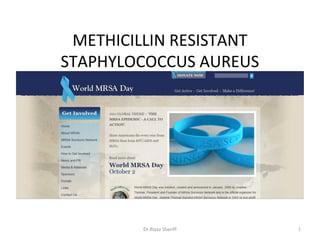
METHICILLIN RESISTANT
STAPHYLOCOCCUS AUREUS


         Dr.Riyaz Sheriff   1
What is MRSA?
• Methicillin Resistant Staphylococcus aureus
  demonstrates resistance to semisynthetic
  penicillins – Methicillin, Cloxacillin & Oxacillin.
• MRSA also exhibit resistance to
  cephalosporins, monobactams and
  carbepenamases


                       Dr.Riyaz Sheriff                 2
• Hospital associated MRSA (HA-MRSA)  MRSA strains
  that circulate and are transmitted to individuals in
  health care facilities
• Risk factors for HA-MRSA
   – Isolation of MRSA after 48hours of hospital admission
   – History of Hospitalization, Surgery, Dialysis
   – History of long term admission within one year of the
     MRSA culture date
   – Presence of indwelling catheter or percutaneous device at
     the time of culture or previous to isolation of MRSA
• Community associated MRSA (CA-MRSA) 
   – MRSA isolates obtained from individuals in community
     who have not had recent exposure to the health care
     system
   – Patients in health care facilities in whom the infection was
     present or incubating at the time of admission
                            Dr.Riyaz Sheriff                        3
Methicillin / Meticillin
• Narrow spectrum antibiotic of penicillin class
  introduced in 1959
• Has ortho-dimethoxy phenyl group attached
  to side chain carbonyl group of penicillin
  nucleus.
• Has been renamed as meticillin to have a
  common international nonproprietary name.


                     Dr.Riyaz Sheriff              4
PENICILLIN             METHICILLIN


             Dr.Riyaz Sheriff        5
Dr.Riyaz Sheriff   6
Why MRSA?
• Methicillin was initially used to detect
  resistance to beta lactamase stable penicillins
  hence the name MRSA.
• Oxacillin is used as alternative to methicillin
   ORSA (oxacillin resistant Staphylococcus
  aureus)


                      Dr.Riyaz Sheriff              7
Mechanism of resistance to penicillins
• Presence of mecA gene
   – mecA gene is carried on
     Staphylococcal cassette
     chromosome mec (SCCmec)
   – SCC have mecA and ccr
     (cassette chromosome
     recombinase) and attach it
     to the 3’ end of
     staphylococcal chromosome
   – Codes for modified penicillin
     binding protein 2a (PBP 2a
     OR PBP 2’)
   – Has low affinity for Beta
     lactams
                               Dr.Riyaz Sheriff   8
Mechanism of resistance to penicillins
• Production of Beta lactamase enzyme
   – Some strains produce excessive Beta lactamase which makes it
     appear borderline resistant to oxacillin (BORSA). Difficult to detect.
   – MRSA with minor alterations to existing PBP  Moderately
     resistant Staphylococcus aureus (MODSA)


                                 Dr.Riyaz Sheriff                         9
Virulence factors of Staphylococcus aureus
•   Capsular polysacchrides                 •        Hemolysins
•   Peptidoglycan and Teichoic acids                  – Alpha Hemolysin
•   Protein A                                         – Beta Hemolysin
•   Enzymes                                           – Gamma Hemolysin
     – Catalase                                       – Delta Hemolysin
     – Clumping factor                                – Panton-Valentine Leukocidin
     – Coagulase                            •        Toxins
     – Fibrinolysins                                  – Epidermolytic toxins
     – Hyaluronidase                                  – Enterotoxins A,B,C,D,E,H & I
     – Lipases                              •        Superantigens
     – Phosphatidylinositol specific                  – Toxic shock syndrome toxin I
        phospholipase C
     – Nuclease


                                  Dr.Riyaz Sheriff                                 10
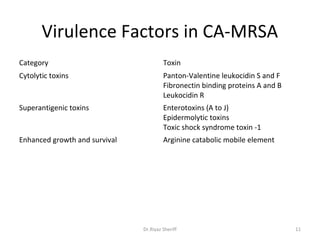
Virulence Factors in CA-MRSA
Category                                Toxin
Cytolytic toxins                        Panton-Valentine leukocidin S and F
                                        Fibronectin binding proteins A and B
                                        Leukocidin R
Superantigenic toxins                   Enterotoxins (A to J)
                                        Epidermolytic toxins
                                        Toxic shock syndrome toxin -1
Enhanced growth and survival            Arginine catabolic mobile element


                               Dr.Riyaz Sheriff                                11
Nomenclature of MRSA
US pulse field   Canadian   Multi locus             SCCmec type   PVL presence
gel              MRSA       sequence
electrophoresi              typing
s
USA 100          2          5                       II            NEGATIVE
USA 200          4          36                      II            NEGATIVE
USA 300          10         8                       IVa           POSITIVE
USA 400          7          1                       IVa           POSITIVE
USA 500          5,9        8                       IV            NEGATIVE
USA 600          1          45                      II            NEGATIVE
USA 700                     72                      IVa           NEGATIVE
USA 800          2          5                       IV            NEGATIVE
USA 1000                    59                      IV            POSITIVE
USA1100                     30                      IV            POSITIVE
                                 Dr.Riyaz Sheriff                                12
Detection of MRSA
• Phenotypic detection systems
   – Disc diffusion test
      • Colony suspension prepared from 5colonies and plated on muller
         hinton agar containing 2-4% NaCl at neutral pH.
      • Oxacillin disc (1ug) placed and incubated at 35°C for 24 hours
      • <10mm is considered resistant, >13mm is considered sensitive.
      • For isolates with intermediate results
           –   Test for mec A, PBP2a
           –   Cefoxitin disc test
           –   Oxacillin MIC test or
           –   Oxacillin salt agar screen test may be performed.
       • Any growth within the zone of inhibition indicates oxacillin
         resistance


                                      Dr.Riyaz Sheriff                   13
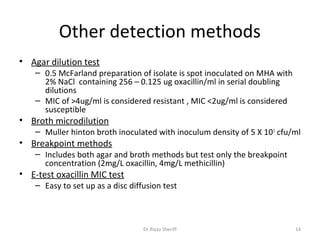
Other detection methods
• Agar dilution test
    – 0.5 McFarland preparation of isolate is spot inoculated on MHA with
      2% NaCl containing 256 – 0.125 ug oxacillin/ml in serial doubling
      dilutions
    – MIC of >4ug/ml is considered resistant , MIC <2ug/ml is considered
      susceptible
• Broth microdilution
    – Muller hinton broth inoculated with inoculum density of 5 X 10 5 cfu/ml
• Breakpoint methods
    – Includes both agar and broth methods but test only the breakpoint
      concentration (2mg/L oxacillin, 4mg/L methicillin)
• E-test oxacillin MIC test
    – Easy to set up as a disc diffusion test


                                   Dr.Riyaz Sheriff                         14
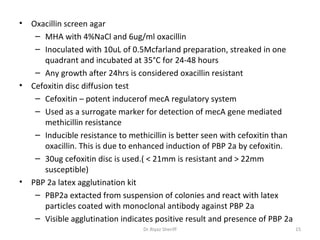
•   Oxacillin screen agar
     – MHA with 4%NaCl and 6ug/ml oxacillin
     – Inoculated with 10uL of 0.5Mcfarland preparation, streaked in one
       quadrant and incubated at 35°C for 24-48 hours
     – Any growth after 24hrs is considered oxacillin resistant
•   Cefoxitin disc diffusion test
     – Cefoxitin – potent inducerof mecA regulatory system
     – Used as a surrogate marker for detection of mecA gene mediated
       methicillin resistance
     – Inducible resistance to methicillin is better seen with cefoxitin than
       oxacillin. This is due to enhanced induction of PBP 2a by cefoxitin.
     – 30ug cefoxitin disc is used.( < 21mm is resistant and > 22mm
       susceptible)
•   PBP 2a latex agglutination kit
     – PBP2a extacted from suspension of colonies and react with latex
       particles coated with monoclonal antibody against PBP 2a
     – Visible agglutination indicates positive result and presence of PBP 2a
                                   Dr.Riyaz Sheriff                             15
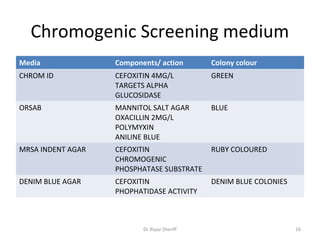
Chromogenic Screening medium
Media              Components/ action        Colony colour
CHROM ID           CEFOXITIN 4MG/L           GREEN
                   TARGETS ALPHA
                   GLUCOSIDASE
ORSAB              MANNITOL SALT AGAR        BLUE
                   OXACILLIN 2MG/L
                   POLYMYXIN
                   ANILINE BLUE
MRSA INDENT AGAR   CEFOXITIN                 RUBY COLOURED
                   CHROMOGENIC
                   PHOSPHATASE SUBSTRATE
DENIM BLUE AGAR    CEFOXITIN                 DENIM BLUE COLONIES
                   PHOPHATIDASE ACTIVITY


                          Dr.Riyaz Sheriff                         16
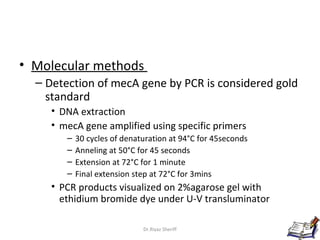
• Molecular methods
  – Detection of mecA gene by PCR is considered gold
    standard
     • DNA extraction
     • mecA gene amplified using specific primers
        –   30 cycles of denaturation at 94°C for 45seconds
        –   Anneling at 50°C for 45 seconds
        –   Extension at 72°C for 1 minute
        –   Final extension step at 72°C for 3mins
     • PCR products visualized on 2%agarose gel with
       ethidium bromide dye under U-V transluminator

                              Dr.Riyaz Sheriff                17
Dr.Riyaz Sheriff   18
Community associated meticillin-
resistant Staphylococcus aureus
strains as a cause of healthcare-
       associated infection

        J.A Otter, G.L. French
   Journal Of Hospital Infection 79
           (2011) 189-193

         Impact factor 3.393
                Dr.Riyaz Sheriff      19
Introduction
• CA-MRSA infections were first reported in early
  1990s from western Australia, New Zealand and
  in America.
• CA-MRSA seems to have evolved from MSSA
  acquiring SCCmec cassettes.
• Have the ability to affect younger, healthy people
  and spread rapidly in community settings.
• CA-MRSA are generally susceptible to non Beta
  Lactam antibiotics, Have small SCCmec cassettes
  (type IV or V), Many of them produce PVL
                       Dr.Riyaz Sheriff            20
Dr.Riyaz Sheriff   21
CA-MRSA in Hospital outbreaks
• Nosocomial outbreaks reported from 2003 from North
  America, Germany, Israel, Switzerland, Greece and UK.
• Most outbreaks have been caused by single cross
  infecting strain
• Infections in health care workers and transmission to
  their household contacts have occurred in several of
  these outbreaks
• PVL + CA-MRSA has been isolated in most of the
  outbreaks but one outbreak in Israel and two
  outbreaks in UK were caused by PVL negative strains
   CA-MRSA do not need PVL to cause nosocomial
  infections

                        Dr.Riyaz Sheriff              22
Control Measures for CA-MRSA
• Isolation of affected patients
• Screening other patients in the unit for asymptomatic
  carriage
• Reinforcement of standard infection control
  procedures
   –   Hand hygiene
   –   Screening of staff members for colonization
   –   Swabbing of environmental surfaces and equipments
   –   Improved environmental cleaning
• Closure of unit to new admissions
• Screening of household contacts of health care
  workers and appropriate management during CA-
  MRSA outbreaks
                           Dr.Riyaz Sheriff                23
CA-MRSA role in endemic HAI
CA-MRSA is overtaking HA-MRSA as a cause of HAI
Initially CA-MRSA was reported in new born infections
and post operative prosthetic joint infections
Recent reports suggest CA-MRSA as a cause of HA
bacteraemias.
16% of hospital onset infections and 22% of health
care associated infections are caused by CA-MRSA
Many countries have reported 10fold increase in CA-
MRSA from 1999 to 2006
In Greece PVL positive CA-MRSA accounted for 45% of
HA-MRSA infections at several hospitals during 2001-
2003
                      Dr.Riyaz Sheriff                  24
CA-MRSA implications
 CA-MRSA is emerging as a cause of hospital associated infections in Asia,
  Africa & South America. The reason for this emergence is not clearly
  understood.
 CA-MRSA have the ability to affect healthy individuals
 CA-MRSA strain with PVL are on the rise resulting in higher virulence.
 Studies have shown that CA-MRSA behave like HA-MRSA once inside the
  hospitals but cause more invasive infections than uncomplicated SSTI.
 CA-MRSA exposed to antibiotics is more likely to acquire resistance genes
  and become MDR strains like HA-MRSA
 Definitions for HA-MRSA and CA-MRSA become more confused.


                                 Dr.Riyaz Sheriff                         25
CA-MRSA implications (Cont’d)
 Control of MRSA in hospital settings will be more difficult.
 With lack of clear knowledge on epidemiology of CA-MRSA the current
  infection control policies may not be successful and needs to be
  modified.
 Hospitals should type MRSA strains involved in outbreaks and there
  should also be periodic assessment of the antibiotic resistance profiles
  among CA-MRSA strains.
 The success of CA-MRSA in spreading in various subsets of the
  community is a major concern.
 Finally there is an urgent need to measure the prevalence and
  epidemiology of CA-MRSA and also develop systems to identify and
  control these organisms in the community, hospitals and other health
  care facilities.

                                Dr.Riyaz Sheriff                         26
Conclusion
 CA-MRSA has emerged as a Nosocomial pathogen in the recent years and
  are beginning to overtake HA-MRSA in hospital infection.
 CA-MRSA infections puts a wider group of people at risk. This includes
  hospitalized patients, Health workers and their community contacts
 Classification of CA-MRSA and HA-MRSA is becoming more confusing
 Western countries report a MRSA incidence ranging from 10.4% to 40%
 In Tamil Nadu MRSA prevalence in clinical samples is estimated to be
  around 31.1% in clinical and 37.9% in carrier samples
 MDR among MRSA in clinical isolates was estimated around 63.6% and
  23% carrier samples
 There is an urgent need to measure the prevalence and epidemiology of
  CA-MRSA and also develop systems to identify and control these
  organisms in the community, hospitals and other health care facilities.


                                Dr.Riyaz Sheriff                        27
References
• Koneman’s atlas and textbook of diagnostic microbiology
• Essentials of medical pharmacology KD tripathi 5th edition
• Michelle barton et al Guidelines for prevention and management of
  community - associated methicillin - resistant Staphylococcus
  aureus: a perspective for Canadian health care practitioners,
  Canadian journal of infectious disease and medical microbiology vol
  17, supplement C 2006 page 4C-24C
• Rajadurapandi et al prevalence and antimicrobial susceptibility
  pattern of methicillin resistant Staphylococcus aureus: a
  multicentre study, IJMM (2006) 24 (1): 34-38
• Benjamin etal Reduced Vancomycin Susceptibility in Staphylococcus
  aureus, Including Vancomycin-Intermediate and Heterogeneous
  Vancomycin- Intermediate Strains: Resistance Mechanisms,
  Laboratory Detection, and Clinical Implications, CMR 2010 p.99-139


                              Dr.Riyaz Sheriff                     28
Dr.Riyaz Sheriff   29

MRSA

  • 1.
  • 2.
    What is MRSA? •Methicillin Resistant Staphylococcus aureus demonstrates resistance to semisynthetic penicillins – Methicillin, Cloxacillin & Oxacillin. • MRSA also exhibit resistance to cephalosporins, monobactams and carbepenamases Dr.Riyaz Sheriff 2
  • 3.
    • Hospital associatedMRSA (HA-MRSA)  MRSA strains that circulate and are transmitted to individuals in health care facilities • Risk factors for HA-MRSA – Isolation of MRSA after 48hours of hospital admission – History of Hospitalization, Surgery, Dialysis – History of long term admission within one year of the MRSA culture date – Presence of indwelling catheter or percutaneous device at the time of culture or previous to isolation of MRSA • Community associated MRSA (CA-MRSA)  – MRSA isolates obtained from individuals in community who have not had recent exposure to the health care system – Patients in health care facilities in whom the infection was present or incubating at the time of admission Dr.Riyaz Sheriff 3
  • 4.
    Methicillin / Meticillin •Narrow spectrum antibiotic of penicillin class introduced in 1959 • Has ortho-dimethoxy phenyl group attached to side chain carbonyl group of penicillin nucleus. • Has been renamed as meticillin to have a common international nonproprietary name. Dr.Riyaz Sheriff 4
  • 5.
    PENICILLIN METHICILLIN Dr.Riyaz Sheriff 5
  • 6.
  • 7.
    Why MRSA? • Methicillinwas initially used to detect resistance to beta lactamase stable penicillins hence the name MRSA. • Oxacillin is used as alternative to methicillin  ORSA (oxacillin resistant Staphylococcus aureus) Dr.Riyaz Sheriff 7
  • 8.
    Mechanism of resistanceto penicillins • Presence of mecA gene – mecA gene is carried on Staphylococcal cassette chromosome mec (SCCmec) – SCC have mecA and ccr (cassette chromosome recombinase) and attach it to the 3’ end of staphylococcal chromosome – Codes for modified penicillin binding protein 2a (PBP 2a OR PBP 2’) – Has low affinity for Beta lactams Dr.Riyaz Sheriff 8
  • 9.
    Mechanism of resistanceto penicillins • Production of Beta lactamase enzyme – Some strains produce excessive Beta lactamase which makes it appear borderline resistant to oxacillin (BORSA). Difficult to detect. – MRSA with minor alterations to existing PBP  Moderately resistant Staphylococcus aureus (MODSA) Dr.Riyaz Sheriff 9
  • 10.
    Virulence factors ofStaphylococcus aureus • Capsular polysacchrides • Hemolysins • Peptidoglycan and Teichoic acids – Alpha Hemolysin • Protein A – Beta Hemolysin • Enzymes – Gamma Hemolysin – Catalase – Delta Hemolysin – Clumping factor – Panton-Valentine Leukocidin – Coagulase • Toxins – Fibrinolysins – Epidermolytic toxins – Hyaluronidase – Enterotoxins A,B,C,D,E,H & I – Lipases • Superantigens – Phosphatidylinositol specific – Toxic shock syndrome toxin I phospholipase C – Nuclease Dr.Riyaz Sheriff 10
  • 11.
    Virulence Factors inCA-MRSA Category Toxin Cytolytic toxins Panton-Valentine leukocidin S and F Fibronectin binding proteins A and B Leukocidin R Superantigenic toxins Enterotoxins (A to J) Epidermolytic toxins Toxic shock syndrome toxin -1 Enhanced growth and survival Arginine catabolic mobile element Dr.Riyaz Sheriff 11
  • 12.
    Nomenclature of MRSA USpulse field Canadian Multi locus SCCmec type PVL presence gel MRSA sequence electrophoresi typing s USA 100 2 5 II NEGATIVE USA 200 4 36 II NEGATIVE USA 300 10 8 IVa POSITIVE USA 400 7 1 IVa POSITIVE USA 500 5,9 8 IV NEGATIVE USA 600 1 45 II NEGATIVE USA 700 72 IVa NEGATIVE USA 800 2 5 IV NEGATIVE USA 1000 59 IV POSITIVE USA1100 30 IV POSITIVE Dr.Riyaz Sheriff 12
  • 13.
    Detection of MRSA •Phenotypic detection systems – Disc diffusion test • Colony suspension prepared from 5colonies and plated on muller hinton agar containing 2-4% NaCl at neutral pH. • Oxacillin disc (1ug) placed and incubated at 35°C for 24 hours • <10mm is considered resistant, >13mm is considered sensitive. • For isolates with intermediate results – Test for mec A, PBP2a – Cefoxitin disc test – Oxacillin MIC test or – Oxacillin salt agar screen test may be performed. • Any growth within the zone of inhibition indicates oxacillin resistance Dr.Riyaz Sheriff 13
  • 14.
    Other detection methods •Agar dilution test – 0.5 McFarland preparation of isolate is spot inoculated on MHA with 2% NaCl containing 256 – 0.125 ug oxacillin/ml in serial doubling dilutions – MIC of >4ug/ml is considered resistant , MIC <2ug/ml is considered susceptible • Broth microdilution – Muller hinton broth inoculated with inoculum density of 5 X 10 5 cfu/ml • Breakpoint methods – Includes both agar and broth methods but test only the breakpoint concentration (2mg/L oxacillin, 4mg/L methicillin) • E-test oxacillin MIC test – Easy to set up as a disc diffusion test Dr.Riyaz Sheriff 14
  • 15.
    Oxacillin screen agar – MHA with 4%NaCl and 6ug/ml oxacillin – Inoculated with 10uL of 0.5Mcfarland preparation, streaked in one quadrant and incubated at 35°C for 24-48 hours – Any growth after 24hrs is considered oxacillin resistant • Cefoxitin disc diffusion test – Cefoxitin – potent inducerof mecA regulatory system – Used as a surrogate marker for detection of mecA gene mediated methicillin resistance – Inducible resistance to methicillin is better seen with cefoxitin than oxacillin. This is due to enhanced induction of PBP 2a by cefoxitin. – 30ug cefoxitin disc is used.( < 21mm is resistant and > 22mm susceptible) • PBP 2a latex agglutination kit – PBP2a extacted from suspension of colonies and react with latex particles coated with monoclonal antibody against PBP 2a – Visible agglutination indicates positive result and presence of PBP 2a Dr.Riyaz Sheriff 15
  • 16.
    Chromogenic Screening medium Media Components/ action Colony colour CHROM ID CEFOXITIN 4MG/L GREEN TARGETS ALPHA GLUCOSIDASE ORSAB MANNITOL SALT AGAR BLUE OXACILLIN 2MG/L POLYMYXIN ANILINE BLUE MRSA INDENT AGAR CEFOXITIN RUBY COLOURED CHROMOGENIC PHOSPHATASE SUBSTRATE DENIM BLUE AGAR CEFOXITIN DENIM BLUE COLONIES PHOPHATIDASE ACTIVITY Dr.Riyaz Sheriff 16
  • 17.
    • Molecular methods – Detection of mecA gene by PCR is considered gold standard • DNA extraction • mecA gene amplified using specific primers – 30 cycles of denaturation at 94°C for 45seconds – Anneling at 50°C for 45 seconds – Extension at 72°C for 1 minute – Final extension step at 72°C for 3mins • PCR products visualized on 2%agarose gel with ethidium bromide dye under U-V transluminator Dr.Riyaz Sheriff 17
  • 18.
  • 19.
    Community associated meticillin- resistantStaphylococcus aureus strains as a cause of healthcare- associated infection J.A Otter, G.L. French Journal Of Hospital Infection 79 (2011) 189-193 Impact factor 3.393 Dr.Riyaz Sheriff 19
  • 20.
    Introduction • CA-MRSA infectionswere first reported in early 1990s from western Australia, New Zealand and in America. • CA-MRSA seems to have evolved from MSSA acquiring SCCmec cassettes. • Have the ability to affect younger, healthy people and spread rapidly in community settings. • CA-MRSA are generally susceptible to non Beta Lactam antibiotics, Have small SCCmec cassettes (type IV or V), Many of them produce PVL Dr.Riyaz Sheriff 20
  • 21.
  • 22.
    CA-MRSA in Hospitaloutbreaks • Nosocomial outbreaks reported from 2003 from North America, Germany, Israel, Switzerland, Greece and UK. • Most outbreaks have been caused by single cross infecting strain • Infections in health care workers and transmission to their household contacts have occurred in several of these outbreaks • PVL + CA-MRSA has been isolated in most of the outbreaks but one outbreak in Israel and two outbreaks in UK were caused by PVL negative strains  CA-MRSA do not need PVL to cause nosocomial infections Dr.Riyaz Sheriff 22
  • 23.
    Control Measures forCA-MRSA • Isolation of affected patients • Screening other patients in the unit for asymptomatic carriage • Reinforcement of standard infection control procedures – Hand hygiene – Screening of staff members for colonization – Swabbing of environmental surfaces and equipments – Improved environmental cleaning • Closure of unit to new admissions • Screening of household contacts of health care workers and appropriate management during CA- MRSA outbreaks Dr.Riyaz Sheriff 23
  • 24.
    CA-MRSA role inendemic HAI CA-MRSA is overtaking HA-MRSA as a cause of HAI Initially CA-MRSA was reported in new born infections and post operative prosthetic joint infections Recent reports suggest CA-MRSA as a cause of HA bacteraemias. 16% of hospital onset infections and 22% of health care associated infections are caused by CA-MRSA Many countries have reported 10fold increase in CA- MRSA from 1999 to 2006 In Greece PVL positive CA-MRSA accounted for 45% of HA-MRSA infections at several hospitals during 2001- 2003 Dr.Riyaz Sheriff 24
  • 25.
    CA-MRSA implications  CA-MRSAis emerging as a cause of hospital associated infections in Asia, Africa & South America. The reason for this emergence is not clearly understood.  CA-MRSA have the ability to affect healthy individuals  CA-MRSA strain with PVL are on the rise resulting in higher virulence.  Studies have shown that CA-MRSA behave like HA-MRSA once inside the hospitals but cause more invasive infections than uncomplicated SSTI.  CA-MRSA exposed to antibiotics is more likely to acquire resistance genes and become MDR strains like HA-MRSA  Definitions for HA-MRSA and CA-MRSA become more confused. Dr.Riyaz Sheriff 25
  • 26.
    CA-MRSA implications (Cont’d) Control of MRSA in hospital settings will be more difficult.  With lack of clear knowledge on epidemiology of CA-MRSA the current infection control policies may not be successful and needs to be modified.  Hospitals should type MRSA strains involved in outbreaks and there should also be periodic assessment of the antibiotic resistance profiles among CA-MRSA strains.  The success of CA-MRSA in spreading in various subsets of the community is a major concern.  Finally there is an urgent need to measure the prevalence and epidemiology of CA-MRSA and also develop systems to identify and control these organisms in the community, hospitals and other health care facilities. Dr.Riyaz Sheriff 26
  • 27.
    Conclusion  CA-MRSA hasemerged as a Nosocomial pathogen in the recent years and are beginning to overtake HA-MRSA in hospital infection.  CA-MRSA infections puts a wider group of people at risk. This includes hospitalized patients, Health workers and their community contacts  Classification of CA-MRSA and HA-MRSA is becoming more confusing  Western countries report a MRSA incidence ranging from 10.4% to 40%  In Tamil Nadu MRSA prevalence in clinical samples is estimated to be around 31.1% in clinical and 37.9% in carrier samples  MDR among MRSA in clinical isolates was estimated around 63.6% and 23% carrier samples  There is an urgent need to measure the prevalence and epidemiology of CA-MRSA and also develop systems to identify and control these organisms in the community, hospitals and other health care facilities. Dr.Riyaz Sheriff 27
  • 28.
    References • Koneman’s atlasand textbook of diagnostic microbiology • Essentials of medical pharmacology KD tripathi 5th edition • Michelle barton et al Guidelines for prevention and management of community - associated methicillin - resistant Staphylococcus aureus: a perspective for Canadian health care practitioners, Canadian journal of infectious disease and medical microbiology vol 17, supplement C 2006 page 4C-24C • Rajadurapandi et al prevalence and antimicrobial susceptibility pattern of methicillin resistant Staphylococcus aureus: a multicentre study, IJMM (2006) 24 (1): 34-38 • Benjamin etal Reduced Vancomycin Susceptibility in Staphylococcus aureus, Including Vancomycin-Intermediate and Heterogeneous Vancomycin- Intermediate Strains: Resistance Mechanisms, Laboratory Detection, and Clinical Implications, CMR 2010 p.99-139 Dr.Riyaz Sheriff 28
  • 29.