Methicillin Resistant
Staphylococcus Aureus
Peter Daley MD FRCPC DTM+H
     Memorial University
Staphylococcus


                 Figure 19.1
Staphylococci
• Gram-positive cocci, nonmotile, facultative
  anaerobes
• Cells occur in grapelike clusters because cells
  division occurs along different planes and the
  daughter cells remain attached to one another
• Salt-tolerant – allows them to tolerate the salt
  present on human skin
• Tolerant of desiccation – allows survival on
  environmental surfaces (fomites)
• Two species are commonly associated with
  staphylococcal diseases in humans
  – Staphylococcus aureus – the more virulent strain
    that can produce a variety of conditions depending
    on the site of infection
  – Staphylococcus epidermidis – normal microbiota of
    human skin that can cause opportunistic infections
    in immunocompromised patients or when
    introduced into the body
Pathogenicity
• “Staph’ infections result when staphylococci
  breach the body’s physical barriers
• Entry of only a few hundred bacteria can result
  in disease
• Pathogenicity results from three features
  – Structures that enable it to evade phagocytosis
  – Production of enzymes
  – Production of toxins
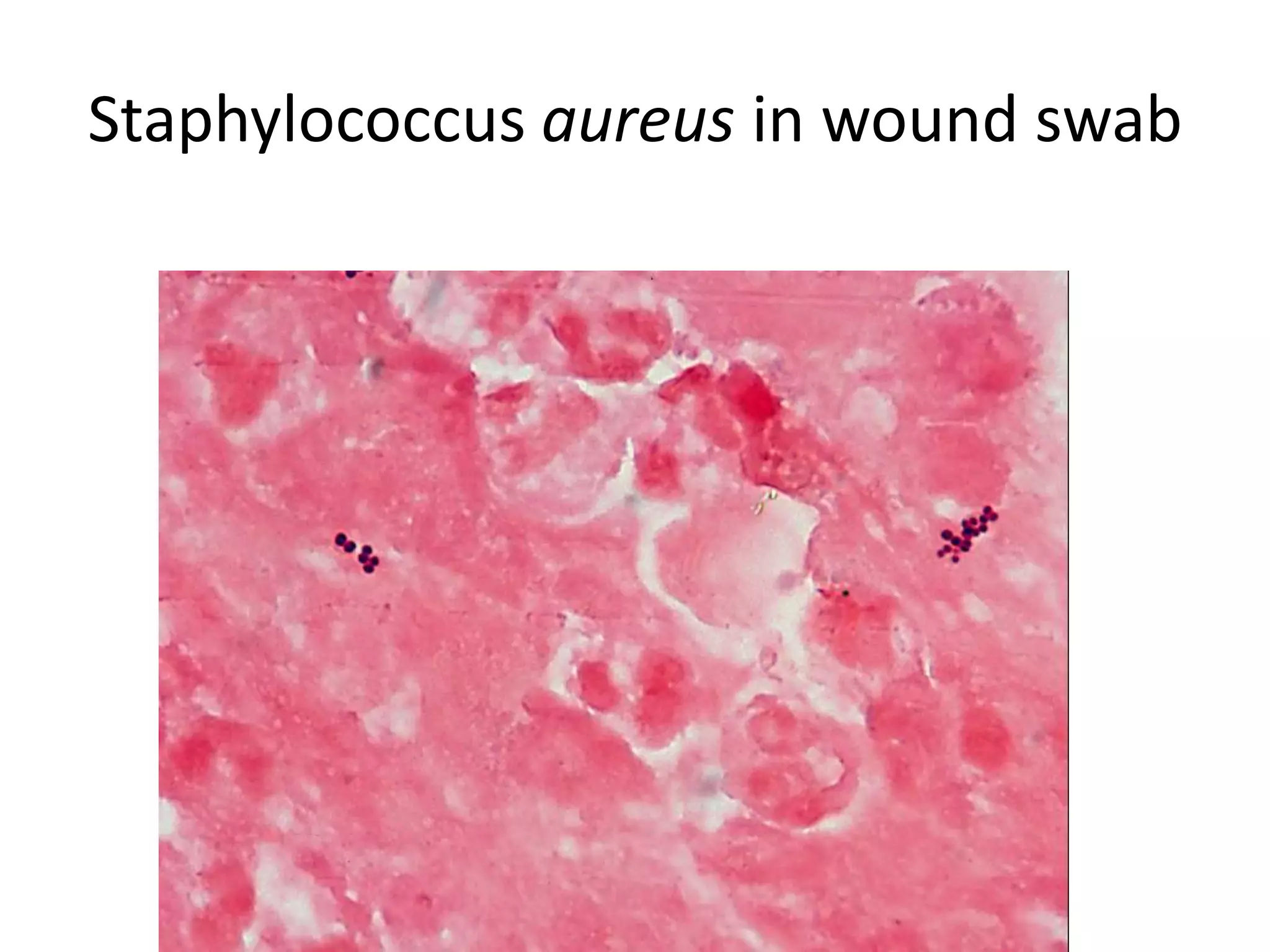
Staphylococcus aureus in wound swab
Impetigo

    •   Superficial, local
    •   Pustular/crusted
    •   GAS/SA
    •   Children
    •   Topical therapy
Folliculitis

      •   Follicle infection
      •   SA
      •   Apocrine regions
      •   Whirlpool folliculitis
      •   May scar
      •   Acne
      •   Local treatment
Erysipelas

     • GAS
     • Portal of entry
     • Lymphatic
       involvement
     • Bright red, painful
     • Raised border
     • Oral or IV therapy
Cellulitis

     • Systemic illness
     • Vague border
     • GAS/SA
     • Portal of entry
     • Returns
     • Occasional Vibrio,
       Erysipelothrix
     • Oral/IV therapy
     • Edema control
Skin Abscess

      •   Furuncle, carbuncle
      •   Deep collection
      •   SA
      •   Needs drainage
      •   IVDU
      •   May be recurrent
Fournier’s Gangrene post-op
Evolution of Resistance in S. aureus
          Penicillin                   Methicillin
                    Penicillin-resistant           Methicillin-
S. aureus                                          resistant
           [1950s]     S. aureus         [1970s]
                                                    S. aureus (MRSA)

                                                          Vancomycin
                                       [1997]

                                                        [1990s]

 Vancomycin                Vancomycin        Vancomycin-resistant
  resistant     [ 2002 ]   intermediate-      enterococci (VRE)
  S. aureus                  resistant
                             S. aureus
                              (VISA)
Mechanism of Methicillin Resistance
• Mediated by mecA gene
  – Encodes abnormal low-affinity binding protein,
    PBP-2a
  – Encodes resistance to all beta-lactams
  – MecA gene is located on a mobile genetic element
    called SCCmec staphylococcal chromasomal
    cassette
  – That cassette may contain many other
  resistance genes
HA-MRSA in Hospitals in
                   CANADA vs. U.S. (CNISP)

                                US       Canada

              50
% Resistant


              40
              30
              20
              10
               0
                83

                87


                          92


                                    94


                                               96


                                                             98


                                                                    00
              19

              19


                        19


                                  19


                                             19


                                                           19


                                                                  20
                                         Year

                        (Conly J. CMAJ 2002;167:885-891)
Many are colonized, few are infected


                       Clinical
                       Infections


             Colonized
          (Asymptomatic)
              Patients
MRSA Surveillance Definitions
•   Colonization – asymptomatic
•   Infection – symptomatic
•   Hospital acquired
•   Healthcare associated – clinics, long term care
•   Community acquired
S. aureus Colonization
• About 30% of people are colonized
• Average 2.8 strains /person
• Colonization more frequent in
   –   Newborns
   –   Hemodialysis patients
   –   People with dermatitis, eczema
   –   Diabetics
• Half Life: 40 months
CNISP 2009
CNISP 2009
CNISP 2009
CNISP 2009
CNISP 2009
Risk Factors for HA-MRSA
•   Hospitalized within the last year
•   Surgery within the last year
•   Dialysis within last year
•   Resided in long-term care facility
•   ABX >3 times w/in past year
•   DM
Were Hospital acquired MRSA so successful
       only because they were antibiotic
                   resistant?
• Probably:
   – Virulent but not hyper-virulent
   – They are frequent colonizers but cause a respectable
     number of infections.
   – Patients with HA-MRSA often have more co-
     morbidities and hence have higher mortality rates.
   – We have to use less effective antibiotics
   – Sometimes our initial guesses are wrong so patients
     go untreated for several days
Community-Associated Methicillin-Resistant
              S. aureus (CA-MRSA)

• First described in Australia in 1993
• In the late 1990s more reports of MRSA occurring in
  the community in patients without established risk
  factors (Usually skin infections)
   – Younger patients
   – Aboriginals especially in Sask and Manitoba
   – Outbreaks:
      •   Injection drug users
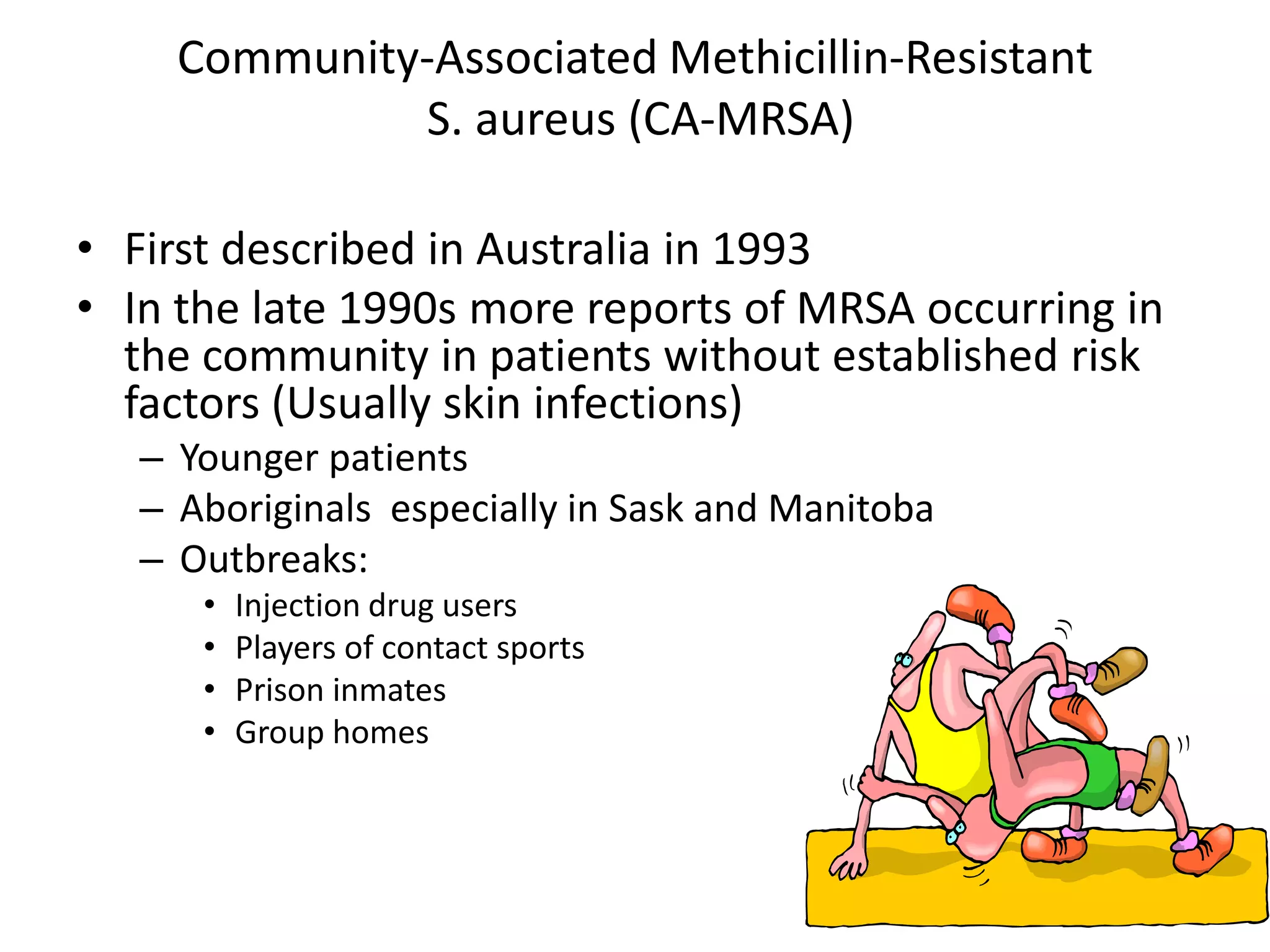
      •   Players of contact sports
      •   Prison inmates
      •   Group homes
The emergence of CA-MRSA in
      the United States


 Methicillin-Resistant S. aureus Infections among
 Patients in the Emergency Department Moran et
                         al
             Volume 355:666-674, 2006
Prevalence of MRSA Among
                     422 ED Patients With SSTI
     7/13 (54%)                            11/28 (39%)
                                                                      4/20 (20%)

                          59%                                 32/58 (55%)
                                          43/58 (74%)
    24/47 (51%)                                               17/25 (68%)
                            26/42 (62%)
                                                        23/32 (72%)
                  18/30 (60%)

                                               46/69 (67%)

          MSSA 17%


Moran GJ et al.
SSTIs in 11 US EDs,
                                     August 2004
  • 422 patients total                                          Site of Infection:
  • 62% male                                                    • Head/Neck 13%
  • Median age 40
        (range 18-79)                                           • Torso 17%
  • Racial mix:                                                 • Upper Ext        28%
     White       28%                                            • Lower Ext        28%
     Black      46%
     Hispanic 22%                                               • Perineum         15%
     Other        3%

Moran GJ et al. Society of Academic Emergency Medicine, 2005.
185 cases from 1999-2002
CA-MRSA in athletes
A Clone of Methicillin-Resistant Staphylococcus aureus
          among Professional Football Players
             Kazakova SV, Hageman J, Matava M, et al.
                N Engl J Med 2005; 352 (5): 468-75

• September 2003
     • Large skin MRSA abscesses among St. Louis
       Rams football team
     • Subsequent cases in opposing team members
       prompted


• November 2003
     • CDC invited to investigate transmission (August 1-
       November 30)
Results
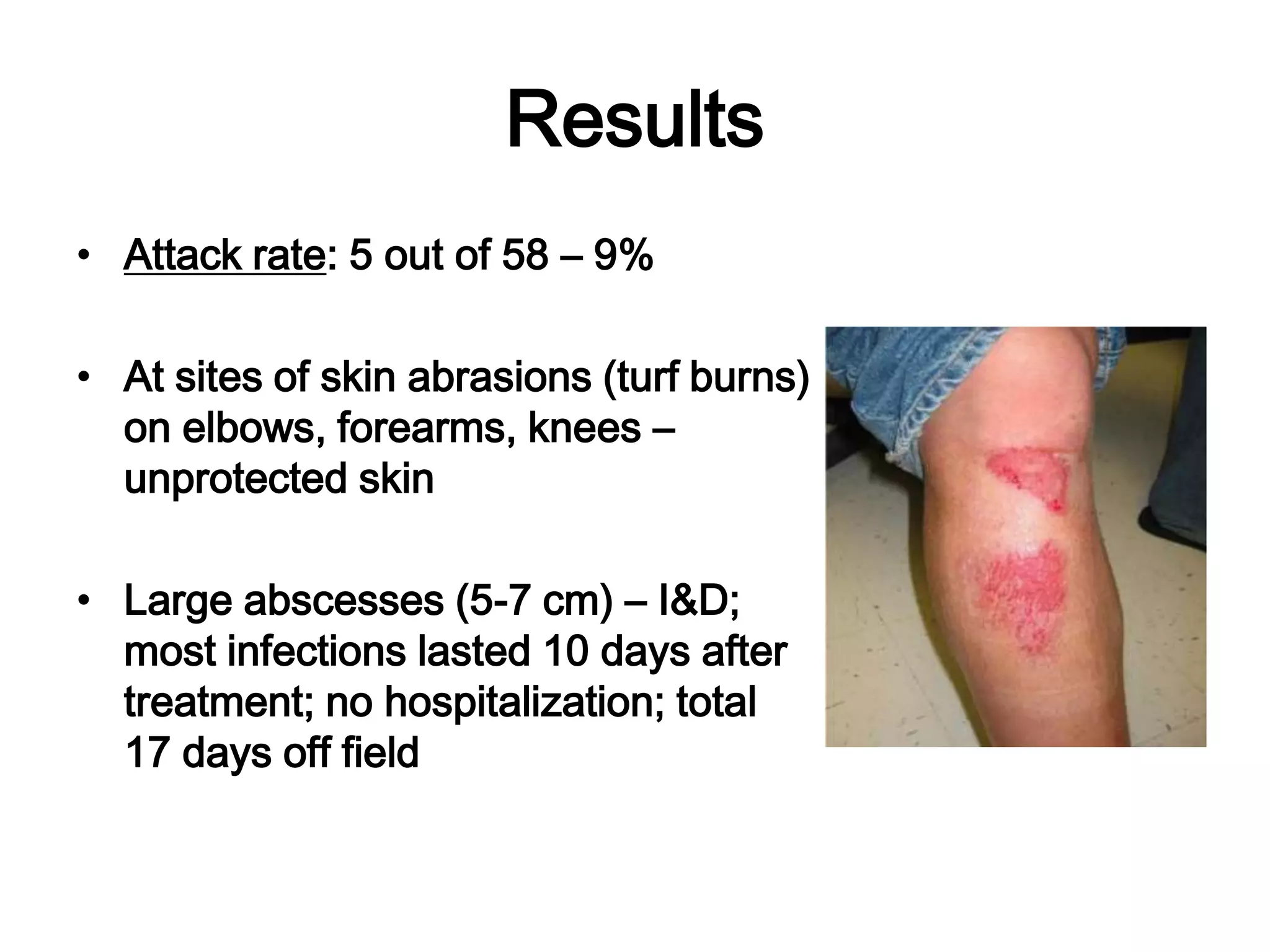
• Attack rate: 5 out of 58 – 9%

• At sites of skin abrasions (turf burns)
  on elbows, forearms, knees –
  unprotected skin

• Large abscesses (5-7 cm) – I&D;
  most infections lasted 10 days after
  treatment; no hospitalization; total
  17 days off field
Case Player Position
Results
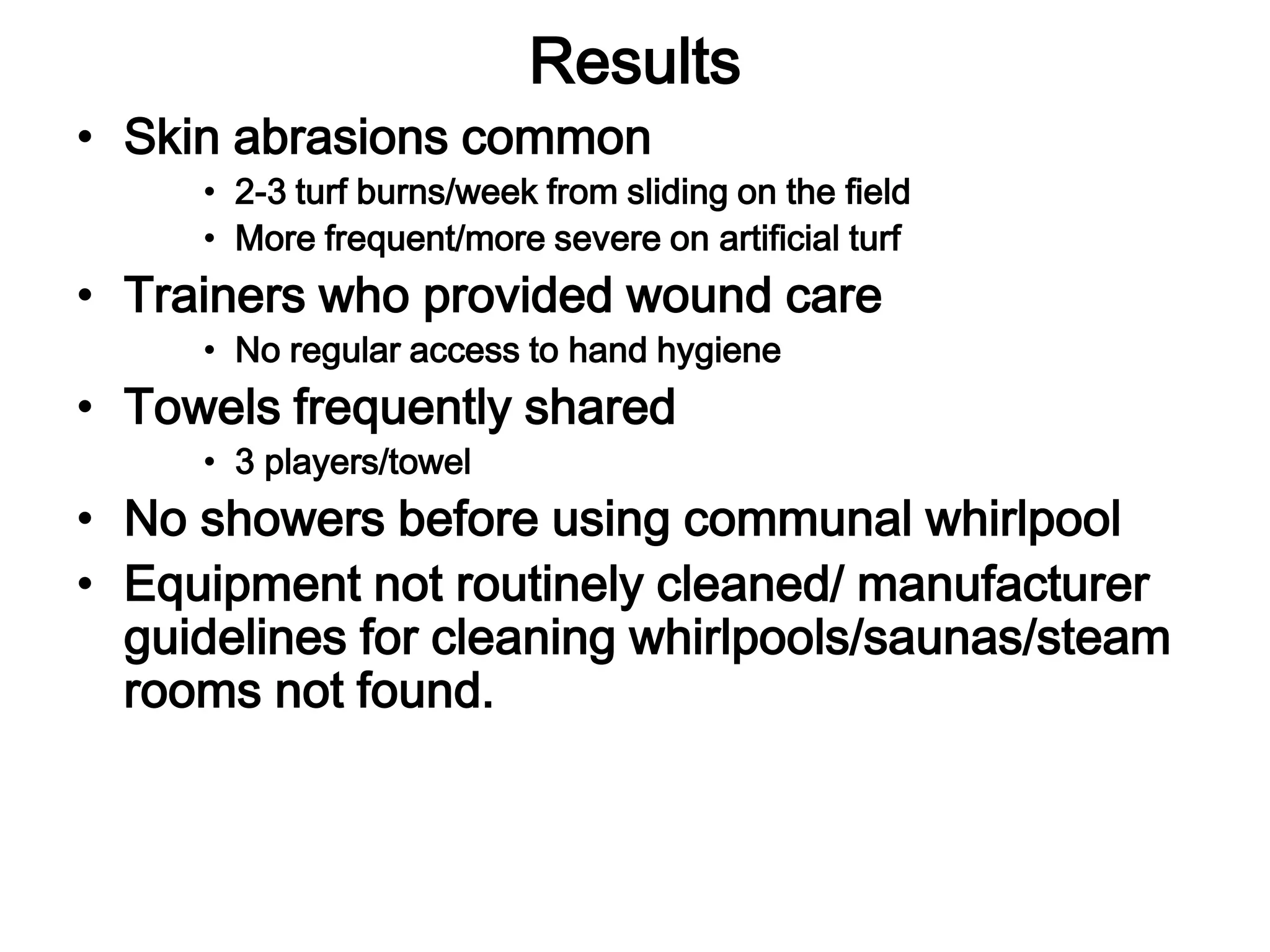
• Skin abrasions common
     • 2-3 turf burns/week from sliding on the field
     • More frequent/more severe on artificial turf
• Trainers who provided wound care
     • No regular access to hand hygiene
• Towels frequently shared
     • 3 players/towel
• No showers before using communal whirlpool
• Equipment not routinely cleaned/ manufacturer
  guidelines for cleaning whirlpools/saunas/steam
  rooms not found.
MRSA as a community and hospital
                pathogen
        CA-MRSA                      HA-MRSA
   Invasive/high rate of       High rate of colonisation
         infection
 High %age of soft tissue      Less likely to cause soft
       infections                  tissue infection
 Susceptible to non-beta-           Multi-resistant
    lactams (to date)
Causes necrotising infection   Bacteremias, pneumonia
                                and wound infections
Panton-Valentine leucocidin (PVL) toxin

• Cytotoxin present in <5% of MSSA
• Rare in HA-MRSA
• Carried on bacteriophage …incorporated
  into chromosome
• Capable of destroying WBC /severe tissue
  damage and associated with necrotic skin
  lesions /severe necrotizing pneumonia


  Lina et al, CID: 29:1128, 1999
How to treat CA-MRSA SSTIs
• Culture                        • Antibiotics
   – Severe skin infections        –   TMP/SMX
   – All treatment failures of     –   Doxycycline
     presumed S.aureus skin        –   Levo, Moxi might be OK
     infections
                                   –   Clindamycin (if D-tested)
• Drainage is essential            –   No Macrolide or
                                       Amoxicillin /clavulanic
                                       acid
When to suspect CA-MRSA
• When CA-MRSA reaches 10-15% of strains, all
  patients with SSTIs should be suspected.
• Severe Staph aureus infections, ie, necrotizing
  fasciitis, necrotizing pneumonia, or neonatal
  sepsis.
• When CA-MRSA risk factors are present.
• When there has been a poor response to
  initial beta-lactam therapy.
Significance of S. aureus
                   Nasal Carriage
   Nasal carriage of S. aureus is a risk for
   infection in hospital (usually same strain):
– nosocomial bacteremia (RR 30; 95% CI 2.0-4.7)                   (von Eiff,
  NEJM 2001; Wertheim, Lancet 2004)

– BSI, exit site infection in dialysis patients                 (Luzar, NEJM
  1990; Kluytmans, ICHE 1996)

– SSI (2-9 X increased risk)
  (Kluytmans, JID 1995; Perl, NEJM 2002; Kalmeijer, CID 2002)

– ICU-acquired infection (2-5 X increased risk)                 (Honda, ICHE
  2010)
Significance of MRSA Colonization
  Colonization with MRSA associated with a greater risk
  of subsequent infection:
• Nasal carriers of MRSA 3.9 times more likely to develop
  nosocomial staphylococcal bacteremia than were
  MSSA carriers        (Pujol, Am J Med 1996)


• MRSA colonization at ICU admission associated with
  higher risk of ICU-acquired S. aureus (MRSA) infection; RR
  4.1   (Honda, Infect Control Hosp Epidemiol 2010)
Risk of MRSA Colonization Becoming
           an Infection
• 60 of 209 (29%) adults with newly identified
  colonization developed a subsequent MRSA
  infection during 18 months of follow-up (Huang, CID
  2003)

• 8 of 38 (21%) with newly identified colonization
  developed MRSA infection in 1 year of follow-up
  (Davis, CID 2004)
Decolonization
• Decolonization is not recommended for usual
  management.
• Decolonization may be tried when patients have
  multiple infections over several months.
• The recommended regimen is mupirocin ointment
  bid for 10 days.
• Mupirocin susceptibility should be tested.
• “A combined strategy of intranasal mupirocin topical
  antiseptics and systemic antibiotics, eg. rifampin or
  clindamycin may be considered.”
S. aureus Decolonization
                Recommendations
• possibly useful in patients with recurrent skin/soft
  tissue infection (need more data for CA-MRSA)
• mupirocin susceptibility testing should be done prior
  to use for decolonization
• MRSA as an infection control measure needs to be
  studied; consider in outbreaks or select patients
S. aureus Decolonization
            Recommendations

• no routine decolonization pre-op or in
  nonsurgical patients; perhaps consider in
  surgical patients known to be S. aureus
  carriers
• consider in dialysis patients, but risk of
  mupirocin resistance in the long-term
Environmental contamination of surfaces in an
            MRSA patient room
Resistant bacteria on the skin or in the gastrointestinal tract of patients
can often be found on common items.

                    Bed Linen
                 Patient Gown

                Overbed Table
                      BP Cuff
                    Side Rails
             Bath Door Handle

               IV Pump Button
            Room Door Handle

                                 0   10   20   30    40   50   60

                  Percent of Surfaces Contaminated
Manorapid
      Synergy
      …………
      …………
      …………
      …………
      …………
      …………
      Antiseptica
Remember!!

Methicillin resistant staphylococcus aureus

  • 1.
    Methicillin Resistant Staphylococcus Aureus PeterDaley MD FRCPC DTM+H Memorial University
  • 3.
    Staphylococcus Figure 19.1
  • 4.
    Staphylococci • Gram-positive cocci,nonmotile, facultative anaerobes • Cells occur in grapelike clusters because cells division occurs along different planes and the daughter cells remain attached to one another • Salt-tolerant – allows them to tolerate the salt present on human skin • Tolerant of desiccation – allows survival on environmental surfaces (fomites)
  • 5.
    • Two speciesare commonly associated with staphylococcal diseases in humans – Staphylococcus aureus – the more virulent strain that can produce a variety of conditions depending on the site of infection – Staphylococcus epidermidis – normal microbiota of human skin that can cause opportunistic infections in immunocompromised patients or when introduced into the body
  • 6.
    Pathogenicity • “Staph’ infectionsresult when staphylococci breach the body’s physical barriers • Entry of only a few hundred bacteria can result in disease • Pathogenicity results from three features – Structures that enable it to evade phagocytosis – Production of enzymes – Production of toxins
  • 7.
  • 8.
    Impetigo • Superficial, local • Pustular/crusted • GAS/SA • Children • Topical therapy
  • 9.
    Folliculitis • Follicle infection • SA • Apocrine regions • Whirlpool folliculitis • May scar • Acne • Local treatment
  • 10.
    Erysipelas • GAS • Portal of entry • Lymphatic involvement • Bright red, painful • Raised border • Oral or IV therapy
  • 11.
    Cellulitis • Systemic illness • Vague border • GAS/SA • Portal of entry • Returns • Occasional Vibrio, Erysipelothrix • Oral/IV therapy • Edema control
  • 12.
    Skin Abscess • Furuncle, carbuncle • Deep collection • SA • Needs drainage • IVDU • May be recurrent
  • 14.
  • 15.
    Evolution of Resistancein S. aureus Penicillin Methicillin Penicillin-resistant Methicillin- S. aureus resistant [1950s] S. aureus [1970s] S. aureus (MRSA) Vancomycin [1997] [1990s] Vancomycin Vancomycin Vancomycin-resistant resistant [ 2002 ] intermediate- enterococci (VRE) S. aureus resistant S. aureus (VISA)
  • 16.
    Mechanism of MethicillinResistance • Mediated by mecA gene – Encodes abnormal low-affinity binding protein, PBP-2a – Encodes resistance to all beta-lactams – MecA gene is located on a mobile genetic element called SCCmec staphylococcal chromasomal cassette – That cassette may contain many other resistance genes
  • 17.
    HA-MRSA in Hospitalsin CANADA vs. U.S. (CNISP) US Canada 50 % Resistant 40 30 20 10 0 83 87 92 94 96 98 00 19 19 19 19 19 19 20 Year (Conly J. CMAJ 2002;167:885-891)
  • 18.
    Many are colonized,few are infected Clinical Infections Colonized (Asymptomatic) Patients
  • 19.
    MRSA Surveillance Definitions • Colonization – asymptomatic • Infection – symptomatic • Hospital acquired • Healthcare associated – clinics, long term care • Community acquired
  • 20.
    S. aureus Colonization •About 30% of people are colonized • Average 2.8 strains /person • Colonization more frequent in – Newborns – Hemodialysis patients – People with dermatitis, eczema – Diabetics • Half Life: 40 months
  • 21.
  • 22.
  • 23.
  • 24.
  • 25.
  • 26.
    Risk Factors forHA-MRSA • Hospitalized within the last year • Surgery within the last year • Dialysis within last year • Resided in long-term care facility • ABX >3 times w/in past year • DM
  • 27.
    Were Hospital acquiredMRSA so successful only because they were antibiotic resistant? • Probably: – Virulent but not hyper-virulent – They are frequent colonizers but cause a respectable number of infections. – Patients with HA-MRSA often have more co- morbidities and hence have higher mortality rates. – We have to use less effective antibiotics – Sometimes our initial guesses are wrong so patients go untreated for several days
  • 28.
    Community-Associated Methicillin-Resistant S. aureus (CA-MRSA) • First described in Australia in 1993 • In the late 1990s more reports of MRSA occurring in the community in patients without established risk factors (Usually skin infections) – Younger patients – Aboriginals especially in Sask and Manitoba – Outbreaks: • Injection drug users • Players of contact sports • Prison inmates • Group homes
  • 29.
    The emergence ofCA-MRSA in the United States Methicillin-Resistant S. aureus Infections among Patients in the Emergency Department Moran et al Volume 355:666-674, 2006
  • 30.
    Prevalence of MRSAAmong 422 ED Patients With SSTI 7/13 (54%) 11/28 (39%) 4/20 (20%) 59% 32/58 (55%) 43/58 (74%) 24/47 (51%) 17/25 (68%) 26/42 (62%) 23/32 (72%) 18/30 (60%) 46/69 (67%) MSSA 17% Moran GJ et al.
  • 31.
    SSTIs in 11US EDs, August 2004 • 422 patients total Site of Infection: • 62% male • Head/Neck 13% • Median age 40 (range 18-79) • Torso 17% • Racial mix: • Upper Ext 28% White 28% • Lower Ext 28% Black 46% Hispanic 22% • Perineum 15% Other 3% Moran GJ et al. Society of Academic Emergency Medicine, 2005.
  • 32.
    185 cases from1999-2002
  • 33.
  • 34.
    A Clone ofMethicillin-Resistant Staphylococcus aureus among Professional Football Players Kazakova SV, Hageman J, Matava M, et al. N Engl J Med 2005; 352 (5): 468-75 • September 2003 • Large skin MRSA abscesses among St. Louis Rams football team • Subsequent cases in opposing team members prompted • November 2003 • CDC invited to investigate transmission (August 1- November 30)
  • 35.
    Results • Attack rate:5 out of 58 – 9% • At sites of skin abrasions (turf burns) on elbows, forearms, knees – unprotected skin • Large abscesses (5-7 cm) – I&D; most infections lasted 10 days after treatment; no hospitalization; total 17 days off field
  • 36.
  • 37.
    Results • Skin abrasionscommon • 2-3 turf burns/week from sliding on the field • More frequent/more severe on artificial turf • Trainers who provided wound care • No regular access to hand hygiene • Towels frequently shared • 3 players/towel • No showers before using communal whirlpool • Equipment not routinely cleaned/ manufacturer guidelines for cleaning whirlpools/saunas/steam rooms not found.
  • 39.
    MRSA as acommunity and hospital pathogen CA-MRSA HA-MRSA Invasive/high rate of High rate of colonisation infection High %age of soft tissue Less likely to cause soft infections tissue infection Susceptible to non-beta- Multi-resistant lactams (to date) Causes necrotising infection Bacteremias, pneumonia and wound infections
  • 40.
    Panton-Valentine leucocidin (PVL)toxin • Cytotoxin present in <5% of MSSA • Rare in HA-MRSA • Carried on bacteriophage …incorporated into chromosome • Capable of destroying WBC /severe tissue damage and associated with necrotic skin lesions /severe necrotizing pneumonia Lina et al, CID: 29:1128, 1999
  • 41.
    How to treatCA-MRSA SSTIs • Culture • Antibiotics – Severe skin infections – TMP/SMX – All treatment failures of – Doxycycline presumed S.aureus skin – Levo, Moxi might be OK infections – Clindamycin (if D-tested) • Drainage is essential – No Macrolide or Amoxicillin /clavulanic acid
  • 42.
    When to suspectCA-MRSA • When CA-MRSA reaches 10-15% of strains, all patients with SSTIs should be suspected. • Severe Staph aureus infections, ie, necrotizing fasciitis, necrotizing pneumonia, or neonatal sepsis. • When CA-MRSA risk factors are present. • When there has been a poor response to initial beta-lactam therapy.
  • 43.
    Significance of S.aureus Nasal Carriage Nasal carriage of S. aureus is a risk for infection in hospital (usually same strain): – nosocomial bacteremia (RR 30; 95% CI 2.0-4.7) (von Eiff, NEJM 2001; Wertheim, Lancet 2004) – BSI, exit site infection in dialysis patients (Luzar, NEJM 1990; Kluytmans, ICHE 1996) – SSI (2-9 X increased risk) (Kluytmans, JID 1995; Perl, NEJM 2002; Kalmeijer, CID 2002) – ICU-acquired infection (2-5 X increased risk) (Honda, ICHE 2010)
  • 44.
    Significance of MRSAColonization Colonization with MRSA associated with a greater risk of subsequent infection: • Nasal carriers of MRSA 3.9 times more likely to develop nosocomial staphylococcal bacteremia than were MSSA carriers (Pujol, Am J Med 1996) • MRSA colonization at ICU admission associated with higher risk of ICU-acquired S. aureus (MRSA) infection; RR 4.1 (Honda, Infect Control Hosp Epidemiol 2010)
  • 45.
    Risk of MRSAColonization Becoming an Infection • 60 of 209 (29%) adults with newly identified colonization developed a subsequent MRSA infection during 18 months of follow-up (Huang, CID 2003) • 8 of 38 (21%) with newly identified colonization developed MRSA infection in 1 year of follow-up (Davis, CID 2004)
  • 46.
    Decolonization • Decolonization isnot recommended for usual management. • Decolonization may be tried when patients have multiple infections over several months. • The recommended regimen is mupirocin ointment bid for 10 days. • Mupirocin susceptibility should be tested. • “A combined strategy of intranasal mupirocin topical antiseptics and systemic antibiotics, eg. rifampin or clindamycin may be considered.”
  • 47.
    S. aureus Decolonization Recommendations • possibly useful in patients with recurrent skin/soft tissue infection (need more data for CA-MRSA) • mupirocin susceptibility testing should be done prior to use for decolonization • MRSA as an infection control measure needs to be studied; consider in outbreaks or select patients
  • 48.
    S. aureus Decolonization Recommendations • no routine decolonization pre-op or in nonsurgical patients; perhaps consider in surgical patients known to be S. aureus carriers • consider in dialysis patients, but risk of mupirocin resistance in the long-term
  • 49.
    Environmental contamination ofsurfaces in an MRSA patient room Resistant bacteria on the skin or in the gastrointestinal tract of patients can often be found on common items. Bed Linen Patient Gown Overbed Table BP Cuff Side Rails Bath Door Handle IV Pump Button Room Door Handle 0 10 20 30 40 50 60 Percent of Surfaces Contaminated
  • 50.
    Manorapid Synergy ………… ………… ………… ………… ………… ………… Antiseptica Remember!!