Metal semiconductor contact
ANCHIT BISWAS
TECHNO INDIA ,SALTLAKE
Metal-Semiconductor Interfaces
 Rectifying (Schottky Junction)
 Non-Rectifying (Ohmic Contacts)
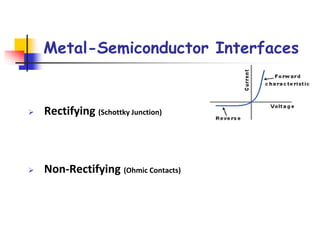
Metal-Semiconductor Interfaces
 Rectifying (Schottky Junction)
 Non-Rectifying (Ohmic Contacts)
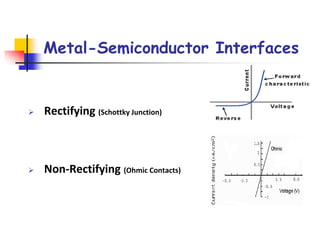
Metal-Semiconductor Interfaces
 Rectifying (Schottky Junction)
 Non-Rectifying (Ohmic Contacts)
Metal-Semiconductor Interfaces
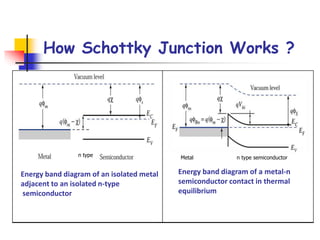
How Schottky Junction Works ?
Energy band diagram of an isolated metal
adjacent to an isolated n-type
semiconductor
n type
How Schottky Junction Works ?
Energy band diagram of an isolated metal
adjacent to an isolated n-type
semiconductor
Energy band diagram of a metal-n
semiconductor contact in thermal
equilibrium
n type Metal n type semiconductor
How Schottky Junction Works ?
Energy band diagram of an isolated metal
adjacent to an isolated n-type
semiconductor
Energy band diagram of a metal-n
semiconductor contact in thermal
equilibrium
n type
How Schottky Junction Works ?
Under forward bias condition
n type
Thermionic -emission
How Schottky Junction Work ?
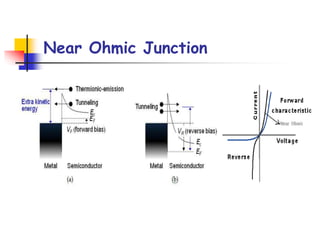
Under forward bias condition Under reverse bias condition
n type n type
Thermionic -emission
Near Ohmic Junction
Advantages of Schottky Diode
 Low turn on voltage
 Fast recovery time
 Low junction capacitance
Applications of Schotty Diode
 RF mixer and detector diode
 solar cell applications
 etc
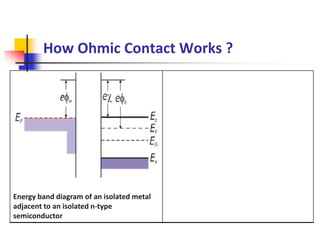
How Ohmic Contact Works ?
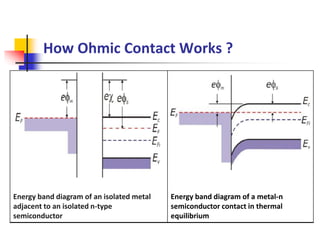
Energy band diagram of an isolated metal
adjacent to an isolated n-type
semiconductor
n type
How Ohmic Contact Works ?
Energy band diagram of an isolated metal
adjacent to an isolated n-type
semiconductor
n type
Energy band diagram of a metal-n
semiconductor contact in thermal
equilibrium
How Ohmic Contact Works ?
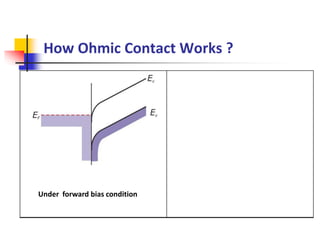
Under forward bias condition
How Ohmic Contact Works ?
Under forward bias condition Under reverse bias conditon
Ohmic vs Schotty
Metal semiconductor contact

Metal semiconductor contact

Editor's Notes

  • #10 n a rectifying Schottky barrier, the barrier is high enough that there is a depletion region in the semiconductor, near the interface. This gives the barrier a high resistance when small voltage biases are applied to it. Under large voltage bias, theelectrical current flowing through the barrier is essentially governed by the laws of thermionic emission, combined with the fact that the Schottky barrier is fixed relative to the metal's Fermi level.[3] Under forward bias, there are many thermally excited electrons in the semiconductor that are able to pass over the barrier. The passage of these electrons over the barrier (without any electrons coming back) corresponds to a current in the opposite direction. The current rises very rapidly with bias, however at high biases the series resistance of the semiconductor can start to limit the current. Under reverse bias, there is a small leakage current as some thermally excited electrons in the metal have enough energy to surmount the barrier. To first approximation this current should be constant (as in the Shockley diode equation), however current rises gradually with reverse bias due to a weak barrier lowering (similar to the vacuumSchottky effect). At very high biases, the depletion region breaks down. (the discussion above is for a Schottky barrier to an n-type semiconductor; similar considerations apply for a p-type semiconductor) The current-voltage relationship is qualitatively the same as with a p-n junction, however the physical process is somewhat different.[4]
  • #11 n a rectifying Schottky barrier, the barrier is high enough that there is a depletion region in the semiconductor, near the interface. This gives the barrier a high resistance when small voltage biases are applied to it. Under large voltage bias, theelectrical current flowing through the barrier is essentially governed by the laws of thermionic emission, combined with the fact that the Schottky barrier is fixed relative to the metal's Fermi level.[3] Under forward bias, there are many thermally excited electrons in the semiconductor that are able to pass over the barrier. The passage of these electrons over the barrier (without any electrons coming back) corresponds to a current in the opposite direction. The current rises very rapidly with bias, however at high biases the series resistance of the semiconductor can start to limit the current. Under reverse bias, there is a small leakage current as some thermally excited electrons in the metal have enough energy to surmount the barrier. To first approximation this current should be constant (as in the Shockley diode equation), however current rises gradually with reverse bias due to a weak barrier lowering (similar to the vacuumSchottky effect). At very high biases, the depletion region breaks down. (the discussion above is for a Schottky barrier to an n-type semiconductor; similar considerations apply for a p-type semiconductor) The current-voltage relationship is qualitatively the same as with a p-n junction, however the physical process is somewhat different.[4]