




Morphogen gradients
By
Mrs Sanchita Choubey
(M.Sc., PGDCR, Pursuing Ph. D)
Assistant Professor of Microbiology
Dr. D Y Patil Arts Commerce and Science College Pimpri, Pune
science-img.com
science-img.com
**Morphogenesis is the outcome of correct pattern
formation
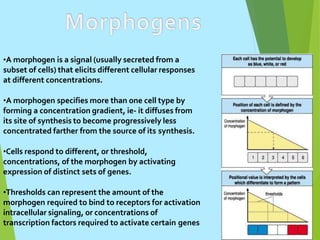
•A morphogen is a signal (usually secreted from a
subset of cells) that elicits different cellular responses
at different concentrations.
•A morphogen specifies more than one cell type by
forming a concentration gradient, ie- it diffuses from
its site of synthesis to become progressively less
concentrated farther from the source of its synthesis.
•Cells respond to different, or threshold,
concentrations, of the morphogen by activating
expression of distinct sets of genes.
•Thresholds can represent the amount of the
morphogen required to bind to receptors for activation
intracellular signaling, or concentrations of
transcription factors required to activate certain genes
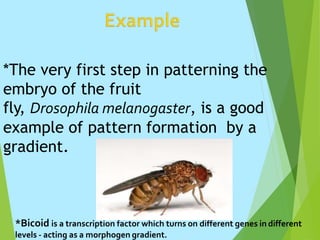
*The very first step in patterning the
embryo of the fruit
fly, Drosophila melanogaster, is a good
example of pattern formation by a
gradient.
*Bicoid is a transcription factor which turns on different genes in different
levels - acting as a morphogen gradient.
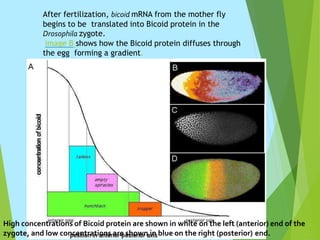
The four genes shown in part
A (tailless, empty spiracles,
hunchback, and kruppel) are
found in different locations
within the Drosophila
embryo, as a result of the
amount of Bicoid protein at a
particular location in the
embryo.
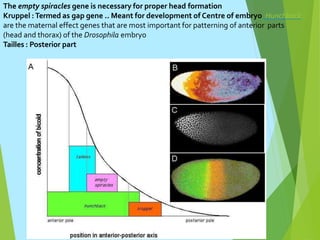
The empty spiracles gene is necessary for proper head formation
Kruppel :Termed as gap gene .. Meant for development of Centre of embryo Hunchback
are the maternal effect genes that are most important for patterning of anterior parts
(head and thorax) of the Drosophila embryo
Tailles : Posterior part
After fertilization, bicoid mRNA from the mother fly
begins to be translated into Bicoid protein in the
Drosophila zygote.
image B shows how the Bicoid protein diffuses through
the egg forming a gradient.
High concentrations of Bicoid protein are shown in white on the left (anterior) end of the
zygote, and low concentrations are shown in blue on the right (posterior) end.
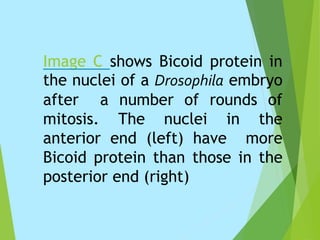
Image C shows Bicoid protein in
the nuclei of a Drosophila embryo
after a number of rounds of
mitosis. The nuclei in the
anterior end (left) have more
Bicoid protein than those in the
posterior end (right)
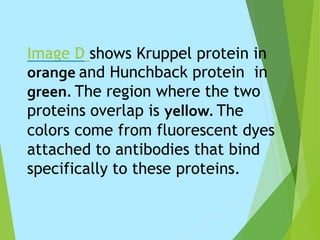
Image D shows Kruppel protein in
orange and Hunchback protein in
green. The region where the two
proteins overlap is yellow. The
colors come from fluorescent dyes
attached to antibodies that bind
specifically to these proteins.
studentreader.com
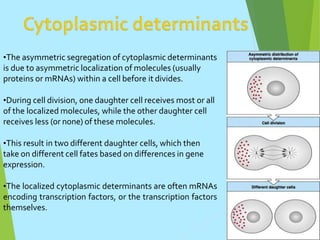
•The asymmetric segregation of cytoplasmic determinants
is due to asymmetric localization of molecules (usually
proteins or mRNAs) within a cell before it divides.
•During cell division, one daughter cell receives most or all
of the localized molecules, while the other daughter cell
receives less (or none) of these molecules.
•This result in two different daughter cells, which then
take on different cell fates based on differences in gene
expression.
•The localized cytoplasmic determinants are often mRNAs
encoding transcription factors, or the transcription factors
themselves.
Morphogen gradient

Morphogen gradient

  • 1.
    Morphogen gradients By Mrs SanchitaChoubey (M.Sc., PGDCR, Pursuing Ph. D) Assistant Professor of Microbiology Dr. D Y Patil Arts Commerce and Science College Pimpri, Pune
  • 2.
  • 3.
    science-img.com **Morphogenesis is theoutcome of correct pattern formation
  • 4.
    •A morphogen isa signal (usually secreted from a subset of cells) that elicits different cellular responses at different concentrations. •A morphogen specifies more than one cell type by forming a concentration gradient, ie- it diffuses from its site of synthesis to become progressively less concentrated farther from the source of its synthesis. •Cells respond to different, or threshold, concentrations, of the morphogen by activating expression of distinct sets of genes. •Thresholds can represent the amount of the morphogen required to bind to receptors for activation intracellular signaling, or concentrations of transcription factors required to activate certain genes
  • 5.
    *The very firststep in patterning the embryo of the fruit fly, Drosophila melanogaster, is a good example of pattern formation by a gradient. *Bicoid is a transcription factor which turns on different genes in different levels - acting as a morphogen gradient.
  • 6.
    The four genesshown in part A (tailless, empty spiracles, hunchback, and kruppel) are found in different locations within the Drosophila embryo, as a result of the amount of Bicoid protein at a particular location in the embryo.
  • 7.
    The empty spiraclesgene is necessary for proper head formation Kruppel :Termed as gap gene .. Meant for development of Centre of embryo Hunchback are the maternal effect genes that are most important for patterning of anterior parts (head and thorax) of the Drosophila embryo Tailles : Posterior part
  • 8.
    After fertilization, bicoidmRNA from the mother fly begins to be translated into Bicoid protein in the Drosophila zygote. image B shows how the Bicoid protein diffuses through the egg forming a gradient. High concentrations of Bicoid protein are shown in white on the left (anterior) end of the zygote, and low concentrations are shown in blue on the right (posterior) end.
  • 9.
    Image C showsBicoid protein in the nuclei of a Drosophila embryo after a number of rounds of mitosis. The nuclei in the anterior end (left) have more Bicoid protein than those in the posterior end (right)
  • 10.
    Image D showsKruppel protein in orange and Hunchback protein in green. The region where the two proteins overlap is yellow. The colors come from fluorescent dyes attached to antibodies that bind specifically to these proteins.
  • 11.
    studentreader.com •The asymmetric segregationof cytoplasmic determinants is due to asymmetric localization of molecules (usually proteins or mRNAs) within a cell before it divides. •During cell division, one daughter cell receives most or all of the localized molecules, while the other daughter cell receives less (or none) of these molecules. •This result in two different daughter cells, which then take on different cell fates based on differences in gene expression. •The localized cytoplasmic determinants are often mRNAs encoding transcription factors, or the transcription factors themselves.