
FATE
MAPDr. Dinesh C. Sharma,
Associate Professor & Head
Dept of Zoology
Km. Mayawati Govt. Girls P.G. College, Badalpur, GB nagar
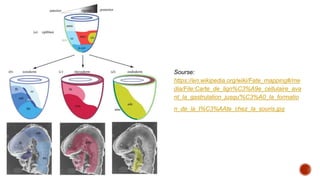
A chart showing the fate of each part of an early embryo, in a
particular blastula stage is called fate maps. It is done because
the correct interpretation of gastrulation is impossible without
the knowledge of the position which are the presumptive
germinal layers (Ectoderm, Mesoderm and Endoderm) occupy in
blastula.
Fate mapping is a method used in developmental biology to
study the embryonic origin of various adult tissues and
structures. The "fate" of each cell or group of cells is mapped
onto the embryo, showing which parts of the embryo will
develop into which tissue. When carried out at single-cell
resolution, this process is called cell lineage tracing. It is also
used to trace the development of tumors.
The fate of the cells is determined in the blastula or early
gastrula, so fate mapping can be done at these stage.
Sourse:
https://en.wikipedia.org/wiki/Fate_mapping#/me
dia/File:Carte_de_lign%C3%A9e_cellulaire_ava
nt_la_gastrulation_jusqu'%C3%A0_la_formatio
n_de_la_t%C3%AAte_chez_la_souris.jpg
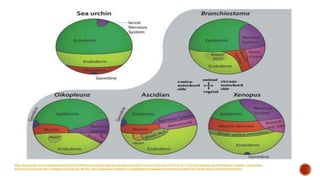
The fate maps of different
types of animal’s eggs can be
constructed by the following
methods.
1- Construction of fate maps buy
Natural marking- in this case the
cytoplasm of the fertilized egg of
some animals (Eg. Cionia, Styla,
Urochordate) has natural colour
difference in various portions.
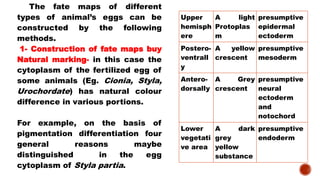
For example, on the basis of
pigmentation differentiation four
general reasons maybe
distinguished in the egg
cytoplasm of Styla partia.
Upper
hemisph
ere
A light
Protoplas
m
presumptive
epidermal
ectoderm
Postero-
ventrall
y
A yellow
crescent
presumptive
mesoderm
Antero-
dorsally
A Grey
crescent
presumptive
neural
ectoderm
and
notochord
Lower
vegetati
ve area
A dark
grey
yellow
substance
presumptive
endoderm
https://www.google.co.in/url?sa=i&url=https%3A%2F%2Fbioone.org%2Fjournals%2Fzoological-science%2Fvolume-31%2Fissue-10%2Fzs140117%2FCell-Lineages-and-Fate-Maps-in-Tunicates--Conservation-
and%2F10.2108%2Fzs140117.full&psig=AOvVaw2vM--9EQNp_CWrLi0cpqqC&ust=1600507011040000&source=images&cd=vfe&ved=0CAIQjRxqFwoTCIiFhbCv8usCFQAAAAAdAAAAABAd
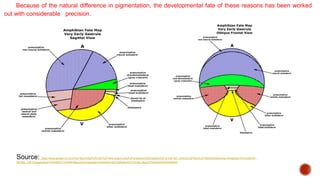
Because of the natural difference in pigmentation, the developmental fate of these reasons has been worked
out with considerable precision.
Source: https://www.google.co.in/url?sa=i&url=http%3A%2F%2Fwww.auburn.edu%2Facademic%2Fclasses%2Fzy%2Fvert_embryo%2Fhtml%2F08amphibfatemap.html&psig=AOvVaw2vM--
9EQNp_CWrLi0cpqqC&ust=1600507011040000&source=images&cd=vfe&ved=0CAIQjRxqFwoTCIiFhbCv8usCFQAAAAAdAAAAABAN
2-Construction of fate maps by artificial marking- Wather Vogt (1925) discovered the
artificial marking method in the construction of fate maps of amphibians. Following
artificial marking methods are used for fate mapping
A-Vital staining marking method- This is done with the help of vital stains (Eg. neutral
red, Nile blue sulphate, Bismarck Brown, Janus green) which are restain by cells for
considerable periods and not interfere the normal process.
For example - For the construction of the Fate map of an amphibian a small piece of
Agar or cellophane (stain careers) is stained with vital stain and it is pressed against an
area of blastula for a short period. The stain diffuses from stain careers to blastomeres,
which will retain their distinctive coloration for several days. By so marking several
areas simultaneously, it is possible to follow the movement of gastrulation by continuous
observation. Moreover, the persistence of the stain makes it possible to establish the
ultimate location of marked material in the embryo. This in turn, enables one to project
the pattern of parts back onto the blastula and thus, construct a map of prospective
organ reason.
By vital staining methods, the fate maps have been made for a number of vertebrate
species.
B- Carbon particle marking method- This method
discovered by Spratt (1946). In this method the tiny
carbon particles are applied on the surface of the
embryo. Carbon particle is stick to the surface of
the cells and can thus be used as markers enabling
the investigator to follow the movement of cells and
draw of the fate maps.
C-Radioactive labelling marking methods- radioactive
labelling of blastomeres for the fate mapping is used
now a days for construction of Fate map.

FATE Map

  • 1.
    FATE MAPDr. Dinesh C.Sharma, Associate Professor & Head Dept of Zoology Km. Mayawati Govt. Girls P.G. College, Badalpur, GB nagar
  • 2.
    A chart showingthe fate of each part of an early embryo, in a particular blastula stage is called fate maps. It is done because the correct interpretation of gastrulation is impossible without the knowledge of the position which are the presumptive germinal layers (Ectoderm, Mesoderm and Endoderm) occupy in blastula. Fate mapping is a method used in developmental biology to study the embryonic origin of various adult tissues and structures. The "fate" of each cell or group of cells is mapped onto the embryo, showing which parts of the embryo will develop into which tissue. When carried out at single-cell resolution, this process is called cell lineage tracing. It is also used to trace the development of tumors. The fate of the cells is determined in the blastula or early gastrula, so fate mapping can be done at these stage.
  • 3.
  • 4.
    The fate mapsof different types of animal’s eggs can be constructed by the following methods. 1- Construction of fate maps buy Natural marking- in this case the cytoplasm of the fertilized egg of some animals (Eg. Cionia, Styla, Urochordate) has natural colour difference in various portions. For example, on the basis of pigmentation differentiation four general reasons maybe distinguished in the egg cytoplasm of Styla partia. Upper hemisph ere A light Protoplas m presumptive epidermal ectoderm Postero- ventrall y A yellow crescent presumptive mesoderm Antero- dorsally A Grey crescent presumptive neural ectoderm and notochord Lower vegetati ve area A dark grey yellow substance presumptive endoderm
  • 5.
  • 6.
    Because of thenatural difference in pigmentation, the developmental fate of these reasons has been worked out with considerable precision. Source: https://www.google.co.in/url?sa=i&url=http%3A%2F%2Fwww.auburn.edu%2Facademic%2Fclasses%2Fzy%2Fvert_embryo%2Fhtml%2F08amphibfatemap.html&psig=AOvVaw2vM-- 9EQNp_CWrLi0cpqqC&ust=1600507011040000&source=images&cd=vfe&ved=0CAIQjRxqFwoTCIiFhbCv8usCFQAAAAAdAAAAABAN
  • 7.
    2-Construction of fatemaps by artificial marking- Wather Vogt (1925) discovered the artificial marking method in the construction of fate maps of amphibians. Following artificial marking methods are used for fate mapping A-Vital staining marking method- This is done with the help of vital stains (Eg. neutral red, Nile blue sulphate, Bismarck Brown, Janus green) which are restain by cells for considerable periods and not interfere the normal process. For example - For the construction of the Fate map of an amphibian a small piece of Agar or cellophane (stain careers) is stained with vital stain and it is pressed against an area of blastula for a short period. The stain diffuses from stain careers to blastomeres, which will retain their distinctive coloration for several days. By so marking several areas simultaneously, it is possible to follow the movement of gastrulation by continuous observation. Moreover, the persistence of the stain makes it possible to establish the ultimate location of marked material in the embryo. This in turn, enables one to project the pattern of parts back onto the blastula and thus, construct a map of prospective organ reason. By vital staining methods, the fate maps have been made for a number of vertebrate species.
  • 8.
    B- Carbon particlemarking method- This method discovered by Spratt (1946). In this method the tiny carbon particles are applied on the surface of the embryo. Carbon particle is stick to the surface of the cells and can thus be used as markers enabling the investigator to follow the movement of cells and draw of the fate maps. C-Radioactive labelling marking methods- radioactive labelling of blastomeres for the fate mapping is used now a days for construction of Fate map.