TOPIC: CELL FATE
SUBMITTED TO: DR. SIBTAIN AHMAD
PRESENTED BY: MUHAMMAD AHMAD
BS (HONS) ZOOLOGY
UNIVERSITY OF OKARA
29-Jan-2018CELL FATE BY PROGRESSIVE DETERMINANTS 1
CELL FATE BY PROGRESSIVE
DETERMINANTS
29-Jan-2018CELL FATE BY PROGRESSIVE DETERMINANTS 2
• Cell fate—
• What a cell will become (if
left alone).
• Potency
• The total of all structures
that a cell can form in an
appropriate environment.
29-Jan-2018CELL FATE BY PROGRESSIVE DETERMINANTS 3
• Determination
• A stepwise process
during which the potency
of cell becomes limited to
its fate.
• Determinant—
• a molecule that regulates
cell fate
29-Jan-2018CELL FATE BY PROGRESSIVE DETERMINANTS 4
Differentiation (Specification)
• A fertilized egg contains cytoplasmic
components that are unequally distributed
within the egg. These different cytoplasmic
components are believed to have
morphogenetic determinants that control
the functioning of a specific cell type. This
is now called differentiation. Zygote
contains complete information for the
development of an individual but how these
cells differentiate.
• In order to understand the concept of
differentiation, Spemann performed a series
of experiments on amphibian embryo.
29-Jan-2018CELL FATE BY PROGRESSIVE DETERMINANTS 5
• Spemann took out piece of ectoderm from
frog’s embryo and grew it in a separate dish.
The embryo from which the piece of
ectoderm was removed, was unable to form
normal nervous system but has a defective
nervous system. Similarly the isolated piece
did not develop any structure even though it
was active and healthy.
• In other experiment, he separated the
mesoderm underlying ectoderm and folded
the flap of ectoderm to its original piece. The
frog did not develop any nervous system.
• It was proved that mesoderm had some
effect on the ectoderm to stimulate the
ectodermal cells to form nervous system.
29-Jan-2018CELL FATE BY PROGRESSIVE DETERMINANTS 6
Modes of Specification
• There are three general
ways a cell can become
specified for a particular
fate, they are:
• Autonomous specification
• Conditional specification
• Syncytial specification
29-Jan-2018CELL FATE BY PROGRESSIVE DETERMINANTS 7
Autonomous Specification
• This type of specification results from
cell-intrinsic properties. The cell-intrinsic
properties arise from a cleavage of a cell
with asymmetrically expressed maternal
cytoplasmic determinants (proteins,
small regulatory RNAs and mRNA).
• The fate of the cell depends on factors
secreted into its cytoplasm during
cleavage.
• Autonomous specification was
demonstrated in 1887 by a French
medical student, Laurent Chabry,
working on tunicate embryos.
• This asymmetric cell division usually
occurs early in embryogenesis.
29-Jan-2018CELL FATE BY PROGRESSIVE DETERMINANTS 8
Example of Autonomous Specification
in Tunicates (Sea Squirt's)
29-Jan-2018CELL FATE BY PROGRESSIVE DETERMINANTS 9
Autonomous specification in the early tunicate embryo.
When the four blastomere pairs of the 8-cell embryo are
dissociated, each forms structure that it would have
formed if it had remained in the embryo. 29-Jan-2018CELL FATE BY PROGRESSIVE DETERMINANTS 10
Conditional Specification
• This type of specification is a cell-
extrinsic process that relies on cues and
interactions between cells or from
concentration-gradients of morphogens.
• Inductive interactions between
neighboring cells is the most common
mode of tissue patterning.
• In this mechanism, one or two cells from
a group of cells with the same
developmental potential are exposed to a
signal from outside the group.
29-Jan-2018CELL FATE BY PROGRESSIVE DETERMINANTS 11
• Another mechanism that determines the
cell fate is regional determination.
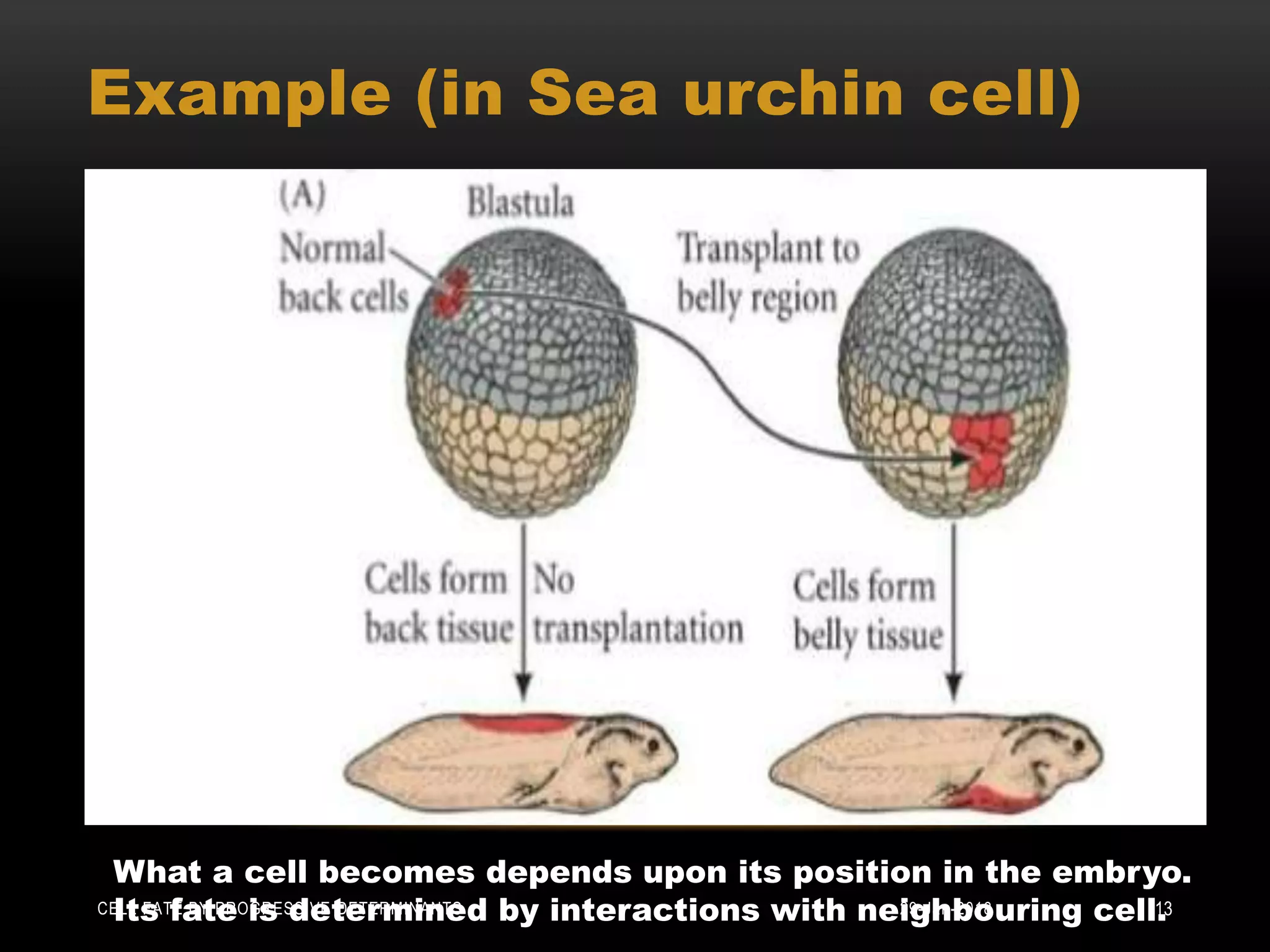
• Regional determination is based upon the
region or position of cell within the
embryo, it is also known as positional
value.
• This was first observed in chick, when
mesoderm was taken from the
prospective thigh region of a chick
embryo, was grafted onto the wing
region and did not transform to wing
tissue, but instead into toe tissue.
29-Jan-2018CELL FATE BY PROGRESSIVE DETERMINANTS 12
Example (in Sea urchin cell)
What a cell becomes depends upon its position in the embryo.
Its fate is determined by interactions with neighbouring cell.29-Jan-2018CELL FATE BY PROGRESSIVE DETERMINANTS 13
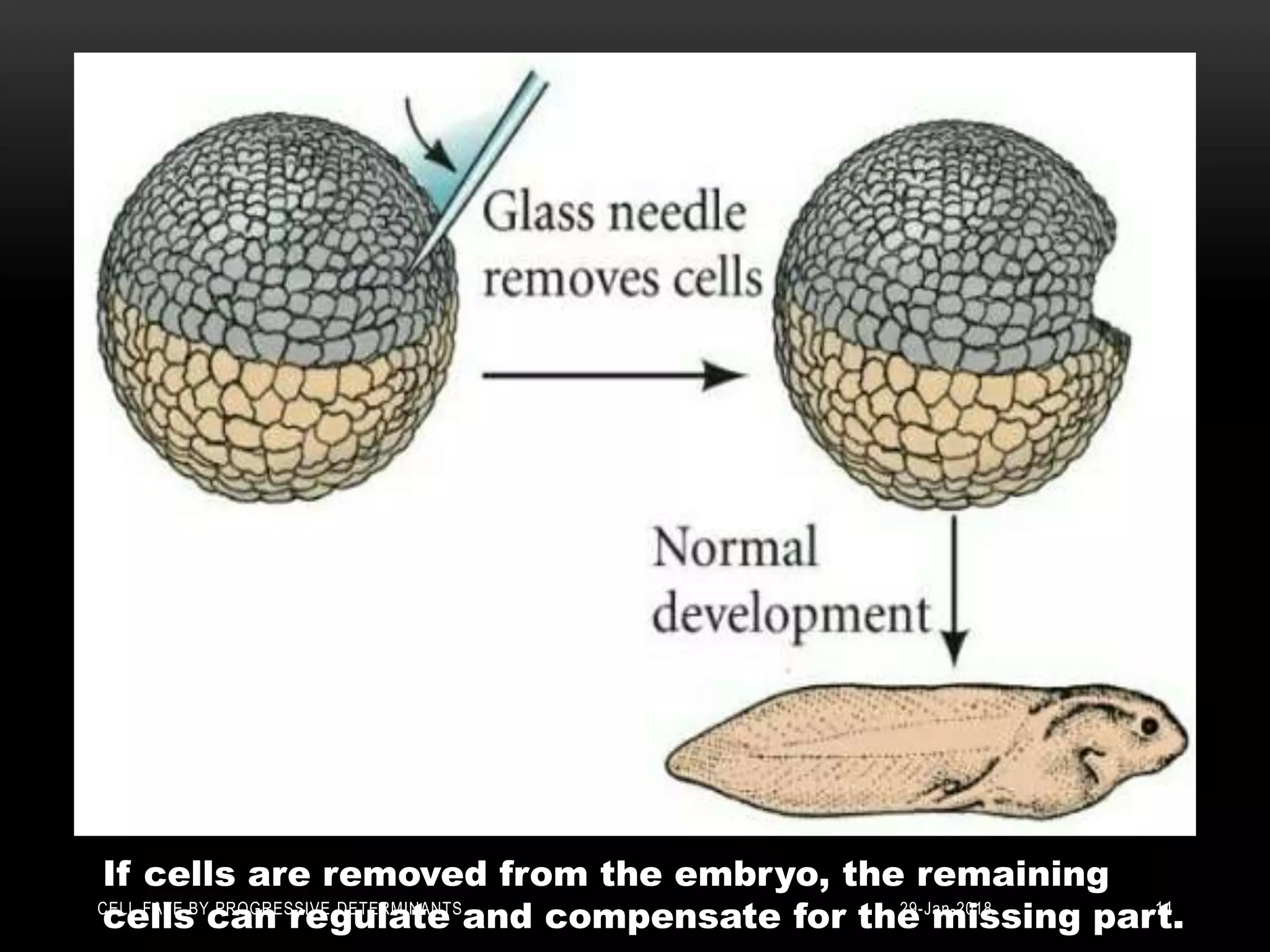
If cells are removed from the embryo, the remaining
cells can regulate and compensate for the missing part.29-Jan-2018CELL FATE BY PROGRESSIVE DETERMINANTS 14
Syncytial Specification
• This type of a specification is a
hybrid of the autonomous and
conditional that occurs in insects.
This method involves the action of
morphogen gradients within the
syncytium.
• There are no cell boundaries in the
syncytium, these morphogens can
influence nuclei in a concentration-
dependent manner.
29-Jan-2018CELL FATE BY PROGRESSIVE DETERMINANTS 15
• Many insects also use a third means, known
as syncytial specification, to commit cells
to their fates. Here, interactions occur not
between cells, but between parts of one
cell.
• In early embryos of these insects, cell
division is not complete. Rather, the nuclei
divide within the egg cytoplasm. This
creates many nuclei in the large egg cell. A
cytoplasm that contains many nuclei is
called a syncytium.
• The egg cytoplasm, however, is not uniform.
Rather, the anterior of the egg cytoplasm is
markedly different from the posterior.
29-Jan-2018CELL FATE BY PROGRESSIVE DETERMINANTS 16
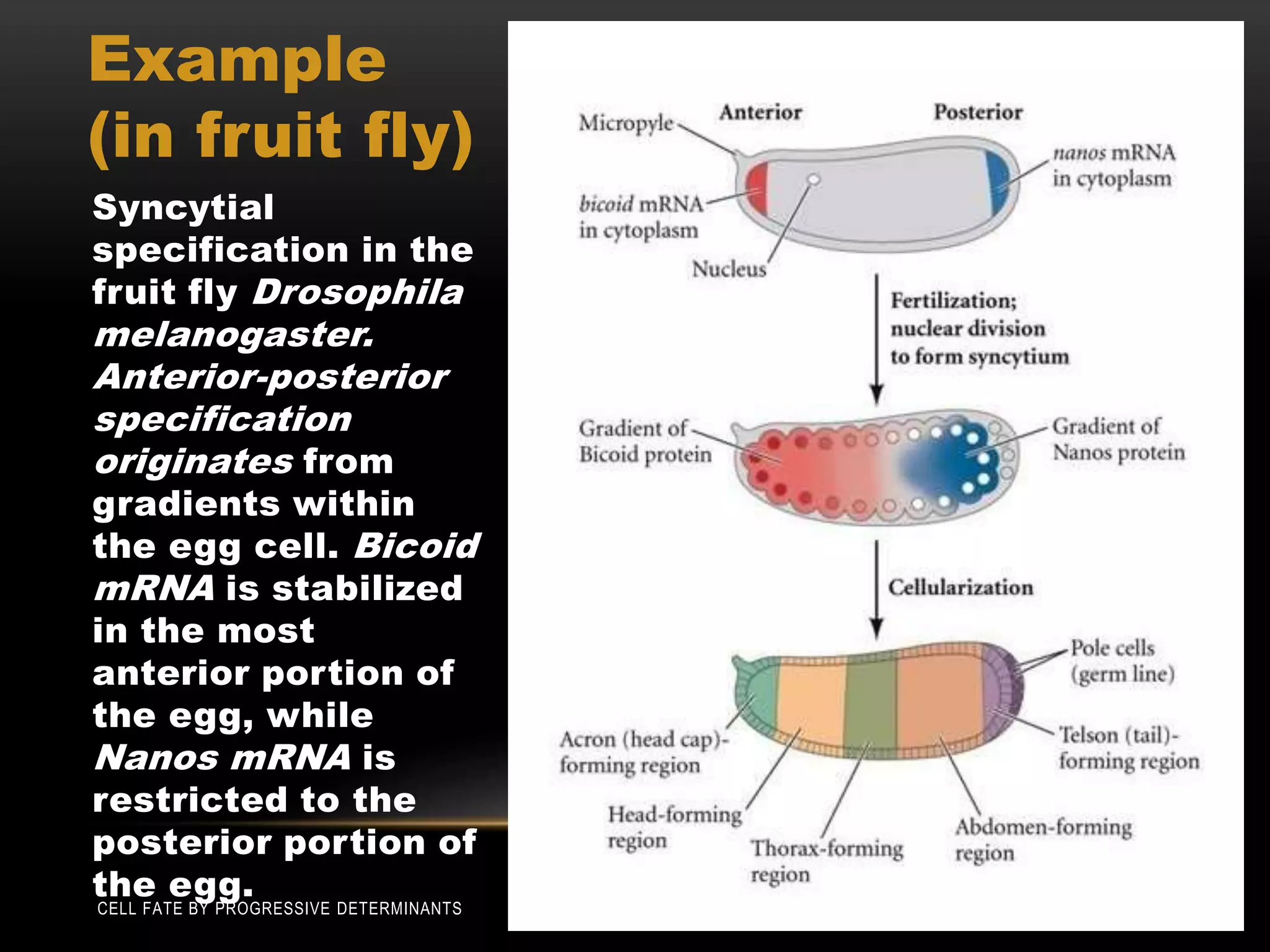
Example
(in fruit fly)
Syncytial
specification in the
fruit fly Drosophila
melanogaster.
Anterior-posterior
specification
originates from
gradients within
the egg cell. Bicoid
mRNA is stabilized
in the most
anterior portion of
the egg, while
Nanos mRNA is
restricted to the
posterior portion of
the egg.
29-Jan-2018CELL FATE BY PROGRESSIVE DETERMINANTS 17
Role of Cytoplasm
• It is known that different cytoplasmic components
contain different morphogenetic determinants that
are responsible for cell differentiation. These
determinants are present in blastomeres. The
fertilized egg of an ascidian contains cytoplasm of
five different colours that is segregated into
different blastomeres.
• Clear cytoplasm – It produces larval epidermis.
• Yellow cytoplasm – It gives rise to muscle cells.
• Gray vegetal cytoplasm – It gives rise to gut.
• Grey equatorial cytoplasm – It produces notochord
and neural tube.
29-Jan-2018CELL FATE BY PROGRESSIVE DETERMINANTS 18
• From different experiments, it was
concluded that both gene and
cytoplasm play important role in
development. Nucleus contains all
the genes, which determine the
characteristics of the individual,
while cytoplasm plays the role of
selection of genes.
• During the cell fate determination
some specific genes are turned on
while the others are turned off.
29-Jan-2018CELL FATE BY PROGRESSIVE DETERMINANTS 19
• Determination is followed by
differentiation, the actual
changes in biochemistry,
structure, and function that
result in specific cell types.
• Differentiation often involves
a change in appearance as
well as function.
29-Jan-2018CELL FATE BY PROGRESSIVE DETERMINANTS 20
• Cell interactions
• Contact with neighboring
cells influence cell fate.
• There are three pathways of
cell interactions, these are:
• Diffusion
• Direct contact
• Gap junction
29-Jan-2018CELL FATE BY PROGRESSIVE DETERMINANTS 21
29-Jan-2018CELL FATE BY PROGRESSIVE DETERMINANTS 22
REGULATION IN
DEVELOPMENT
• variable cleavage (most
species)
• Use stepwise approximation
to correct imbalances
• development in individual
cells can be shifted
29-Jan-2018CELL FATE BY PROGRESSIVE DETERMINANTS 23
• mosaic development –
(nematodes, ascidians)
• Potency map is identical to fate
map, all cells determined.
• regulative development
(amphibian, sea urchin,
mammals)
• Potency greater than fate, Cells
not yet determined.
29-Jan-2018CELL FATE BY PROGRESSIVE DETERMINANTS 24
References
• Gilbert, Scott (2006). Developmental biology (8th
ed.). Sunderland, Mass.: Sinauer Associates, Inc.
Publishers. pp. 53–55. ISBN 978-0-87893-250-4.
• Gilbert, S. F. (2000). Developmental Biology
(https://www.ncbi.nlm.nih.gov/books/bv.fcgi?rid=dbi
o.section.333) (6th ed.).
• The Developmental Mechanics of Cell Specification
- Developmental Biology - NCBI Bookshelf
• https://www.ncbi.nlm.nih.gov/books/NBK9968/
29-Jan-2018CELL FATE BY PROGRESSIVE DETERMINANTS 25
THANKS
29-Jan-2018CELL FATE BY PROGRESSIVE DETERMINANTS 26

Cell Fate by Progressive Determinants

  • 1.
    TOPIC: CELL FATE SUBMITTEDTO: DR. SIBTAIN AHMAD PRESENTED BY: MUHAMMAD AHMAD BS (HONS) ZOOLOGY UNIVERSITY OF OKARA 29-Jan-2018CELL FATE BY PROGRESSIVE DETERMINANTS 1
  • 2.
    CELL FATE BYPROGRESSIVE DETERMINANTS 29-Jan-2018CELL FATE BY PROGRESSIVE DETERMINANTS 2
  • 3.
    • Cell fate— •What a cell will become (if left alone). • Potency • The total of all structures that a cell can form in an appropriate environment. 29-Jan-2018CELL FATE BY PROGRESSIVE DETERMINANTS 3
  • 4.
    • Determination • Astepwise process during which the potency of cell becomes limited to its fate. • Determinant— • a molecule that regulates cell fate 29-Jan-2018CELL FATE BY PROGRESSIVE DETERMINANTS 4
  • 5.
    Differentiation (Specification) • Afertilized egg contains cytoplasmic components that are unequally distributed within the egg. These different cytoplasmic components are believed to have morphogenetic determinants that control the functioning of a specific cell type. This is now called differentiation. Zygote contains complete information for the development of an individual but how these cells differentiate. • In order to understand the concept of differentiation, Spemann performed a series of experiments on amphibian embryo. 29-Jan-2018CELL FATE BY PROGRESSIVE DETERMINANTS 5
  • 6.
    • Spemann tookout piece of ectoderm from frog’s embryo and grew it in a separate dish. The embryo from which the piece of ectoderm was removed, was unable to form normal nervous system but has a defective nervous system. Similarly the isolated piece did not develop any structure even though it was active and healthy. • In other experiment, he separated the mesoderm underlying ectoderm and folded the flap of ectoderm to its original piece. The frog did not develop any nervous system. • It was proved that mesoderm had some effect on the ectoderm to stimulate the ectodermal cells to form nervous system. 29-Jan-2018CELL FATE BY PROGRESSIVE DETERMINANTS 6
  • 7.
    Modes of Specification •There are three general ways a cell can become specified for a particular fate, they are: • Autonomous specification • Conditional specification • Syncytial specification 29-Jan-2018CELL FATE BY PROGRESSIVE DETERMINANTS 7
  • 8.
    Autonomous Specification • Thistype of specification results from cell-intrinsic properties. The cell-intrinsic properties arise from a cleavage of a cell with asymmetrically expressed maternal cytoplasmic determinants (proteins, small regulatory RNAs and mRNA). • The fate of the cell depends on factors secreted into its cytoplasm during cleavage. • Autonomous specification was demonstrated in 1887 by a French medical student, Laurent Chabry, working on tunicate embryos. • This asymmetric cell division usually occurs early in embryogenesis. 29-Jan-2018CELL FATE BY PROGRESSIVE DETERMINANTS 8
  • 9.
    Example of AutonomousSpecification in Tunicates (Sea Squirt's) 29-Jan-2018CELL FATE BY PROGRESSIVE DETERMINANTS 9
  • 10.
    Autonomous specification inthe early tunicate embryo. When the four blastomere pairs of the 8-cell embryo are dissociated, each forms structure that it would have formed if it had remained in the embryo. 29-Jan-2018CELL FATE BY PROGRESSIVE DETERMINANTS 10
  • 11.
    Conditional Specification • Thistype of specification is a cell- extrinsic process that relies on cues and interactions between cells or from concentration-gradients of morphogens. • Inductive interactions between neighboring cells is the most common mode of tissue patterning. • In this mechanism, one or two cells from a group of cells with the same developmental potential are exposed to a signal from outside the group. 29-Jan-2018CELL FATE BY PROGRESSIVE DETERMINANTS 11
  • 12.
    • Another mechanismthat determines the cell fate is regional determination. • Regional determination is based upon the region or position of cell within the embryo, it is also known as positional value. • This was first observed in chick, when mesoderm was taken from the prospective thigh region of a chick embryo, was grafted onto the wing region and did not transform to wing tissue, but instead into toe tissue. 29-Jan-2018CELL FATE BY PROGRESSIVE DETERMINANTS 12
  • 13.
    Example (in Seaurchin cell) What a cell becomes depends upon its position in the embryo. Its fate is determined by interactions with neighbouring cell.29-Jan-2018CELL FATE BY PROGRESSIVE DETERMINANTS 13
  • 14.
    If cells areremoved from the embryo, the remaining cells can regulate and compensate for the missing part.29-Jan-2018CELL FATE BY PROGRESSIVE DETERMINANTS 14
  • 15.
    Syncytial Specification • Thistype of a specification is a hybrid of the autonomous and conditional that occurs in insects. This method involves the action of morphogen gradients within the syncytium. • There are no cell boundaries in the syncytium, these morphogens can influence nuclei in a concentration- dependent manner. 29-Jan-2018CELL FATE BY PROGRESSIVE DETERMINANTS 15
  • 16.
    • Many insectsalso use a third means, known as syncytial specification, to commit cells to their fates. Here, interactions occur not between cells, but between parts of one cell. • In early embryos of these insects, cell division is not complete. Rather, the nuclei divide within the egg cytoplasm. This creates many nuclei in the large egg cell. A cytoplasm that contains many nuclei is called a syncytium. • The egg cytoplasm, however, is not uniform. Rather, the anterior of the egg cytoplasm is markedly different from the posterior. 29-Jan-2018CELL FATE BY PROGRESSIVE DETERMINANTS 16
  • 17.
    Example (in fruit fly) Syncytial specificationin the fruit fly Drosophila melanogaster. Anterior-posterior specification originates from gradients within the egg cell. Bicoid mRNA is stabilized in the most anterior portion of the egg, while Nanos mRNA is restricted to the posterior portion of the egg. 29-Jan-2018CELL FATE BY PROGRESSIVE DETERMINANTS 17
  • 18.
    Role of Cytoplasm •It is known that different cytoplasmic components contain different morphogenetic determinants that are responsible for cell differentiation. These determinants are present in blastomeres. The fertilized egg of an ascidian contains cytoplasm of five different colours that is segregated into different blastomeres. • Clear cytoplasm – It produces larval epidermis. • Yellow cytoplasm – It gives rise to muscle cells. • Gray vegetal cytoplasm – It gives rise to gut. • Grey equatorial cytoplasm – It produces notochord and neural tube. 29-Jan-2018CELL FATE BY PROGRESSIVE DETERMINANTS 18
  • 19.
    • From differentexperiments, it was concluded that both gene and cytoplasm play important role in development. Nucleus contains all the genes, which determine the characteristics of the individual, while cytoplasm plays the role of selection of genes. • During the cell fate determination some specific genes are turned on while the others are turned off. 29-Jan-2018CELL FATE BY PROGRESSIVE DETERMINANTS 19
  • 20.
    • Determination isfollowed by differentiation, the actual changes in biochemistry, structure, and function that result in specific cell types. • Differentiation often involves a change in appearance as well as function. 29-Jan-2018CELL FATE BY PROGRESSIVE DETERMINANTS 20
  • 21.
    • Cell interactions •Contact with neighboring cells influence cell fate. • There are three pathways of cell interactions, these are: • Diffusion • Direct contact • Gap junction 29-Jan-2018CELL FATE BY PROGRESSIVE DETERMINANTS 21
  • 22.
    29-Jan-2018CELL FATE BYPROGRESSIVE DETERMINANTS 22
  • 23.
    REGULATION IN DEVELOPMENT • variablecleavage (most species) • Use stepwise approximation to correct imbalances • development in individual cells can be shifted 29-Jan-2018CELL FATE BY PROGRESSIVE DETERMINANTS 23
  • 24.
    • mosaic development– (nematodes, ascidians) • Potency map is identical to fate map, all cells determined. • regulative development (amphibian, sea urchin, mammals) • Potency greater than fate, Cells not yet determined. 29-Jan-2018CELL FATE BY PROGRESSIVE DETERMINANTS 24
  • 25.
    References • Gilbert, Scott(2006). Developmental biology (8th ed.). Sunderland, Mass.: Sinauer Associates, Inc. Publishers. pp. 53–55. ISBN 978-0-87893-250-4. • Gilbert, S. F. (2000). Developmental Biology (https://www.ncbi.nlm.nih.gov/books/bv.fcgi?rid=dbi o.section.333) (6th ed.). • The Developmental Mechanics of Cell Specification - Developmental Biology - NCBI Bookshelf • https://www.ncbi.nlm.nih.gov/books/NBK9968/ 29-Jan-2018CELL FATE BY PROGRESSIVE DETERMINANTS 25
  • 26.
    THANKS 29-Jan-2018CELL FATE BYPROGRESSIVE DETERMINANTS 26