ANA 801 - DEVELOPMENTAL BIOLOGY
AND TERATOLOGY
BY
ADESEJI WASIU ADEBAYO
UMAR BUKOLA
OUTLINE
2
 INTRODUCTION
 GENES OF PATTERN FORMATION
 CLINICAL IMPORTANCE
 CONCLUSION
 REFERENCES
INTRODUCTION
3
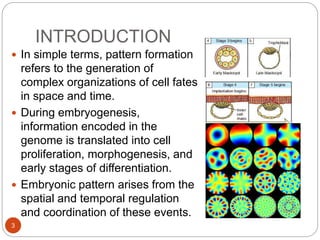
 In simple terms, pattern formation
refers to the generation of
complex organizations of cell fates
in space and time.
 During embryogenesis,
information encoded in the
genome is translated into cell
proliferation, morphogenesis, and
early stages of differentiation.
 Embryonic pattern arises from the
spatial and temporal regulation
and coordination of these events.
INTRODUCTION
4
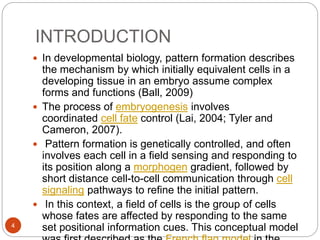
 In developmental biology, pattern formation describes
the mechanism by which initially equivalent cells in a
developing tissue in an embryo assume complex
forms and functions (Ball, 2009)
 The process of embryogenesis involves
coordinated cell fate control (Lai, 2004; Tyler and
Cameron, 2007).
 Pattern formation is genetically controlled, and often
involves each cell in a field sensing and responding to
its position along a morphogen gradient, followed by
short distance cell-to-cell communication through cell
signaling pathways to refine the initial pattern.
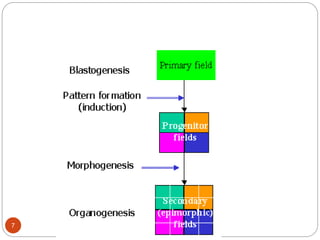
 In this context, a field of cells is the group of cells
whose fates are affected by responding to the same
set positional information cues. This conceptual model
Why Pattern Formation?
5
 The reliable development of highly complex
organisms is an intriguing and fascinating
problem. The genetic material is, as a rule, the
same in each cell of an organism. How do then
cells, under the influence of their common genes,
produce spatial patterns ?
 Development of an organism is, of course, under
genetic control but the genetic information is
usually the same in all cells.
 A crucial problem is therefore the generation of
spatial patterns that allow a different fate of some
cells in relation to others
 (Koch and Meinhardt, 1994).
DEFINITION OF TERMS
6
 Induction is the stimulation of a cell to differentiate in
response to a stimulus produced by another cell. It is
mediated by inducer substances that diffuse from
one cell to another. It results in cell determination.
 Determination is the commitment of a cell to undergo
differentiation. It is an irreversible process but is not
accompanied by morphological changes.
 Determinants are the cytoplasmic effector molecules
that mediate determination.
 Differentiation is the variation in the pattern of
expression of a common set of genes to form cells of
diverse morphology and function.
7
8
9
10
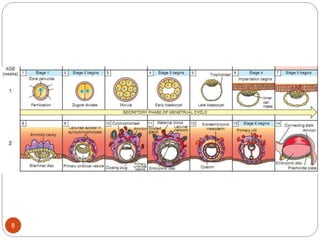
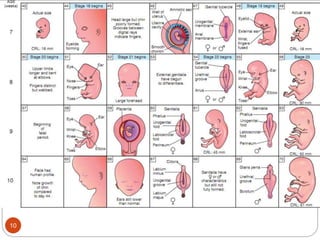
Time-table of landmarks in early
human development
11
 Day 1 - cleavage
 Days 2-4 - morula; free-
floating conceptus in uterine
tube
 Days 5-6 - formation of
the blastocyst and
embryoblast;
 - implantation
 Week 2 (days 7-14)
 - formation of the
bilaminar embryo 0.1 mm
 Week 3 (days 15-20) -
formation of the trilaminar
embryo 1.0 mm
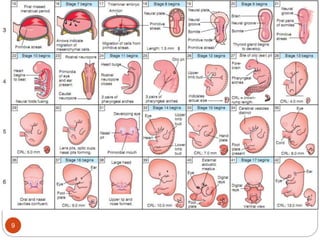
 Week 4 (days 21-28)
 Day 21 - formation of neural
tube 2.0 mm
 Day 22 - formation of the heart
 Day 23 - formation of eye and
ear rudiments
 Day 25 - formation of branchial
arches
 Day 26 - formation of upper
limb bud
 Day 28 - formation of the lower
limb bud 5.0 mm
 Weeks 5 to 9 (2nd month) - Period of
organogenesis
 Week
6 1.0
cm
 Week 9
4.0 cm
GENES OF PATTERN
FORMATION
12
 Every organism has a unique body pattern.
 This patterning is controlled and influenced by the
HOMEOBOX genes.
 These specify how different areas of the body
develop their individual structures, e.g. Arms, legs
etc.
HOMEOBOX GENE
13
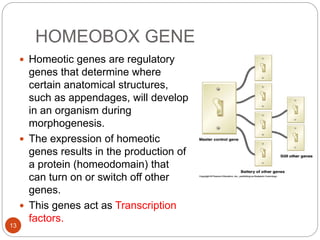
 Homeotic genes are regulatory
genes that determine where
certain anatomical structures,
such as appendages, will develop
in an organism during
morphogenesis.
 The expression of homeotic
genes results in the production of
a protein (homeodomain) that
can turn on or switch off other
genes.
 This genes act as Transcription
factors.
HOX GENE
14
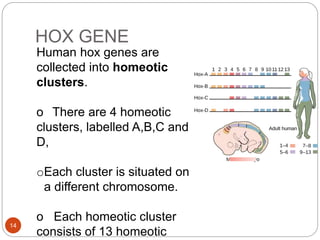
Human hox genes are
collected into homeotic
clusters.
o There are 4 homeotic
clusters, labelled A,B,C and
D,
oEach cluster is situated on
a different chromosome.
o Each homeotic cluster
consists of 13 homeotic
The RNA expression pattern of three mouse Hox genes in the
vertebral column of a sectioned 12.5-day-old mouse embryo:
the anterior limit of each of the expression pattern is different
Each Hox gene is expressed in a continuous block beginning at a
Specific anterior limit and running posteriorly to the end of the
developing vertebral column
HOX GENE
16
The four numerically corresponding genes for the four
different clusters form a paralogous group.
o The hox genes are responsible for patterning along
the antero-posterior axis.
o The genes are expressed sequentially beginning with
the paralogous group 1, which is expressed first
o The sequential genes specify different segments in
cranio-caudal sequence extending from paralogous
group 1, which specifies the most cranial structures, to
paralogous group 13, which specifies the most caudal
structures.
o Thus the first genes to be expressed specify the most
cranial structures while the last to be expressed specify
the most caudal structures. This is responsible for the
cranio-caudal sequence of development, where the
more cranial segments develop slightly before the
more caudal structures. Consequently the upper limb
develops ahead of the lower limb.
Clinical Correlates
17
 Mutations in genes of pattern formation leads to a
lot of clinical important congenital malformations
and anomalies
 Aniridia
 Synpolydactyly
 Axenfeld-Rieger syndrome
 Branchiootorenal syndrome
 Coloboma
 Langer mesomelic dysplasia
 Léri-Weill dyschondrosteosis
 Microphthalmia
 Mowat-Wilson syndrome
 Amelia
 Limb deformities
Synpolydactyly
18
Mutation in the HOX D13
gene.
Aniridia
19
Aniridia with PAX6 gene
mutation.
Axenfeld-rieger syndrome
20
mutations in one of the genes known
as PAX6, PITX2 and FOXC1.
REFERENCES
21
• A. J. Koch and H. Meinhardt (1994). Biological
Pattern Formation : from Basic Mechanisms to
Complex Structures. Rev. Modern Physics 66,
1481-1507
• Ball, (2009). Shapes, pp. 261–290.
• Eric C. Lai (2004). "Notch signaling: control of
cell communication and cell fate" 131 (5). pp.
965–73. doi:10.1242/dev.01074
• Melinda J. Tyler, David A. Cameron (2007).
"Cellular pattern formation during retinal
regeneration: A role for homotypic control of cell
fate acquisition". Vision Research 47 (4): 501–
FOR LISTENING
22

PATTERN FORMATION

  • 1.
    ANA 801 -DEVELOPMENTAL BIOLOGY AND TERATOLOGY BY ADESEJI WASIU ADEBAYO UMAR BUKOLA
  • 2.
    OUTLINE 2  INTRODUCTION  GENESOF PATTERN FORMATION  CLINICAL IMPORTANCE  CONCLUSION  REFERENCES
  • 3.
    INTRODUCTION 3  In simpleterms, pattern formation refers to the generation of complex organizations of cell fates in space and time.  During embryogenesis, information encoded in the genome is translated into cell proliferation, morphogenesis, and early stages of differentiation.  Embryonic pattern arises from the spatial and temporal regulation and coordination of these events.
  • 4.
    INTRODUCTION 4  In developmentalbiology, pattern formation describes the mechanism by which initially equivalent cells in a developing tissue in an embryo assume complex forms and functions (Ball, 2009)  The process of embryogenesis involves coordinated cell fate control (Lai, 2004; Tyler and Cameron, 2007).  Pattern formation is genetically controlled, and often involves each cell in a field sensing and responding to its position along a morphogen gradient, followed by short distance cell-to-cell communication through cell signaling pathways to refine the initial pattern.  In this context, a field of cells is the group of cells whose fates are affected by responding to the same set positional information cues. This conceptual model
  • 5.
    Why Pattern Formation? 5 The reliable development of highly complex organisms is an intriguing and fascinating problem. The genetic material is, as a rule, the same in each cell of an organism. How do then cells, under the influence of their common genes, produce spatial patterns ?  Development of an organism is, of course, under genetic control but the genetic information is usually the same in all cells.  A crucial problem is therefore the generation of spatial patterns that allow a different fate of some cells in relation to others  (Koch and Meinhardt, 1994).
  • 6.
    DEFINITION OF TERMS 6 Induction is the stimulation of a cell to differentiate in response to a stimulus produced by another cell. It is mediated by inducer substances that diffuse from one cell to another. It results in cell determination.  Determination is the commitment of a cell to undergo differentiation. It is an irreversible process but is not accompanied by morphological changes.  Determinants are the cytoplasmic effector molecules that mediate determination.  Differentiation is the variation in the pattern of expression of a common set of genes to form cells of diverse morphology and function.
  • 7.
  • 8.
  • 9.
  • 10.
  • 11.
    Time-table of landmarksin early human development 11  Day 1 - cleavage  Days 2-4 - morula; free- floating conceptus in uterine tube  Days 5-6 - formation of the blastocyst and embryoblast;  - implantation  Week 2 (days 7-14)  - formation of the bilaminar embryo 0.1 mm  Week 3 (days 15-20) - formation of the trilaminar embryo 1.0 mm  Week 4 (days 21-28)  Day 21 - formation of neural tube 2.0 mm  Day 22 - formation of the heart  Day 23 - formation of eye and ear rudiments  Day 25 - formation of branchial arches  Day 26 - formation of upper limb bud  Day 28 - formation of the lower limb bud 5.0 mm  Weeks 5 to 9 (2nd month) - Period of organogenesis  Week 6 1.0 cm  Week 9 4.0 cm
  • 12.
    GENES OF PATTERN FORMATION 12 Every organism has a unique body pattern.  This patterning is controlled and influenced by the HOMEOBOX genes.  These specify how different areas of the body develop their individual structures, e.g. Arms, legs etc.
  • 13.
    HOMEOBOX GENE 13  Homeoticgenes are regulatory genes that determine where certain anatomical structures, such as appendages, will develop in an organism during morphogenesis.  The expression of homeotic genes results in the production of a protein (homeodomain) that can turn on or switch off other genes.  This genes act as Transcription factors.
  • 14.
    HOX GENE 14 Human hoxgenes are collected into homeotic clusters. o There are 4 homeotic clusters, labelled A,B,C and D, oEach cluster is situated on a different chromosome. o Each homeotic cluster consists of 13 homeotic
  • 15.
    The RNA expressionpattern of three mouse Hox genes in the vertebral column of a sectioned 12.5-day-old mouse embryo: the anterior limit of each of the expression pattern is different Each Hox gene is expressed in a continuous block beginning at a Specific anterior limit and running posteriorly to the end of the developing vertebral column
  • 16.
    HOX GENE 16 The fournumerically corresponding genes for the four different clusters form a paralogous group. o The hox genes are responsible for patterning along the antero-posterior axis. o The genes are expressed sequentially beginning with the paralogous group 1, which is expressed first o The sequential genes specify different segments in cranio-caudal sequence extending from paralogous group 1, which specifies the most cranial structures, to paralogous group 13, which specifies the most caudal structures. o Thus the first genes to be expressed specify the most cranial structures while the last to be expressed specify the most caudal structures. This is responsible for the cranio-caudal sequence of development, where the more cranial segments develop slightly before the more caudal structures. Consequently the upper limb develops ahead of the lower limb.
  • 17.
    Clinical Correlates 17  Mutationsin genes of pattern formation leads to a lot of clinical important congenital malformations and anomalies  Aniridia  Synpolydactyly  Axenfeld-Rieger syndrome  Branchiootorenal syndrome  Coloboma  Langer mesomelic dysplasia  Léri-Weill dyschondrosteosis  Microphthalmia  Mowat-Wilson syndrome  Amelia  Limb deformities
  • 18.
  • 19.
  • 20.
    Axenfeld-rieger syndrome 20 mutations inone of the genes known as PAX6, PITX2 and FOXC1.
  • 21.
    REFERENCES 21 • A. J.Koch and H. Meinhardt (1994). Biological Pattern Formation : from Basic Mechanisms to Complex Structures. Rev. Modern Physics 66, 1481-1507 • Ball, (2009). Shapes, pp. 261–290. • Eric C. Lai (2004). "Notch signaling: control of cell communication and cell fate" 131 (5). pp. 965–73. doi:10.1242/dev.01074 • Melinda J. Tyler, David A. Cameron (2007). "Cellular pattern formation during retinal regeneration: A role for homotypic control of cell fate acquisition". Vision Research 47 (4): 501–
  • 22.

Editor's Notes

  • #10  time-table of  landmarks in early human development Day 1           - cleavage Days 2-4       - morula; free-floating conceptus in uterine tube Days 5-6       - formation of the blastocyst and embryoblast;                    - implantation Week 2 (days 7-14)                              - formation of the bilaminar embryo      0.1 mm Week 3 (days 15-20)                    -formation of the trilaminar embryo       1.0 mm Week 4 (days 21-28) Day 21         - formation of neural tube                     2.0 mm Day 22         - formation of the heart Day 23         - formation of eye and ear rudiments Day 25         - formation of branchial arches Day 26         - formation of upper limb bud Day 28         - formation of the lower limb bud          5.0 mm Weeks 5 to 9 (2nd month) - Period of organogenesis Week 6                                                         1.0 cm Week 9                                                         4.0 cm End of embryonic period