MOLECULAR MECHANISM OF
SEX DETERMENITION IN
DROSOPHILA & HUMAN
A Seminar On:
Presented by-
Sambit Kumar Dwibedy
PG 2nd Year
Semester Roll No-03
CONTENTS
1.Introduction
2.Sex Chromosomes & Sex Determination
3.Different Mechanisms Of Sex Determination
4.Sex Determination In Drosophila
a. X:A Ratio Mechanism
b. Molecular Mechanism
5.Sex Determination in Human
a. Chromosomal Basis
b. Molecular Mechanism
6.Conclusion
?
INTRODUCTION
• The word SEX is derived from the Latin word sexus meaning
separation.
• Sex is the morphological ,physiological & behavioral difference
observed among egg producing organism and sperm producing
organism.
WHAT IS SEX DETERMINATION?
It refers to the hormonal, environmental and genetical
especially molecular mechanism that make an organism
either male or female.
SEX CHROMOSOME
Fig: Allosomes of Human
Fig: Chromosomes of Drosophila
DIFFERENT SEX DETERMINATION SYSTEM
1.Chromosomal Basis Of Sex Determination
2.Genic Determination Of Sex
3.Cytoplasmic Sex Determination
4.Genic Balance Theory
5.Haplodiploidy Mechanism
6.Environmental Sex Determination
SEX DETERMINATION IN DROSOPHILA
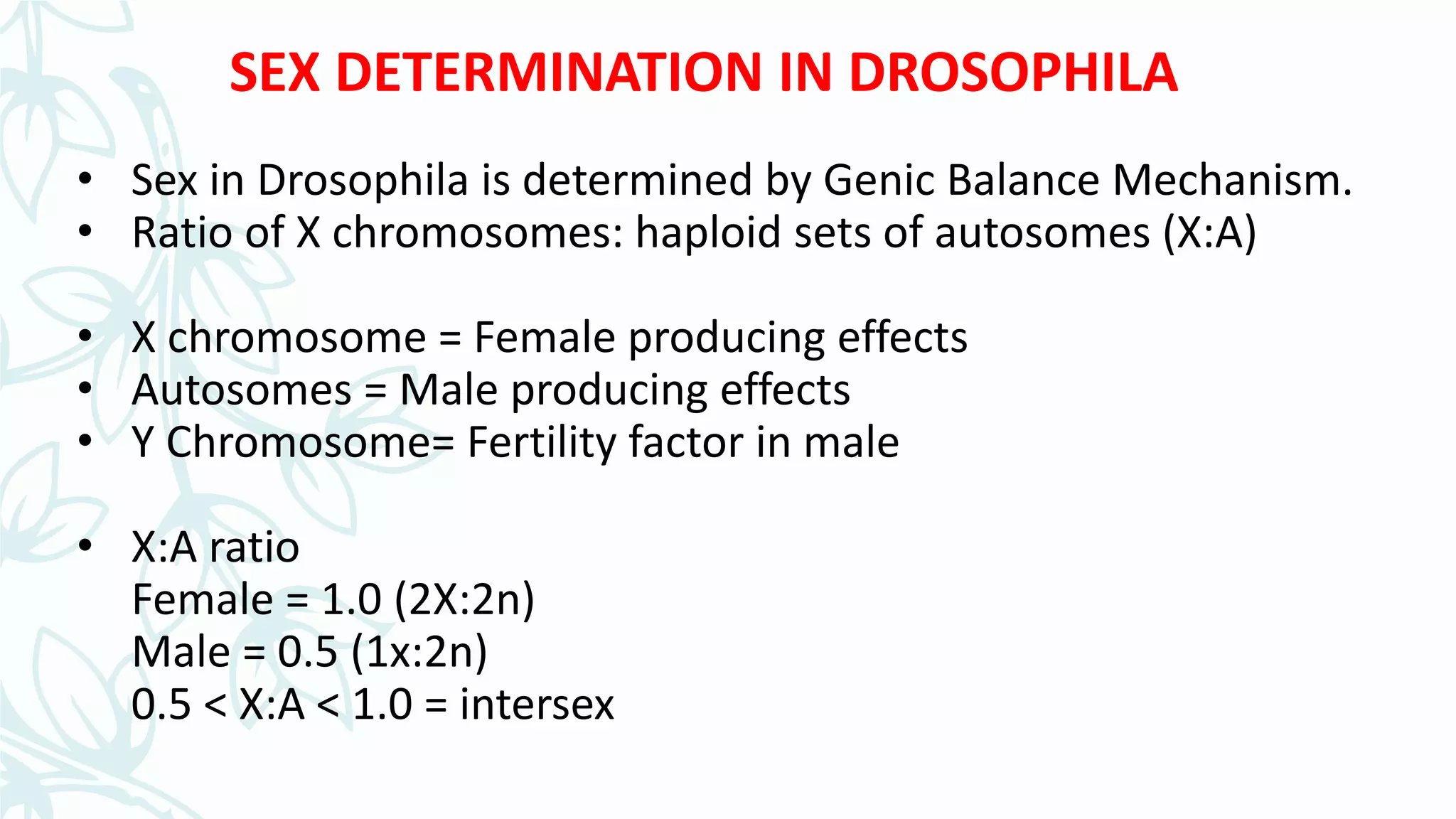
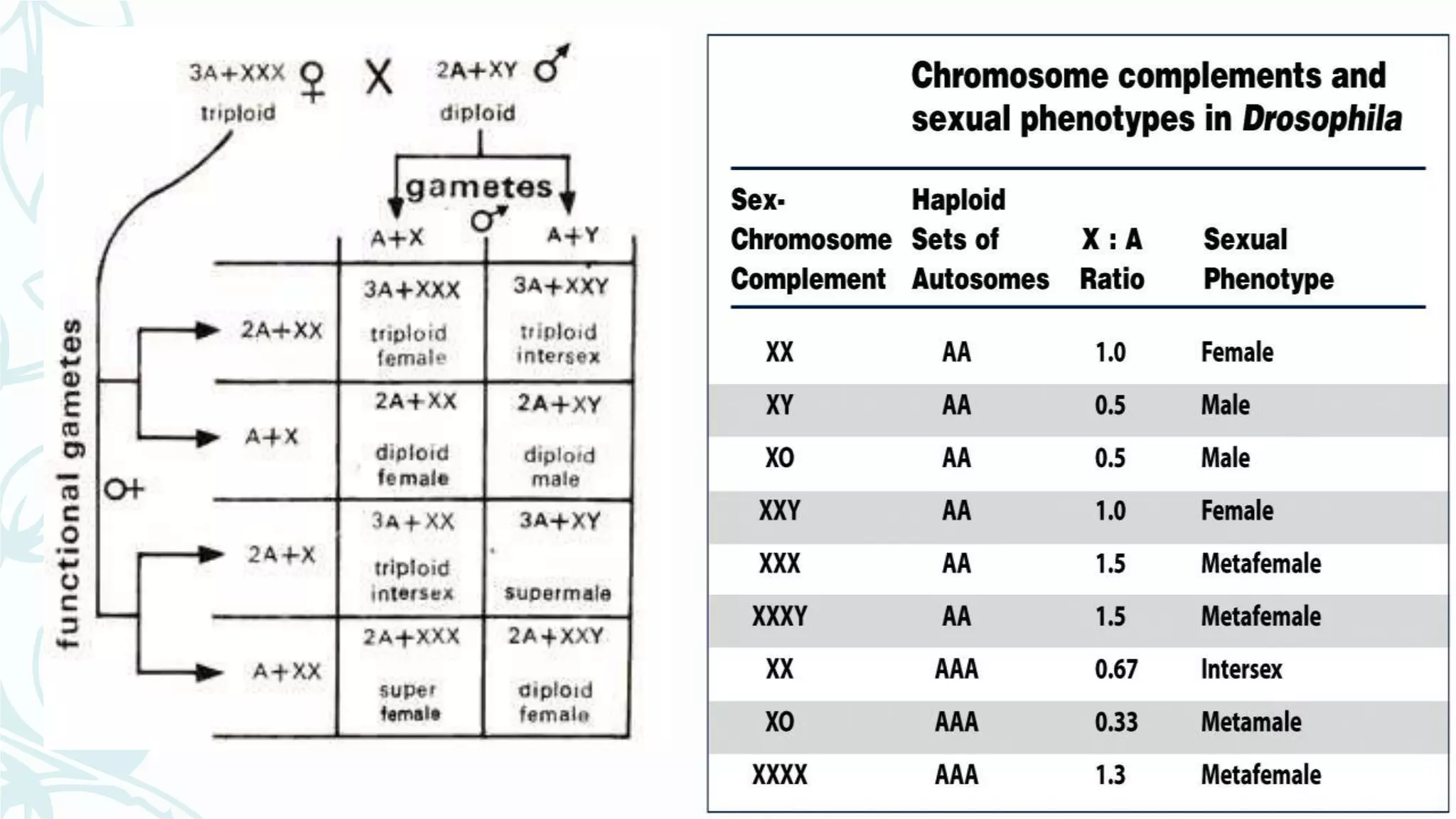
• Sex in Drosophila is determined by Genic Balance Mechanism.
• Ratio of X chromosomes: haploid sets of autosomes (X:A)
• X chromosome = Female producing effects
• Autosomes = Male producing effects
• Y Chromosome= Fertility factor in male
• X:A ratio
Female = 1.0 (2X:2n)
Male = 0.5 (1x:2n)
0.5 < X:A < 1.0 = intersex
GYNANDROMORPHS
3 types
• Bilateral Gynandromorph
• Anterior-Posterior
Gynandromorph
• Sex Piebalds
XX
xxX0
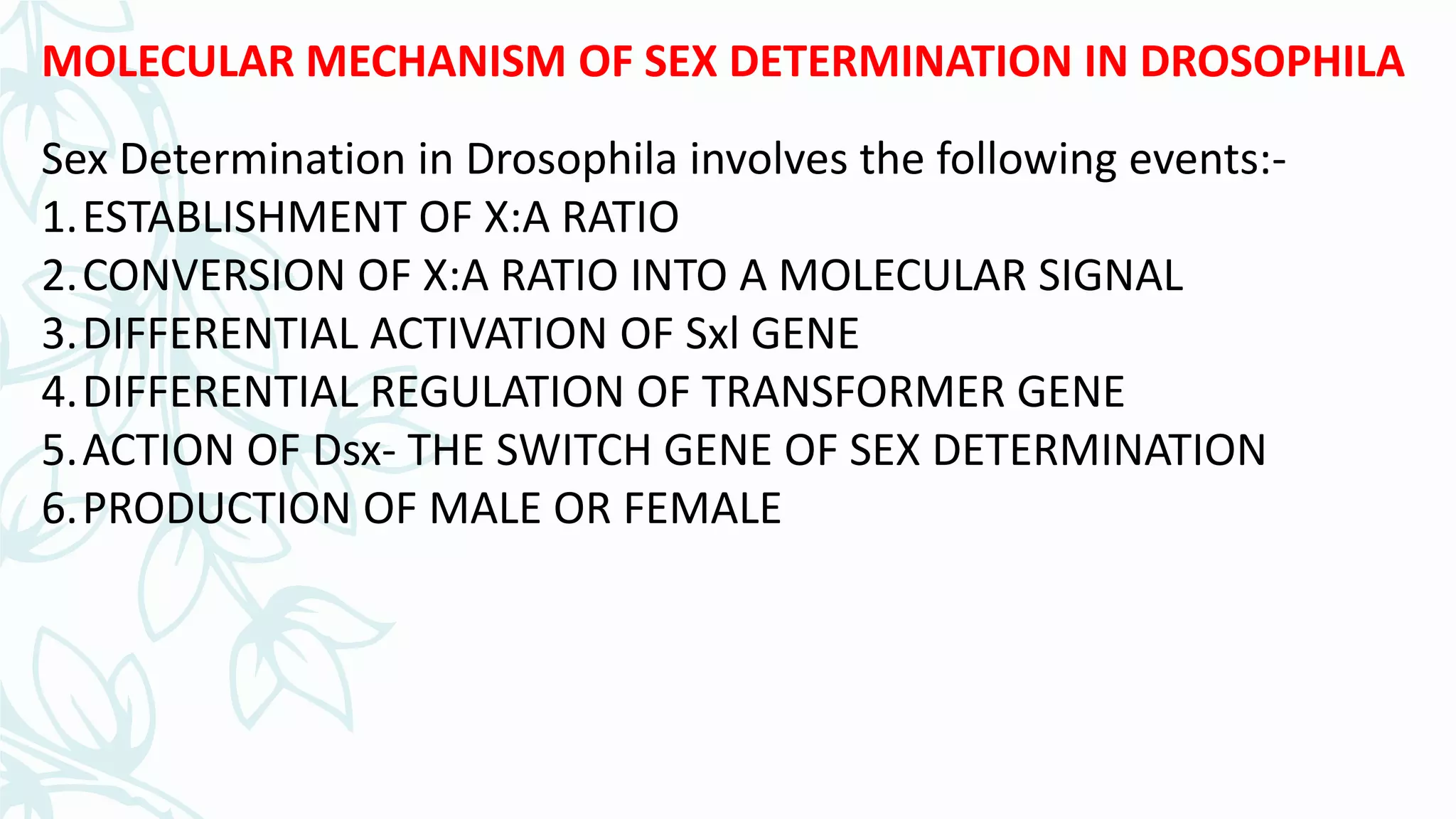
MOLECULAR MECHANISM OF SEX DETERMINATION IN DROSOPHILA
Sex Determination in Drosophila involves the following events:-
1.ESTABLISHMENT OF X:A RATIO
2.CONVERSION OF X:A RATIO INTO A MOLECULAR SIGNAL
3.DIFFERENTIAL ACTIVATION OF Sxl GENE
4.DIFFERENTIAL REGULATION OF TRANSFORMER GENE
5.ACTION OF Dsx- THE SWITCH GENE OF SEX DETERMINATION
6.PRODUCTION OF MALE OR FEMALE
ESTABLISHMENT OF X:A RATIO
• Establishment of X:A ratio involves interaction between proteins that
are encoded by several X-linked genes and proteins encoded by
several autosomal genes.
• X-linked genes are also called numerator genes. e.g. sis-a ,sis-b ,sis-c,
ran.
• Autosomal genes are also called denominator genes. e.g. dpn, emc
• The denominator gene encode denominator proteins which
antagonize numerator proteins.
• In XX embryo – Denominator proteins < Numerator protein
→Embryo Follow Female Pathway
• In XY embryo – Denominator proteins > Numerator protein
→Embryo Follow Male Pathway
CONVERSION OF X:A RATIO INTO A MOLECULAR SIGNAL
1.Sxl is the master regulator of the sex determination pathway.
2.In XX Drosophila Sxl is active during the first 2 hours of after
fertilization.
3.Sxl gene transcribe a distinct embryonic type m-RNA from the
promoter PE.
4.The early Sxl m-RNA are processed and translated into SXL protein.
5.After a few divisions , transcription starts from PM promoter instead of
PE.
6.Transcription from PM promoter is also initiated in XY embryos.
DIFFERENTIAL ACTIVATION OF Sxl GENE
1.If SXL protein is already available (i.e.,from early translation) the sxl pre-
mRNA is spliced to form the functional female specific message.
2. This encodes a functional protein of 314 amino acids.
3.In wild type Drosophila with one X chromosome & 2 sets of autosomes, Sxl
gene is transcribed from the late promoter. In absence of early SXL protein, the
RNA splicing does not exclude the male specific exon in the m-RNA.
4. The resulting RNA encodes a non-functional peptide as the male specific
exon contains a translation termination codon (UGA) after amino acid 48.
Mechanism of sxl Splicing
1. In male the m-RNA is spliced in a manner that yields 8 exons and the termination
codon is within exon no 3.
2. In female, RNA processing yields only 7 exons and the male specific exon 3 is spliced
out as a large intron.
DIFFERENTIAL REGULATION OF TRANSFORMER GENE
1.The expression of tra gene is controlled by SXL protein.
2.Tra gene is transcribed into pre-tra mRNA.
3.tra pre-mRNA is spliced alternatively to create a female specific
mRNA and a non specific mRNA.
4.Male specific tra mRNA contains a termination codon in the
second exon.
5.This exon is not utilized in female specific m-RNA.
6.Female specific tra RNA is translated into a functional TRA protein.
7.But in male TRA protein is not synthesized.
Dsx- THE SWITCH GENE OF SEX DETERMINATION
1.Doublesex gene is an autosomal gene that can produce 2 different proteins
through alternate splicing of its m-RNA.
2.A gene named tra 2 produce TRA 2 protein in both male and female.
3.Dsx gene produce pre dsx mRNA.
4.If the TRA & TRA 2 both are present, the dsx transcript is processed in a
female specific manner and produces DSXF protein.
5.In absence of TRA, a male specific transcript is made which encodes DSXM
protein.
PRODUCTION OF MALE OR FEMALE
1.DSXF represses the genes required for male development and activates
female specific genes. Ultimately the XX Drosophila develops into a female.
2.DSXM inhibits female traits and promote male traits. Ultimately the XY
Drosophila develops into a Male.
SEX DETERMINATION IN HUMAN
Chromosomal Mechanism
MOLECULARE MECHANISM
• Embryos are developed completely neutral for about 2 weeks. Then it follow either male or
female pathway.
• Early embryo has a bipotential gonad.
• The bipotential gonad later can follow one of the 2 alternative pathway and develop into
testes or ovary.
• Normal growth & maintenance of bipotential gonad is regulated by few genes including
EMX2, GATA4,WT1,LHX9 & SF1.
• Male phenotype in human is determined by sry gene.
• This gene is present on the short arm of the Y- chromosome.
• When sry gene is not present as in XX individuals the bipotential gonad follow ovarian
pathway.
• Loss of function of sry results in complete male to female sex reversal.
TESTIS PATHWAY
Sry is expressed only in some somatic cells of the bipotential gonad.
Sry gene encodes SRY or TDF protein.(Testis determining factor).
Target gene of SRY in the bipotential gonad is sox9.
Sox9 produce SOX9 protein and induce testis development.
SOX9 activates FGF9 protein.
FGF9 cause some somatic cells of the gonad to differentiate into sertoli cells.
Sertoli cell produce anti-mullerian hormone., which supress the development of
female reproductive tract.
Sertoli cells also induce other somatic cells of the gonad to become leydig cells
Leydig cell secrete male sex hormone testosterone.
This hormone completes the development of testis
OVARIAN PATHWAY
In absence of sry expression gonad develops into ovary.
Some somatic cell become follicle cell.
Other somatic cell become theca cell and secrete the female sex
hormone estrogen.
Estrogen completes the development of ovary and contribute in
development of female secondary sexual character.
BIPOTENTIAL GONAD
NO sry TDF
FOLLICLE CELL
THECAL CELL
ESTROGEN
OVARY
SOX9
FGF9
SERTOLI CELL- ANTI MULLERIAN HORMONE
LEYDIG CELLS
TESTOSTERONE
TESTIS
sry
CONCLUSION
Sex is a biological riddle.
Hundreds of theories & mechanisms have discovered regarding
determination of sex. But non of them are satisfactory.
Several things in this field are yet to be discovered.
BIBLIOGRAPHY
1.Snustad,P. & Simpsons,M.J.(2003)Principles of genetics 3rd ed.John
Wiley & Sons,Inc.:USA.
2.Sing,B.D.(2003)Genetics2nd ed.Kalyani publisher:Noida.
3.Dobzhansky,T.etal(1973)Principles of genetics.5th ed.TATA McGRAW
hill company ltd:New Delhi
4.Rastogi,V.B.(1984)Elements of genetics.11th ed.Kedar Nath Ram
Nath:Meerut
Sex determination in drosophila & human

Sex determination in drosophila & human

  • 1.
    MOLECULAR MECHANISM OF SEXDETERMENITION IN DROSOPHILA & HUMAN A Seminar On: Presented by- Sambit Kumar Dwibedy PG 2nd Year Semester Roll No-03
  • 2.
    CONTENTS 1.Introduction 2.Sex Chromosomes &Sex Determination 3.Different Mechanisms Of Sex Determination 4.Sex Determination In Drosophila a. X:A Ratio Mechanism b. Molecular Mechanism 5.Sex Determination in Human a. Chromosomal Basis b. Molecular Mechanism 6.Conclusion ?
  • 3.
    INTRODUCTION • The wordSEX is derived from the Latin word sexus meaning separation. • Sex is the morphological ,physiological & behavioral difference observed among egg producing organism and sperm producing organism.
  • 4.
    WHAT IS SEXDETERMINATION? It refers to the hormonal, environmental and genetical especially molecular mechanism that make an organism either male or female.
  • 5.
    SEX CHROMOSOME Fig: Allosomesof Human Fig: Chromosomes of Drosophila
  • 6.
    DIFFERENT SEX DETERMINATIONSYSTEM 1.Chromosomal Basis Of Sex Determination 2.Genic Determination Of Sex 3.Cytoplasmic Sex Determination 4.Genic Balance Theory 5.Haplodiploidy Mechanism 6.Environmental Sex Determination
  • 7.
    SEX DETERMINATION INDROSOPHILA • Sex in Drosophila is determined by Genic Balance Mechanism. • Ratio of X chromosomes: haploid sets of autosomes (X:A) • X chromosome = Female producing effects • Autosomes = Male producing effects • Y Chromosome= Fertility factor in male • X:A ratio Female = 1.0 (2X:2n) Male = 0.5 (1x:2n) 0.5 < X:A < 1.0 = intersex
  • 9.
    GYNANDROMORPHS 3 types • BilateralGynandromorph • Anterior-Posterior Gynandromorph • Sex Piebalds XX xxX0
  • 10.
    MOLECULAR MECHANISM OFSEX DETERMINATION IN DROSOPHILA Sex Determination in Drosophila involves the following events:- 1.ESTABLISHMENT OF X:A RATIO 2.CONVERSION OF X:A RATIO INTO A MOLECULAR SIGNAL 3.DIFFERENTIAL ACTIVATION OF Sxl GENE 4.DIFFERENTIAL REGULATION OF TRANSFORMER GENE 5.ACTION OF Dsx- THE SWITCH GENE OF SEX DETERMINATION 6.PRODUCTION OF MALE OR FEMALE
  • 11.
    ESTABLISHMENT OF X:ARATIO • Establishment of X:A ratio involves interaction between proteins that are encoded by several X-linked genes and proteins encoded by several autosomal genes. • X-linked genes are also called numerator genes. e.g. sis-a ,sis-b ,sis-c, ran. • Autosomal genes are also called denominator genes. e.g. dpn, emc • The denominator gene encode denominator proteins which antagonize numerator proteins. • In XX embryo – Denominator proteins < Numerator protein →Embryo Follow Female Pathway • In XY embryo – Denominator proteins > Numerator protein →Embryo Follow Male Pathway
  • 12.
    CONVERSION OF X:ARATIO INTO A MOLECULAR SIGNAL
  • 13.
    CONVERSION OF X:ARATIO INTO A MOLECULAR SIGNAL 1.Sxl is the master regulator of the sex determination pathway. 2.In XX Drosophila Sxl is active during the first 2 hours of after fertilization. 3.Sxl gene transcribe a distinct embryonic type m-RNA from the promoter PE. 4.The early Sxl m-RNA are processed and translated into SXL protein. 5.After a few divisions , transcription starts from PM promoter instead of PE. 6.Transcription from PM promoter is also initiated in XY embryos.
  • 14.
    DIFFERENTIAL ACTIVATION OFSxl GENE 1.If SXL protein is already available (i.e.,from early translation) the sxl pre- mRNA is spliced to form the functional female specific message. 2. This encodes a functional protein of 314 amino acids. 3.In wild type Drosophila with one X chromosome & 2 sets of autosomes, Sxl gene is transcribed from the late promoter. In absence of early SXL protein, the RNA splicing does not exclude the male specific exon in the m-RNA. 4. The resulting RNA encodes a non-functional peptide as the male specific exon contains a translation termination codon (UGA) after amino acid 48.
  • 15.
    Mechanism of sxlSplicing 1. In male the m-RNA is spliced in a manner that yields 8 exons and the termination codon is within exon no 3. 2. In female, RNA processing yields only 7 exons and the male specific exon 3 is spliced out as a large intron.
  • 16.
    DIFFERENTIAL REGULATION OFTRANSFORMER GENE 1.The expression of tra gene is controlled by SXL protein. 2.Tra gene is transcribed into pre-tra mRNA. 3.tra pre-mRNA is spliced alternatively to create a female specific mRNA and a non specific mRNA. 4.Male specific tra mRNA contains a termination codon in the second exon. 5.This exon is not utilized in female specific m-RNA. 6.Female specific tra RNA is translated into a functional TRA protein. 7.But in male TRA protein is not synthesized.
  • 18.
    Dsx- THE SWITCHGENE OF SEX DETERMINATION 1.Doublesex gene is an autosomal gene that can produce 2 different proteins through alternate splicing of its m-RNA. 2.A gene named tra 2 produce TRA 2 protein in both male and female. 3.Dsx gene produce pre dsx mRNA. 4.If the TRA & TRA 2 both are present, the dsx transcript is processed in a female specific manner and produces DSXF protein. 5.In absence of TRA, a male specific transcript is made which encodes DSXM protein.
  • 19.
    PRODUCTION OF MALEOR FEMALE 1.DSXF represses the genes required for male development and activates female specific genes. Ultimately the XX Drosophila develops into a female. 2.DSXM inhibits female traits and promote male traits. Ultimately the XY Drosophila develops into a Male.
  • 21.
    SEX DETERMINATION INHUMAN Chromosomal Mechanism
  • 22.
    MOLECULARE MECHANISM • Embryosare developed completely neutral for about 2 weeks. Then it follow either male or female pathway. • Early embryo has a bipotential gonad. • The bipotential gonad later can follow one of the 2 alternative pathway and develop into testes or ovary. • Normal growth & maintenance of bipotential gonad is regulated by few genes including EMX2, GATA4,WT1,LHX9 & SF1. • Male phenotype in human is determined by sry gene. • This gene is present on the short arm of the Y- chromosome. • When sry gene is not present as in XX individuals the bipotential gonad follow ovarian pathway. • Loss of function of sry results in complete male to female sex reversal.
  • 23.
    TESTIS PATHWAY Sry isexpressed only in some somatic cells of the bipotential gonad. Sry gene encodes SRY or TDF protein.(Testis determining factor). Target gene of SRY in the bipotential gonad is sox9. Sox9 produce SOX9 protein and induce testis development. SOX9 activates FGF9 protein. FGF9 cause some somatic cells of the gonad to differentiate into sertoli cells. Sertoli cell produce anti-mullerian hormone., which supress the development of female reproductive tract. Sertoli cells also induce other somatic cells of the gonad to become leydig cells Leydig cell secrete male sex hormone testosterone. This hormone completes the development of testis
  • 24.
    OVARIAN PATHWAY In absenceof sry expression gonad develops into ovary. Some somatic cell become follicle cell. Other somatic cell become theca cell and secrete the female sex hormone estrogen. Estrogen completes the development of ovary and contribute in development of female secondary sexual character.
  • 25.
    BIPOTENTIAL GONAD NO sryTDF FOLLICLE CELL THECAL CELL ESTROGEN OVARY SOX9 FGF9 SERTOLI CELL- ANTI MULLERIAN HORMONE LEYDIG CELLS TESTOSTERONE TESTIS sry
  • 26.
    CONCLUSION Sex is abiological riddle. Hundreds of theories & mechanisms have discovered regarding determination of sex. But non of them are satisfactory. Several things in this field are yet to be discovered.
  • 27.
    BIBLIOGRAPHY 1.Snustad,P. & Simpsons,M.J.(2003)Principlesof genetics 3rd ed.John Wiley & Sons,Inc.:USA. 2.Sing,B.D.(2003)Genetics2nd ed.Kalyani publisher:Noida. 3.Dobzhansky,T.etal(1973)Principles of genetics.5th ed.TATA McGRAW hill company ltd:New Delhi 4.Rastogi,V.B.(1984)Elements of genetics.11th ed.Kedar Nath Ram Nath:Meerut