Presented by:
Nang Uttama Tungkhang
Roll no:20/BIOT/017
M.Sc 2nd semester,
Department of biotechnology
Mizoram university
• Introduction
 What is pattern formation
• Genes of pattern
formation
• Pattern formation in
Drosophila
melanogaster
• Medical conditions
INTRODUCTION
• What is pattern formation?
• The development of a spatial organization in which an
organism’s tissues and organs are all in their characteristic
places.
• Occurs during embryogenesis.
• Basic body plan is established.
• Major axes are established.
• studied most extensively in Drosophila melanogaster.
Genes of pattern formation
• Every organism has a unique body pattern
• This patterning is controlled and influenced by the
HOMEOTIC genes.
• These genes control and carry out tasks such as
 Cell division
 Cell migration
 Cell differentiation
 Cell death
• these are the master genes that regulates the
expression of numerous other genes.
• Homeotic genes contain a sequence of DNA known as
a homeobox, which encodes for 60 amino acids
within the homeotic transcription factor protein.
• If a mutation occurs in the homeobox of homeotic
genes, an organism will not develop correctly.
• these genes are found in many animals including fruit
flies, mice, and humans.
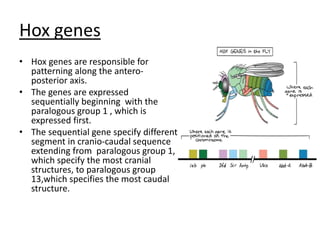
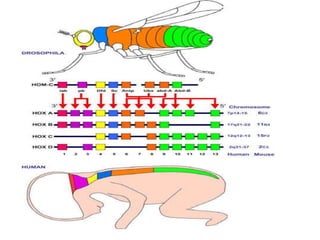
Hox genes
• Hox genes are responsible for
patterning along the antero-
posterior axis.
• The genes are expressed
sequentially beginning with the
paralogous group 1 , which is
expressed first.
• The sequential gene specify different
segment in cranio-caudal sequence
extending from paralogous group 1,
which specify the most cranial
structures, to paralogous group
13,which specifies the most caudal
structure.
Pattern formation genes in fruit fly
• Cytoplasmic determinants are present in the
unfertilized egg.
Provide positional information for placement
of axes prior to fertilization.
Establishes number and orientation of
segments
Ultimately trigger formation of specific
structures within each segment.
• Development occurs after fertilization.
Drosophila melanogaster
• Segmentation genes; directs the actual
formation segments after the embryo’s major
axes are defined.
• three sets of segmentation genes are
activated sequentially
 Gap genes
 Pair-rule genes
 Segment polarity genes
Drosophila melanogaster
• Gap genes –
map out basic subdivisions along the embryo’s
anterior-posterior axis.
• Pair- rule genes –
Define pattern in terms of pair of segments.
• Segment polarity genes-
Set the anterior-posterior axis of each
segments.
Drosophila melanogaster
• Homeotic genes
Specify the types of appendages and other
structures that each segment will form.
Encodes transcription factors.
 control the expression of genes responsible
for specific anatomical structures.
o Eg., ‘’antennae go here’’, ‘’legs go here’’.
Genetic disorders
Mutations in genes of pattern formation leads to
Lot of congenital malformations
Example :-
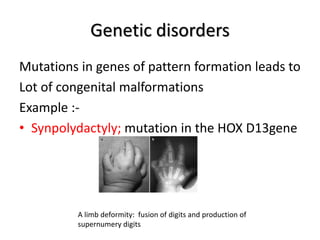
• Synpolydactyly; mutation in the HOX D13gene
A limb deformity: fusion of digits and production of
supernumery digits
Genetic disorders
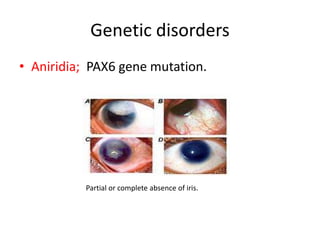
• Aniridia; PAX6 gene mutation.
Partial or complete absence of iris.
Genetic disorders
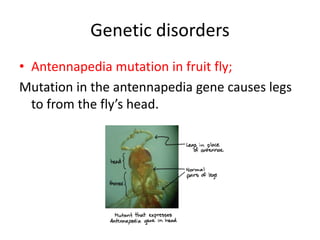
• Antennapedia mutation in fruit fly;
Mutation in the antennapedia gene causes legs
to from the fly’s head.
pattern formation genes

pattern formation genes

  • 1.
    Presented by: Nang UttamaTungkhang Roll no:20/BIOT/017 M.Sc 2nd semester, Department of biotechnology Mizoram university
  • 2.
    • Introduction  Whatis pattern formation • Genes of pattern formation • Pattern formation in Drosophila melanogaster • Medical conditions
  • 3.
    INTRODUCTION • What ispattern formation? • The development of a spatial organization in which an organism’s tissues and organs are all in their characteristic places. • Occurs during embryogenesis. • Basic body plan is established. • Major axes are established. • studied most extensively in Drosophila melanogaster.
  • 4.
    Genes of patternformation • Every organism has a unique body pattern • This patterning is controlled and influenced by the HOMEOTIC genes. • These genes control and carry out tasks such as  Cell division  Cell migration  Cell differentiation  Cell death
  • 5.
    • these arethe master genes that regulates the expression of numerous other genes. • Homeotic genes contain a sequence of DNA known as a homeobox, which encodes for 60 amino acids within the homeotic transcription factor protein. • If a mutation occurs in the homeobox of homeotic genes, an organism will not develop correctly. • these genes are found in many animals including fruit flies, mice, and humans.
  • 6.
    Hox genes • Hoxgenes are responsible for patterning along the antero- posterior axis. • The genes are expressed sequentially beginning with the paralogous group 1 , which is expressed first. • The sequential gene specify different segment in cranio-caudal sequence extending from paralogous group 1, which specify the most cranial structures, to paralogous group 13,which specifies the most caudal structure.
  • 8.
    Pattern formation genesin fruit fly • Cytoplasmic determinants are present in the unfertilized egg. Provide positional information for placement of axes prior to fertilization. Establishes number and orientation of segments Ultimately trigger formation of specific structures within each segment. • Development occurs after fertilization.
  • 9.
    Drosophila melanogaster • Segmentationgenes; directs the actual formation segments after the embryo’s major axes are defined. • three sets of segmentation genes are activated sequentially  Gap genes  Pair-rule genes  Segment polarity genes
  • 10.
    Drosophila melanogaster • Gapgenes – map out basic subdivisions along the embryo’s anterior-posterior axis. • Pair- rule genes – Define pattern in terms of pair of segments. • Segment polarity genes- Set the anterior-posterior axis of each segments.
  • 11.
    Drosophila melanogaster • Homeoticgenes Specify the types of appendages and other structures that each segment will form. Encodes transcription factors.  control the expression of genes responsible for specific anatomical structures. o Eg., ‘’antennae go here’’, ‘’legs go here’’.
  • 12.
    Genetic disorders Mutations ingenes of pattern formation leads to Lot of congenital malformations Example :- • Synpolydactyly; mutation in the HOX D13gene A limb deformity: fusion of digits and production of supernumery digits
  • 13.
    Genetic disorders • Aniridia;PAX6 gene mutation. Partial or complete absence of iris.
  • 14.
    Genetic disorders • Antennapediamutation in fruit fly; Mutation in the antennapedia gene causes legs to from the fly’s head.