Cell Cycle
By
Mrs Sanchita Choubey
(M.Sc., PGDCR, Pursuing Ph. D)
Assistant Professor of Microbiology
Dr. D Y Patil Arts Commerce and
Science College Pimpri, Pune
OVERVIEW OF THE CELL CYCLE
fatimaArivera
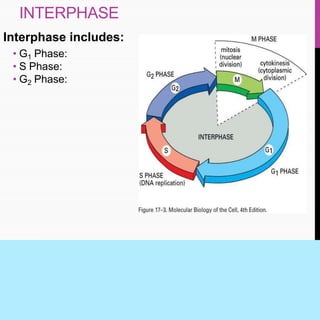
INTERPHASE
Interphase includes:
• G1 Phase:
• S Phase:
• G2 Phase:
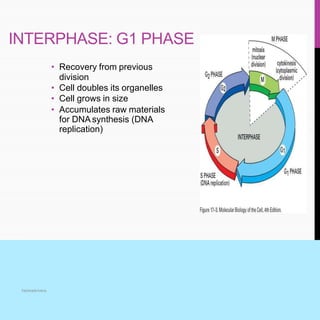
INTERPHASE: G1 PHASE
fatimaArivera
• Recovery from previous
division
• Cell doubles its organelles
• Cell grows in size
• Accumulates raw materials
for DNAsynthesis (DNA
replication)
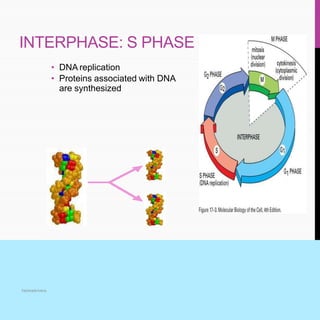
INTERPHASE: S PHASE
fatimaArivera
• DNA replication
• Proteins associated with DNA
are synthesized
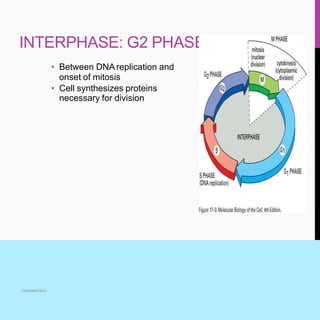
INTERPHASE: G2 PHASE
fatimaArivera
• Between DNA replication and
onset of mitosis
• Cell synthesizes proteins
necessary for division
CELL CYCLE: MITOSIS PHASE
fatimaArivera
Mitosis phase includes:
• Mitosis (karyokinesis)
• Nuclear division
• Daughter chromosomes
distributed to two daughter
nuclei
• Cytokinesis
• Cytoplasm division
• Results in two genetically
identical daughter cells
CELL CYCLE: MITOSIS PHASE
fatimaArivera
SIGNIFICANCE OF MITOSIS
fatimaArivera
• Permits growth and repair.
• In plants it retains the ability to
divide throughout the life of the
plant
• In mammals, mitosis is necessary:
• Fertilized egg becomes an
embryo
• Embryo becomes a fetus
• Allows a cut to heal or a broken
bone to mend
• Chromatin condenses.
• Centrosomes separate,
moving to opposite ends
of the nucleus
• The centrosomes start to
form a framework used to
separate the two sister
chromatids called the
mitotic spindle, that is
made of microtubules
• Nucleolus disappears
• Nuclear envelope
disintegrates
MITOSIS PHASE: PROPHASE
What’s happening? What the cell looks like?
fatimaArivera
MITOSIS PHASE: PROMETAPHASE
fatimaArivera
What’s happening? What the cell looks like?
• Nuclear envelope
fragments
• Chromosomes become
more condensed
• A kinetochore is formed
at the centromere, the
point where the sister
chromatids are attached
• Microtubules attach at
the kinetochores
MITOSIS PHASE: METAPHASE
fatimaArivera
What’s happening? What the cell looks like?
• Chromosomes align on
an axis called the
metaphase plate
• Note: the spindle
consists of
microtubules, one
attached to each
chromosome
MITOSIS PHASE:ANAPHASE
fatimaArivera
What’s happening? What the cell looks like?
• Each centromere splits
making two chromatids
free
• Each chromatid moves
toward a pole
• Cell begins to elongate,
caused by microtubules
not associated with the
kinetochore
MITOSIS PHASE: TELOPHASE
fatimaArivera
What’s happening? What the cell looks like?
• Formation of nuclear
membrane and nucleolus
• Short and thick
chromosomes begin to
elongate to form long and
thin chromatin
• Formation of the cleavage
furrow - a shallow groove in
the cell near the old
metaphase plate
• Cytokinesis = division of the
cytoplasm
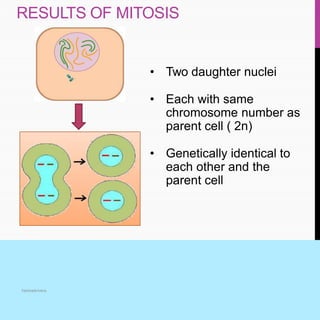
RESULTS OF MITOSIS
fatimaArivera
• Two daughter nuclei
• Each with same
chromosome number as
parent cell ( 2n)
• Genetically identical to
each other and the
parent cell
MEIOSIS
fatimaArivera
• Formation of Gametes (Eggs & Sperm)
• Called Reduction- division
• Preceded by interphase which includes
chromosome replication
• Two meiotic divisions
• Meiosis I and Meiosis II
• Original cell is diploid (2n)
• Four daughter cells produced that are
haploid (n)
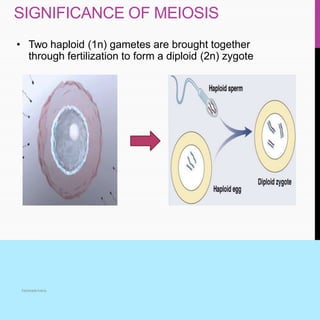
SIGNIFICANCE OF MEIOSIS
fatimaArivera
• Two haploid (1n) gametes are brought together
through fertilization to form a diploid (2n) zygote
MEIOSIS I: PROPHASE I
fatimaArivera
Prophase I is further subdivided into
periods known as
•Leptotena
•Zygotena
•Pachytena
•Diplotena
•Diakinesis
A physical exchange of
chromosome pieces
PROPHASE I
fatimaArivera
METAPHASE I
fatimaArivera
Homologous pairs
of chromosomes
align along the
equator of the cell
ANAPHASE I
fatimaArivera
Homologs separate and
move to opposite poles.
Sister chromatids remain
attached at their centromeres.
TELOPHASE I
 Nuclear
envelopes
reassemble.
 Spindle disappears.
 Cytokinesis divides
cell into two.
fatimaArivera
MEIOSIS II: PROPHASE II
fatimaArivera
Nuclear envelope
fragments.
Spindle forms.
MEIOSIS II: METAPHASE II
fatimaArivera
Chromosomes align
along equator of cell.
MEIOSIS II: ANAPHASE II
 Sister chromatids separate
and move to opposite poles.
fatimaArivera
Equator
Pole
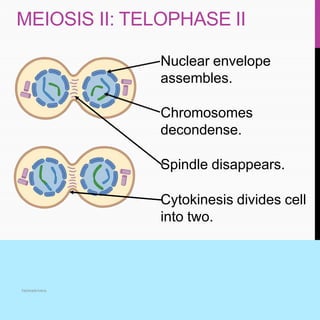
MEIOSIS II: TELOPHASE II
fatimaArivera
Nuclear envelope
assembles.
Chromosomes
decondense.
Spindle disappears.
Cytokinesis divides cell
into two.
RESULTS OF MEIOSIS
fatimaArivera
• Four haploid cells with one
copy of each chromosome
SUMMARY OF MEIOSIS I
fatimaArivera
Nucleus
Spindle
fibers
Nuclear
envelope
EARLY
PROPHASE
I
LATE PROPHASE I METAPHASE I ANAPHASE I TELOPHASE I &
CYTOKINESIS
SUMMARY OF MEIOSIS II
Prophase II Metaphase II Anaphase II Telophase II 4 I
Undentical
haploid
cells
fatimaArivera
Intracellular control of the
cell cycle
fatimaArivera
The cell cycle is controlled by
regulator molecules that either:
promote the process (positive)
stop it from progressing (negative)
Positive: Cdks & Cyclins
fatimaArivera
 Cyclins
◦ The regulatory subunits of the protein
kinases that control the cell cycle
 Cyclin-Dependent Kinases (Cdks)
◦ The catalytic subunits of the protein
kinases
◦ Must be associated with a cyclin in order
to be activated
fatimaArivera
Negative: Rb & p53
fatimaArivera
 Tumor suppressor genes
 Tumor suppressor gene codes for a
signaling protein in an inhibitory
pathway. If a tumor suppressor gene
mutates, the end result can be
active cell division.
Negative: Rb & p53
fatimaArivera
◦ Retinoblastoma protein(Rb)
◦ prevents cell moving into S phase by
binding to a transcription factor
◦ When Rb is phosphorylated it cannot bind
so cell can move into S phase
◦ p53
◦ prevents damaged from dividing (by
inhibiting Rb pathway)
p53
 p53 protein halts cell division if it detects
damaged DNA
 options:
 stimulates repair enzymes to fix DNA
 forces cell into G0 resting stage
 keeps cell in G1 arrest
 causes apoptosis of damaged cell
 ALL cancers have to shut down p53 activity
 Cancer is essentially a failure of cell division
control
p53 is the
Cell Cycle
Enforcer
fatimaArivera
fatimaArivera
Generic cell cycle checkpoints
Is environment favorable?
Are all DNA replicated?
Are all chromosomes
attached to the spindle?
fatimaArivera
G1
S
G2
M
G1 Checkpoint
G2 Checkpoint
M Checkpoint
G1
Cdk
G1
Cyclin
P
Active G1 Cdk-Cyclin
• Growth factors
• Nutritional state of cell
• Size of cell
Degraded G1 Cyclin
Mitotic
Cdk
Mitotic
Cyclin
P
ActiveMitotic
Cdk-Cyclin
(MPF)
• Replication completed
• DNA integrity
APC
Chromosomes attached at
metaphase plate
Degraded Mitotic Cyclin
Control of the
Cell Cycle
THANK YOU!
fatimaArivera

Cell cycle

  • 1.
    Cell Cycle By Mrs SanchitaChoubey (M.Sc., PGDCR, Pursuing Ph. D) Assistant Professor of Microbiology Dr. D Y Patil Arts Commerce and Science College Pimpri, Pune
  • 2.
    OVERVIEW OF THECELL CYCLE fatimaArivera
  • 3.
    INTERPHASE Interphase includes: • G1Phase: • S Phase: • G2 Phase:
  • 4.
    INTERPHASE: G1 PHASE fatimaArivera •Recovery from previous division • Cell doubles its organelles • Cell grows in size • Accumulates raw materials for DNAsynthesis (DNA replication)
  • 5.
    INTERPHASE: S PHASE fatimaArivera •DNA replication • Proteins associated with DNA are synthesized
  • 6.
    INTERPHASE: G2 PHASE fatimaArivera •Between DNA replication and onset of mitosis • Cell synthesizes proteins necessary for division
  • 7.
    CELL CYCLE: MITOSISPHASE fatimaArivera Mitosis phase includes: • Mitosis (karyokinesis) • Nuclear division • Daughter chromosomes distributed to two daughter nuclei • Cytokinesis • Cytoplasm division • Results in two genetically identical daughter cells
  • 8.
    CELL CYCLE: MITOSISPHASE fatimaArivera
  • 9.
    SIGNIFICANCE OF MITOSIS fatimaArivera •Permits growth and repair. • In plants it retains the ability to divide throughout the life of the plant • In mammals, mitosis is necessary: • Fertilized egg becomes an embryo • Embryo becomes a fetus • Allows a cut to heal or a broken bone to mend
  • 10.
    • Chromatin condenses. •Centrosomes separate, moving to opposite ends of the nucleus • The centrosomes start to form a framework used to separate the two sister chromatids called the mitotic spindle, that is made of microtubules • Nucleolus disappears • Nuclear envelope disintegrates MITOSIS PHASE: PROPHASE What’s happening? What the cell looks like? fatimaArivera
  • 11.
    MITOSIS PHASE: PROMETAPHASE fatimaArivera What’shappening? What the cell looks like? • Nuclear envelope fragments • Chromosomes become more condensed • A kinetochore is formed at the centromere, the point where the sister chromatids are attached • Microtubules attach at the kinetochores
  • 12.
    MITOSIS PHASE: METAPHASE fatimaArivera What’shappening? What the cell looks like? • Chromosomes align on an axis called the metaphase plate • Note: the spindle consists of microtubules, one attached to each chromosome
  • 13.
    MITOSIS PHASE:ANAPHASE fatimaArivera What’s happening?What the cell looks like? • Each centromere splits making two chromatids free • Each chromatid moves toward a pole • Cell begins to elongate, caused by microtubules not associated with the kinetochore
  • 14.
    MITOSIS PHASE: TELOPHASE fatimaArivera What’shappening? What the cell looks like? • Formation of nuclear membrane and nucleolus • Short and thick chromosomes begin to elongate to form long and thin chromatin • Formation of the cleavage furrow - a shallow groove in the cell near the old metaphase plate • Cytokinesis = division of the cytoplasm
  • 15.
    RESULTS OF MITOSIS fatimaArivera •Two daughter nuclei • Each with same chromosome number as parent cell ( 2n) • Genetically identical to each other and the parent cell
  • 16.
    MEIOSIS fatimaArivera • Formation ofGametes (Eggs & Sperm) • Called Reduction- division • Preceded by interphase which includes chromosome replication • Two meiotic divisions • Meiosis I and Meiosis II • Original cell is diploid (2n) • Four daughter cells produced that are haploid (n)
  • 17.
    SIGNIFICANCE OF MEIOSIS fatimaArivera •Two haploid (1n) gametes are brought together through fertilization to form a diploid (2n) zygote
  • 18.
    MEIOSIS I: PROPHASEI fatimaArivera Prophase I is further subdivided into periods known as •Leptotena •Zygotena •Pachytena •Diplotena •Diakinesis
  • 19.
    A physical exchangeof chromosome pieces PROPHASE I fatimaArivera
  • 20.
    METAPHASE I fatimaArivera Homologous pairs ofchromosomes align along the equator of the cell
  • 21.
    ANAPHASE I fatimaArivera Homologs separateand move to opposite poles. Sister chromatids remain attached at their centromeres.
  • 22.
    TELOPHASE I  Nuclear envelopes reassemble. Spindle disappears.  Cytokinesis divides cell into two. fatimaArivera
  • 23.
    MEIOSIS II: PROPHASEII fatimaArivera Nuclear envelope fragments. Spindle forms.
  • 24.
    MEIOSIS II: METAPHASEII fatimaArivera Chromosomes align along equator of cell.
  • 25.
    MEIOSIS II: ANAPHASEII  Sister chromatids separate and move to opposite poles. fatimaArivera Equator Pole
  • 26.
    MEIOSIS II: TELOPHASEII fatimaArivera Nuclear envelope assembles. Chromosomes decondense. Spindle disappears. Cytokinesis divides cell into two.
  • 27.
    RESULTS OF MEIOSIS fatimaArivera •Four haploid cells with one copy of each chromosome
  • 28.
    SUMMARY OF MEIOSISI fatimaArivera Nucleus Spindle fibers Nuclear envelope EARLY PROPHASE I LATE PROPHASE I METAPHASE I ANAPHASE I TELOPHASE I & CYTOKINESIS
  • 29.
    SUMMARY OF MEIOSISII Prophase II Metaphase II Anaphase II Telophase II 4 I Undentical haploid cells fatimaArivera
  • 30.
    Intracellular control ofthe cell cycle fatimaArivera The cell cycle is controlled by regulator molecules that either: promote the process (positive) stop it from progressing (negative)
  • 31.
    Positive: Cdks &Cyclins fatimaArivera  Cyclins ◦ The regulatory subunits of the protein kinases that control the cell cycle  Cyclin-Dependent Kinases (Cdks) ◦ The catalytic subunits of the protein kinases ◦ Must be associated with a cyclin in order to be activated
  • 32.
  • 33.
    Negative: Rb &p53 fatimaArivera  Tumor suppressor genes  Tumor suppressor gene codes for a signaling protein in an inhibitory pathway. If a tumor suppressor gene mutates, the end result can be active cell division.
  • 34.
    Negative: Rb &p53 fatimaArivera ◦ Retinoblastoma protein(Rb) ◦ prevents cell moving into S phase by binding to a transcription factor ◦ When Rb is phosphorylated it cannot bind so cell can move into S phase ◦ p53 ◦ prevents damaged from dividing (by inhibiting Rb pathway)
  • 35.
    p53  p53 proteinhalts cell division if it detects damaged DNA  options:  stimulates repair enzymes to fix DNA  forces cell into G0 resting stage  keeps cell in G1 arrest  causes apoptosis of damaged cell  ALL cancers have to shut down p53 activity  Cancer is essentially a failure of cell division control p53 is the Cell Cycle Enforcer fatimaArivera
  • 36.
  • 37.
    Generic cell cyclecheckpoints Is environment favorable? Is environment favorable? Are all DNA replicated? Are all chromosomes attached to the spindle? fatimaArivera
  • 38.
    G1 S G2 M G1 Checkpoint G2 Checkpoint MCheckpoint G1 Cdk G1 Cyclin P Active G1 Cdk-Cyclin • Growth factors • Nutritional state of cell • Size of cell Degraded G1 Cyclin Mitotic Cdk Mitotic Cyclin P ActiveMitotic Cdk-Cyclin (MPF) • Replication completed • DNA integrity APC Chromosomes attached at metaphase plate Degraded Mitotic Cyclin Control of the Cell Cycle
  • 39.