Hox genes
(Developmental Biology)
By
Mrs Sanchita Choubey
(M.Sc., PGDCR, Pursuing Ph. D)
Assistant Professor of Microbiology
Dr. D Y Patil Arts Commerce and Science College Pimpri, Pune
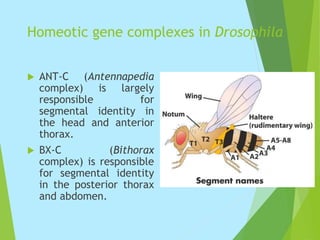
Homeotic gene complexes in Drosophila
 ANT-C (Antennapedia
complex) is largely
responsible for
segmental identity in
the head and anterior
thorax.
 BX-C (Bithorax
complex) is responsible
for segmental identity
in the posterior thorax
and abdomen.
HOMEOSIS
 Homeosis or homeotic transformation, is the development of one
body part with the phenotype of another.
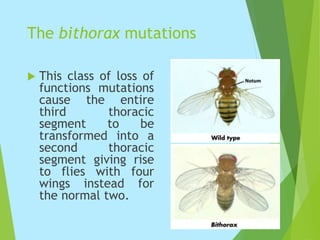
The bithorax mutations
 This class of loss of
functions mutations
cause the entire
third thoracic
segment to be
transformed into a
second thoracic
segment giving rise
to flies with four
wings instead for
the normal two.
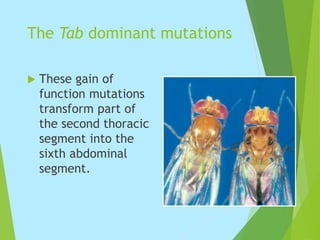
The Tab dominant mutations
 These gain of
function mutations
transform part of
the second thoracic
segment into the
sixth abdominal
segment.
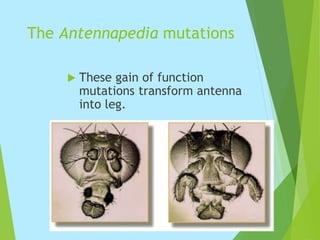
The Antennapedia mutations
 These gain of function
mutations transform antenna
into leg.
The Homeodomain
 The homeotic genes encode transcription factors of a
class called homeodomain proteins. The homeodomain
is a 60aa protein domain, which binds DNA. Hox genes
bind DNA regulatory elements of their target genes in a
specific combination so that the expression pattern in
each of the different segments is unique.
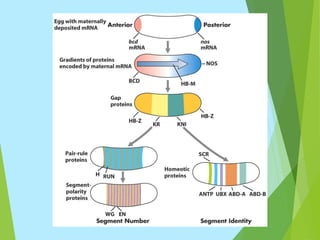
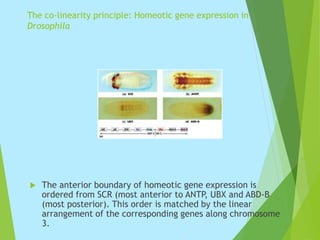
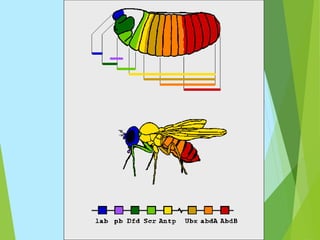
The co-linearity principle: Homeotic gene expression in
Drosophila
 The anterior boundary of homeotic gene expression is
ordered from SCR (most anterior to ANTP, UBX and ABD-B
(most posterior). This order is matched by the linear
arrangement of the corresponding genes along chromosome
3.
A2
A1
T2
T3
T
1
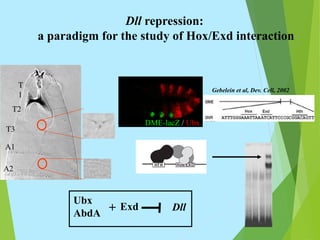
Gebelein et al, Dev. Cell, 2002
Dll repression:
a paradigm for the study of Hox/Exd interaction
DME-lacZ / Ubx
Ubx
AbdA
Dll
Exd
+
The DNA sequence motif hypothesis
 Different combination of DNA modules would
give different combination of co-factors bound
on the promoter and thus a different array of
transcriptional interactions with each Hox
protein (Li et al, Development 126, 5581-5589,
1999).
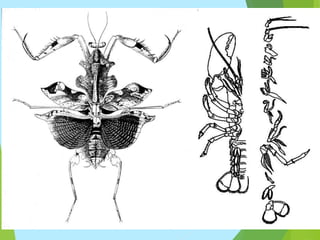
Developmental strategies in
animals are ancient and
highly conserved. In essence,
a mammal, a worm and a fly-
three very different
organisms-are put together
with the same basic building
blocks and regulatory devices.
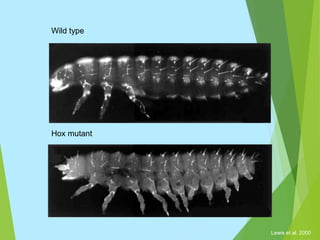
Wild type
Hox mutant
Lewis et al. 2000
Is there a “ground” state?
What could constitute a
“ground” state?
Where all HOX genes are
expressed in all segments
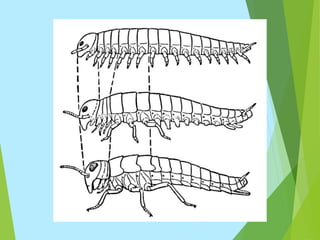
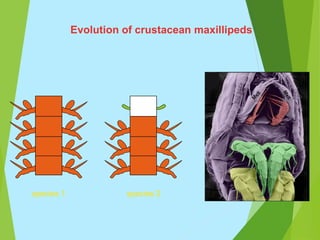
Changes in Hox gene expression can
help explain the evolution of arthropod
body plans
species 1 species 2
Evolution of crustacean maxillipeds
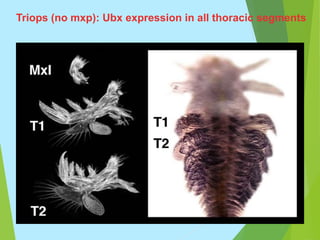
Triops (no mxp): Ubx expression in all thoracic segments
T1
T2
T3
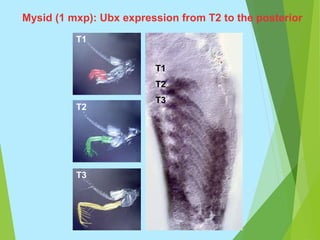
T1
T2
T3
Mysid (1 mxp): Ubx expression from T2 to the posterior
Changes in Hox genes
 Duplication of genes or whole clusters (mammals) by unequal crossing
over
 Following duplication there is diversification of both coding and
regulatory sequences
 Changes (rare) in coding sequences (Ubx in Diptera vs. Ubx in
Lepidoptera)
 Changes in the expression of Hox targets

Hox genes

  • 1.
    Hox genes (Developmental Biology) By MrsSanchita Choubey (M.Sc., PGDCR, Pursuing Ph. D) Assistant Professor of Microbiology Dr. D Y Patil Arts Commerce and Science College Pimpri, Pune
  • 3.
    Homeotic gene complexesin Drosophila  ANT-C (Antennapedia complex) is largely responsible for segmental identity in the head and anterior thorax.  BX-C (Bithorax complex) is responsible for segmental identity in the posterior thorax and abdomen.
  • 4.
    HOMEOSIS  Homeosis orhomeotic transformation, is the development of one body part with the phenotype of another.
  • 5.
    The bithorax mutations This class of loss of functions mutations cause the entire third thoracic segment to be transformed into a second thoracic segment giving rise to flies with four wings instead for the normal two.
  • 6.
    The Tab dominantmutations  These gain of function mutations transform part of the second thoracic segment into the sixth abdominal segment.
  • 7.
    The Antennapedia mutations These gain of function mutations transform antenna into leg.
  • 8.
    The Homeodomain  Thehomeotic genes encode transcription factors of a class called homeodomain proteins. The homeodomain is a 60aa protein domain, which binds DNA. Hox genes bind DNA regulatory elements of their target genes in a specific combination so that the expression pattern in each of the different segments is unique.
  • 9.
    The co-linearity principle:Homeotic gene expression in Drosophila  The anterior boundary of homeotic gene expression is ordered from SCR (most anterior to ANTP, UBX and ABD-B (most posterior). This order is matched by the linear arrangement of the corresponding genes along chromosome 3.
  • 10.
    A2 A1 T2 T3 T 1 Gebelein et al,Dev. Cell, 2002 Dll repression: a paradigm for the study of Hox/Exd interaction DME-lacZ / Ubx Ubx AbdA Dll Exd +
  • 11.
    The DNA sequencemotif hypothesis  Different combination of DNA modules would give different combination of co-factors bound on the promoter and thus a different array of transcriptional interactions with each Hox protein (Li et al, Development 126, 5581-5589, 1999).
  • 12.
    Developmental strategies in animalsare ancient and highly conserved. In essence, a mammal, a worm and a fly- three very different organisms-are put together with the same basic building blocks and regulatory devices.
  • 14.
  • 16.
    Is there a“ground” state? What could constitute a “ground” state? Where all HOX genes are expressed in all segments
  • 18.
    Changes in Hoxgene expression can help explain the evolution of arthropod body plans
  • 19.
    species 1 species2 Evolution of crustacean maxillipeds
  • 20.
    Triops (no mxp):Ubx expression in all thoracic segments
  • 21.
    T1 T2 T3 T1 T2 T3 Mysid (1 mxp):Ubx expression from T2 to the posterior
  • 22.
    Changes in Hoxgenes  Duplication of genes or whole clusters (mammals) by unequal crossing over  Following duplication there is diversification of both coding and regulatory sequences  Changes (rare) in coding sequences (Ubx in Diptera vs. Ubx in Lepidoptera)  Changes in the expression of Hox targets