Myoglobin and Hemoglobin
By
Mrs Sanchita Choubey
(M.Sc., PGDCR, Pursuing Ph. D)
Assistant Professor of Microbiology
Dr. D Y Patil Arts Commerce and Science College Pimpri, Pune
Myoglobin & Hemoglobin
Objectives
 Identify biological functions.
 Identify parts of Mb & their roles in
O2 transport.
 Identify how Hb differs from Mb.
Myoglobin
 O2 transport, storage
in cells.
 Two parts: protein
and heme prosthetic
group.
 Protein:
 155 amino acids, ~ 17
kDa.
 Compact, globin fold.
 75% helix.
Heme
 Heme is composed of porphyrin and Fe2+.
 Porphyrin is non-polar, except two proprionate groups.
 Porphyrin binds O2.
Heme Ligands
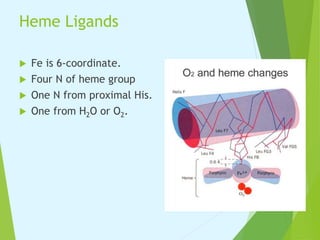
 Fe is 6-coordinate.
 Four N of heme group
 One N from proximal His.
 One from H2O or O2.
Heme – Protein Interaction
 Heme stabilizes
protein fold.
 Binds through hf
interactions
 Prooprionate groups
on surface.
carboxyl group of
proprionate.
Myoglobin
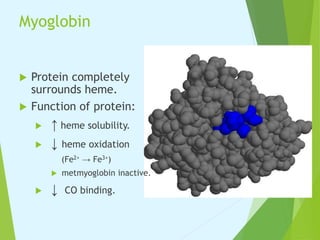
 Protein completely
surrounds heme.
 Function of protein:
 ↑ heme solubility.
 ↓ heme oxidation
(Fe2+ → Fe3+)
 metmyoglobin inactive.
 ↓ CO binding.
O2 vs. CO2 binding.
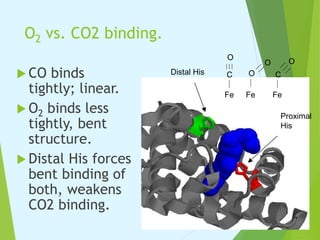
 CO binds
tightly; linear.
 O2 binds less
tightly, bent
structure.
 Distal His forces
bent binding of
both, weakens
CO2 binding.
Distal His
Proximal
His
Fe
C
O
Fe
O
O
Fe
C
O
Hemoglobin
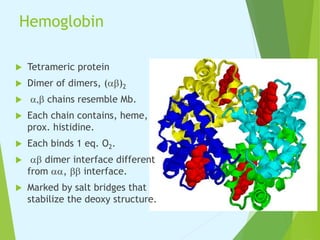
 Tetrameric protein
 Dimer of dimers, (ab)2
 a,b chains resemble Mb.
 Each chain contains, heme,
prox. histidine.
 Each binds 1 eq. O2.
 ab dimer interface different
from aa, bb interface.
 Marked by salt bridges that
stabilize the deoxy structure.
0
0.2
0.4
0.6
0.8
1
0 20 40 60 80 100 120
pO
2,
mm Hg
Y,
fractional
saturation
4° Structure of Hb alters O2 binding.
 Interactions between
dimers alters oxygen
binding.
 Direct plot shows Hb
has lower affinity than
Mb.
 Sets up delivery
system.
 O2 bound by Hb in
lungs; released in
tissues.
Mb Hb
Cooperative regulation
Hb oxygen binding:
 Start binding with given affinity in deoxy state, subsequent binding
enhances affinity.
 Defines positive cooperative regulation.
 Only seen in multi-domain proteins.
 Hill coefficient ~ number of interacting subunits. Advantage: binding
is more sensitive to small changes in [ligand].
Molecular Model
 In deoxy state, Fe out
of heme plane;
domed.
 Bind O2, moves Fe.
 This moves proximal
His and its helix.
 Moving helix alters
a/b interface.
 Deoxy = Tense (T)
 Oxy = Relaxed (R)
Fe
N N
N
O
O

Fe
N N
N

0.7A
His-F8
proximal side
distal side
N
N
C
O
Fe
Fe
CO
F Helix.
T
R
H146 D94
Bohr Effect
 Oxygen affinity sensitive to pH.
 ↓ pH; ↑ pO2,50 (lowers sensitivity).
 D94 ↔ H146 salt bridge in T
state only.
 Excess H+ forms salt bridge,
favors deoxy state.
0
0.2
0.4
0.6
0.8
1
0 20 40 60 80 100 120
pH = 7.5
pH = 7.2
pH = 6.8
log pO2
log
Q
CO2
 Produced during aerobic
metabolism.
 Reacts with N terminal
amino; carbamylation
reaction.
 Negative charge forms salt
bridge with aR141,
stabilizes deoxy state.
R-NH2 + CO2 R-NH-CO2
- + H+
In tissues,
High CO2
In lungs,
Low CO2
0
0.2
0.4
0.6
0.8
1
0 20 40 60 80 100 120
pH = 7.5
pH = 7.2
pH = 6.8
log pO2
log
Q
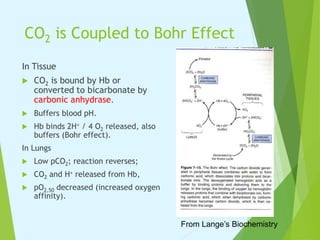
CO2 is Coupled to Bohr Effect
In Tissue
 CO2 is bound by Hb or
converted to bicarbonate by
carbonic anhydrase.
 Buffers blood pH.
 Hb binds 2H+ / 4 O2 released, also
buffers (Bohr effect).
In Lungs
 Low pCO2; reaction reverses;
 CO2 and H+ released from Hb,
 pO2,50 decreased (increased oxygen
affinity).
From Lange’s Biochemistry
2,3-BPG
 Side product of
glycolysis.
 indicates active
respiration, need O2.
 Binds cationic region in
T-form.
 Favors deoxy, releases O2
to tissues.
 [2,3-BPG] is high,
responsible for observed
pO2,50 of 27 mm Hg.
 stripped Hb has pO2, 50 ~
8 mm Hg.
Another look at 2,3-BPG
 BPG acts as a
“wedge” and drives
the R state to the T
state.
 Forces release of
bound O2 in active
tissue.
 BPG increases at
high altitude.
Myoglobin and Hemoglobin

Myoglobin and Hemoglobin

  • 1.
    Myoglobin and Hemoglobin By MrsSanchita Choubey (M.Sc., PGDCR, Pursuing Ph. D) Assistant Professor of Microbiology Dr. D Y Patil Arts Commerce and Science College Pimpri, Pune
  • 2.
    Myoglobin & Hemoglobin Objectives Identify biological functions.  Identify parts of Mb & their roles in O2 transport.  Identify how Hb differs from Mb.
  • 3.
    Myoglobin  O2 transport,storage in cells.  Two parts: protein and heme prosthetic group.  Protein:  155 amino acids, ~ 17 kDa.  Compact, globin fold.  75% helix.
  • 4.
    Heme  Heme iscomposed of porphyrin and Fe2+.  Porphyrin is non-polar, except two proprionate groups.  Porphyrin binds O2.
  • 5.
    Heme Ligands  Feis 6-coordinate.  Four N of heme group  One N from proximal His.  One from H2O or O2.
  • 6.
    Heme – ProteinInteraction  Heme stabilizes protein fold.  Binds through hf interactions  Prooprionate groups on surface. carboxyl group of proprionate.
  • 7.
    Myoglobin  Protein completely surroundsheme.  Function of protein:  ↑ heme solubility.  ↓ heme oxidation (Fe2+ → Fe3+)  metmyoglobin inactive.  ↓ CO binding.
  • 8.
    O2 vs. CO2binding.  CO binds tightly; linear.  O2 binds less tightly, bent structure.  Distal His forces bent binding of both, weakens CO2 binding. Distal His Proximal His Fe C O Fe O O Fe C O
  • 9.
    Hemoglobin  Tetrameric protein Dimer of dimers, (ab)2  a,b chains resemble Mb.  Each chain contains, heme, prox. histidine.  Each binds 1 eq. O2.  ab dimer interface different from aa, bb interface.  Marked by salt bridges that stabilize the deoxy structure.
  • 10.
    0 0.2 0.4 0.6 0.8 1 0 20 4060 80 100 120 pO 2, mm Hg Y, fractional saturation 4° Structure of Hb alters O2 binding.  Interactions between dimers alters oxygen binding.  Direct plot shows Hb has lower affinity than Mb.  Sets up delivery system.  O2 bound by Hb in lungs; released in tissues. Mb Hb
  • 11.
    Cooperative regulation Hb oxygenbinding:  Start binding with given affinity in deoxy state, subsequent binding enhances affinity.  Defines positive cooperative regulation.  Only seen in multi-domain proteins.  Hill coefficient ~ number of interacting subunits. Advantage: binding is more sensitive to small changes in [ligand].
  • 12.
    Molecular Model  Indeoxy state, Fe out of heme plane; domed.  Bind O2, moves Fe.  This moves proximal His and its helix.  Moving helix alters a/b interface.  Deoxy = Tense (T)  Oxy = Relaxed (R) Fe N N N O O  Fe N N N  0.7A His-F8 proximal side distal side N N C O Fe Fe CO F Helix. T R
  • 13.
    H146 D94 Bohr Effect Oxygen affinity sensitive to pH.  ↓ pH; ↑ pO2,50 (lowers sensitivity).  D94 ↔ H146 salt bridge in T state only.  Excess H+ forms salt bridge, favors deoxy state. 0 0.2 0.4 0.6 0.8 1 0 20 40 60 80 100 120 pH = 7.5 pH = 7.2 pH = 6.8 log pO2 log Q
  • 14.
    CO2  Produced duringaerobic metabolism.  Reacts with N terminal amino; carbamylation reaction.  Negative charge forms salt bridge with aR141, stabilizes deoxy state. R-NH2 + CO2 R-NH-CO2 - + H+ In tissues, High CO2 In lungs, Low CO2 0 0.2 0.4 0.6 0.8 1 0 20 40 60 80 100 120 pH = 7.5 pH = 7.2 pH = 6.8 log pO2 log Q
  • 15.
    CO2 is Coupledto Bohr Effect In Tissue  CO2 is bound by Hb or converted to bicarbonate by carbonic anhydrase.  Buffers blood pH.  Hb binds 2H+ / 4 O2 released, also buffers (Bohr effect). In Lungs  Low pCO2; reaction reverses;  CO2 and H+ released from Hb,  pO2,50 decreased (increased oxygen affinity). From Lange’s Biochemistry
  • 16.
    2,3-BPG  Side productof glycolysis.  indicates active respiration, need O2.  Binds cationic region in T-form.  Favors deoxy, releases O2 to tissues.  [2,3-BPG] is high, responsible for observed pO2,50 of 27 mm Hg.  stripped Hb has pO2, 50 ~ 8 mm Hg.
  • 17.
    Another look at2,3-BPG  BPG acts as a “wedge” and drives the R state to the T state.  Forces release of bound O2 in active tissue.  BPG increases at high altitude.