Axes and pattern formation
in Chick
Dr.M.Jothimuniyandi
Assistant Professor
 The chick (Gallus gallus domesticus) is a domesticated
bird species widely used as a model organism in
developmental biology due to its accessibility, ease of
observation, and relevance to vertebrate development.
 Chick embryos develop in eggs, making them an ideal
system for studying early embryogenesis, pattern
formation, and tissue development without invasive
procedures.
Chick
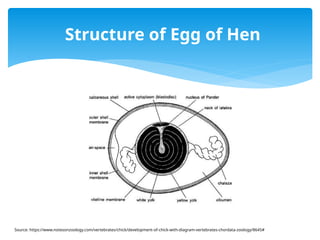
Structure of Egg of Hen
Source: https://www.notesonzoology.com/vertebrates/chick/development-of-chick-with-diagram-vertebrates-chordata-zoology/8645#
 Axes and pattern formation in the chick embryo are
essential processes during early development that
define the body plan and establish the spatial
organization of tissues and organs.
 The key axes involved are the anterior-posterior (AP),
dorsal-ventral (DV), and left-right (LR) axes.
Axes and pattern formation in
Chick
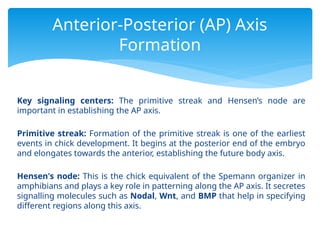
Key signaling centers: The primitive streak and Hensen’s node are
important in establishing the AP axis.
Primitive streak: Formation of the primitive streak is one of the earliest
events in chick development. It begins at the posterior end of the embryo
and elongates towards the anterior, establishing the future body axis.
Hensen's node: This is the chick equivalent of the Spemann organizer in
amphibians and plays a key role in patterning along the AP axis. It secretes
signalling molecules such as Nodal, Wnt, and BMP that help in specifying
different regions along this axis.
Anterior-Posterior (AP) Axis
Formation
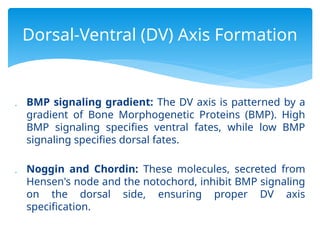
 BMP signaling gradient: The DV axis is patterned by a
gradient of Bone Morphogenetic Proteins (BMP). High
BMP signaling specifies ventral fates, while low BMP
signaling specifies dorsal fates.
 Noggin and Chordin: These molecules, secreted from
Hensen's node and the notochord, inhibit BMP signaling
on the dorsal side, ensuring proper DV axis
specification.
Dorsal-Ventral (DV) Axis Formation
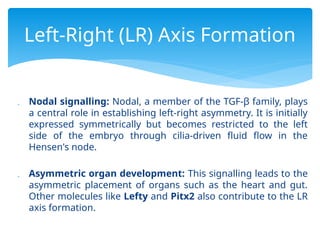
 Nodal signalling: Nodal, a member of the TGF-β family, plays
a central role in establishing left-right asymmetry. It is initially
expressed symmetrically but becomes restricted to the left
side of the embryo through cilia-driven fluid flow in the
Hensen's node.
 Asymmetric organ development: This signalling leads to the
asymmetric placement of organs such as the heart and gut.
Other molecules like Lefty and Pitx2 also contribute to the LR
axis formation.
Left-Right (LR) Axis Formation
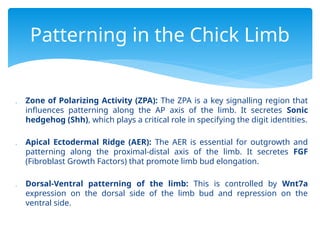
 Zone of Polarizing Activity (ZPA): The ZPA is a key signalling region that
influences patterning along the AP axis of the limb. It secretes Sonic
hedgehog (Shh), which plays a critical role in specifying the digit identities.
 Apical Ectodermal Ridge (AER): The AER is essential for outgrowth and
patterning along the proximal-distal axis of the limb. It secretes FGF
(Fibroblast Growth Factors) that promote limb bud elongation.
 Dorsal-Ventral patterning of the limb: This is controlled by Wnt7a
expression on the dorsal side of the limb bud and repression on the
ventral side.
Patterning in the Chick Limb
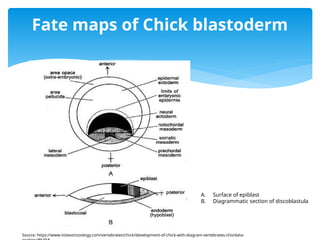
Fate maps of Chick blastoderm
Source: https://www.notesonzoology.com/vertebrates/chick/development-of-chick-with-diagram-vertebrates-chordata-
A. Surface of epiblast
B. Diagrammatic section of discoblastula
Questio
n?
THANK
YOU

Axes and pattern formation in Chick.pptx

  • 1.
    Axes and patternformation in Chick Dr.M.Jothimuniyandi Assistant Professor
  • 2.
     The chick(Gallus gallus domesticus) is a domesticated bird species widely used as a model organism in developmental biology due to its accessibility, ease of observation, and relevance to vertebrate development.  Chick embryos develop in eggs, making them an ideal system for studying early embryogenesis, pattern formation, and tissue development without invasive procedures. Chick
  • 3.
    Structure of Eggof Hen Source: https://www.notesonzoology.com/vertebrates/chick/development-of-chick-with-diagram-vertebrates-chordata-zoology/8645#
  • 4.
     Axes andpattern formation in the chick embryo are essential processes during early development that define the body plan and establish the spatial organization of tissues and organs.  The key axes involved are the anterior-posterior (AP), dorsal-ventral (DV), and left-right (LR) axes. Axes and pattern formation in Chick
  • 5.
    Key signaling centers:The primitive streak and Hensen’s node are important in establishing the AP axis. Primitive streak: Formation of the primitive streak is one of the earliest events in chick development. It begins at the posterior end of the embryo and elongates towards the anterior, establishing the future body axis. Hensen's node: This is the chick equivalent of the Spemann organizer in amphibians and plays a key role in patterning along the AP axis. It secretes signalling molecules such as Nodal, Wnt, and BMP that help in specifying different regions along this axis. Anterior-Posterior (AP) Axis Formation
  • 6.
     BMP signalinggradient: The DV axis is patterned by a gradient of Bone Morphogenetic Proteins (BMP). High BMP signaling specifies ventral fates, while low BMP signaling specifies dorsal fates.  Noggin and Chordin: These molecules, secreted from Hensen's node and the notochord, inhibit BMP signaling on the dorsal side, ensuring proper DV axis specification. Dorsal-Ventral (DV) Axis Formation
  • 7.
     Nodal signalling:Nodal, a member of the TGF-β family, plays a central role in establishing left-right asymmetry. It is initially expressed symmetrically but becomes restricted to the left side of the embryo through cilia-driven fluid flow in the Hensen's node.  Asymmetric organ development: This signalling leads to the asymmetric placement of organs such as the heart and gut. Other molecules like Lefty and Pitx2 also contribute to the LR axis formation. Left-Right (LR) Axis Formation
  • 8.
     Zone ofPolarizing Activity (ZPA): The ZPA is a key signalling region that influences patterning along the AP axis of the limb. It secretes Sonic hedgehog (Shh), which plays a critical role in specifying the digit identities.  Apical Ectodermal Ridge (AER): The AER is essential for outgrowth and patterning along the proximal-distal axis of the limb. It secretes FGF (Fibroblast Growth Factors) that promote limb bud elongation.  Dorsal-Ventral patterning of the limb: This is controlled by Wnt7a expression on the dorsal side of the limb bud and repression on the ventral side. Patterning in the Chick Limb
  • 9.
    Fate maps ofChick blastoderm Source: https://www.notesonzoology.com/vertebrates/chick/development-of-chick-with-diagram-vertebrates-chordata- A. Surface of epiblast B. Diagrammatic section of discoblastula
  • 10.
  • 11.