Computer Aided Drug
Design
POOJA S NATHAN
S5 BT
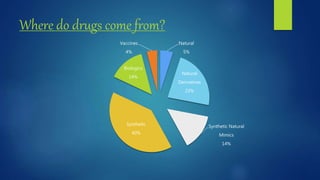
Where do drugs come from?
Natural
5%
Natural
Derivatives
23%
Synthetic Natural
Mimics
14%
Synthetic
40%
Biologics
14%
Vaccines
4%
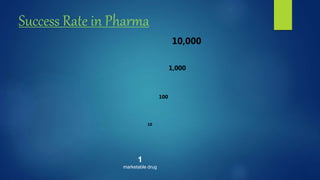
Success Rate in Pharma
10,000
1,000
100
10
1
marketable drug
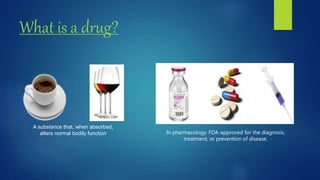
What is a drug?
A substance that, when absorbed,
alters normal bodily function In pharmacology: FDA-approved for the diagnosis,
treatment, or prevention of disease.
History of Drug Discovery
 Early 19th century - extraction of compounds from plants
(morphine, cocaine).
 Late 19th century - fewer natural products used, more synthetic
substances. Dye and chemical companies start research labs and
discover medical applications. (Bayer)
 1905 - John Langley: Theory of receptive substances which stated
“The concept of specific receptors that bind drugs or transmitter
substances onto the cell, thereby either initiating biological effects
or inhibiting cellular functions”
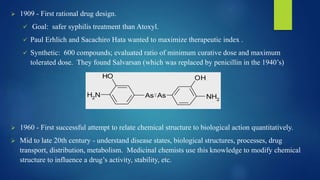
 1909 - First rational drug design.
 Goal: safer syphilis treatment than Atoxyl.
 Paul Erhlich and Sacachiro Hata wanted to maximize therapeutic index .
 Synthetic: 600 compounds; evaluated ratio of minimum curative dose and maximum
tolerated dose. They found Salvarsan (which was replaced by penicillin in the 1940’s)
 1960 - First successful attempt to relate chemical structure to biological action quantitatively.
 Mid to late 20th century - understand disease states, biological structures, processes, drug
transport, distribution, metabolism. Medicinal chemists use this knowledge to modify chemical
structure to influence a drug’s activity, stability, etc.
As As
OH
NH2
OH
NH2
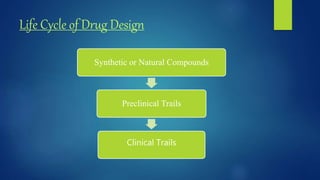
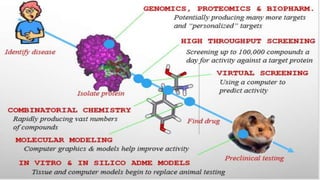
Life Cycle of Drug Design
Synthetic or Natural Compounds
Preclinical Trails
Clinical Trails
Hits Lead and drugs
 Hits are chemical compounds that produce biological activity
through to represent therapeutic potential.
 Biological screening is carried out to identify those compounds
that possess the biological activity, better than the ‘Hits’. Such
compounds identified are called ‘Leads’
 The initial leads are unlikely to be the final drugs. Complex
evaluations are necessary and typically the initial hit is
modified atom-by-atom to improve important as a
characteristic of the molecule.
 The choice of lead structure is very important for success
in drug development.
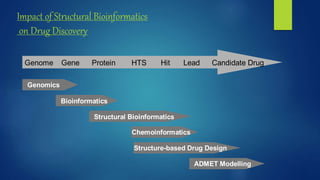
Impact of Structural Bioinformatics
on Drug Discovery
Genome Gene Protein HTS Hit Lead Candidate Drug
Genomics
Bioinformatics
Structural Bioinformatics
Chemoinformatics
Structure-based Drug Design
ADMET Modelling
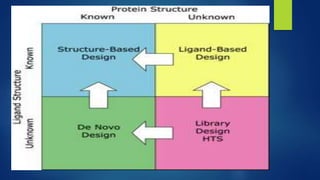
Drug designing approaches
 There are four basic approaches for drug designing
 Ligand based approach
 Target based approaches
 De novo approaches
 SBDD
Ligand based approach
 These are used when the receptor is not known.
 Ligand based approaches try to identify characteristics
common to known ligands to use in screening for new or
improved drugs.
 If a set of active ligands molecules is known for the
macromolecular target, but little or no structural information
exists for the target, ligand based computational method can
be employed
 There are two methods to do this:
 Quantitative Structure Activity Relationship(QSAR) method
 Pharmacophore method
 Is the specific 3-D arrangement of functional groups within a molecular
framework that are specifically bind to a macromolecule or an enzyme
active site.
 Identification of a pharmacophore is an important step in the interaction
between a receptor and a ligand.
Target based approaches
 Target based drug design methods based on the structure of the
biological target either bound or unbound to an inhibitor or
substrate.
 Target based design methods are also known as structure based or
rational design methods.
 Docking involves scanning a database of known molecules for those
likely to bind well to the receptor.
 Docking is used to generate possible binding geometries and can
evaluate using a scoring function.
 The method may also involve some refinement of the initially
generated conformations before or after scanning.
De novo approaches
 De novo design is the approach to build a customized Ligand
for a given receptor.
 This approach involves the ligand optimization
 Ligand optimization can be done by analyzing protein active
site properties that could be probable area of contact by the
ligand.
 The analyzed active site properties are described to negative
image of protein such as hydrogen bond, hydrogen bond
acceptor and hydrophobic contact region.
Structure based drug design
 Structure-based drug design (SBDD, also known as rational
drug design) is a technique that accelerates the drug discovery
process by utilizing structural information to improve the lead
optimization process.
 It has been estimated that SBDD can reduce the cost from
target identification to investigational new drug(IND) filling
by 50%.
 The technique requires high resolution 3-D structure of the
inhibitor bound to the target obtained using X-ray
crystallography.
 Once the structure is obtained, the interactions between the
inhibitor and the active site of the target are analyzed. Improved
inhibitors result from this analysis, resulting in a shortening of
the lead optimization process.
 Rational drug design is a method for developing new
pharmaceuticals that typically involves the elucidation of
fundamental physiological mechanisms.
 In thus combines the quest for a scientific understanding of
natural phenomena with the design of useful technology and
hence integrates epistemic and practical aims of research and
development.
Steps involved in drug designing
1. Target identification
2. Target validation
3. Lead identification
4. Lead optimization
5. Docking
6. Pre clinical trials
7. Clinical trails
Target identification
 A target is a molecule(namely a protein) which is present within an
organism.
 The approaches of identifying targets include protein expression,
protein biochemistry, structure function studies, study of biochemical
pathways.
 There are now several other methods to identify specific molecular
targets like high throughput sequencing analysis, positional cloning,
generation of cDNA libraries with ESTs and database mining by
sequence homology.
 It is important to determine whether the novel targets are actually
relevant to the physiology of the disease.
Target validation
 As there are a pleothora of new potential therapeutic drug targets
that are being discovered, selection and validation of novel
molecular targets has become important.
 It needs to be confirmed that the targets identified will affect an
appropriate biological response.
 Targeted gene disruption (TGD) is a term that refers to several
different methods of target validation.
Lead identification
 A lead is a compound(usually a small organic molecule)
that demonstrates a desired biological activity on a
validated molecular target.
To be termed as a lead, the compound must exceed a
specific potency threshold against the target.
The compounds used as potential leads can be from many
sources. The most important sources of leads is libraries
of molecules like peptide libraries, natural compounds
libraries etc.
Some of the technologies used in the lead identification
 Virtual screening
 Chemo informatics
 Pharmacophore mapping
 Quantitative structure activity relationship QSAR
 High throughput docking
 NMR – based screening
 Chemical genetics
Lead optimization
 Once a lead compound is established in the identification
process, we need to optimize the desirable traits of the
lead
 To be considered for further development , lead should be
amenable for chemistry optimization.
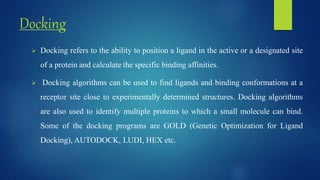
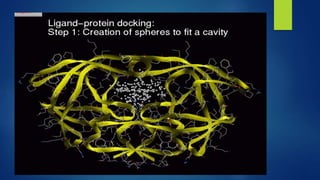
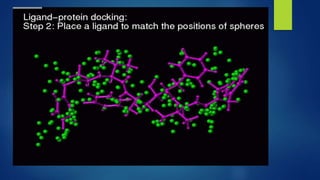
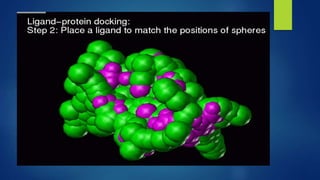
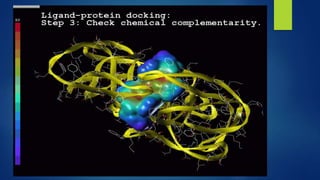
Docking
 Docking refers to the ability to position a ligand in the active or a designated site
of a protein and calculate the specific binding affinities.
 Docking algorithms can be used to find ligands and binding conformations at a
receptor site close to experimentally determined structures. Docking algorithms
are also used to identify multiple proteins to which a small molecule can bind.
Some of the docking programs are GOLD (Genetic Optimization for Ligand
Docking), AUTODOCK, LUDI, HEX etc.
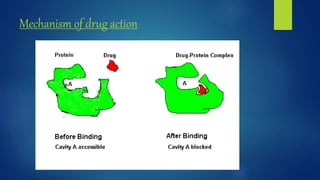
Mechanism of drug action
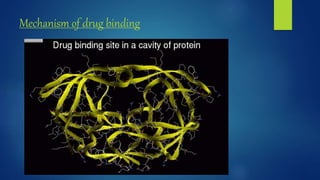
Mechanism of drug binding
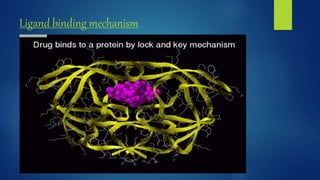
Ligand binding mechanism
.
.
.
.
The current roles of the computer in drug design
 Storing and retrieving information
 Structures determined by X-ray crystallography for biological targets
(enzymes) and drug molecules
 Molecules and activities testing the affect of small structural changes on
biological activity
 Information about toxicity and its relationship to structure
 Visualizing molecules
 Similarities/differences between drugs acting in the same way
 Interaction between drugs and receptors
 Calculations
 Interaction strengths
 Motion (dynamics)
Pre clinical trails
 It is the study of how a drug molecule interacts with its molecular target.
 Pharmacological techniques are employed to study receptor binding,
functional effects, dose responses etc.
 ADMET characteristics are very important at this stage.
 Absorption:- Compounds are delivered by a range of routes in the body.
From the site of initial delivery compounds will be absorbed in specific
patterns
 Distribution:- Once absorbed compounds is distributed throughout the
body, is determined by a route of administration and formulation.
 Metabolism:- Compounds are metabolized or modified biologically as
the body aims to clear them. Liver is the most significant metabolic
organ of an organism.
 Excretion:- Compounds and their metabolites are eliminated from the
body via urinary, exhalation etc.
 Toxicology:- Majority of potent drugs has side effects limiting the
safe dose which can be used in man. Toxicological predictions mostly
pertain to the identification of structural features of drug molecules
likely to confer toxicological properties.
Clinical trails
 Before a drug is approved, clinical trials have to be followed. It
 has distinct phases:
 Phase 0-> micro dosing of candidate to determine distribution
related information
 Phase 1-> first stage testing in humans.
 Phase 2-> access how well the drug works.
 Phase 3-> multicenter trials on large patient groups.
 Phase 4-> involves safety surveillance and ongoing technical
support of a drug after receiving permission to be sold.
Thank you

Computer Aided Drug Design

  • 1.
  • 2.
    Where do drugscome from? Natural 5% Natural Derivatives 23% Synthetic Natural Mimics 14% Synthetic 40% Biologics 14% Vaccines 4%
  • 3.
    Success Rate inPharma 10,000 1,000 100 10 1 marketable drug
  • 4.
    What is adrug? A substance that, when absorbed, alters normal bodily function In pharmacology: FDA-approved for the diagnosis, treatment, or prevention of disease.
  • 5.
    History of DrugDiscovery  Early 19th century - extraction of compounds from plants (morphine, cocaine).  Late 19th century - fewer natural products used, more synthetic substances. Dye and chemical companies start research labs and discover medical applications. (Bayer)  1905 - John Langley: Theory of receptive substances which stated “The concept of specific receptors that bind drugs or transmitter substances onto the cell, thereby either initiating biological effects or inhibiting cellular functions”
  • 6.
     1909 -First rational drug design.  Goal: safer syphilis treatment than Atoxyl.  Paul Erhlich and Sacachiro Hata wanted to maximize therapeutic index .  Synthetic: 600 compounds; evaluated ratio of minimum curative dose and maximum tolerated dose. They found Salvarsan (which was replaced by penicillin in the 1940’s)  1960 - First successful attempt to relate chemical structure to biological action quantitatively.  Mid to late 20th century - understand disease states, biological structures, processes, drug transport, distribution, metabolism. Medicinal chemists use this knowledge to modify chemical structure to influence a drug’s activity, stability, etc. As As OH NH2 OH NH2
  • 7.
    Life Cycle ofDrug Design Synthetic or Natural Compounds Preclinical Trails Clinical Trails
  • 8.
    Hits Lead anddrugs  Hits are chemical compounds that produce biological activity through to represent therapeutic potential.  Biological screening is carried out to identify those compounds that possess the biological activity, better than the ‘Hits’. Such compounds identified are called ‘Leads’
  • 9.
     The initialleads are unlikely to be the final drugs. Complex evaluations are necessary and typically the initial hit is modified atom-by-atom to improve important as a characteristic of the molecule.  The choice of lead structure is very important for success in drug development.
  • 10.
    Impact of StructuralBioinformatics on Drug Discovery Genome Gene Protein HTS Hit Lead Candidate Drug Genomics Bioinformatics Structural Bioinformatics Chemoinformatics Structure-based Drug Design ADMET Modelling
  • 12.
    Drug designing approaches There are four basic approaches for drug designing  Ligand based approach  Target based approaches  De novo approaches  SBDD
  • 14.
    Ligand based approach These are used when the receptor is not known.  Ligand based approaches try to identify characteristics common to known ligands to use in screening for new or improved drugs.  If a set of active ligands molecules is known for the macromolecular target, but little or no structural information exists for the target, ligand based computational method can be employed
  • 15.
     There aretwo methods to do this:  Quantitative Structure Activity Relationship(QSAR) method  Pharmacophore method  Is the specific 3-D arrangement of functional groups within a molecular framework that are specifically bind to a macromolecule or an enzyme active site.  Identification of a pharmacophore is an important step in the interaction between a receptor and a ligand.
  • 16.
    Target based approaches Target based drug design methods based on the structure of the biological target either bound or unbound to an inhibitor or substrate.  Target based design methods are also known as structure based or rational design methods.
  • 17.
     Docking involvesscanning a database of known molecules for those likely to bind well to the receptor.  Docking is used to generate possible binding geometries and can evaluate using a scoring function.  The method may also involve some refinement of the initially generated conformations before or after scanning.
  • 18.
    De novo approaches De novo design is the approach to build a customized Ligand for a given receptor.  This approach involves the ligand optimization  Ligand optimization can be done by analyzing protein active site properties that could be probable area of contact by the ligand.  The analyzed active site properties are described to negative image of protein such as hydrogen bond, hydrogen bond acceptor and hydrophobic contact region.
  • 19.
    Structure based drugdesign  Structure-based drug design (SBDD, also known as rational drug design) is a technique that accelerates the drug discovery process by utilizing structural information to improve the lead optimization process.  It has been estimated that SBDD can reduce the cost from target identification to investigational new drug(IND) filling by 50%.  The technique requires high resolution 3-D structure of the inhibitor bound to the target obtained using X-ray crystallography.
  • 20.
     Once thestructure is obtained, the interactions between the inhibitor and the active site of the target are analyzed. Improved inhibitors result from this analysis, resulting in a shortening of the lead optimization process.  Rational drug design is a method for developing new pharmaceuticals that typically involves the elucidation of fundamental physiological mechanisms.  In thus combines the quest for a scientific understanding of natural phenomena with the design of useful technology and hence integrates epistemic and practical aims of research and development.
  • 21.
    Steps involved indrug designing 1. Target identification 2. Target validation 3. Lead identification 4. Lead optimization 5. Docking 6. Pre clinical trials 7. Clinical trails
  • 22.
    Target identification  Atarget is a molecule(namely a protein) which is present within an organism.  The approaches of identifying targets include protein expression, protein biochemistry, structure function studies, study of biochemical pathways.
  • 23.
     There arenow several other methods to identify specific molecular targets like high throughput sequencing analysis, positional cloning, generation of cDNA libraries with ESTs and database mining by sequence homology.  It is important to determine whether the novel targets are actually relevant to the physiology of the disease.
  • 24.
    Target validation  Asthere are a pleothora of new potential therapeutic drug targets that are being discovered, selection and validation of novel molecular targets has become important.  It needs to be confirmed that the targets identified will affect an appropriate biological response.  Targeted gene disruption (TGD) is a term that refers to several different methods of target validation.
  • 25.
    Lead identification  Alead is a compound(usually a small organic molecule) that demonstrates a desired biological activity on a validated molecular target. To be termed as a lead, the compound must exceed a specific potency threshold against the target. The compounds used as potential leads can be from many sources. The most important sources of leads is libraries of molecules like peptide libraries, natural compounds libraries etc.
  • 26.
    Some of thetechnologies used in the lead identification  Virtual screening  Chemo informatics  Pharmacophore mapping  Quantitative structure activity relationship QSAR  High throughput docking  NMR – based screening  Chemical genetics
  • 27.
    Lead optimization  Oncea lead compound is established in the identification process, we need to optimize the desirable traits of the lead  To be considered for further development , lead should be amenable for chemistry optimization.
  • 28.
    Docking  Docking refersto the ability to position a ligand in the active or a designated site of a protein and calculate the specific binding affinities.  Docking algorithms can be used to find ligands and binding conformations at a receptor site close to experimentally determined structures. Docking algorithms are also used to identify multiple proteins to which a small molecule can bind. Some of the docking programs are GOLD (Genetic Optimization for Ligand Docking), AUTODOCK, LUDI, HEX etc.
  • 29.
  • 30.
  • 31.
  • 32.
  • 33.
  • 34.
  • 35.
  • 36.
    The current rolesof the computer in drug design  Storing and retrieving information  Structures determined by X-ray crystallography for biological targets (enzymes) and drug molecules  Molecules and activities testing the affect of small structural changes on biological activity  Information about toxicity and its relationship to structure  Visualizing molecules  Similarities/differences between drugs acting in the same way  Interaction between drugs and receptors  Calculations  Interaction strengths  Motion (dynamics)
  • 37.
    Pre clinical trails It is the study of how a drug molecule interacts with its molecular target.  Pharmacological techniques are employed to study receptor binding, functional effects, dose responses etc.  ADMET characteristics are very important at this stage.  Absorption:- Compounds are delivered by a range of routes in the body. From the site of initial delivery compounds will be absorbed in specific patterns  Distribution:- Once absorbed compounds is distributed throughout the body, is determined by a route of administration and formulation.
  • 38.
     Metabolism:- Compoundsare metabolized or modified biologically as the body aims to clear them. Liver is the most significant metabolic organ of an organism.  Excretion:- Compounds and their metabolites are eliminated from the body via urinary, exhalation etc.  Toxicology:- Majority of potent drugs has side effects limiting the safe dose which can be used in man. Toxicological predictions mostly pertain to the identification of structural features of drug molecules likely to confer toxicological properties.
  • 39.
    Clinical trails  Beforea drug is approved, clinical trials have to be followed. It  has distinct phases:  Phase 0-> micro dosing of candidate to determine distribution related information  Phase 1-> first stage testing in humans.  Phase 2-> access how well the drug works.  Phase 3-> multicenter trials on large patient groups.  Phase 4-> involves safety surveillance and ongoing technical support of a drug after receiving permission to be sold.
  • 40.