HYGIA INSTITUTE OF PHARMACEUTICAL EDUCATION AND RESEARCH
Ghaila Road, Gazipur Balram Rd, near IIM Road, Prabandh Nagar, Lucknow, Uttar Pradesh 226020
Contents
S.No. Content Page No. Remark
1. Drug Design 1 – 3
2. Types of Drug Design 4
3. Ligand Based Drug Design 5
4. Structure Based Drug Design 6
5. Biological targets 7
6. Examples of Receptors 8
7. Homology Modelling 9
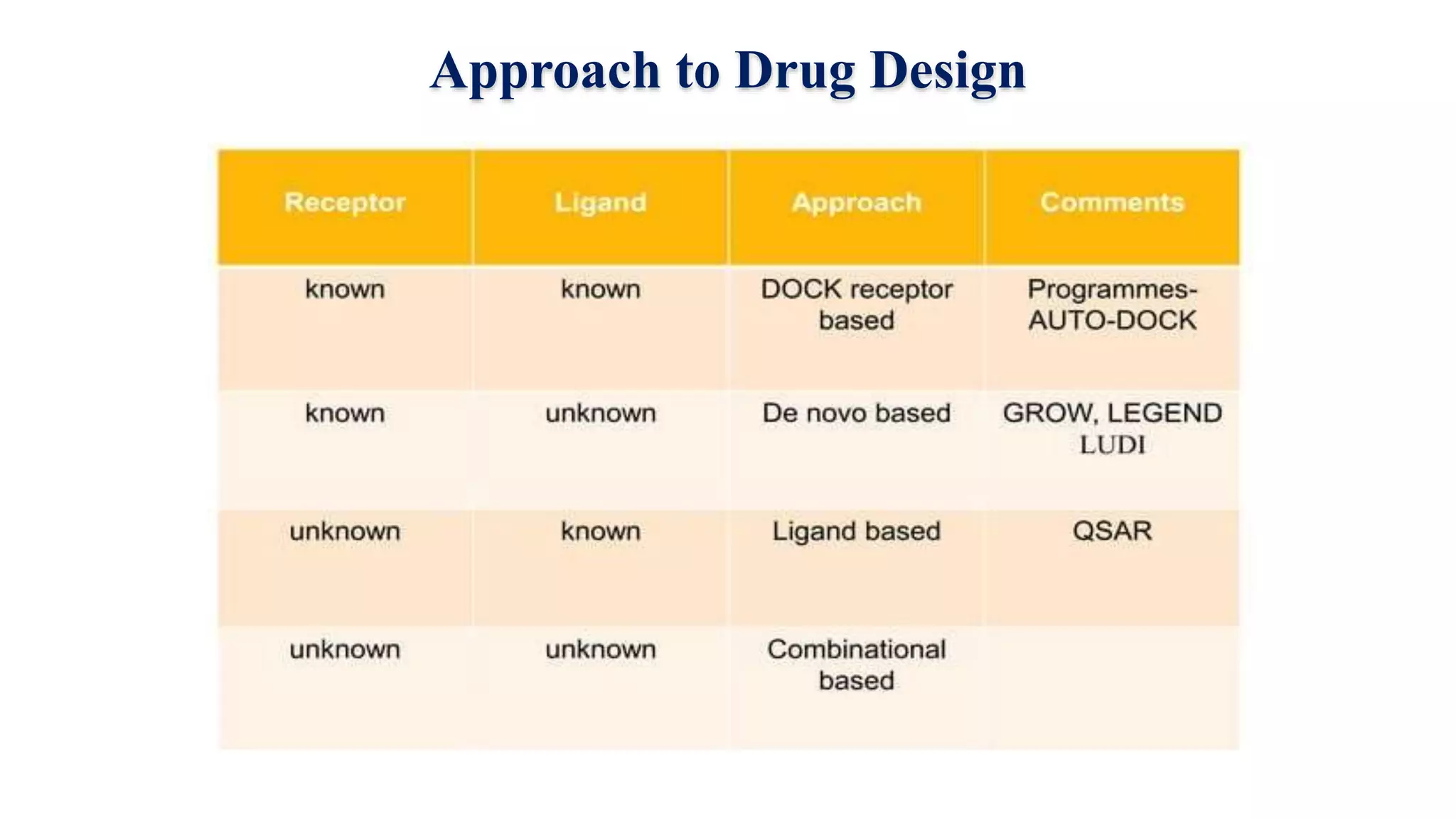
8. Approach to Drug Design 10
9. De-novo Drug Design 11
10. Types, Linking and Evaluation 11-16
11. Methods and aspects for De-novo Drug Design 17-18
12. Applications 19
13. Disadvantages 20
14. LUDI Software (Site Identification, Fitting and Bridging of
fragments).
21-26
Drug Design
 Drug design involves the design of small molecules that are complementary in shape and
charge to the biomolecular targets with which they interact and bind.
 The drug is most commonly an organic small molecule that activates or inhibits the
function of a biomolecule such as a protein, which in turn results in a therapeutic benefit to
the patient.
 Rational drug design or simply rational design, is the inventive process of finding new
medications based on the knowledge of a biological target
 Finally, drug design that relies on the knowledge of the three-dimensional structure of the
biomolecular target is known as structure-based drug design.
 A more accurate term is ligand design (i.e., design of a small molecule that will bind
tightly to its target)
Types of Drug Design
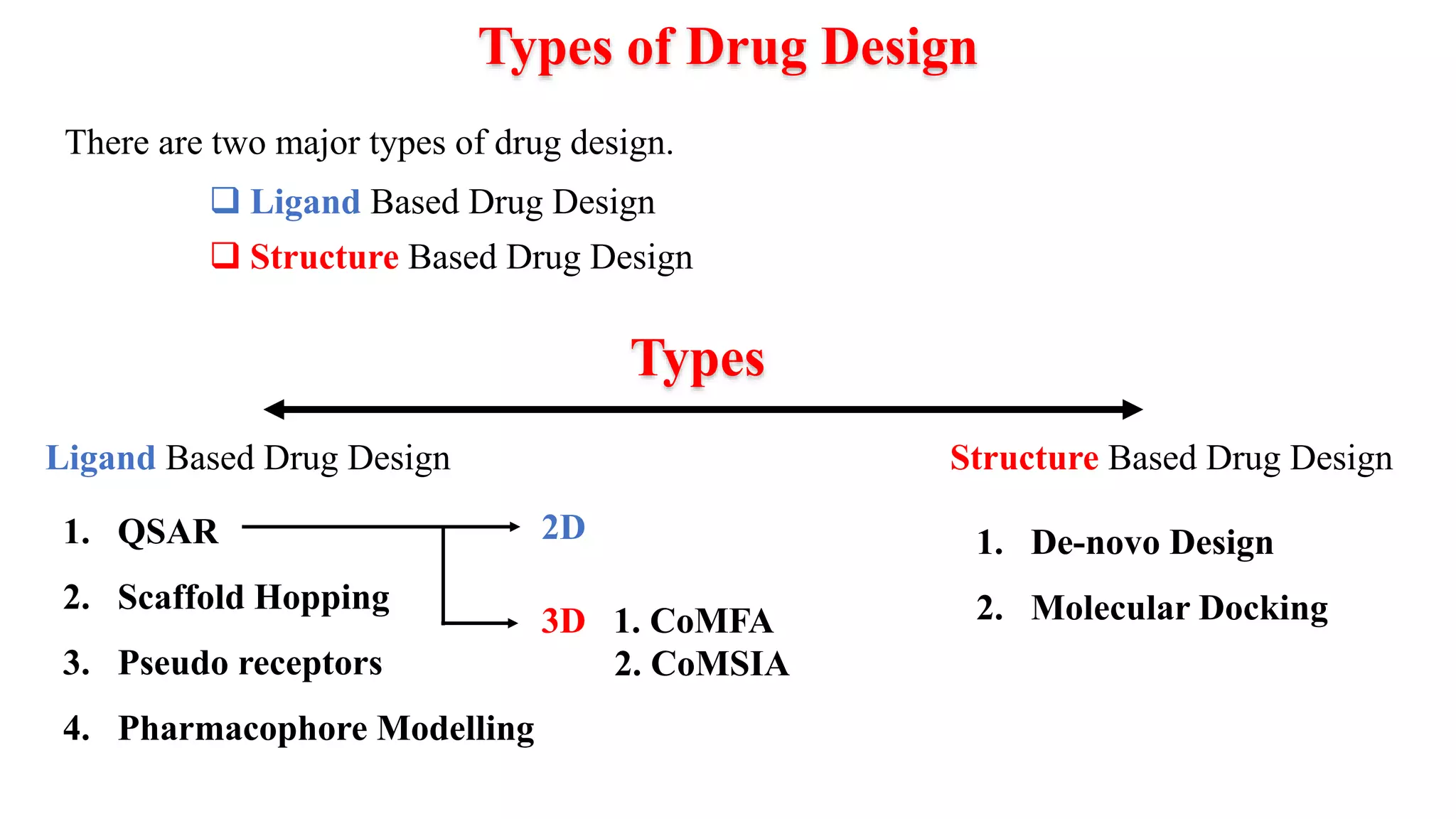
There are two major types of drug design.
 Ligand Based Drug Design
 Structure Based Drug Design
Types
Ligand Based Drug Design Structure Based Drug Design
1. QSAR
2. Scaffold Hopping
3. Pseudo receptors
4. Pharmacophore Modelling
2D
3D 1. CoMFA
2. CoMSIA
1. De-novo Design
2. Molecular Docking
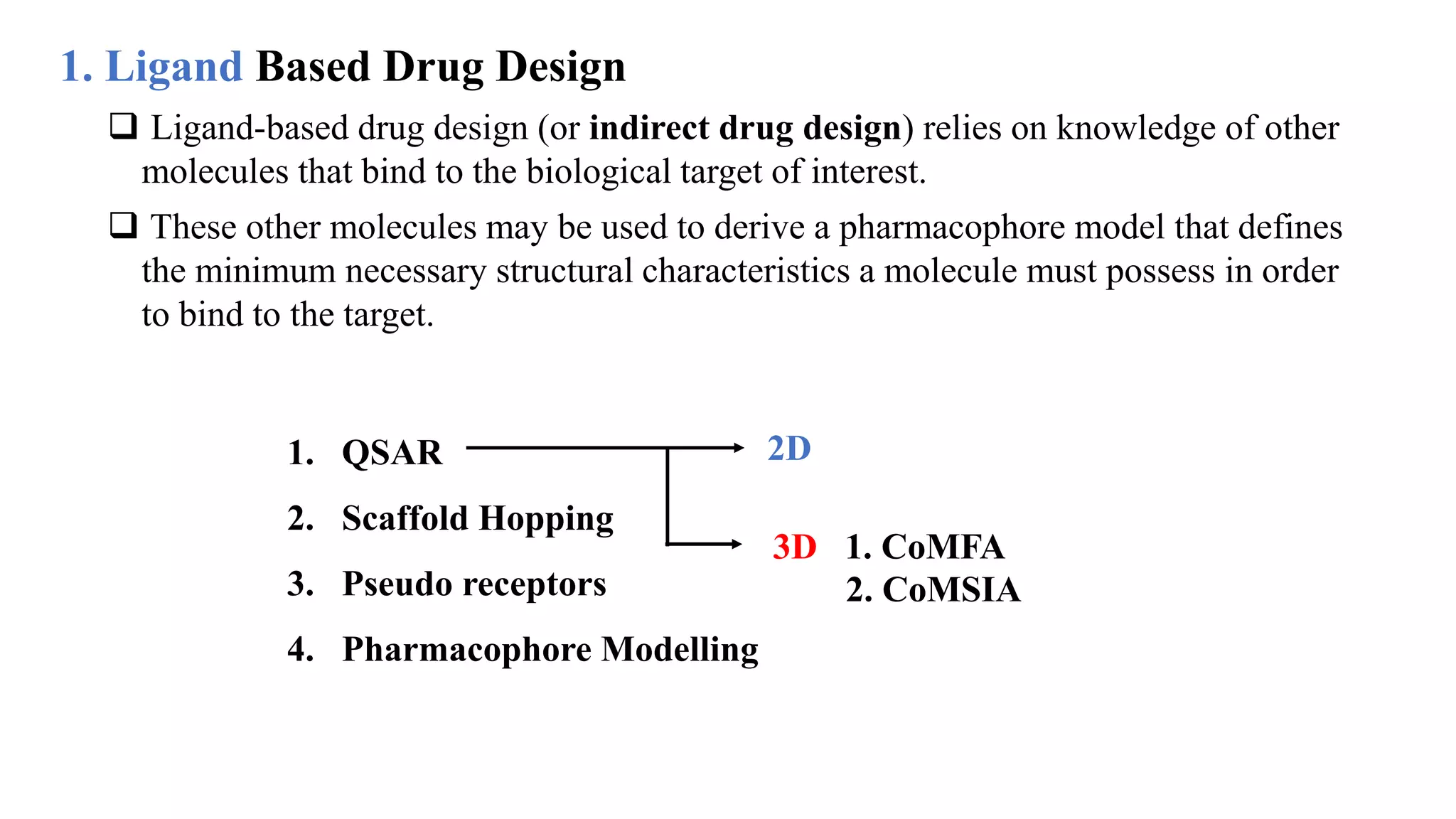
1. Ligand Based Drug Design
 Ligand-based drug design (or indirect drug design) relies on knowledge of other
molecules that bind to the biological target of interest.
 These other molecules may be used to derive a pharmacophore model that defines
the minimum necessary structural characteristics a molecule must possess in order
to bind to the target.
1. QSAR
2. Scaffold Hopping
3. Pseudo receptors
4. Pharmacophore Modelling
2D
3D 1. CoMFA
2. CoMSIA
2. Structure Based Drug Design
 Structure-based drug design (or direct drug design) relies on knowledge of the three
dimensional structure of the biological target obtained through methods such as
1. X-ray crystallography
2. NMR spectroscopy.
X-ray crystallography NMR spectroscopy
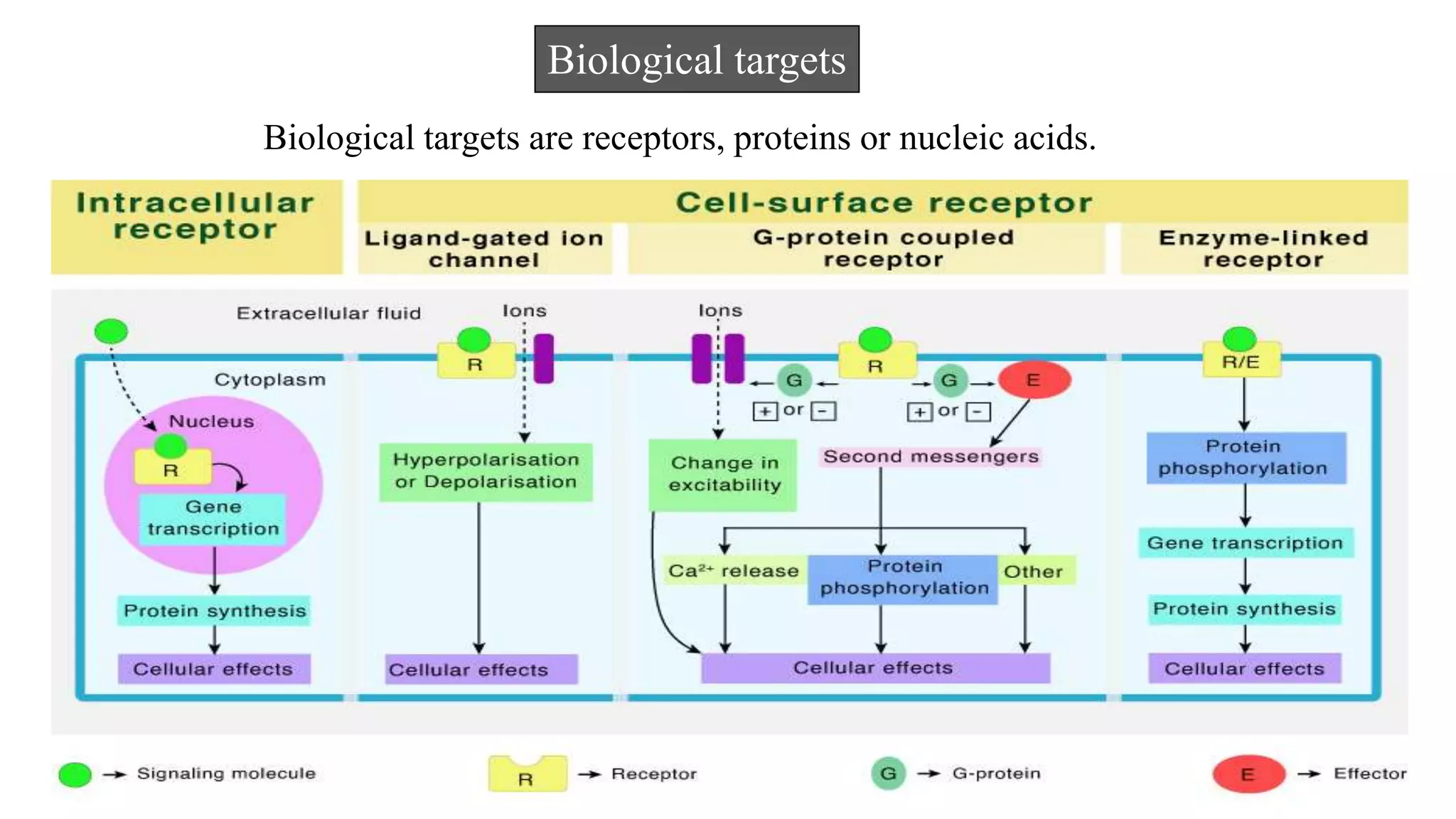
Biological targets
Biological targets are receptors, proteins or nucleic acids.
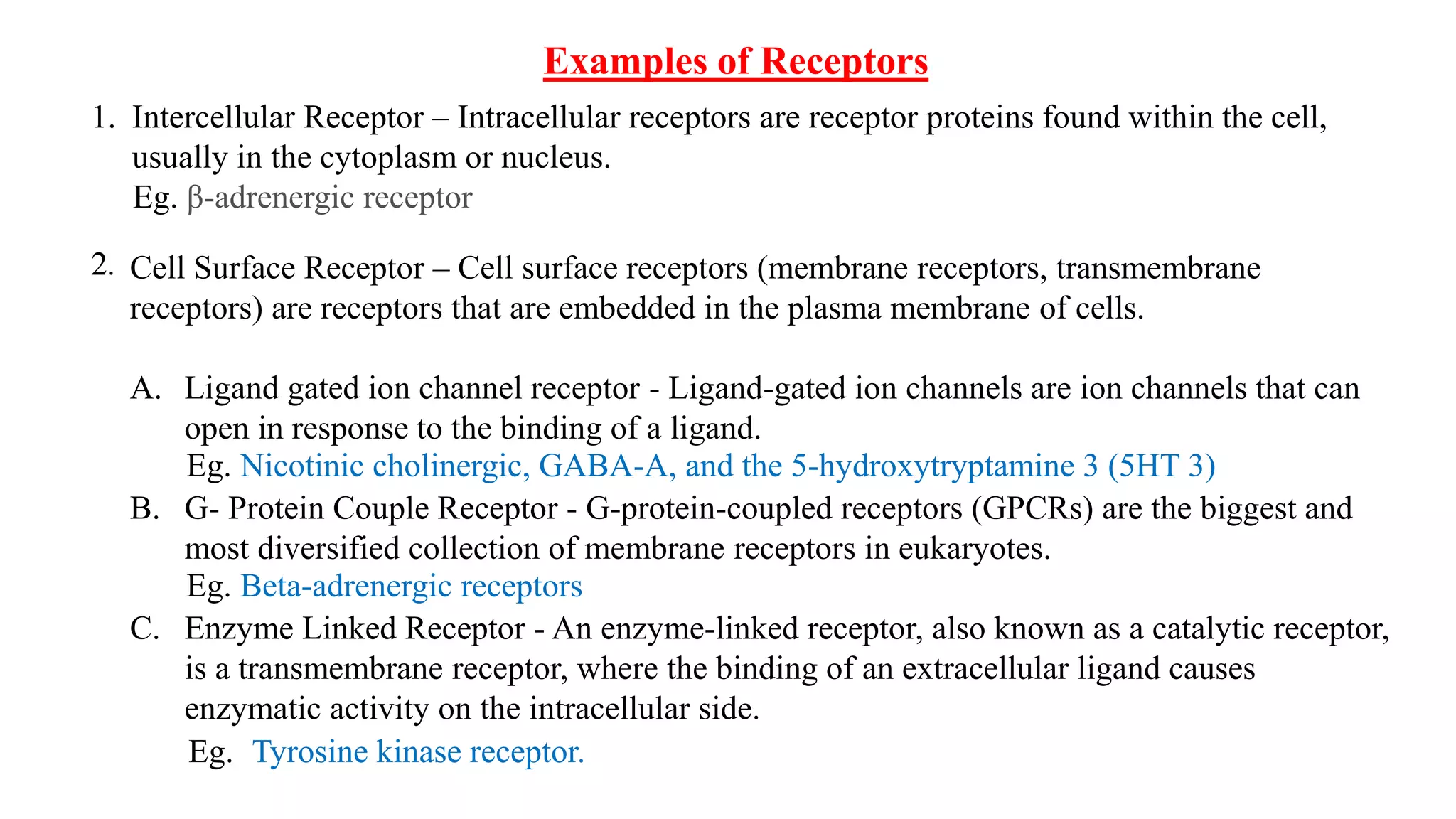
Examples of Receptors
1. Intercellular Receptor – Intracellular receptors are receptor proteins found within the cell,
usually in the cytoplasm or nucleus.
Eg. β-adrenergic receptor
Cell Surface Receptor – Cell surface receptors (membrane receptors, transmembrane
receptors) are receptors that are embedded in the plasma membrane of cells.
A. Ligand gated ion channel receptor - Ligand-gated ion channels are ion channels that can
open in response to the binding of a ligand.
B. G- Protein Couple Receptor - G-protein-coupled receptors (GPCRs) are the biggest and
most diversified collection of membrane receptors in eukaryotes.
C. Enzyme Linked Receptor - An enzyme-linked receptor, also known as a catalytic receptor,
is a transmembrane receptor, where the binding of an extracellular ligand causes
enzymatic activity on the intracellular side.
Eg. Tyrosine kinase receptor.
2.
Eg. Nicotinic cholinergic, GABA-A, and the 5-hydroxytryptamine 3 (5HT 3)
Eg. Beta-adrenergic receptors
 If an experimental structure of a target is not
available, it may be possible to create a
homology model of the target based on the
experimental structure of a related protein.
Homology – Similar Structure
Homology Modelling
 Sequences of Complimentry Protein is aligned
and develop the structural model of unknown
protein structure.
Approach to Drug Design
De-novo Drug Design
 De-novo means start afresh, from the begnning, from the scratch.
 It is a process in which the 3D structure of receptor is used to design newer molecules.
 It involves structural determination of the lead target complexes and lead modifications
using molecular modelling tools.
 Information available about target receptor but no existing leads that can interact .
Types
1. Manual Design
2. Automated Design
1. Manual Design
 This is a slow process.
 A single novel structure is used to design.
2. Automated Design
 This is a much faster process.
 Large numbers of diverse structure is used to design.
Manual Design
Automated Design
Switch
Drawback – It takes more time.
Drawback – It leads to structure form that are difficult to synthesize.
De-novo Drug Design
 De-novo design is the approach to build a customized ligand for a given receptors in
which the 3D structure of the receptor is used to design new ligand molecules.
 Ligand optimization can be done by analyzing protein active site properties that could
be probable area of contact by the ligand.
 The analyzed active site properties are described to negative image of protein such as
hydrogen bond, hydrogen bond acceptor and hydrophobic contact region.
 This approach involves the ligand optimization.
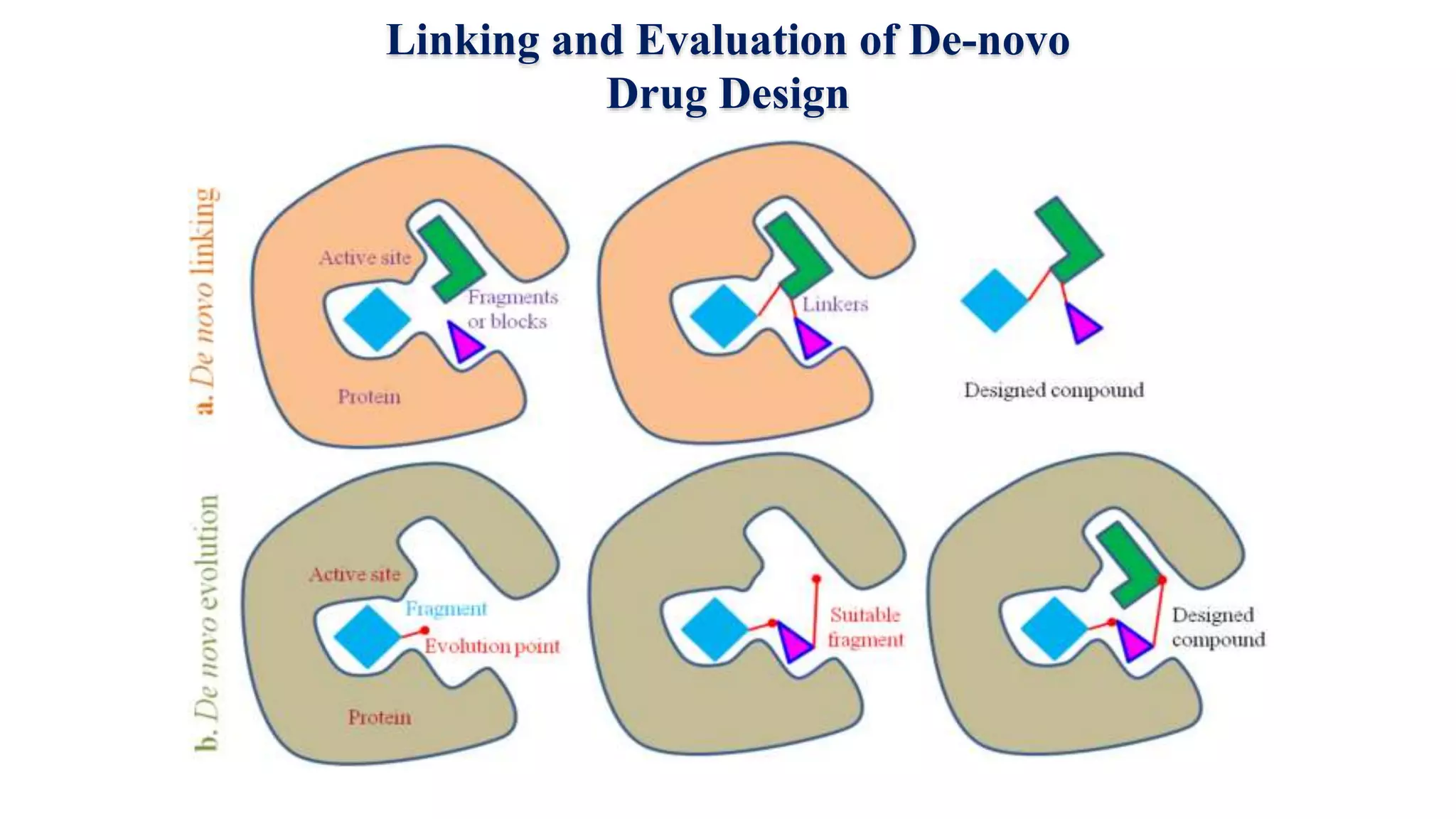
Linking and Evaluation of De-novo
Drug Design
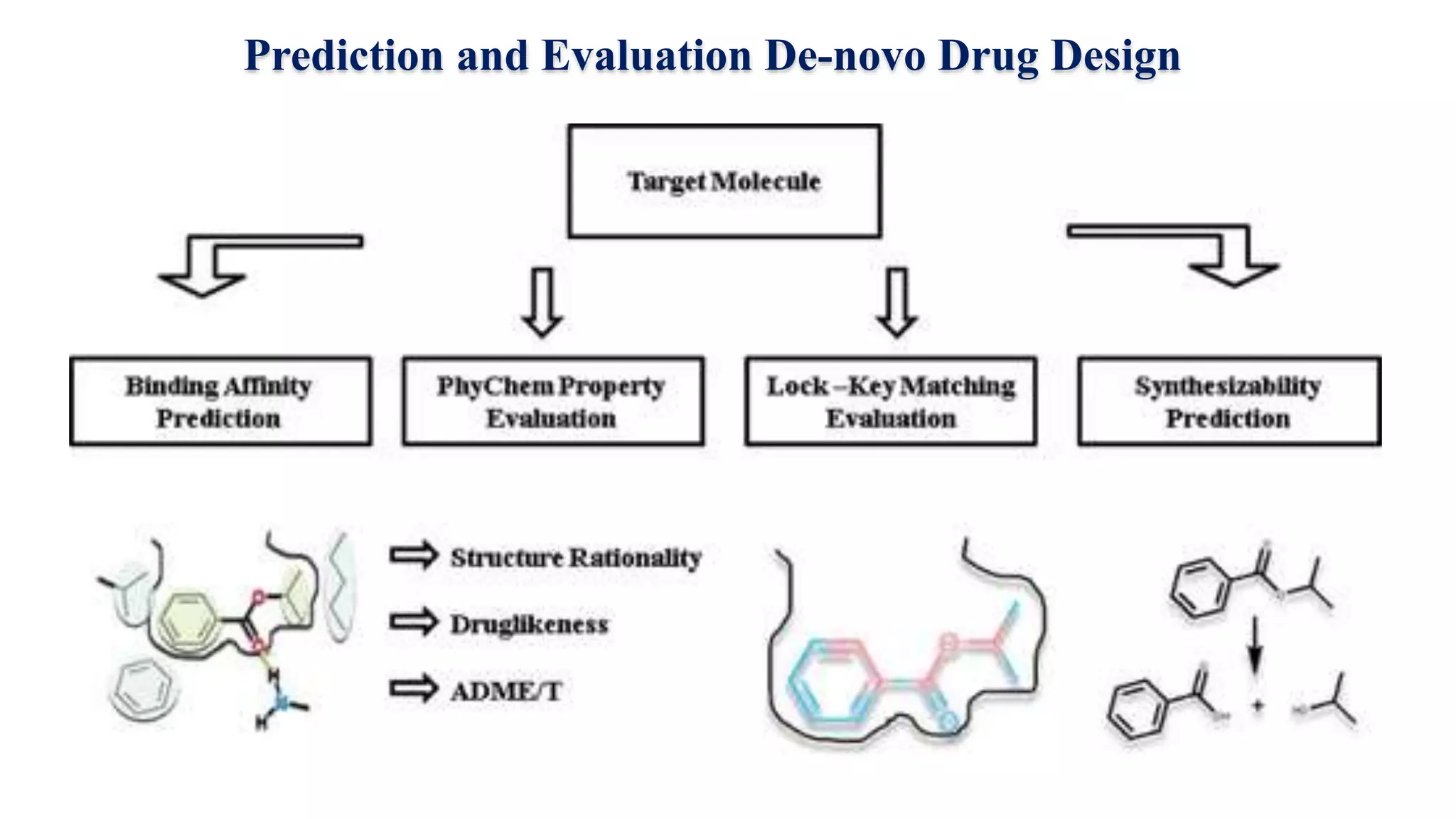
Prediction and Evaluation De-novo Drug Design
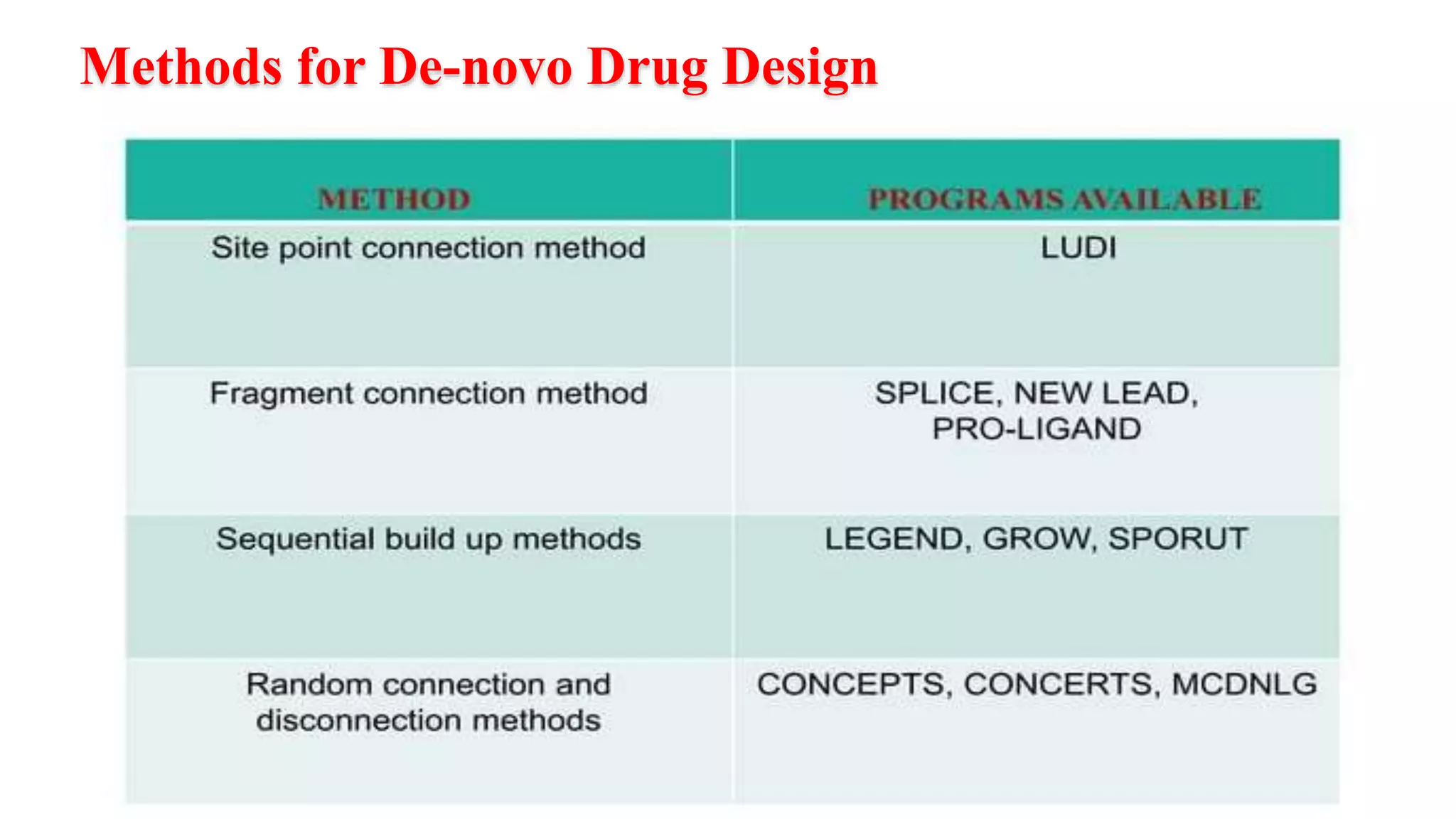
Methods for De-novo Drug Design
Aspects of De-novo Drug Design
1. Flexible molecules are better than rigid molecules.
2. It is pointless designing molecules which are difficult or impossible to synthesized.
3. Similarly, It is pointless designing molecules which need to adopt an unstable
conformation in order to bind.
4. Consideration of the energy losses involved in water desolvation should be taken into
account.
5. There may be subtle difference in structure between receptors and enzymes from
different species. This is significant if the structure of the binding site used for de-
novo design is based on a protein that is not human in origin.
1. Design of HIV 1 protease inhibitors.
2. Design of Bradykinin receptor antagonist.
3. Catechol ortho methyl transferase inhibitors.
4. Estrogen receptor antagonist.
De-novo Drug Design
1. The position of Atoms in the crystal structure is accurate only to 0.2-0.4 A and
allowance should be made for that.
2. It is possible that the designed molecule may not bind to the binding site exactly
as predicted.
3. It is worth leaving scope for variation and elaboration of the molecule. This allows
fine tuning of the molecule’s binding affinity and pharmacokinetics.
 LUDI is a de-novo drug design software used to design the molecules on the basis of the
targets interaction sites and fragment molecule nature.
 It includes three steps
1. Identification of Interaction sites
2. Fitting molecular fragments
3. Fragment bridging
Stage 1: Identification of interaction sites
 The atoms present in the binding site are analyzed to identify those that can take part in
hydrogen bonding interactions and those that can take part in van der Waals interactions.
Stage 2: Fitting molecular fragments
 The LUDI program accesses a library of several hundred molecular fragments.
 The molecules chosen are typically 5-30 atoms in size and are usually rigid in structure
because the fitting procedure assumes rigid fragments.
 Some fragments are included which can adopt different conformations.
Examples used by LUDI
 The best fit will be the one that matches up the fragment with the maximum number of
interaction sites.
 The program can ‘try out’ the various fragments in its library and identify those that can
be matched up or fitted to the available interaction sites in the binding site.
Stage 3: Fragment bridging
 Fragments have been identified and fitted to the binding site, the final stage is to link
them up.
 The program first identifies the molecular fragments that closest to each other in the
binding site, then identifies the closest hydrogen atoms.
 A suitable bridge has been found, a final molecule is created.
Bridging process in LUDI
(Kartik Tiwari) Denovo Drug Design.pptx

(Kartik Tiwari) Denovo Drug Design.pptx

  • 1.
    HYGIA INSTITUTE OFPHARMACEUTICAL EDUCATION AND RESEARCH Ghaila Road, Gazipur Balram Rd, near IIM Road, Prabandh Nagar, Lucknow, Uttar Pradesh 226020
  • 2.
    Contents S.No. Content PageNo. Remark 1. Drug Design 1 – 3 2. Types of Drug Design 4 3. Ligand Based Drug Design 5 4. Structure Based Drug Design 6 5. Biological targets 7 6. Examples of Receptors 8 7. Homology Modelling 9 8. Approach to Drug Design 10 9. De-novo Drug Design 11 10. Types, Linking and Evaluation 11-16 11. Methods and aspects for De-novo Drug Design 17-18 12. Applications 19 13. Disadvantages 20 14. LUDI Software (Site Identification, Fitting and Bridging of fragments). 21-26
  • 3.
    Drug Design  Drugdesign involves the design of small molecules that are complementary in shape and charge to the biomolecular targets with which they interact and bind.  The drug is most commonly an organic small molecule that activates or inhibits the function of a biomolecule such as a protein, which in turn results in a therapeutic benefit to the patient.  Rational drug design or simply rational design, is the inventive process of finding new medications based on the knowledge of a biological target  Finally, drug design that relies on the knowledge of the three-dimensional structure of the biomolecular target is known as structure-based drug design.  A more accurate term is ligand design (i.e., design of a small molecule that will bind tightly to its target)
  • 4.
    Types of DrugDesign There are two major types of drug design.  Ligand Based Drug Design  Structure Based Drug Design Types Ligand Based Drug Design Structure Based Drug Design 1. QSAR 2. Scaffold Hopping 3. Pseudo receptors 4. Pharmacophore Modelling 2D 3D 1. CoMFA 2. CoMSIA 1. De-novo Design 2. Molecular Docking
  • 5.
    1. Ligand BasedDrug Design  Ligand-based drug design (or indirect drug design) relies on knowledge of other molecules that bind to the biological target of interest.  These other molecules may be used to derive a pharmacophore model that defines the minimum necessary structural characteristics a molecule must possess in order to bind to the target. 1. QSAR 2. Scaffold Hopping 3. Pseudo receptors 4. Pharmacophore Modelling 2D 3D 1. CoMFA 2. CoMSIA
  • 6.
    2. Structure BasedDrug Design  Structure-based drug design (or direct drug design) relies on knowledge of the three dimensional structure of the biological target obtained through methods such as 1. X-ray crystallography 2. NMR spectroscopy. X-ray crystallography NMR spectroscopy
  • 7.
    Biological targets Biological targetsare receptors, proteins or nucleic acids.
  • 8.
    Examples of Receptors 1.Intercellular Receptor – Intracellular receptors are receptor proteins found within the cell, usually in the cytoplasm or nucleus. Eg. β-adrenergic receptor Cell Surface Receptor – Cell surface receptors (membrane receptors, transmembrane receptors) are receptors that are embedded in the plasma membrane of cells. A. Ligand gated ion channel receptor - Ligand-gated ion channels are ion channels that can open in response to the binding of a ligand. B. G- Protein Couple Receptor - G-protein-coupled receptors (GPCRs) are the biggest and most diversified collection of membrane receptors in eukaryotes. C. Enzyme Linked Receptor - An enzyme-linked receptor, also known as a catalytic receptor, is a transmembrane receptor, where the binding of an extracellular ligand causes enzymatic activity on the intracellular side. Eg. Tyrosine kinase receptor. 2. Eg. Nicotinic cholinergic, GABA-A, and the 5-hydroxytryptamine 3 (5HT 3) Eg. Beta-adrenergic receptors
  • 9.
     If anexperimental structure of a target is not available, it may be possible to create a homology model of the target based on the experimental structure of a related protein. Homology – Similar Structure Homology Modelling  Sequences of Complimentry Protein is aligned and develop the structural model of unknown protein structure.
  • 10.
  • 11.
    De-novo Drug Design De-novo means start afresh, from the begnning, from the scratch.  It is a process in which the 3D structure of receptor is used to design newer molecules.  It involves structural determination of the lead target complexes and lead modifications using molecular modelling tools.  Information available about target receptor but no existing leads that can interact . Types 1. Manual Design 2. Automated Design
  • 12.
    1. Manual Design This is a slow process.  A single novel structure is used to design. 2. Automated Design  This is a much faster process.  Large numbers of diverse structure is used to design. Manual Design Automated Design Switch Drawback – It takes more time. Drawback – It leads to structure form that are difficult to synthesize.
  • 13.
    De-novo Drug Design De-novo design is the approach to build a customized ligand for a given receptors in which the 3D structure of the receptor is used to design new ligand molecules.  Ligand optimization can be done by analyzing protein active site properties that could be probable area of contact by the ligand.  The analyzed active site properties are described to negative image of protein such as hydrogen bond, hydrogen bond acceptor and hydrophobic contact region.  This approach involves the ligand optimization.
  • 14.
    Linking and Evaluationof De-novo Drug Design
  • 15.
    Prediction and EvaluationDe-novo Drug Design
  • 17.
  • 18.
    Aspects of De-novoDrug Design 1. Flexible molecules are better than rigid molecules. 2. It is pointless designing molecules which are difficult or impossible to synthesized. 3. Similarly, It is pointless designing molecules which need to adopt an unstable conformation in order to bind. 4. Consideration of the energy losses involved in water desolvation should be taken into account. 5. There may be subtle difference in structure between receptors and enzymes from different species. This is significant if the structure of the binding site used for de- novo design is based on a protein that is not human in origin.
  • 19.
    1. Design ofHIV 1 protease inhibitors. 2. Design of Bradykinin receptor antagonist. 3. Catechol ortho methyl transferase inhibitors. 4. Estrogen receptor antagonist.
  • 20.
    De-novo Drug Design 1.The position of Atoms in the crystal structure is accurate only to 0.2-0.4 A and allowance should be made for that. 2. It is possible that the designed molecule may not bind to the binding site exactly as predicted. 3. It is worth leaving scope for variation and elaboration of the molecule. This allows fine tuning of the molecule’s binding affinity and pharmacokinetics.
  • 21.
     LUDI isa de-novo drug design software used to design the molecules on the basis of the targets interaction sites and fragment molecule nature.  It includes three steps 1. Identification of Interaction sites 2. Fitting molecular fragments 3. Fragment bridging
  • 22.
    Stage 1: Identificationof interaction sites  The atoms present in the binding site are analyzed to identify those that can take part in hydrogen bonding interactions and those that can take part in van der Waals interactions.
  • 23.
    Stage 2: Fittingmolecular fragments  The LUDI program accesses a library of several hundred molecular fragments.  The molecules chosen are typically 5-30 atoms in size and are usually rigid in structure because the fitting procedure assumes rigid fragments.  Some fragments are included which can adopt different conformations. Examples used by LUDI
  • 24.
     The bestfit will be the one that matches up the fragment with the maximum number of interaction sites.  The program can ‘try out’ the various fragments in its library and identify those that can be matched up or fitted to the available interaction sites in the binding site.
  • 25.
    Stage 3: Fragmentbridging  Fragments have been identified and fitted to the binding site, the final stage is to link them up.  The program first identifies the molecular fragments that closest to each other in the binding site, then identifies the closest hydrogen atoms.  A suitable bridge has been found, a final molecule is created. Bridging process in LUDI