6/10/2023
Department of Pharmaceutical
Chemistry 1
SUBMITTED BY,
MANIMEGALAI.G
M.PHARM II SEMESTER
 Drugs are essential for the prevention and
treatment of disease. Thus, ideal drugs are in
great demand. But the process of drug design is a
tedious, time consuming and cost intensive
process.
 Use of computational methods in drug discovery
and development process are nowadays gaining
popularity, implementation and appreciation.
 All the world’s major pharmaceutical and
biotechnology companies use computational
design tools.
6/10/2023
Department of Pharmaceutical
Chemistry 2
 Extensive genome decoding of various organisms
including man, proteomic investigations,
discoveries of molecular mechanisms of many
diseases.
 During the last decades, the field of drug
discovery process that direct to new ligands
finding turn into modern science employing of
computer, bioinformatics and experimental
approaches.
 The objective of drug design is to find a chemical
compound that can fit to a specific cavity on a
protein target both geometrically and chemically.
6/10/2023
Department of Pharmaceutical
Chemistry 3
 The use of computers and computational
methods permeates all aspects of drug
discovery and forms the core of structure
based drug design
 CADD has made to serve mankind in
producing newer drugs with improved
effects.
6/10/2023
Department of Pharmaceutical
Chemistry 4
 In 1900,the concept of receptor and lock & key
was given by P.Ehrich (1909) & E.Fisher
 In 1970, the concept of QSAR was established it
had limitations such as two dimensional,
Retrospective analysis
 In 1980s , Beginning of an era of CADD molecular
biology, X ray crystallography, Molecular
modeling along with computer graphics.
 In 1990s, Human genome bioinformatics along
with combinatorial chemistry & High throughput
screening were introduced.
6/10/2023
Department of Pharmaceutical
Chemistry 5
 Drug design, is the inventive process of finding
new medications based on the knowledge of a
biological target.
 Designed molecule should be
 Organic small molecule
 Complementary in shape to the target
 Oppositely charge to the biomolecular target
6/10/2023
Department of Pharmaceutical
Chemistry 6
6/10/2023
Department of Pharmaceutical
Chemistry 7
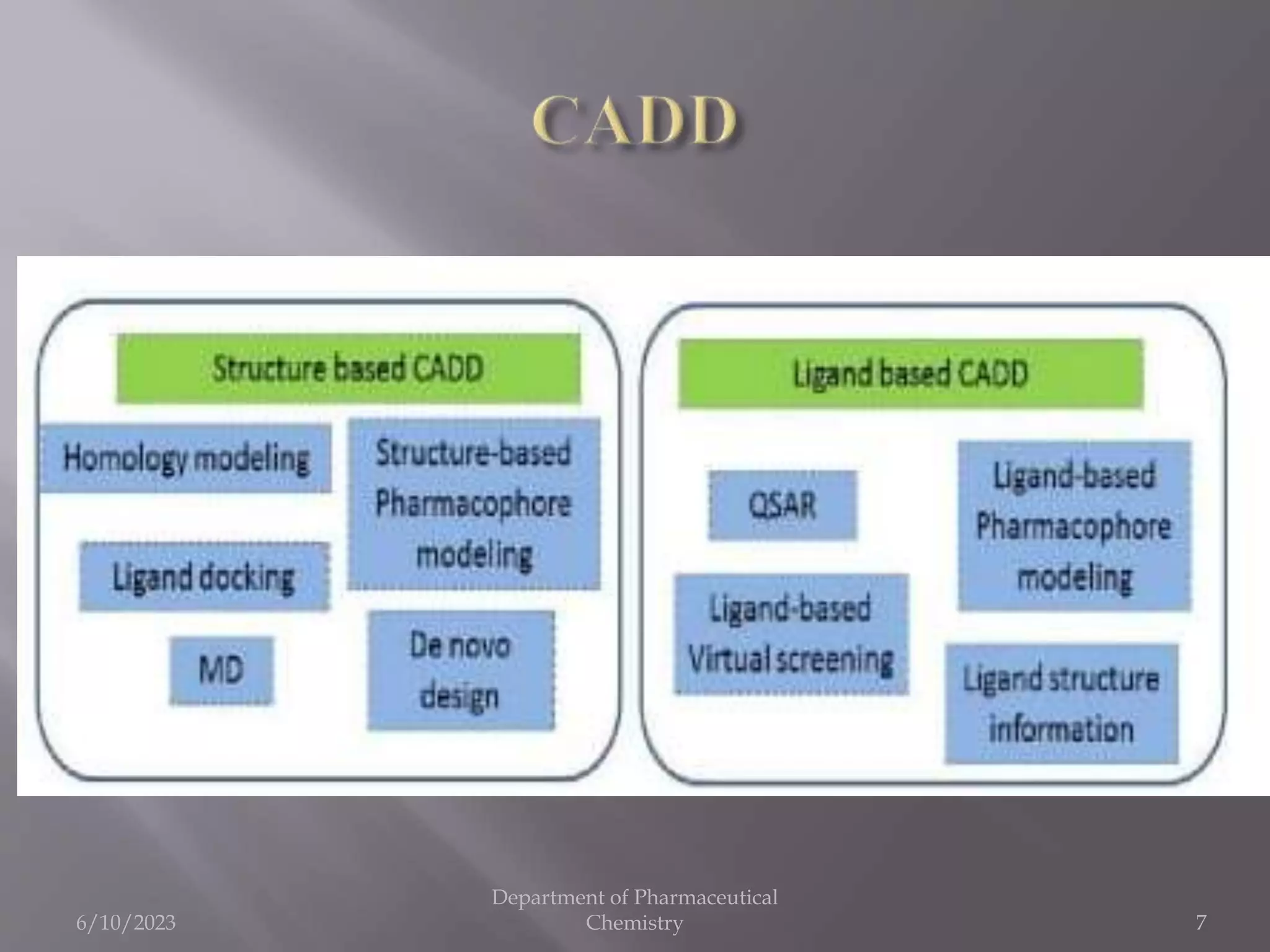
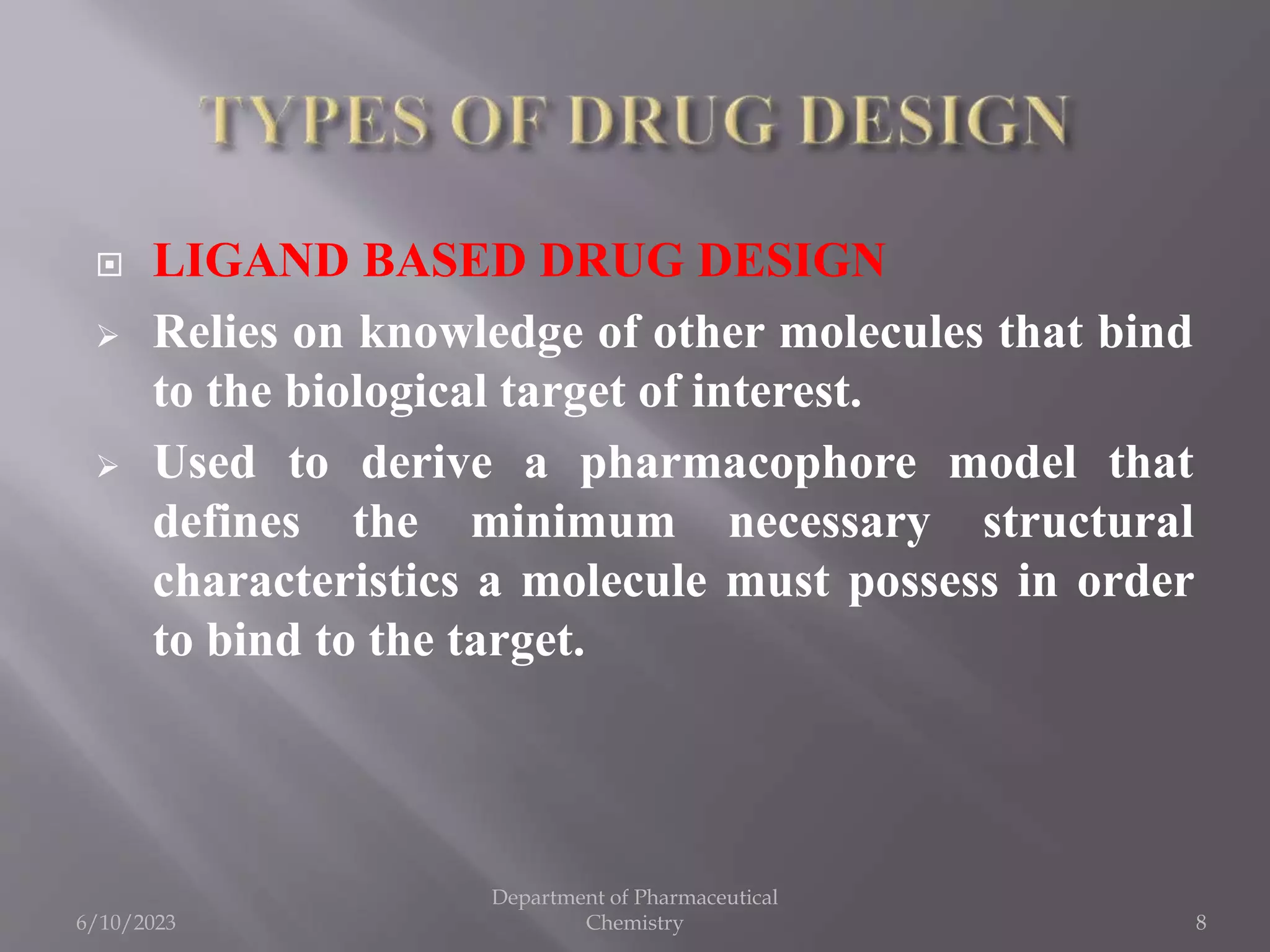
 LIGAND BASED DRUG DESIGN
 Relies on knowledge of other molecules that bind
to the biological target of interest.
 Used to derive a pharmacophore model that
defines the minimum necessary structural
characteristics a molecule must possess in order
to bind to the target.
6/10/2023
Department of Pharmaceutical
Chemistry 8
 STRUCTURE BASED DRUG DESIGN
Relies on knowledge of the three dimensional
structure of the biological target obtained
through:
 X ray crystallography
 Nuclear Magnetic Resonance spectroscopy.
6/10/2023
Department of Pharmaceutical
Chemistry 9
 Traditional life cycle
synthetic or natural compound
Preclinical trials
Clinical trials
6/10/2023
Department of Pharmaceutical
Chemistry 10
Target selection
Lead identification
Lead optimization
6/10/2023
Department of Pharmaceutical
Chemistry 11
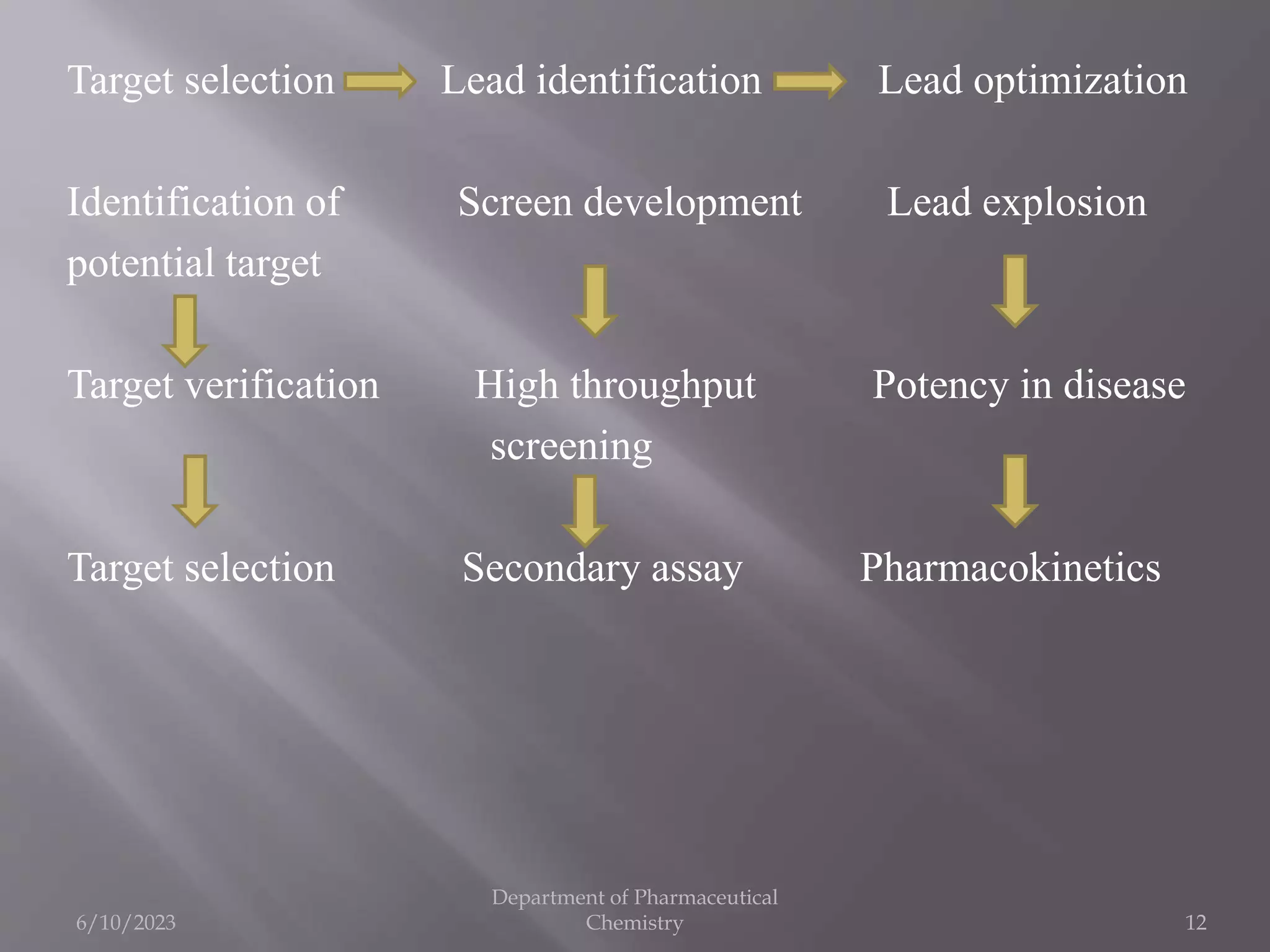
Target selection Lead identification Lead optimization
Identification of Screen development Lead explosion
potential target
Target verification High throughput Potency in disease
screening
Target selection Secondary assay Pharmacokinetics
6/10/2023
Department of Pharmaceutical
Chemistry 12
 To change from:
 Random screening against disease assays
 Natural products, synthetic chemicals
To:
 Rational drug design and testing
 Speed up screening process
 Efficient screening
 De novo design (target directed)
 Integration of testing into design process
 Fail drugs fast (remove hopeless ones as early as
possible)
6/10/2023
Department of Pharmaceutical
Chemistry 13
6/10/2023
Department of Pharmaceutical
Chemistry 14
 Target identification
 A target is a molecule which is present within an
organism
 The approaches of identifying targets include
protein expression, protein biochemistry,
structure function studies, study of biochemical
pathways.
6/10/2023
Department of Pharmaceutical
Chemistry 15
 Target validation
 As there are a plethora of new potential
therapeutics drug targets that are being
discovered, selection and validation of novel
molecular target has become imporatnt.
 It needs to be confirmed that the targets
identified will affect an appropriate biological
response.
 Targeted gene disruption is a term that refers to
several different methods of target validation
6/10/2023
Department of Pharmaceutical
Chemistry 16
 Lead identification
 A lead is a compound that demonstrates a
desired biological activity on a validated
molecular target.
 To be termed as a lead, the compound must
exceed a specific potency threshold against the
target.
 The compounds used as potential leads can be
from many sources. The most important sources
of leads is libraries of molecules.
6/10/2023
Department of Pharmaceutical
Chemistry 17
 Lead optimization
 Once a lead compound is established in the
identification process we need to optimize the
desirable targets of the lead.
 To be considered for further development lead
should be amenable for chemistry optimization.
6/10/2023
Department of Pharmaceutical
Chemistry 18
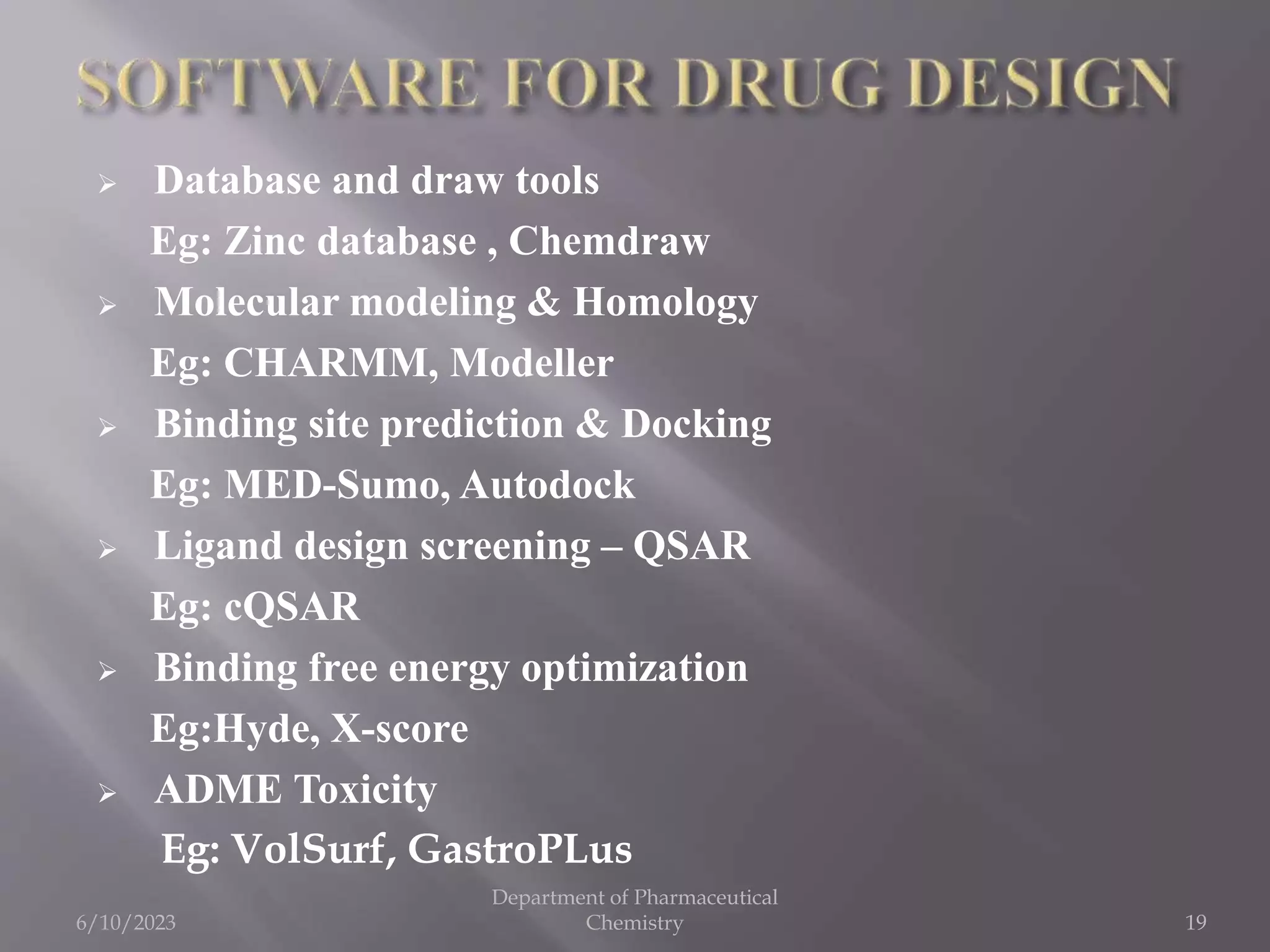
 Database and draw tools
Eg: Zinc database , Chemdraw
 Molecular modeling & Homology
Eg: CHARMM, Modeller
 Binding site prediction & Docking
Eg: MED-Sumo, Autodock
 Ligand design screening – QSAR
Eg: cQSAR
 Binding free energy optimization
Eg:Hyde, X-score
 ADME Toxicity
Eg: VolSurf, GastroPLus
6/10/2023
Department of Pharmaceutical
Chemistry 19
 Time
 Cost
 Accuracy
 Information about the disease
 Screening is reduced
 Database screening
 Less manpower is required
6/10/2023
Department of Pharmaceutical
Chemistry 20
 K+ ion channel blocker
Structure based discovery ( Sotalol is indicated for
the treatment of atrial or ventricular
tachyarrhythmia.
 Thrombin inhibitor
Docking, de novo design ( Hirudin has a blood
anticoagulant property)
6/10/2023
Department of Pharmaceutical
Chemistry 21
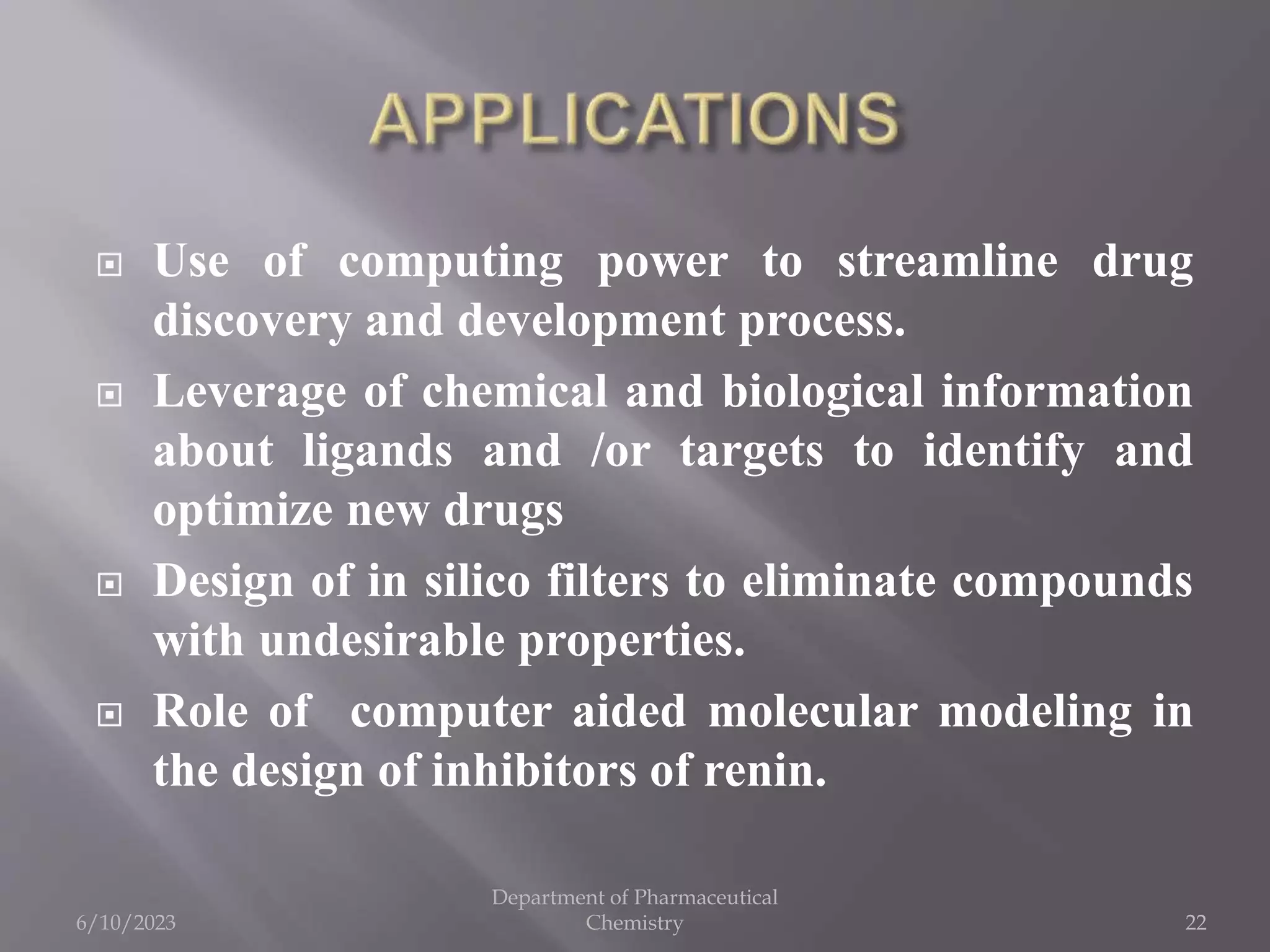
 Use of computing power to streamline drug
discovery and development process.
 Leverage of chemical and biological information
about ligands and /or targets to identify and
optimize new drugs
 Design of in silico filters to eliminate compounds
with undesirable properties.
 Role of computer aided molecular modeling in
the design of inhibitors of renin.
6/10/2023
Department of Pharmaceutical
Chemistry 22
 Inhibitors of Dihydrofolate reductase.
 Approaches to Antiviral drug design
 Conformation biological activity relationships for
receptor – selective, conformationally
constrained opioid peptides .
 Design of conforamtionally restricted
cyclopeptides for the inhibition of cholate uptake
of hepatocytes
6/10/2023
Department of Pharmaceutical
Chemistry 23
 Burger’s Medicinal Chemistry & Drug Discovery
– 6th edition , Volume I , pg no : 417-420.
 International Journal of Creative Research
Thoughts “ Computer Aided Drug Design – An
Overview” , Jasmeen Jahangir Naikwadi et al.
Volume 9, Issue 10 , Oct -2021.
6/10/2023
Department of Pharmaceutical
Chemistry 24

COMPUTER AIDED DRUG DESIGN.pptx

  • 1.
    6/10/2023 Department of Pharmaceutical Chemistry1 SUBMITTED BY, MANIMEGALAI.G M.PHARM II SEMESTER
  • 2.
     Drugs areessential for the prevention and treatment of disease. Thus, ideal drugs are in great demand. But the process of drug design is a tedious, time consuming and cost intensive process.  Use of computational methods in drug discovery and development process are nowadays gaining popularity, implementation and appreciation.  All the world’s major pharmaceutical and biotechnology companies use computational design tools. 6/10/2023 Department of Pharmaceutical Chemistry 2
  • 3.
     Extensive genomedecoding of various organisms including man, proteomic investigations, discoveries of molecular mechanisms of many diseases.  During the last decades, the field of drug discovery process that direct to new ligands finding turn into modern science employing of computer, bioinformatics and experimental approaches.  The objective of drug design is to find a chemical compound that can fit to a specific cavity on a protein target both geometrically and chemically. 6/10/2023 Department of Pharmaceutical Chemistry 3
  • 4.
     The useof computers and computational methods permeates all aspects of drug discovery and forms the core of structure based drug design  CADD has made to serve mankind in producing newer drugs with improved effects. 6/10/2023 Department of Pharmaceutical Chemistry 4
  • 5.
     In 1900,theconcept of receptor and lock & key was given by P.Ehrich (1909) & E.Fisher  In 1970, the concept of QSAR was established it had limitations such as two dimensional, Retrospective analysis  In 1980s , Beginning of an era of CADD molecular biology, X ray crystallography, Molecular modeling along with computer graphics.  In 1990s, Human genome bioinformatics along with combinatorial chemistry & High throughput screening were introduced. 6/10/2023 Department of Pharmaceutical Chemistry 5
  • 6.
     Drug design,is the inventive process of finding new medications based on the knowledge of a biological target.  Designed molecule should be  Organic small molecule  Complementary in shape to the target  Oppositely charge to the biomolecular target 6/10/2023 Department of Pharmaceutical Chemistry 6
  • 7.
  • 8.
     LIGAND BASEDDRUG DESIGN  Relies on knowledge of other molecules that bind to the biological target of interest.  Used to derive a pharmacophore model that defines the minimum necessary structural characteristics a molecule must possess in order to bind to the target. 6/10/2023 Department of Pharmaceutical Chemistry 8
  • 9.
     STRUCTURE BASEDDRUG DESIGN Relies on knowledge of the three dimensional structure of the biological target obtained through:  X ray crystallography  Nuclear Magnetic Resonance spectroscopy. 6/10/2023 Department of Pharmaceutical Chemistry 9
  • 10.
     Traditional lifecycle synthetic or natural compound Preclinical trials Clinical trials 6/10/2023 Department of Pharmaceutical Chemistry 10
  • 11.
    Target selection Lead identification Leadoptimization 6/10/2023 Department of Pharmaceutical Chemistry 11
  • 12.
    Target selection Leadidentification Lead optimization Identification of Screen development Lead explosion potential target Target verification High throughput Potency in disease screening Target selection Secondary assay Pharmacokinetics 6/10/2023 Department of Pharmaceutical Chemistry 12
  • 13.
     To changefrom:  Random screening against disease assays  Natural products, synthetic chemicals To:  Rational drug design and testing  Speed up screening process  Efficient screening  De novo design (target directed)  Integration of testing into design process  Fail drugs fast (remove hopeless ones as early as possible) 6/10/2023 Department of Pharmaceutical Chemistry 13
  • 14.
  • 15.
     Target identification A target is a molecule which is present within an organism  The approaches of identifying targets include protein expression, protein biochemistry, structure function studies, study of biochemical pathways. 6/10/2023 Department of Pharmaceutical Chemistry 15
  • 16.
     Target validation As there are a plethora of new potential therapeutics drug targets that are being discovered, selection and validation of novel molecular target has become imporatnt.  It needs to be confirmed that the targets identified will affect an appropriate biological response.  Targeted gene disruption is a term that refers to several different methods of target validation 6/10/2023 Department of Pharmaceutical Chemistry 16
  • 17.
     Lead identification A lead is a compound that demonstrates a desired biological activity on a validated molecular target.  To be termed as a lead, the compound must exceed a specific potency threshold against the target.  The compounds used as potential leads can be from many sources. The most important sources of leads is libraries of molecules. 6/10/2023 Department of Pharmaceutical Chemistry 17
  • 18.
     Lead optimization Once a lead compound is established in the identification process we need to optimize the desirable targets of the lead.  To be considered for further development lead should be amenable for chemistry optimization. 6/10/2023 Department of Pharmaceutical Chemistry 18
  • 19.
     Database anddraw tools Eg: Zinc database , Chemdraw  Molecular modeling & Homology Eg: CHARMM, Modeller  Binding site prediction & Docking Eg: MED-Sumo, Autodock  Ligand design screening – QSAR Eg: cQSAR  Binding free energy optimization Eg:Hyde, X-score  ADME Toxicity Eg: VolSurf, GastroPLus 6/10/2023 Department of Pharmaceutical Chemistry 19
  • 20.
     Time  Cost Accuracy  Information about the disease  Screening is reduced  Database screening  Less manpower is required 6/10/2023 Department of Pharmaceutical Chemistry 20
  • 21.
     K+ ionchannel blocker Structure based discovery ( Sotalol is indicated for the treatment of atrial or ventricular tachyarrhythmia.  Thrombin inhibitor Docking, de novo design ( Hirudin has a blood anticoagulant property) 6/10/2023 Department of Pharmaceutical Chemistry 21
  • 22.
     Use ofcomputing power to streamline drug discovery and development process.  Leverage of chemical and biological information about ligands and /or targets to identify and optimize new drugs  Design of in silico filters to eliminate compounds with undesirable properties.  Role of computer aided molecular modeling in the design of inhibitors of renin. 6/10/2023 Department of Pharmaceutical Chemistry 22
  • 23.
     Inhibitors ofDihydrofolate reductase.  Approaches to Antiviral drug design  Conformation biological activity relationships for receptor – selective, conformationally constrained opioid peptides .  Design of conforamtionally restricted cyclopeptides for the inhibition of cholate uptake of hepatocytes 6/10/2023 Department of Pharmaceutical Chemistry 23
  • 24.
     Burger’s MedicinalChemistry & Drug Discovery – 6th edition , Volume I , pg no : 417-420.  International Journal of Creative Research Thoughts “ Computer Aided Drug Design – An Overview” , Jasmeen Jahangir Naikwadi et al. Volume 9, Issue 10 , Oct -2021. 6/10/2023 Department of Pharmaceutical Chemistry 24