CONTENT
1. INTRODUCTION
2. PRINCIPLE
3. CADD WORKFLOW
4. CADD METHOD USED FOR
5. CLASSIFICATION OF CADD
6. MOLECULAR DOCKING
7. QSAR
8. PHARMACOPHORE
9. APPLICATION OF CADD
10. CONCLUSION
1. INTRODUCTION
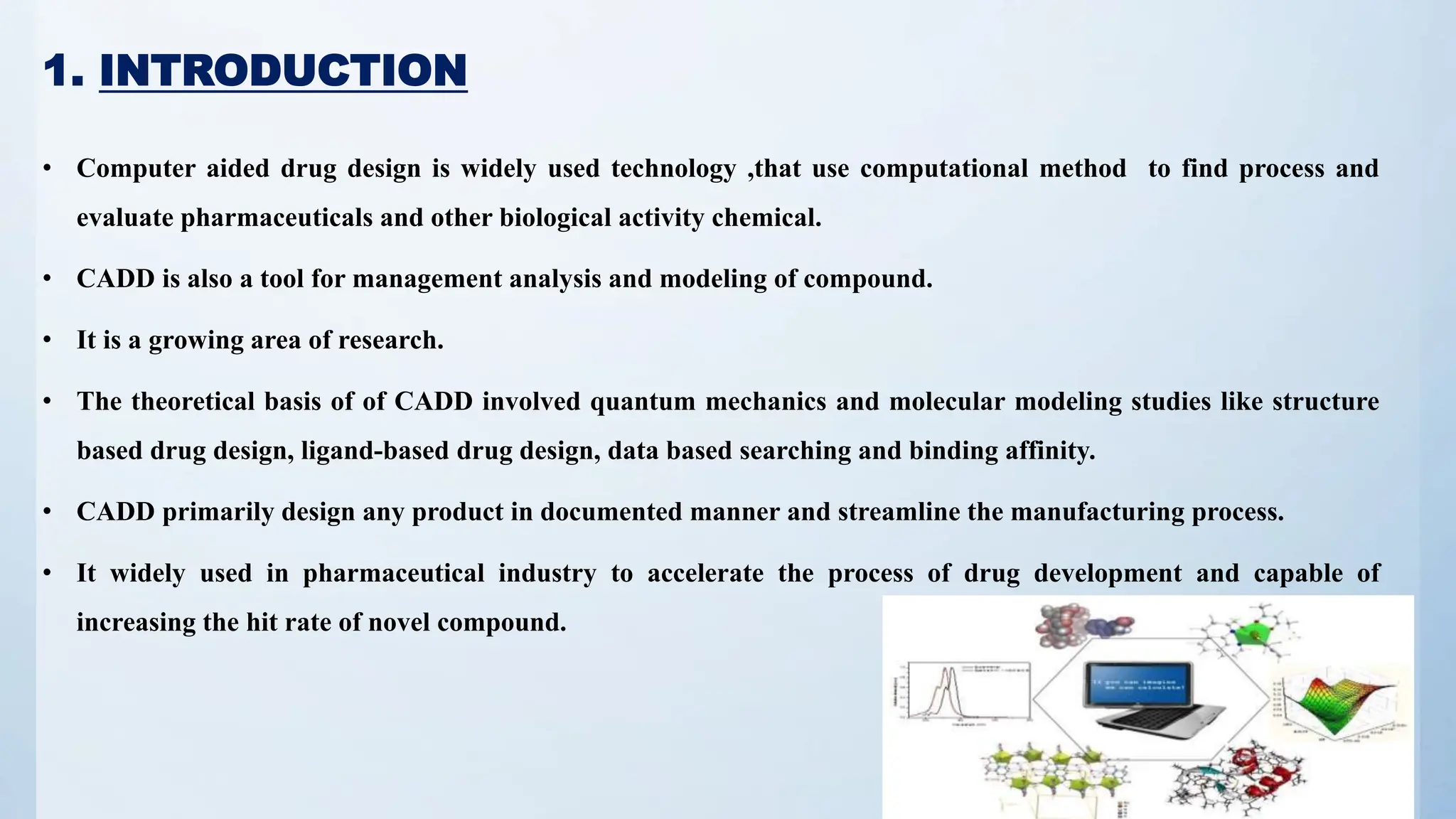
• Computer aided drug design is widely used technology ,that use computational method to find process and
evaluate pharmaceuticals and other biological activity chemical.
• CADD is also a tool for management analysis and modeling of compound.
• It is a growing area of research.
• The theoretical basis of of CADD involved quantum mechanics and molecular modeling studies like structure
based drug design, ligand-based drug design, data based searching and binding affinity.
• CADD primarily design any product in documented manner and streamline the manufacturing process.
• It widely used in pharmaceutical industry to accelerate the process of drug development and capable of
increasing the hit rate of novel compound.
2. PRINCIPLE
• It is basically software program from where we get the activities of structure and lead compound or target we
looking for.
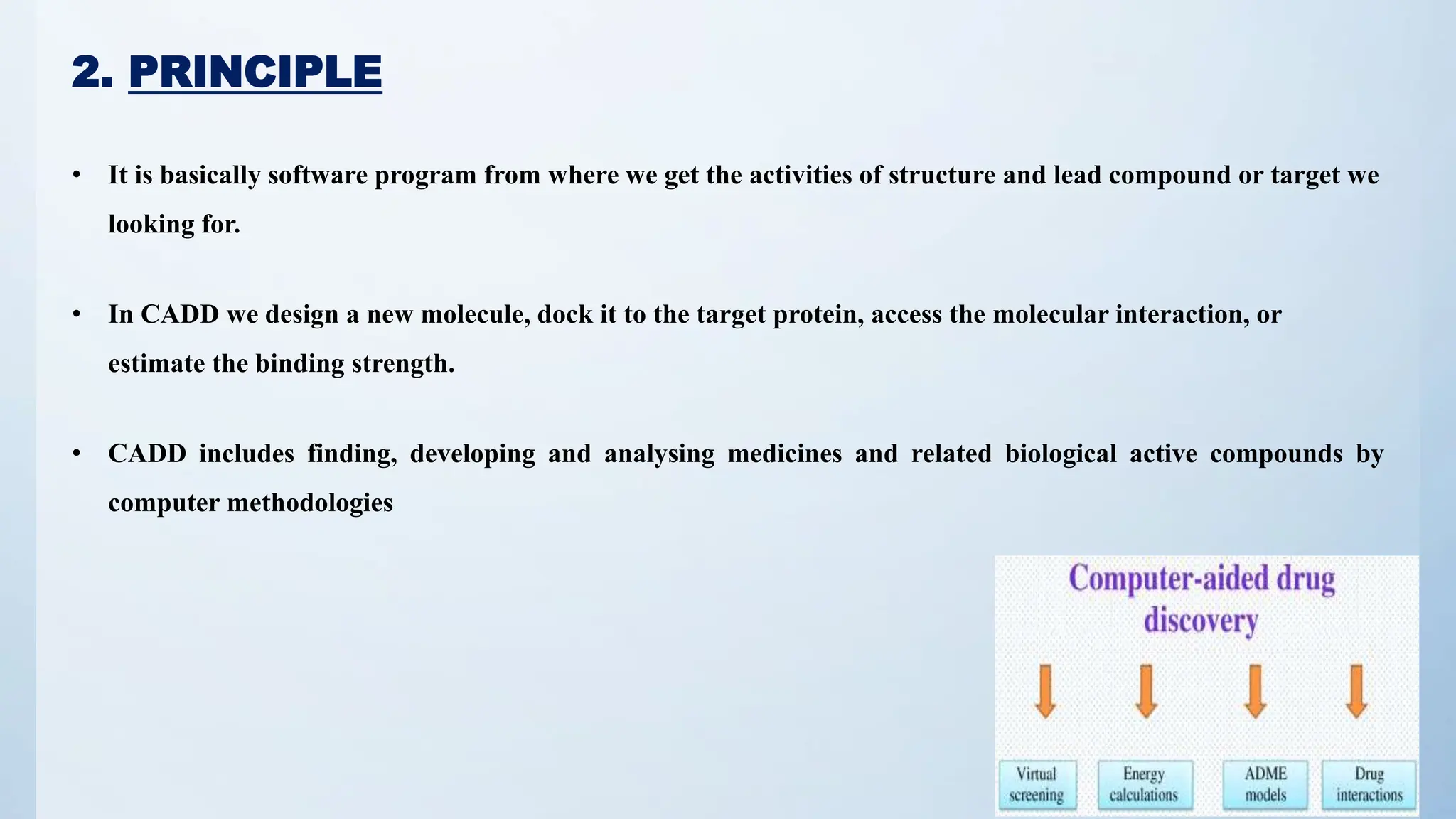
• In CADD we design a new molecule, dock it to the target protein, access the molecular interaction, or
estimate the binding strength.
• CADD includes finding, developing and analysing medicines and related biological active compounds by
computer methodologies
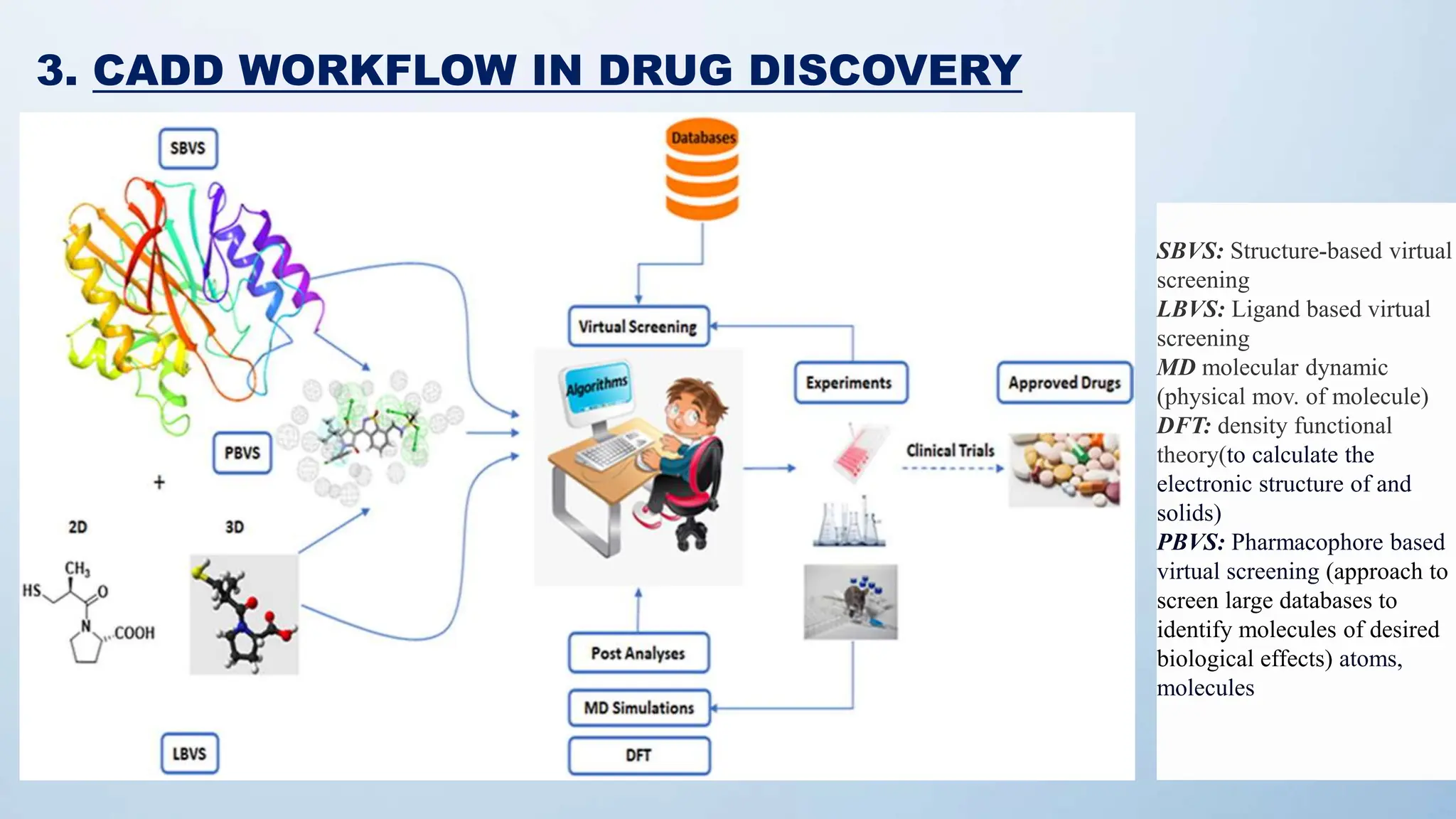
3. CADD WORKFLOW IN DRUG DISCOVERY
SBVS: Structure-based virtual
screening
LBVS: Ligand based virtual
screening
MD molecular dynamic
(physical mov. of molecule)
DFT: density functional
theory(to calculate the
electronic structure of and
solids)
PBVS: Pharmacophore based
virtual screening (approach to
screen large databases to
identify molecules of desired
biological effects) atoms,
molecules
4. CADD METHOD USED FOR:
• Analysis of target structure
• Generation of potential compound
• Docking of those molecule with target
• Ranking of molecule based on bioaffinities
• Optimization of molecule for further development.
• CADD utilized in pre Clinical research and development.
• Target identification and target validation.
• Pharmacokinetics, adme prediction.
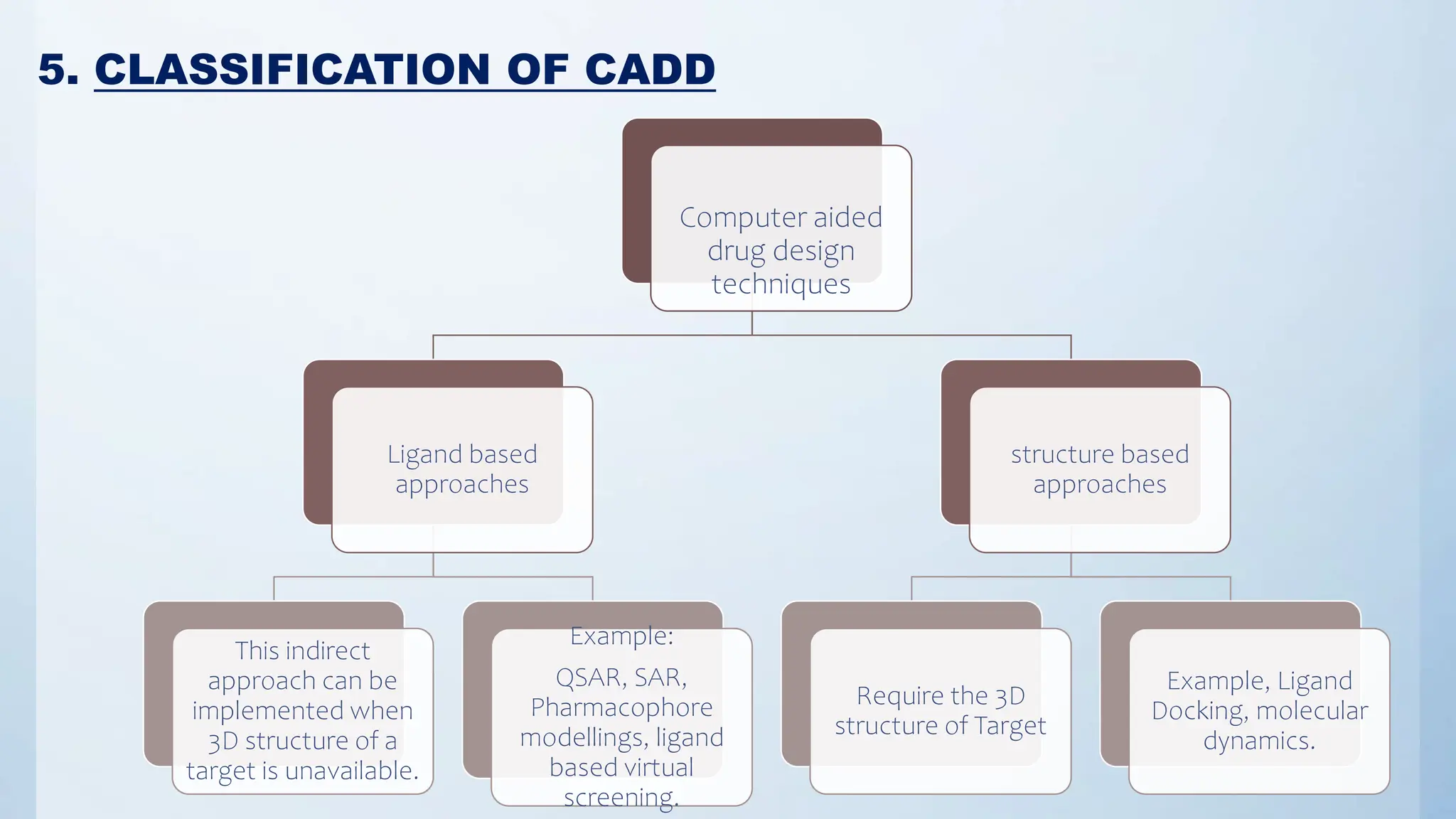
5. CLASSIFICATION OF CADD
Computer aided
drug design
techniques
Ligand based
approaches
This indirect
approach can be
implemented when
3D structure of a
target is unavailable.
Example:
QSAR, SAR,
Pharmacophore
modellings, ligand
based virtual
screening.
structure based
approaches
Require the 3D
structure of Target
Example, Ligand
Docking, molecular
dynamics.
ADVANTAGES OF LBDD
• Ligand based can proceed without protein structure
• Predictive models.
• Less complex and low computational requirement.
LIMITATION OF LBDD
• Difficult To Determine Bio Active Confirmation.
• Selection And Optimizing The Descriptor Or Pharmacophore Constraint.
• Ligand Biased Method
ADVANTAGES OF SBDD
• Protein Structure Provide Valuable Information.
• Ligand Unbiased Method.
• Bioactive Confirmation Can Be Determined.
• Optimization Of Ligand Easy As Protein Structure Serves As Reference.
LIMITATION OF SBDD
• Pose Vs Score Correlation. (The Conformation And Orientation Referred Together As The “Pose” In
Molecular Docking)
• Correct Pose Prediction
• Accounting Protein Flexibility
6. MOLECULAR DOCKING
•Docking attempts to find the “best” matching between two molecules
•It includes finding the Right Key for the Lock
•It can be defined as the binding of small molecule called ligand , on to a specific site in a larger molecule .
• Docking is the computational determination of binding affinity between molecules (protein structure and
ligand).
COMPONENTS OF DOCKING
pre- and/or during docking:
• Representation of receptor binding site and ligand
during docking:
•Sampling of configuration space of the ligand- receptor complex
during docking and scoring:
•Evaluation of ligand-receptor interactions
SOFTWARE TOOL FOR DOCKING
•Autodock
•DOCK
•GOLD
•SwissDock
•DockingServer
7. QUANTITATIVE STRUCTURE-ACTIVITY RELATIONSHIP
(QSAR)
•It is a mathematical relationship which correlates measurable or calculable molecular properties to some specific
biological activity in terms of an equation.
• QSAR attempts to find consistent relationship between biological activity and molecular properties, so that these
“rules” can be used to evaluate the activity of new compounds.
QSAR AND DRUG DESIGN
•To modify the chemical structure of the lead compound to retain or to reinforce the desirable pharmacologic effect
while minimizing unwanted pharmacological and physical and chemical properties, which may result in a superior
therapeutic agent.
•To use target analogs to gain better insight into the pharmacology of the lead molecule and perhaps to reveal new
knowledge of basic biology.
8. PHARMACOPHORE DEVELOPMENT THROUGH CADD
• Pharmacophore: It is a set of structural features in a molecule that is recognized at a receptor site and is
responsible for the molecule's biological activity.
• This set of structural features is often shared by a group of compounds that bind to the same protein target.
• The three dimensional configuration of chemical functional group that is responsible for biological action
• Today, drug research and optimization and development all involve this establishment of pharmacophore models.
9. Application of cadd
• Reduce the synthetic and biological testing effort
• It know the drug receptor interaction pattern
• The approaches minimize the chance of failure
• It give the most promising drug candidate
• Determine the lowest free energy structure for the receptor – ligand complex .
• Search database and rank hits for lead generation.
• Calculate the differential binding of a ligand to two different macromolecules receptors.
• Study the geometry of particular complex.
• Propose modification of a lead molecules to optimize potency or other properties.
LIST OF CLINICALLY APPROVED DRUGS DISCOVERED BY
CADD
 Captopril 1981 Antihypertensive
 Dorzolamide 1995 Carbonic Anhydrase Inhibitor
 Indinavir 1996 Human Immunodeficiency Virus (Hiv)
 Ritonavir 1996 Human Immunodeficiency Virus (Hiv)
 Saquinavir 1995 Human Immunodeficiency Virus (Hiv)
 Triofiban 1998 Fibrinogen Antagonist
 Raltegravir 2007 Human Immunodeficiency Virus (Hiv)
 Aliskiren 2007 Human Renin Inhibitor
 Boceprevir Phase I ii Clinical Trials Hepatitis C Virus (Hcv) Inhibitor
 Nolatrexed Phase I ii Clinical Trials Liver Cancer.
 Tmi-005 Phase I i Clinical Trials Rheumatoid Arthritis
10. CONCLUSION
• Drug discovery and development is a lengthy and complex process that take around 12 to 15 years and cost up to
monthly million dollar for a drug to reach through the market. Despite the huge investment and the time incurred
for the discovery of new drug, the success rate are too low, that only five out of 10,000 compound may make their
way to reach human testing after preliminary evaluation in animal and only one of five compound raised to final
clinical studies.
• This all suggested and earned the need to develop a new methodologies to facilitate and expedite the drug
development and discovery process. Advances in computational technique and parallel hardware support have
enabled computer added drug design method that are being used by the leading pharmaceuticals company and
research group to speed up the drug development process.
• The recent success stories of CADD in discovery has shown its value in the drug development process. CADD
provides useful information about Target molecules, lead compounds, screening and optimization. The CADD
method is built on a variety of approach designing phase, docking, pharmacophore modeling and homology
modeling. CADD may be used to the majority of drug development stage, including preclinical research, lead
optimization, target validation and target selection.
COMPUTER AIDED DRUG DESIGN M.PHARM .pptx

COMPUTER AIDED DRUG DESIGN M.PHARM .pptx

  • 2.
    CONTENT 1. INTRODUCTION 2. PRINCIPLE 3.CADD WORKFLOW 4. CADD METHOD USED FOR 5. CLASSIFICATION OF CADD 6. MOLECULAR DOCKING 7. QSAR 8. PHARMACOPHORE 9. APPLICATION OF CADD 10. CONCLUSION
  • 3.
    1. INTRODUCTION • Computeraided drug design is widely used technology ,that use computational method to find process and evaluate pharmaceuticals and other biological activity chemical. • CADD is also a tool for management analysis and modeling of compound. • It is a growing area of research. • The theoretical basis of of CADD involved quantum mechanics and molecular modeling studies like structure based drug design, ligand-based drug design, data based searching and binding affinity. • CADD primarily design any product in documented manner and streamline the manufacturing process. • It widely used in pharmaceutical industry to accelerate the process of drug development and capable of increasing the hit rate of novel compound.
  • 4.
    2. PRINCIPLE • Itis basically software program from where we get the activities of structure and lead compound or target we looking for. • In CADD we design a new molecule, dock it to the target protein, access the molecular interaction, or estimate the binding strength. • CADD includes finding, developing and analysing medicines and related biological active compounds by computer methodologies
  • 5.
    3. CADD WORKFLOWIN DRUG DISCOVERY SBVS: Structure-based virtual screening LBVS: Ligand based virtual screening MD molecular dynamic (physical mov. of molecule) DFT: density functional theory(to calculate the electronic structure of and solids) PBVS: Pharmacophore based virtual screening (approach to screen large databases to identify molecules of desired biological effects) atoms, molecules
  • 6.
    4. CADD METHODUSED FOR: • Analysis of target structure • Generation of potential compound • Docking of those molecule with target • Ranking of molecule based on bioaffinities • Optimization of molecule for further development. • CADD utilized in pre Clinical research and development. • Target identification and target validation. • Pharmacokinetics, adme prediction.
  • 7.
    5. CLASSIFICATION OFCADD Computer aided drug design techniques Ligand based approaches This indirect approach can be implemented when 3D structure of a target is unavailable. Example: QSAR, SAR, Pharmacophore modellings, ligand based virtual screening. structure based approaches Require the 3D structure of Target Example, Ligand Docking, molecular dynamics.
  • 8.
    ADVANTAGES OF LBDD •Ligand based can proceed without protein structure • Predictive models. • Less complex and low computational requirement. LIMITATION OF LBDD • Difficult To Determine Bio Active Confirmation. • Selection And Optimizing The Descriptor Or Pharmacophore Constraint. • Ligand Biased Method
  • 9.
    ADVANTAGES OF SBDD •Protein Structure Provide Valuable Information. • Ligand Unbiased Method. • Bioactive Confirmation Can Be Determined. • Optimization Of Ligand Easy As Protein Structure Serves As Reference. LIMITATION OF SBDD • Pose Vs Score Correlation. (The Conformation And Orientation Referred Together As The “Pose” In Molecular Docking) • Correct Pose Prediction • Accounting Protein Flexibility
  • 10.
    6. MOLECULAR DOCKING •Dockingattempts to find the “best” matching between two molecules •It includes finding the Right Key for the Lock •It can be defined as the binding of small molecule called ligand , on to a specific site in a larger molecule . • Docking is the computational determination of binding affinity between molecules (protein structure and ligand).
  • 11.
    COMPONENTS OF DOCKING pre-and/or during docking: • Representation of receptor binding site and ligand during docking: •Sampling of configuration space of the ligand- receptor complex during docking and scoring: •Evaluation of ligand-receptor interactions SOFTWARE TOOL FOR DOCKING •Autodock •DOCK •GOLD •SwissDock •DockingServer
  • 12.
    7. QUANTITATIVE STRUCTURE-ACTIVITYRELATIONSHIP (QSAR) •It is a mathematical relationship which correlates measurable or calculable molecular properties to some specific biological activity in terms of an equation. • QSAR attempts to find consistent relationship between biological activity and molecular properties, so that these “rules” can be used to evaluate the activity of new compounds. QSAR AND DRUG DESIGN •To modify the chemical structure of the lead compound to retain or to reinforce the desirable pharmacologic effect while minimizing unwanted pharmacological and physical and chemical properties, which may result in a superior therapeutic agent. •To use target analogs to gain better insight into the pharmacology of the lead molecule and perhaps to reveal new knowledge of basic biology.
  • 13.
    8. PHARMACOPHORE DEVELOPMENTTHROUGH CADD • Pharmacophore: It is a set of structural features in a molecule that is recognized at a receptor site and is responsible for the molecule's biological activity. • This set of structural features is often shared by a group of compounds that bind to the same protein target. • The three dimensional configuration of chemical functional group that is responsible for biological action • Today, drug research and optimization and development all involve this establishment of pharmacophore models.
  • 14.
    9. Application ofcadd • Reduce the synthetic and biological testing effort • It know the drug receptor interaction pattern • The approaches minimize the chance of failure • It give the most promising drug candidate • Determine the lowest free energy structure for the receptor – ligand complex . • Search database and rank hits for lead generation. • Calculate the differential binding of a ligand to two different macromolecules receptors. • Study the geometry of particular complex. • Propose modification of a lead molecules to optimize potency or other properties.
  • 15.
    LIST OF CLINICALLYAPPROVED DRUGS DISCOVERED BY CADD  Captopril 1981 Antihypertensive  Dorzolamide 1995 Carbonic Anhydrase Inhibitor  Indinavir 1996 Human Immunodeficiency Virus (Hiv)  Ritonavir 1996 Human Immunodeficiency Virus (Hiv)  Saquinavir 1995 Human Immunodeficiency Virus (Hiv)  Triofiban 1998 Fibrinogen Antagonist  Raltegravir 2007 Human Immunodeficiency Virus (Hiv)  Aliskiren 2007 Human Renin Inhibitor  Boceprevir Phase I ii Clinical Trials Hepatitis C Virus (Hcv) Inhibitor  Nolatrexed Phase I ii Clinical Trials Liver Cancer.  Tmi-005 Phase I i Clinical Trials Rheumatoid Arthritis
  • 16.
    10. CONCLUSION • Drugdiscovery and development is a lengthy and complex process that take around 12 to 15 years and cost up to monthly million dollar for a drug to reach through the market. Despite the huge investment and the time incurred for the discovery of new drug, the success rate are too low, that only five out of 10,000 compound may make their way to reach human testing after preliminary evaluation in animal and only one of five compound raised to final clinical studies. • This all suggested and earned the need to develop a new methodologies to facilitate and expedite the drug development and discovery process. Advances in computational technique and parallel hardware support have enabled computer added drug design method that are being used by the leading pharmaceuticals company and research group to speed up the drug development process. • The recent success stories of CADD in discovery has shown its value in the drug development process. CADD provides useful information about Target molecules, lead compounds, screening and optimization. The CADD method is built on a variety of approach designing phase, docking, pharmacophore modeling and homology modeling. CADD may be used to the majority of drug development stage, including preclinical research, lead optimization, target validation and target selection.